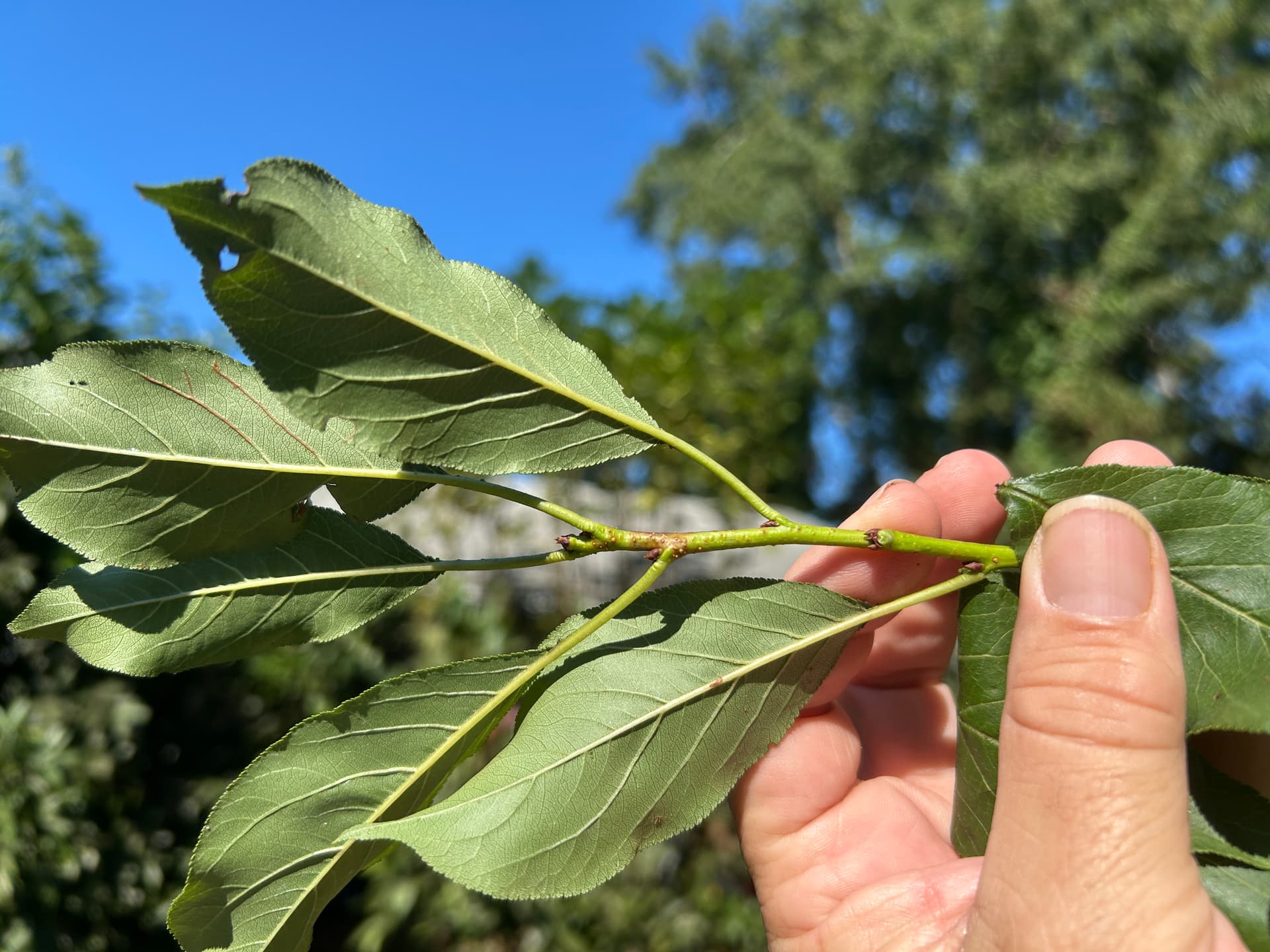
None of the Zaiger pluots I’ve tried had any apricot quality to them and are very un-apricot like in their ability to achieve very high sugar when still very firm. Spring Satin has a velvety skin unlike any plum I’ve ever seen and although it doesn’t taste that much like a cot it seems legit. Also, like a cot it needs to begin to soften to achieve high sugar. At that point it is hands down the very best plum in its season I’ve ever tasted. It’s a great plum because it’s so early and so good. But it’s plum qualities far exceed its cot.
I don’t care what the genetics are, if you can’t see it and can’t taste it, it seems meaningless, beyond the matter of pollination.
I have (what I thought is) a Spring Satin Pluot. But I keep hearing it referred to as a Spring Satin Plumcot. So what is the difference, if any, between a plumcot and a pluot?
I wanted to add that my Spring Satin is one of the biggest Japanese Beetle magnets in my orchard. It gets stripped clean of leaves every year. I guess it’s mighty tasty! There are a couple of my pomegranate varieties that the beetles prefer to all the others, too. ???
Pluot was coined and trademarked by Floyd Zaiger,for his brand of mostly Plum,with some Apricot,while the Plumcot was first developed by Luther Burbank and is suppose to be 50%,both of the two fruits.
Burbank’s words-
“Flesh is honey yellow, firm, rich, aromatic, resembling apricot, sweet and delicious. Resembles apricot very decidedly in form, size, and quality of fruit, while it is more like plum in foliage, upright growth, productiveness, and smooth-skinned fruit.”
@coolmantoole Hi Marcus. I ordered a “Georgia” Chikasaw plumtree many years ago. It is in full bloom right now. I have other plums, one of which is growing right next to it. And several of my other plums overlap in bloom time. I have never had any of the Chikasaw plums ripen. Very sparse fruit set and none of them mature.
However - It is a very good ‘host’ for grafts that I’ve added to it. The grafts grow well and produce fruit. And it’s a pretty little tree . . . so I have left it alone, even though it doesn’t produce its own fruit for me.
Your information - that it needs another wild pollinator - is most likely the problem. I always assumed that Virginia was just too northern for a Georgia native. Now I am thinking that is not true.
Maybe accident but not really. Pluots are actually a trademark name from a specific university breeding program. They may be more plum than apricot, but the breeder trademark tied to patent and branding rights is the difference that mattered. No other breeder could introduce a pluot regardless of the genetics of the tree.
I’m testing Spring Satin in SE Georgia. I haven’t been able to get super clear answers to how many chilling hours Spring Satin really needs to bloom properly. USDA is notorious for highballing that question. They just default to the 750 hours they can count on at Byron, GA. I know of a tree that bloomed in Florida, sort of. And I spoke with the folks at Ison Nursery, and they are saying that it’s working for people who get around 400 hours. I have grafted several. In fact, I plan to sell a few grafted onto Toole’s Heirloom Chickasaw plum this year. I have one grafted onto Ridgeland which already has flower buds formed on it. We will know whether or not the 500 or so chilling hours I get will be enough to make it bloom properly.
When a name becomes common use and you actively would have to re-educate the public to only use it in the context of the trademark, it can lose its trademark protection. I think with as widely as the term “pluot” is used by hobbyists with no regard to what it technically should or shouldn’t be applied to, there is almost no likelihood of them winning in court if other breeders use the term “pluot” to apply to new cultivars developed independently.