This is a good link about Taishu persimmon too
1 Like
I don´t have to prove to you or anybody else what I have…my pictures of ripe fruits speak clearly for themselves. I got it from a reputable source. And what was your source? It seems to me that you just cannot accept the fact that you have “fake Taishu” which was quite readily distributed to other growers without even testing if it is true to name. I am far from taking your illusions away so dream on. In the mean time you can post your pictures of ripe fruit if you have any. I will not post any more comments on this subject.
As should be evident from my earlier posts, especially those in a separate thread, I was perfectly willing to believe you. I’m completely open to the possibility that I am growing a different, great-tasting PCNA variety.
But I try to base my beliefs on facts, so then I did some research. As documented, I found that Japanese scientists had published pictures of Taishu with hermaphroditic flowers. So your statement that “Taishu does not produce bisexual flowers” is clearly wrong. Not wrong because I am in denial; wrong because scientific evidence says so.
The fact that you have not observed hermaphroditic flowers on your Taishu proves nothing about either your tree or mine. You could very well grow a Taishu that just never produced hermaphroditic flowers, even though it can. It may be true that my Taishu doesn’t behave like your Taishu. I can only take comfort in the fact that my Taishu behaves just like the one in the Japanese research report.
My further research also suggests that there is no other documented example of a hermaphroditic PCNA. I asked you to tell me what else my tree might be but you ignored my question. I can only infer that you are not aware of another hermaphroditic PCNA. I might be willing to believe that I’m not growing Taishu, if you could give me a more credible alternate hypothesis.
2 Likes
h27.pdf (1.5 MB)
From ChatGPT:
The document is the FY2015 Annual Report of the Gifu Prefectural Agricultural Technology Center. In the persimmon section, it states explicitly:
“Taishu bears male flowers, female flowers, and perfect flowers (bisexual/hermaphroditic flowers).”
The relevant subsection is titled “Mass production of fruit derived from bisexual flowers of ‘Taishu’.” The translation is:
(2) Mass production of fruit derived from bisexual flowers of ‘Taishu’
“‘Taishu’ produces male flowers, female flowers, and perfect flowers (bisexual flowers), and the bisexual flowers only very rarely set fruit. These fruits are elongated and small, but have a higher sugar content and better eating quality than fruits derived from female flowers.
Therefore, with the aim of commercializing fruit derived from bisexual flowers, we investigated the induction of bisexual flowers from male flowers using forchlorfenuron (CPPU), a synthetic cytokinin, and techniques for large-scale fruit production.
For inducing bisexual flowers from male flowers with forchlorfenuron, the appropriate treatment period was considered to be after leaf expansion, when the new shoots had elongated and the flower buds had become visible. Taking economics into account, a spray concentration of 10 ppm was considered appropriate.
Treatment tended to suppress coloration and reduce sugar content, but the effects on eating quality were small and considered acceptable. Yield from treated trees, converted to a per-10-are basis, reached approximately 1.5 metric tons when combined with gibberellin treatment to prevent physiological fruit drop.”
5 Likes
A Japanese blog:
Translation form ChatGPT:
Taishu Persimmon — Male and Female
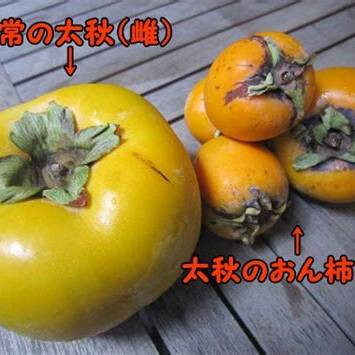
The persimmon I harvested the other day was like this, but apparently some persimmons produce two different kinds of fruit .
I had thought this was because my persimmon was just an unnamed wild tree, but apparently the same thing can happen even with improved cultivars.
There is a persimmon called ‘Taishu’ .
It has a distinctive crisp, crunchy texture. Although crunchy, it is full of sweet juice and is an extremely delicious persimmon, almost like a pear without the gritty stone cells.
Its characteristic crisp texture is actually better when the fruit is still just slightly green, so, unusually, fruit that has not yet turned deep red is preferable.
Apparently, Taishu also produces two kinds of fruit .
Thank you, Kazu-san, for these unusual persimmons!
The ordinary kind of Taishu that is normally sold is the fruit that develops from a female flower .
The other type is called an “on-gaki” [雄柿, literally “male persimmon”].
They are completely different in size and shape.
When cut open, however, their color is fairly similar. The “male persimmon” also has no dark “sesame” flecks in the flesh, and it is a delicious, crisp sweet persimmon .
My heart-shaped persimmon also produces two kinds of fruit. Fruit from its female flowers develops dark flecks and is partially astringent, while the smaller type has no flecks and remains astringent.
Although the smaller fruit is called a “male persimmon,” a flower with only stamens cannot produce fruit, can it? I suspect that it is actually the enlargement of a “perfect flower” (bisexual flower).
The photograph at left is one that I used in an earlier article. It shows two types of flowers on my persimmon that are not female flowers.
The upper flower has something resembling an ovary, so I think it is probably a perfect (bisexual) flower .
The lower flower lacks that structure and appears to have only stamens.
When I looked into it, persimmons apparently have the following types of flowering habit:
- Female flowers only: ‘Fuyu’, ‘Jiro’, ‘Hiratanenashi’
- Male flowers only: none among ordinary kaki; Diospyros lotus [date-plum / mame-gaki] is dioecious
- Both female and male flowers: ‘Zenjimaru’, ‘Nishimura Wase’, ‘Fudegaki’
- Female, male, and perfect flowers: ‘Meoto-gaki’, ‘Shogatsu’, and only a very small number of others
I had intended to organize the relationship between flower type, seeds, sweetness, and astringency, but there is relatively little information available about flowering type, and there are still many things I do not really understand.
For commercial growing, whether or not a pollinizer tree is required is more important, and information on that is easier to find.
From that information, I would infer that cultivars requiring a pollinizer do not enlarge their fruit properly without pollination—that is, without seeds—and therefore either do not produce male flowers or produce very few.
Cultivars that do not require a pollinizer probably produce both male and female flowers, don’t they?
But ‘Hiratanenashi’, which apparently bears only female flowers and does not require a pollinizer, must therefore enlarge its fruit even without pollination. Hmm.
Also, I find statements saying that cultivars producing perfect flowers are extremely rare, but two-thirds of my persimmon trees seem to do exactly that. Moreover, on one of them, fruit from bisexual flowers makes up the overwhelming majority.
Why would that be?
Is it simply that kind of cultivar?
Or perhaps trees growing under harsh conditions produce more bisexual flowers…?
Seed formation and sweetness/astringency
Pollination-constant non-astringent persimmons [PCNA]
The fruit ripens and becomes sweet regardless of whether seeds are present.
Pollination-variant non-astringent persimmons [PVNA]
When there are many seeds, the fruit becomes sweet; when there are few seeds, it remains astringent. Dark “sesame” flecks generally form around the seeds.
Pollination-variant astringent persimmons [PVA]
The fruit is basically astringent, but if a few seeds form, dark flecks develop around those seeds and those portions become sweet.
Pollination-constant astringent persimmons [PCA]
The fruit remains astringent regardless of whether seeds are present.
Flowering-type examples
Female flowers only
- ‘Fuyu’
- ‘Jiro’
- ‘Hiratanenashi’
Female and male flowers
- ‘Zenjimaru’
- ‘Nishimura Wase’
- ‘Fudegaki’
Female, male, and perfect/bisexual flowers
- ‘Meoto-gaki’
- ‘Shogatsu’
- ‘Taishu’ — fruit from the perfect flowers is also sweet
- My heart-shaped persimmon — fruit from the bisexual flowers is astringent, and these fruits are the majority
- My persimmon growing beside the loquat
- ‘Kumemaru’ (‘Toyama No. 1’) — apparently few female flowers and many perfect flowers
Male flowers only / dioecious
- Diospyros lotus (“mame-gaki”)
- apparently none among ordinary kaki
2 Likes
I’m gonna stop beating this dead horse soon. It should be undeniable now that Taishu can produce hermaphroditic flowers. As you will see below, there have been numerous published scientific articles on the topic. Some take-aways:
- Taishu produces hermaphroditic flowers.
- Fruit from those hermaphroditic flowers is relatively rare.
- But such fruit is tasty.
- The metabolic mechanisms are understood.
- Japanese growers have used metabolic interventions to increase hermaphroditic (“male”) fruit production, reaching an experimental level of 6.7 tons per acre.
- Taishu’s pollen from male flowers is not very effective – despite numerous male flowers, it is not a good pollenizer.
- We don’t know enough to assess Taisha’s pollen from hermapohroditic flowers.
This last point is important for anyone with dream of back-crossing JT-02 x Taishu. It may be tough to get viable seeds.
So here’s more from ChatGPT. The “take-aways” listed above were extracted from this commentary:
xxxxxxxxxxxxxxxxx
I found considerably more, including several Japanese papers that clarify what is happening in ‘Taishu’. The evidence is strong that Taishu really does produce functional hermaphroditic flowers, but there is an important distinction between the female function and male/pollen function of those flowers.
1. Taishu naturally produces three flower types
The Gifu Agricultural Technology Center states explicitly that ‘Taishu’ bears:
male flowers + female flowers + perfect/hermaphroditic flowers.
The naturally occurring hermaphroditic flowers only rarely retain fruit without intervention, but when they do, their fruit is characteristically smaller and more elongated than ordinary Taishu fruit from female flowers and tends to have higher soluble solids and good eating quality.
This agrees with an earlier Kochi University study specifically entitled “Flowering and fruit characteristics of hermaphroditic flowers of ‘Taishu’ persimmon”, published by Hasegawa, Hamada and Ogata in 2008.
So I would regard the classification of Taishu as polygamomonoecious/trimonoecious as established, not anecdotal.
2. CPPU can convert prospective male flowers into hermaphroditic flowers
This is perhaps the most interesting result.
Gifu treated Taishu shoots with forchlorfenuron (CPPU), a synthetic cytokinin. Flowers that otherwise would have developed as male flowers instead developed a gynoecium and became morphologically hermaphroditic. Gifu concluded that the best practical timing was after leaf expansion, once shoots were elongating and flower buds were visible, and that about 10 ppm CPPU was the economically appropriate concentration.
This wasn’t just a curiosity. They developed it as a fruit-production technique. Combined with gibberellin treatment to suppress physiological fruit drop, their experimental yield of fruit from these hermaphroditic flowers reached about:
1.5 metric tons per 10 ares = ~15 metric tons/ha ≈ 6.7 US tons/acre.
That demonstrates unequivocally that the induced pistils are physiologically functional enough to produce fruit.
3. We now know the molecular mechanism
A much later study by Masuda et al. in Nature Plants (2022) essentially explains the Gifu observation at the molecular level.
They found that hexaploid kaki can revert a nominally male flower toward hermaphroditism through activation of a gene they named DkRAD, a RADIALIS-like transcription factor. There are two routes:
- naturally occurring hermaphroditic flowers;
- artificially induced hermaphroditic flowers produced through cytokinin signaling.
CPPU is supplying precisely that cytokinin stimulus. DkRAD promotes development/growth of the gynoecium in what otherwise would have been a male flower.
Importantly, this is not simply a mutation knocking out male function. The normal male developmental program remains substantially intact while female structures are restored. That is why the authors describe the phenomenon as a “reinvention” or reversion to hermaphroditism.
This makes Taishu especially interesting genetically: a flower destined to be male can, under the right hormonal/developmental conditions, acquire a functional ovary.
4. Natural Taishu male pollen is fertile—but poor
Here we have very useful quantitative data from Fukuoka.
A 1997 Fukuoka Agricultural Research Center study measured pollen quantity and germination of Taishu against established kaki pollinizers. The results were:
| Cultivar | Pollen, 1995 | Germination | Pollen, 1996 | Germination |
|---|---|---|---|---|
| Taishu | 0.06 g/100 flowers | 5.3% | 0.10 g/100 flowers | 6.8% |
| Zenjimaru | 0.37 | 64.8% | 0.30 | 47.8% |
| Akagaki | 0.10 | 42.6% | 0.15 | 14.8% |
These are the actual values in their Table 5.
Thus Taishu’s male flowers produce real, germinable pollen, but the germination rate in this experiment was only about 5–7%, versus roughly 48–65% for Zenjimaru. The researchers consequently regarded Taishu as a poor pollenizer despite its production of many male flowers.
That distinction is important given our earlier discussion: “produces male flowers” does not necessarily mean “good pollenizer.”
5. What about pollen from the hermaphroditic flowers themselves?
This is the one point for which I have not found convincing quantitative Taishu-specific evidence.
The papers I located clearly establish:
- Taishu’s ordinary male flowers have functional anthers and germinable pollen.
- Natural Taishu hermaphroditic flowers have functional ovaries.
- CPPU-induced hermaphroditic flowers have sufficiently functional ovaries to produce commercial quantities of fruit.
- The hermaphroditic condition represents restoration of gynoecium development in a fundamentally male developmental pathway.
That last fact makes it biologically quite plausible that the stamens of a Taishu hermaphroditic flower retain some pollen function. But I have not found a Taishu experiment measuring the germination rate of pollen taken specifically from hermaphroditic flowers. I would therefore not yet say that those flowers are demonstrated to be fully bisexual in the reproductive sense.
6. An interesting age effect
A 2020 Gifu study adds something directly relevant to your earlier question about age. Its stated motivation says that as Taishu trees mature, the proportion of male and hermaphroditic flowers increases, tending to reduce yield.
So your suggestion that flower sex expression can change with tree age/developmental state is supported for Taishu. It is not simply that every Taishu tree expresses a fixed ratio of female/male/hermaphroditic flowers throughout its life.
That also makes the reports of old Fuyu/Jiro trees occasionally throwing male flowers somewhat less extraordinary than they initially appear, although I would still want cultivar-specific evidence before extrapolating the Taishu mechanism directly to Fuyu or Jiro.
Bottom line
For breeding purposes, I would now describe Taishu this way:
Taishu is a PCNA, polygamomonoecious kaki capable of producing female, male, and true hermaphroditic flowers. Its ordinary male flowers make viable pollen, although pollen quantity and germination are unusually low. Its hermaphroditic flowers possess genuinely functional ovaries and can produce fruit; cytokinin/CPPU can convert prospective male flowers to the hermaphroditic state by restoring gynoecium development. What remains insufficiently demonstrated is whether pollen from the hermaphroditic flowers themselves has useful fertility.
One other implication is worth emphasizing: Taishu being widely used as a male breeding parent does not mean its pollen is especially vigorous. It can be a valuable genetic parent despite the ~5–7% germination figures; breeders can compensate with large pollen quantities and controlled pollination.
There are also 2008 and 2009 Kochi studies specifically examining the size of Taishu male/hermaphroditic flowers versus fruit set. I think those are the next papers worth pursuing, because they may tell us whether the continuum from male → partially bisexual → fully functional hermaphrodite can be predicted simply from ovary/flower size.
3 Likes
it does appear from this there are a few others with perfect flowers, but i think its probably more likely you just have taishu, who knows though.
1 Like
RIght. What I don’t know is whether the others are PCNA, which mine definitely is (I harvested a bunch last year).
Maybe someone can tell me whether Meoto-gaki, Shogatsu, or any others are PCNA.
p.s. I asked Chat. It says that Meotogaki is PCA, Shogatsu is PVNA, and one other Kobogata Obishi is PVNA. It identified no other names as producing “perfect flowers.”
1 Like
Hi. Sorry but your persimmons are not Taishu. They look like Taiho (太丰 Taifeng).
https://ishidou.jp/seedling/kaki.php?d=y81PSbVNySwuUEsrzUu2Tc0rKapUA5Pxefm2JqZqBYnpqbYA
1 Like
It looks like Kishu to me.
2 Likes
I think you got the real Taishu. There are plenty of videos of Taishu on Chinese version of TikTok showing the same “male” fruits you get.
3 Likes
Thanks. I appreciate the feedback. I’d appreciate it even if the news were bad, but obviously I’m relieved to get news like this. 
1 Like
It should be pretty clear by now that you very likely have the real deal Taishu.
Pretty exciting to see 2 types of fruits on the same tree. Mine isn’t mature enough to set fruit yet.
3 Likes
Yeah, this whole discussion has been an education. I didn’t notice the “male fruit” on my potted Taishu last year; I’ll bet that there were none. This year I saw them on both the potted Taishu and on a 1-year old graft placed on a branch of IKKJ.
1 Like
A couple years ago you advocated for Cunningham’s Law. Cunningham’s Law states that “the best way to get the right answer on the internet is not to ask a question; it’s to post the wrong answer.”
The implication seemed to be that you are deliberately posting the wrong answers here in order to provoke the rest of us to tell you the right answers. At the time, I noted this implication and you did not deny it.
Do you still advocate for and adhere to Cunningham’s Law?
2 Likes
Yes, but the suggestion you have Kishu is sincere. Look up photos of Kishu.
No need to look it up. Taishu is Fig 1B in the article published by the Japanese breeders, as I mentioned. Kishu is Fig 1D. In other words, the two varieties are pictured one above the other.
If you can use pictures such as these to identify or differentiate varieties, you have better eyes than me. I can’t see meaningful differences.
Anyway, subtle differences in what the fruits look like are irrelevant. There’s a much more compelling way to tell them apart: As we’ve established, Taishu makes hermaphroditic fruit; other PCNAs, including Kishu, do not. End of story.
p.s. Here’s an abstract of the paper announcing the release of Kishu. I couldn’t access the complete paper. The abstract notes that Kisha produces an abundance of female flowers but few male flowers; there is no mention of hermaphroditic flowers. Of course, that just confirms what we already know.
https://www.cabidigitallibrary.org/doi/full/10.5555/20093193979
1 Like
Here you go:
20093193979.pdf (273.9 KB)
4 Likes
Awesome. Thx.
Here’s a translation, courtesy of ChatGPT. There’re some minor comments from Chat especially at the end.
My main take-away re the discussion about Taishu is that the complete text confirms the observation in the abstract that in Kishu male flowers are rare. Hermaphroditic flowers are not mentioned.
Taishu, of course, has abundant male flowers and frequent hermaphroditic flowers.
Kishu_English_Translation.pdf (16.4 KB)
1 Like