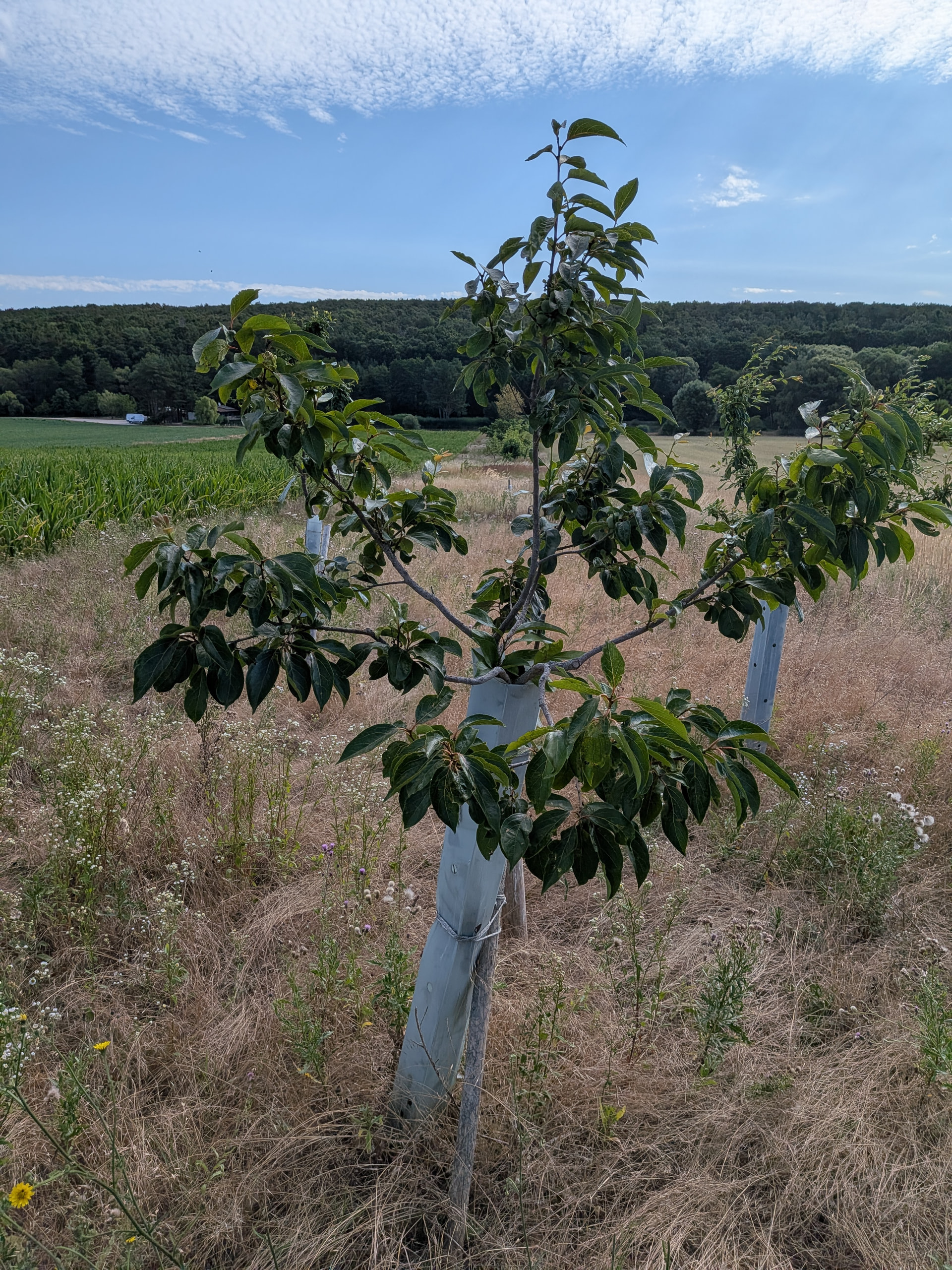
Bozhy Dar for me is quite dwarfing/slow growing.
This tree is in its sixth season planted and not much taller than 1.5m
5 Likes
This April temp swing showed me still anoher variable that renders hard numbers for cold hardiness to be very unreliable. I had thought the danger of warm to cold was all about accelerating movement out of dormancy from the warmth, but it turns out to also makes plants at the same state of seasonal development to be more tender to cold.
In some parts of the world winter temps are quite stable without big swings from warmer to colder temps, which can make a world of difference on what a plant can survive- and that is just one of I don’t know how many variables in play. Academics may have an emotional tendency to want a level of certainty that seems never to be teneble in horticulture.
3 Likes
I’ll very familiar with the Caucasian persimmons, I picked and ate lots of their fruit, although 90% of it usually gets wasted due to the tiny size of the fruit, the height of the trees, and the extremely short ripening window where they’re edible before falling to the ground and likely splatting.
So to answer your question Universal looks so much like the Caucasian persimmon that I recognized it as Caucasian persimmon when I saw it, especially the fruit clusters. And the name Universal seems to imply it combined everything, and that’s an excellent name for a cross between the 3 species that they have in the area.
No I do not grow it, and I certainly will not grow it unless I’m in an area with Caucasian persimmon, it may perfectly well be an American Asians cross, but to me that’s a risk that’s too big to take that it’s just a tiny fruited hybrid, and I’m not sure why I’d plant a tree like that when Bozhiy Dar can be used as a male pollinator while producing large fruit, and Sosnovskaya is a wonderfully cold hardy self-fruitful female, so I don’t know what the benefit really would be. But if I do get land in an area with well spread or wild Caucasian persimmon then I definitely will try in order to attempt to pollinate them with Universal.
2 Likes
Does the Bozhiy Dar have perfect flowers? Could the reason for the small fruit and fruiting in clusters be because it flowers in clusters like a male, but sets fruit on all the flowers making it fruit in the clusters and make them all small because there are so many?
1 Like
Small size per se would not be an issue. I’d want it mainly for its male flowers. Does it flower? Am I right assuming DV rootstock?
3 Likes
Yes, it flowers male and female, here it says the flowers are separate male and female, it would be interesting to know if it has male and female branches like honey locust, probably not.
If you’re in the US it will be on DV rootstock, in Russia it would likely come on Caucasian Persimmon rootstock, but it would be a worthwhile question, in the EU I really don’t know.
2 Likes
I am going to push back on your claim because - with all the confusion around cultivars - it only spreads more confusion. If you have a solid source that indicates breeding was specifically done with D. lotus its something else.
No I do not grow it, and I certainly will not grow it unless I’m in an area with Caucasian persimmon,
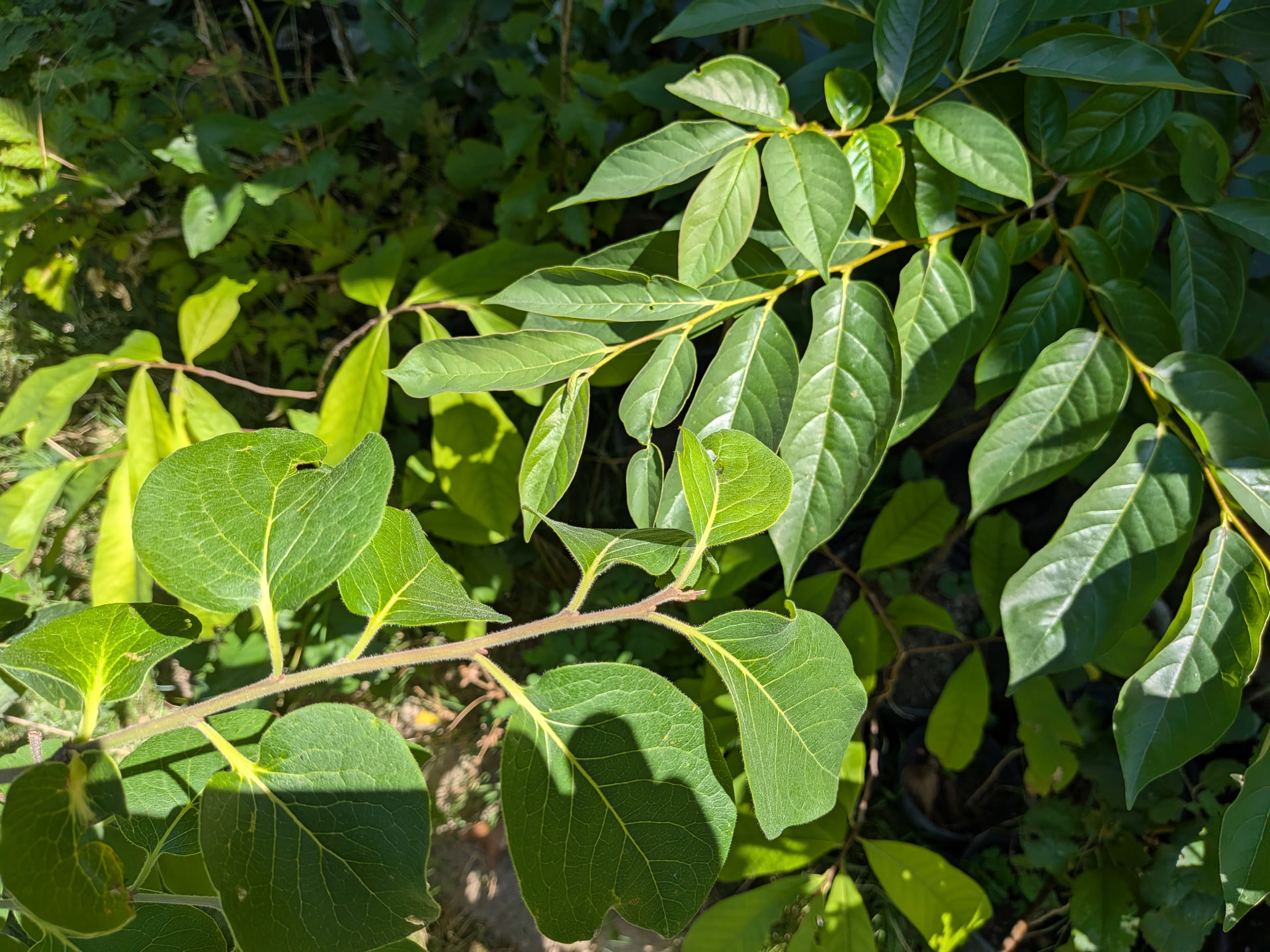
So this is more or less hearsay that you are stating as a semi-fact. Have you at least seen the tree in person or are you judging this solely through pictures online? If you looked at a tree in person - are you sure it is a verified universal?
@jrd51 you have universal, right? does it look like it has D. lotus traits?
kind regards,
Nicholas
3 Likes

You’re right to push back and you’re likely correct that it just looks like one, but for me my philosophy is always risk vs reward.
It would be a catastrophe for the US if the wild American persimmons were mixed with or overtaken by Caucasian Persimmon.
Caucasian persimmon is in every way inferior, or equal, to American persimmon, except in it’s ability to reproduce and spread. Its fruit is tiny, from the size of a pea to the size of a cherry, and this makes it so birds are much more likely to carry the fruit and the seeds long distances, especially when larger birds eat the seeds, making the Caucasian persimmon an excellent candidate for being a horrific invasive tree in American Persimmon territory.
The same logic applies if you don’t have wild persimmons, you would want the superior American persimmon growing there from everything from timber to fruit, or the Asian persimmon or even hybrids of the two, but we don’t want to spread the Caucasian persimmon outside its native range.
So, you’re probably right, it probably is an Virginiana x Kaki , but the risk is too great compared to the lack of reward considering that better trees, like Bozhiy Dar, exist.
2 Likes
Thanks but I was asking Nicholas specifically if his small Bozhy Dar is flowering yet.
1 Like
I’m not great at discerning flowers for persimmon but it looked like it had both types of flowers and many triplet clusters. I will make sure to take pictures for you next spring
5 Likes
I don’t believe that hybridization between d. Lotus and kaki/virginiana is straightforward. There apparently exists a hybrid with costata. I intentionally got myself a large Fruited lotus cultivar from Mikatani to see if it will set viable seed from my hybrids but don’t have high hopes.
Lotus isn’t all that bad (I’ve had fruit from the botanical garden in Vienna) and it may have other desirable traits. In any case it is not as hardy as virginiana and likely not adapted to the US conditions.
I don’t think that its warranted to drop a perfectly fine cultivar (by various accounts) over a vague hunch. Trial it in practice. If it makes excellent fruit keep it, else drop it.
Most accounts I have read give universal a better taste. Bozhy Dar is allright taste wise but not exceptional
4 Likes
No, I have a source for it and will graft it next year. So far, my hybrids include stand alone established trees of JT-02 and Kasandra, 1-year old trees of Chuchupaka, a new grafted tree of Dar Sofiyivki, and new grafted branches of Stepova Krasunya and Kolgospnytsa on Kasandra. For breeding purposes I also have a new grafted branch of Luotiantianshi on Kaki (Chocolate).
Thanks for your inputs.
3 Likes
The clusters were probably male flowers. Judging by the amount of fruit, I’m guessing that there were plenty of male flowers as well, so it would serve well as s pollen source despite its small size.
Just checking – Is the tree on DV rootstock?
Oh, since you already have Caucasian persimmon there, please try out universal and let us know what it’s really like! If it’s useful and it’s offspring is good, that would be great to know!
I just think it’s a big risk to plant it where there is no Caucasian persimmon, until there’s confirmation that it isn’t Caucasian.
The tree came from Limbach nursery (what trav posted)
I’m not sure what rootstock they use
1 Like
Am I missing something? I don’t understand that comment. Every 90 chromosome tree I’ve seen pollinated by a 60 produced seedless fruit - and vice versa.
2 Likes

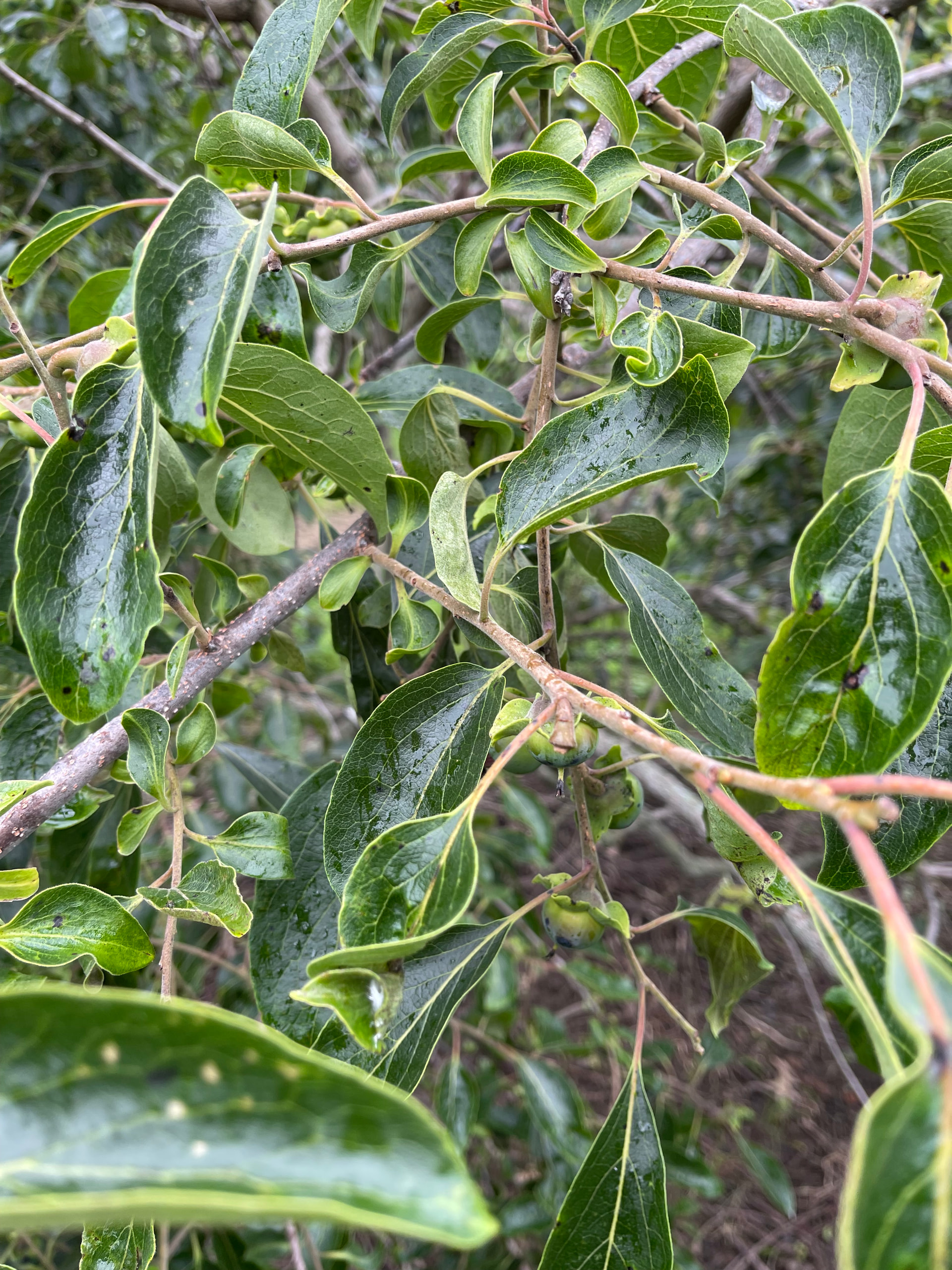
This one is Mei Zye grown out by David Pierce in Terre Haute. It’s the best of about two hundred open pollinated (D.virginiana) Rosseyanka seedlings. The presumed pollinator is a Claypool male he had grafted near his Rosseyanka. Gets a load of nice fruit every year. Much reduced stature compared to its siblings. I really like the stature. Bet if he pruned it up, it could be a very tidy tree.
I grafted it this year at my place. Thinking it might be worth trying to introduce that dwarfing phenotype into some of my favorite native varieties.
9 Likes
I was actually shocked Rossiyanka was bred in 1959! And Nikitskaya Bodovaya in 1975, much older than I thought.
This is a very interesting read and highlights the second of those and Bozhiy Dar as the two best.
And from a little more searching V.N. Derevyanko bred almot all of his trees that we know about on the 1970’s and 80’s so probably all of these “new” varieties are 40 years old.
**This was put through a translator and if you see “the Russian persimmon” it probably means Rossiyanka persimmon, which we transliterate not translate, I fixed a few, but there are too many to fix.
https://www.drive2.ru/b/677160900196569123/
Persimmons for the temperate zone.
June 2, 2024
Virgina persimmon / American persimmon / Diospyros virginiana

Homeland is the southern part of North America.
The trees are no more than 20m high and have a fairly good frost resistance.
Virgin persimmon is a high-quality rootstock.
The root system can withstand frosts up to -15°C, the crown-up to -35°C. Seedlings develop well on heavy loam and sandy loam, waterlogged soils, but they are difficult to tolerate transplanting.
Cultivated varieties of Virgin persimmon, which in America are called persimmons, have been bred. In Russia, an interspecific hybrid with eastern persimmon, called Rossiyanka and the Nikitsky burgundy variety, was bred.
To get delicious fruits, eastern persimmon has long been cultivated, but the frost resistance of this species is low, it can withstand frost only up to -18…-20. In order to correct this shortcoming, experts from different countries repeatedly tried to cross the eastern persimmon with the Virgin persimmon (a frost-resistant species, but with small fruits), but there was no success. The breakthrough was made in 1959 by the Crimean scientist Arkady Konstantinovich Pasenkov. After pollinating the Virgin persimmon with Eastern persimmon pollen, he obtained a fundamentally new hybrid plant. From the virgin persimmon, frost resistance was inherited, and from the eastern persimmon, a larger size. This very first hybrid persimmon was named Russian and became the progenitor of all other varieties of hybrid persimmon.
The gift of Sofiyevka - Dar Sofiyevki

The earliest variety. The newest variety, obtained in the Sofiyevka arboretum Park in 2015 from pollination of the Kolkhoznitsa variety with a winter-hardy variety of Virgin persimmon. It started being distributed in the fall of 2017. The author of the variety is a well-known breeder V. N. Derevyanko.
Self-fertile variety, perfectly fructifies without a pollinator (parthenocarpic), but when pollinated, the fruit quality is higher. The tree is medium-sized, about 2.5 m or slightly higher.
Frost resistance is higher than that of the Rossiyanka variety, and it can withstand temperatures of -27 or even lower without freezing.
Fruits are red-orange in color, flattened, rounded-square in cross-section, the top is slightly depressed. The mass of fruits is 100-130 g, the largest ones are up to 160 g. The pulp has a density of medium consistency, excellent taste and subtle aroma. The sugar content is 12.5%. Already gaining color, but still unripe hard fruits are practically not tart.
At the moment, this is the earliest variety of hybrid persimmon, maturation begins in early October, a month earlier than in the Russian, and even earlier than in Sosnovskaya. Timely collected fruits can be stored for about 3.5 months. Ripe fruits do not fall off and remain on the tree until December.
God’s Gift - Bozhiy Dar

The best pollinator. A new variety of persimmon from the famous breeder VN Derevyanko. It was obtained from pollination of the Nikitskaya Maroon variety with a hardy Virgin persimmon variety.
A monoecious self-fruiting variety, persimmon of this variety has male, female and hermaphrodite flowers. According to the author of the variety, it is the best pollinator of other hybrid and Virgin persimmon varieties. The adult tree has a height of about 2.5 m.
Frost resistance is about -26. This is higher than that of Nikitskaya Maroon, but lower than that of the Russian.
The fruits are small, slightly flattened, round in cross-section, red-orange in color. The top of the fruit is flat, with characteristic thin rounded annular scars. From bisexual flowers, smaller fruits are formed, weighing 20-30 g, from female — larger, 70-120 g. The taste is excellent, very sweet. Brix 23.There are few seeds and they are very small. Already gaining color, but still unripe hard fruits are practically not tart.
Ripen in October, earlier than in Nikitskaya Burgundy and Rossiyanka, but later than in Sosnovkaya variety. Timely collected fruits can be stored for about one month.
Nikitskaya Maroon - Bordovaya

This is a medium-sized (5-6 m) variety bred in the Nikitsky Botanical Garden. The variety was included in the State Register of Approved varieties in 2014. It is recommended for growing in all regions. For its creation, the Russian persimmon was used.
The most delicious variety. A very famous persimmon variety, obtained in the Nikitsky Botanical Garden in 1975 from free pollination of the Rossiyanka variety, the author of the variety is A. N. Kazas.
A self-fertile variety, it can bear fruit without a pollinator (parthenocarpic), but with a pollinator, the yield increases. The height of an adult tree is up to 3 m.
Frost resistance -24…-25.
Fruits are red-maroon, with a noticeable waxy coating, slightly flattened, round in cross-section. Weight 70-127 g, the largest up to 150 g. The taste is excellent, one of the most delicious varieties of persimmon. Brics 25.
Maturation in late October. Fruiting is annual, the yield is high. Fruits can be stored until the end of December.
The Nikitskaya burgundy variety belongs to the intermediate group, in which, under favorable conditions, fruits are formed without fertilization. The culture forms only female flowers.
To increase the yield and weight of fruits, pollination is necessary. After that, sweeter specimens are formed.
When the temperature drops to -29 °C, it is possible to freeze the buds on annual increments. The percentage of damage to generative and vegetative buds does not exceed 20 %.
Russian woman - Rossiyanka

The oldest variety. A very well-known, but already outdated persimmon variety, created in the Nikitsky Botanical Garden in 1959, the author of the variety is A. K. Pasenkov. Obtained from pollination of Virgin persimmon with eastern persimmon pollen.
A self-fertile variety, it can bear fruit without a pollinator (parthenocarpic), but with a pollinator, the yield increases. The tree is strong, reaching a height of 5 m.
Frost resistance -27…-30 degrees.
The fruits are slightly flattened, round in cross-section, and orange in color. Their mass is 40-60 g, the largest can reach 70 g. Brics 23. Pollinated fruits contain single large seeds.
Late variety, matures in November. In cool regions, it may not have time to ripen. The yield without pollinator can reach 100 kg, and with a pollinator 200 kg. Fruits are stored for up to two months.
4 Likes