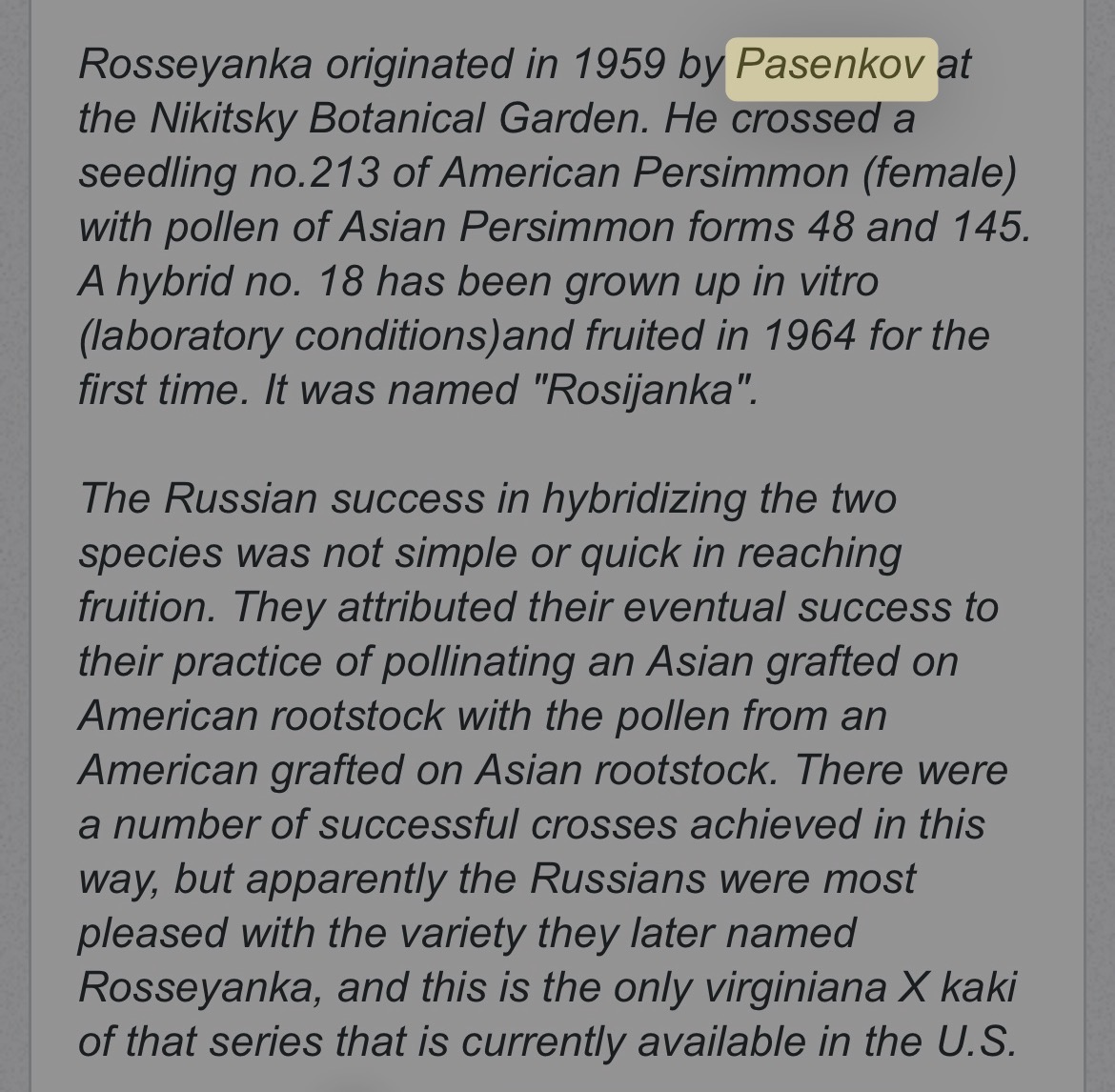
Interesting how a person that apparently died in the 80’s is publishing papers on persimmon with his wife in 2016….
Trav, I am not sure how you research things but I’d avoid posting claims that people died without being sure you got the right person
Interesting how a person that apparently died in the 80’s is publishing papers on persimmon with his wife in 2016….
Trav, I am not sure how you research things but I’d avoid posting claims that people died without being sure you got the right person
Sorry about that, you’re right, that was an AI answer and it wasn’t correct, but it’s pretty surprisingly how little information is available about him.
I see so many dates of “breeding” being listed as the date if release to the public making trees look decades newer than they are, and people’s general idea about this history of these trees and where they come from is generally all wrong. I was asking AI about when the trees were actually bred and it didn’t have dates, so I asked when V. N. Derevyanko died and it said in the 80’s, which is even after all of the trees that I can find breeding dates were actually bred, but fortunately, it seems he still is alive and staying in his home city if the 3rd time I asked AI can be trusted.
FWIW, I asked ChatGPT a similar question months ago. I gave me good dates, but interestingly two of the four references were from this forum.
Here’s a translation of the paper posted by @Nicholas
American_Persimmon_Introduction_in_Ukraine_English_Translation_fixed.pdf (1.2 MB)
Well this was from my search for actuallu new varieties, because all of the trees mentioned here are first and second generation trees from Rossiyanka bred in 1959 and Nikitskaya Bodovaya is from 1975! Maybe I’m young but does 51 years old count as a new generation? All these mentioned here, except maybe that one are Soviet Second generation trees, so I my search for a new generation, 3rd or 4th, the only one I have found so far that fits the original question is the variety Aleksei Chelombit, but there’s very little info about it. Here’s the best I can do:
Alexey Chelombit (Persimmon)
Post Sun May 18, 2025 12:46 am
Alexey Chelombit (Persimmon) is included in the State Register of the Russian Federation. The average maturation period. Universal. The tree is medium-sized, semi-vertical with an average growth rate. The crown is medium thick, broadly pyramidal. Shoots of medium thickness and length, straight, with short internodes, with small oblong lentils in large numbers. The leaves are of medium length and width, ovate, with a blunt base and a pointed tip. The flowers are only female, small in diameter, with a regular cruciform cup, with a four-lobed corolla. The fruits are large, one-dimensional, rounded, with moderate grooves at the top, without cracks at the top and longitudinal grooves. The cup is slightly depressed, large, horizontal. The peduncle is short, thick, and square in cross-section. The peel is light yellow. The flesh is yellow with the presence of astringent substance and small brown spots, juicy, the consistency of thick jam, very sweet, with a faint aroma. Fruits with an average weight of 180.0 g. The average yield is 108.0 kg/ha. Fruiting is annual. The sugar content in fruits is 22.4%, vitamin C is 62.5 mg / 100 g. The fresh tasting score is 5 points. The transportability is good. According to the applicant, the variety has increased resistance to major diseases. Drought resistance and heat tolerance are high. It has a relatively high winter hardiness.
Year of inclusion in the register: 2024
Region(s): Northern (1), Northwestern (2), Central (3), Volga-Vyatka (4), Central Caucasus (5), North Caucasus (6), Middle Volga (7), Lower Volga (8), Ural (9), West Siberian (10), East Siberian (11), Far Eastern (12)
Originator(s): NIKITSKY BOTANICAL GARDEN-NATIONAL SCIENTIFIC CENTER OF THE RUSSIAN ACADEMY OF SCIENCES, ORDER OF THE RED BANNER OF LABOR
Also my “paranoia” has been greatly vindicated, and I have found very interesting info, I beg you who live outside the range of Caucasian persimmon aka “date plum” to not plant these trees, but there is a program testing and crossing thembin Sochi, but no varieties have been named or released according to the latest research I have found
“As a result of research, we marked out the most productive varieties and hybrids of diospyros kaki (there was a mistake saying “eastern date-plum”) Hiakume’,‘Hachia’,‘Djiro’, ‘Seedles’, ‘Zenji-Maru’, ‘Khostinsky ’, hybrid №39 and ‘MVG Omarova’. Of these, the most productive for four years of fruiting were the varieties: ‘Hiakume’ - whose yield is 82.5 c/ha, ‘Hachia’ - 73.5 c/ha and ‘Djiro’ - 72.0 c/ha, these varieties are characterized active growth of shoots, high fruit set, as well as varieties with large fruits, such as ‘Hiakume’ -231 g and ‘Hachia’ -228 g.”
Hybrid №39 has a name now Zukhra
Khostinsky ’, hybrid №39 and ‘MVG Omarova’ are probably all new F1 D. Virginiana x Kaki hybrids.
https://agrojr.ru/index.php/asj/article/download/1201/998
While Universal is not mentioned but there is a program in process in Sochi and it is possible that they were doing the same in the Ukraine, I do not know anything for certain other than crosses have been made for research.
Trav, again you fall victim to really badly researched/ translated information that can be trivially checked to be false.
The cultivars you list are not hybrids of D. lotus but rather just D. kaki cultivars. (Granted, some open pollinated but there is nothing to indicate they are D. lotus hybrids)
I’m really not sure what you are trying to achieve here - I can vaguely understand your concerns but for what it is worth your alarmist posts are doing more harm than good by confusing basic facts.
Well to answer your question not one new variety has been mentioned, and all of these are second generation Soviet or truly Russian Persimmons, only Alexey Chelombit is possibly what he asked for, a new generation of Ukrainian persimmons.
Beyond that I was searching for new varieties and copied this out of a scientific journal there wasa big mistake, and I shared it before reading the whole thing. There are new F1 hybrids between Meader and other diospyros Virginiana cultivars and different Asian persimmons.
Apparently those last three are new hybrids between Virginiana and kaki. 39 is named Zukhra.
but it’s interesting and expected
No it is certainly not expected that a majority of ukrainian/russian hybrids and kaki cultivars magically are additionally hybrids with D. Lotus against all well known publications and sources.
You are providing a prime example for how armchair musings with LLMs can be extremely problematic. Not only do you appear to blindly accept anything output as fact you also don’t make good delineations what was from an LLM or from your own research (which in this case calling it superficial would be generous)
I’m out of this discussion for now - no point in arguing if the other side doesn’t want to listen.
happy growing!
This has nothing to do with AI:
Read for yourself, the conclusion is also in English already:
Clearly, you must be trolling me
The article is on cultivars of Diospyros kaki L.
Thank you, that is an awesome write up.
I love the crisscross of grafting them! Genius.
since they list hiakume and hachia as varieties of “eastern date-plum”, “eastern date-plum” must be Diospyros kaki
It must have been a translation mistake that made its way into an agricultural journal, I checked for the original in Russian, but didn’t didn’t it at first.
@Nicholas I was wrong. I’m just not familiar with Asian Persimmons only hybrids and Bichye Serdtsa or bull’s heart, which I’m getting very conflicting information on whether or not it’s pure Asian or a Virginiana hybrid.
“Date plum” is Caucasian persimmon, and “Eastern date plum” is not mentioned anywhere else in English, so I checked the Russian text thoroughly now, and yes it was Kaki and the hybrid parent was not stated, but from other places in the text it clearly is Virginiana x Kaki.
So I made a mistake in getting excited and publishing it quickly, but in my fact checking I have found that I was not entirely mistaken, those hybrids DO exist in an agricultural research facility in Sochi, although possibly only for research, and may not be released unless they find some exceptional value to them.
My Universal hybrid persimmon graft from this Spring is taking off nicely with 8 inches above the grafted union buried underground for insurance.
Tony
yes, crosses were made between D.lotus and D.kaki during the same project as when Rosseyanka was obtained. The fruit was of low quality and these crosses were discontinued.
I find the judgement on the quality of persimmons somewhat absurd. The sugar content is what most defines the quality of persimmon, wether it be american, asian or hybrid. However, sugar content is not a trait but a result of culture and growing conditions. That is also the reason why “sugar content” is not considered a trait when appllying for varietal protection (breeder’s rights). Many aspects determine a variety i.e. leaf shape, color of the one year old shoots, number of lenticells on one year shoots, shape of the calyx, etc. these are all comparable traits that will not differ when a variety is grown under either optimal conditions or unfavorable conditions. Sugar content of the fruit is very much linked to cultural conditions. Dar Sofiyivky and Rosseyanka for instance, are two hybrids that are worthless in central or northern Europe because the fruit of these varieties is extremely bland. This is because of lack of clear sky sunshine in this part of the world. The same varieties grown in the mediterranean will produce good sweet fruit. The point I’m trying to make is that the label “sweet” is not universal and therefore should be taken with a huge pinch of salt when considering the use of a “sweet” variety in crossing in order to boost the sugar content in new offspring.
On the other hand it might be a good idea to select the sweetest varieties in very unfavorable growing conditions where you normally get bland fruit on most varieties. these selected varieties show POTENTIAL in reaching sufficient sugar levels even in very unfavarable conditions.
Another thing that I have learned is that no matter how you think you can steer the results in hybrids by selecting very particular parents, you will always end up with completely different results. Persimmon breeding is very much a matter of luck and therefore numbers are very important. It is better to make thousands of crossings and grow them out so the very best ones can be selected than very meticulously choosing specific parents and making a few well considered crosses. New apple and pear varieties are also the results of tens of thousands of seedlings grown to fruition. Apple and pear breeders have the advantage of being able to use genetic analysis so they can discard a huge part of the one year old seedlings by determining that certain traits are failing in particular seedlings. Small scale persimmon breeders, and certainly hobbyists do not have this advantage unfortunately. So it all comes down to numbers…..
@Mikatani – Great points. I live in a borderline area (coastal Z7A) that has a fairly mild winter, a fairly short growing season, but plenty of sun May - October. Much of the northern U.S. is similar, though in much of the north the winters can be colder but the growing season is longer. For example, 200 miles down the coast the Zone is the same but the growing season is 1-2 weeks longer at both ends. Anyway, as you recommend my experimentation with various fruits is largely intended to discover what works best here.
For example, one thing I’ve discovered is that I can grow great main crop figs, provided I focus on early-ripening varieties. The harvest starts in mid-August.
As another example, I have ripened an excellent paw-paw. Only one so far but the trees are young and this year’s crop promises to be at least a dozen. Again, I need varieties that ripen early.
Re persimmons, it’s a work in progress. Early-ripening American varieties do well, ripening in late September / early October. But anything later fails. Asians such as IKKJ, Giboshi, Sheng color up very well by early November then finish inside, all acceptably sweet. Hybrids such as Kasandra and Jt-02 are similar. The flavor and sweetness of Kasandra are outstanding. I’m growing Dar Sof and Chuchupaka hoping that they perform as well.
Re breeding, I would experiment mainly trying to produce high quality fruit that ripens well in my growing conditions – 80 F and sunny July and August, 70 F and sunny May and September. So for example, maybe I can combine the earliness of Universal with the flavor and size of Kolgospnytsya. I totally get your point that results are unpredictable so numbers matter. There’s a joke about Albert Einstein and Marilyn Monroe building on the obviuous risk that the genes combine differently than hoped (i.e., his looks, her brains).
If I do manage to produce lots of seeds, I’ll end up sending most of them to other growers who have the space, time, and ambition to grow them out. I’d probably keep only a small subset for myself. For example, two years ago I gave away roughly 500 seeds from Kasandra to a single grower north of me.
You are very knowledgeable about persimmons so I’d value your input. If you were in my position, what would you do? More specifically, given (1) the relatively small set of male-flowering (but fruiting) hybrids and kakis and even Americans, and (2) the much larger set of female-flowering hybrids, which crosses would you attempt hoping to produce a fruit that ripens early in a short-season but sunny location?
Welled said! That is why I grew out a bunch of crosses to see which ones is good for my Z5 Omaha, Nebraska.
Tony
Yep, Dithmar (Mikatani) is a very experienced persimmon breeder. He mentioned before that his own goal is developing great tasting cultivars that don’t require a lot of accumulated heat hours, as the growing season where he is in Belgium is relatively short and mild. Cold hardiness isn’t his breeding goals either (fairly mild winter).