What variety are you using as interstem? Made a few searches and couldn’t find much on this topic
1 Like
Anything that is quince compatible will work. There’s a thread here listing many varieties.
Quince as a pear rootstock is highly under-appreciated, it is by far the most dwarfing and the most precocious. The compatibility issue is easily solved by an interstem – if you are not sure if some variety is compatible just add an interstem. The only downside is suckering, and in particular those suckers can get blight strikes which can kill the tree. That said even in bad blight years that never happened to me. Also at some point it gets too cold, I think zone 5 and up is OK.
3 Likes
Ahh gotcha, thanks 
Wouldn’t aronia or amelanchier alnifolia be the most dwarfing? Compatibility would likely be worse though.
Practically speaking they are not viable pear rootstocks for compatibility and other reasons.
1 Like
I have both Hosui and Chojuro. The best Hosui I’ve had are better than the best Chojuro, but I’ve produced more good Chojuro. Hosui is very shy bearing for me with the limited care I give.
2 Likes
Makes sense. My shinsui so far have been much more productive than the Hosui. Only has been a few years though. This year I pruned my Hosui a lot less and there’s a ton of blooms. They seem to have a disproportionate number of prunes on the branch tips so maybe I’ve been over pruning them? Barring anything crazy happening I’m hoping for a very large harvest this year
‘Shinsui’ is supposed to be one of the highest production pears there is, so much so that the crop can easily break branches.
3 Likes
The main question is vigor, precocious pears like Asian pears and a select few European pears or hybrids dwarf by early fruiting with precocious rootstock, the quince is used to dward European pears by providing low vigor, even if the graft takes with or without an interstem, it’s not what you really want for good fruiting with Asian pears.
Most Asian pears and even Callery are incompatible with quince, I believe because of an enzymes at the graft union, so that’s an issue, but a long enough interstem should work, does anyone know about betulafolia and quince compatibility?
But if you’ve got extra rootstock, you could try, but I’d add an interstem of an ideal rootstock for Asian pears and bury the interstem, or bury the graft union.
1 Like
The tops of rootstocks! I did so many M111 interstems with chip buds or small whip and tongue grafts from my purchases scions, and grafted those interstems into very questionable rootstocks and buried them almost to the too variety, sometimes I think I buried that too; they survived surprisingly well.
3 Likes
Haven’t seen much on Tawara asian pear so thought I’d make a report. This guy is a bit of a survivor tree; it had been horribly root pruned and potted when I bought it, and then I moved it a few months after planting. So it had a very rough start to life and took a couple years to establish, but now it’s one of my most vigorous trees and fairly precocious, too. It’s had at least 3 growing seasons in my yard, this might be the fourth. Grew ~3-4 ft each year last two years.
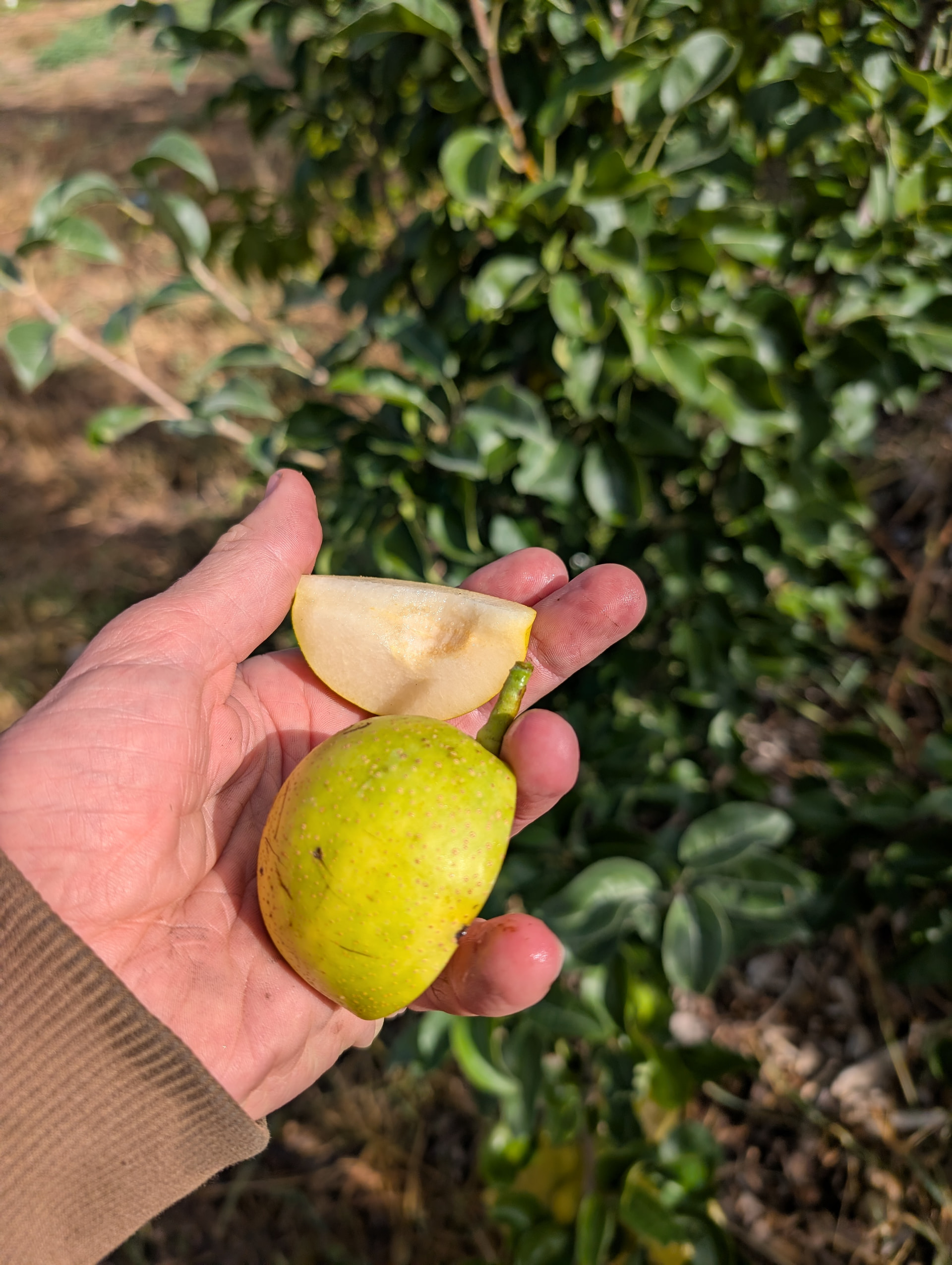
This is its first year bearing. I tested a stem this morning and it easily separated so I ate one and was surprised at its ripeness. Had a pleasant lemony flavor, quite juicy, crisp, slightly gritty. Small. I had another, pictured above, more yellow than the first and sweeter. Neither had the light texture of the best asian pears but were quite enjoyable. Much better than my first Juicy Jewel crop from a couple weeks ago (which in fairness was also a first-year crop). I ate a third which was less ripe. So I picked a few more to leave on the counter and left the rest to ripen on the tree.

I’m in Western Montana Zone 5. We had a big freeze right at peak bloom this year, about 24 degrees, and this tree shrugged it off. My soils are generally poor and rocky although I do fertilize and drip irrigate. The vigorousness of this tree seems to help it in our fairly short growing season compared to my other 7 pears.

Unfortunately the landscape around my yard changed so this tree is no longer on the correct spacing with the other trees. Poor thing will have to be moved again. I might put it into a big pot as a patio-pear or graft parts to some other varieties to it and gift it to a friend. But it’s a nice pear and an early-mid september ripening time would fit well between the peaches and other pears or euro plums.
5 Likes
Raja is great! One of the best Asian pears in my opinion, and a fast grower! We’ve got fruit 3 years after planting and they were not big trees when I planted them!
1 Like
Raja is a great pear. It’s also a bad splitter in the rain. Even so in it’s good years it’s one of the best asians.
5 Likes
Had a nice side by side taste comparison between Raja, Chojuro, and Drippin Honey. From best to worst.
Chojuro- Highly under rated IMO. Some have a nice butterscotch flavor.
Raja- Super juicy and tasty. Flavor slightly lighter.
Drippin Honey- To me it’s not as good as the high praise it often gets. Good pear, just kind of weak on flavor.
+++++++++++++++++++++++++++++++++++++++++++++++
Ichi Ban- Ripened earlier, but decided to include it. Super early ripening which has it’s own value. Kind of light on flavor, but not bad.
Shinseiki also ripened earlier. The best of the yellow pears and ultra sweet. Much harder texture to the bronze varieties.
Still to come. KG, Shinko, Mishiraso, Seuri, Shin Li, Yoinashi, and Niitaka. Have some other varieties, but they have not fruited.
9 Likes
One thing I’ve always heard about chojuro is they’re always different, different soils produce different flavors even different weather does, so don’t grow too much of it, because some years with strange weather you might be disappointed, but it is one of the top pears on my list to get.
1 Like
Most of that could be said of every variety.
true, but chojuro especially only sometimes has its unique butterscotch flavor allegedly.
Was great when I had it though
1 Like
Chojuro was one of my first asians. Your right the butterscotch intensity varies from year to year. It’s always been good though even in the light butterscotch years.
3 Likes
Yes, my Chojuro have been inconsistent. This year it did very well when none of my other pears did. I’m quite enjoying them and having 1 or 2 daily for the past couple of weeks. They are very sweet, and some have nice butterscotch flavor, others just a good balance of sweet and acid. I’ve had some years in which they were bland.
The texture isn’t the best, but its fine. It also seems to be resistant or tolerant of rust. This year I have rust in the orchard worse than any of the last 15. On the multigrafted tree,Chojuro and I think Yakumo seem unscathed. Seuri Li is the worst for that. I con’t recall how Hosui (which didn’t make any fruit) and Korean Giant did, but definitely significantly better than Seuri Li. I think Yoinashi also shows significant rust (I could be mixing up the two “Y” pears but probably didn’t).
1 Like
I had a stretch of butterscotch-free years on my Chojuro and decided to take it out. It is a beautiful looking pear and not as prone to rots so if it was butterscotch every year it would have been one of the very best.
I’ve also had several “OK” years for Drippin’ Honey. I just ate one a few minutes ago, perfectly decent but nothing special. I had one year where I had some really good ones but have not repeated that, and the pick timing is also an issue as the window is narrow. One other sign is the birds and bees are all over the Kosui and Hosui but not bothering the the DH .. I agree with the pests, those two pears are much more flavorful. My DH is in the way of my Kosui so I may remove it.
Kosui has an amazingly long picking window, I had some that were disfigured by the early frost that I just left on the tree when I picked the rest of the crop. Almost a month later I tried one just to see what they were up to, and they are still crisp and dripping with sugary sweetness. This guy is my #1 asian pear overall. The only downside is the skin is one of the most thin and so the slightest damage can lead to a rot.
6 Likes