Top 20 Fire Blight Resistant Apples (Aggregated from 11 Studies)

I’ve been frustrated by how much disease resistance ratings vary from region to region. One extension office might list a variety as “Resistant” while another lists the same apple as “Moderately Susceptible.”

I decided to try to find a consensus. I compiled data from 11 independent university and extension studies, normalized their rating scales (converting them all to a standardized 1-6 scale), and averaged the results. I only included varieties that appeared in at least 5 of the studies to ensure the data was reliable.
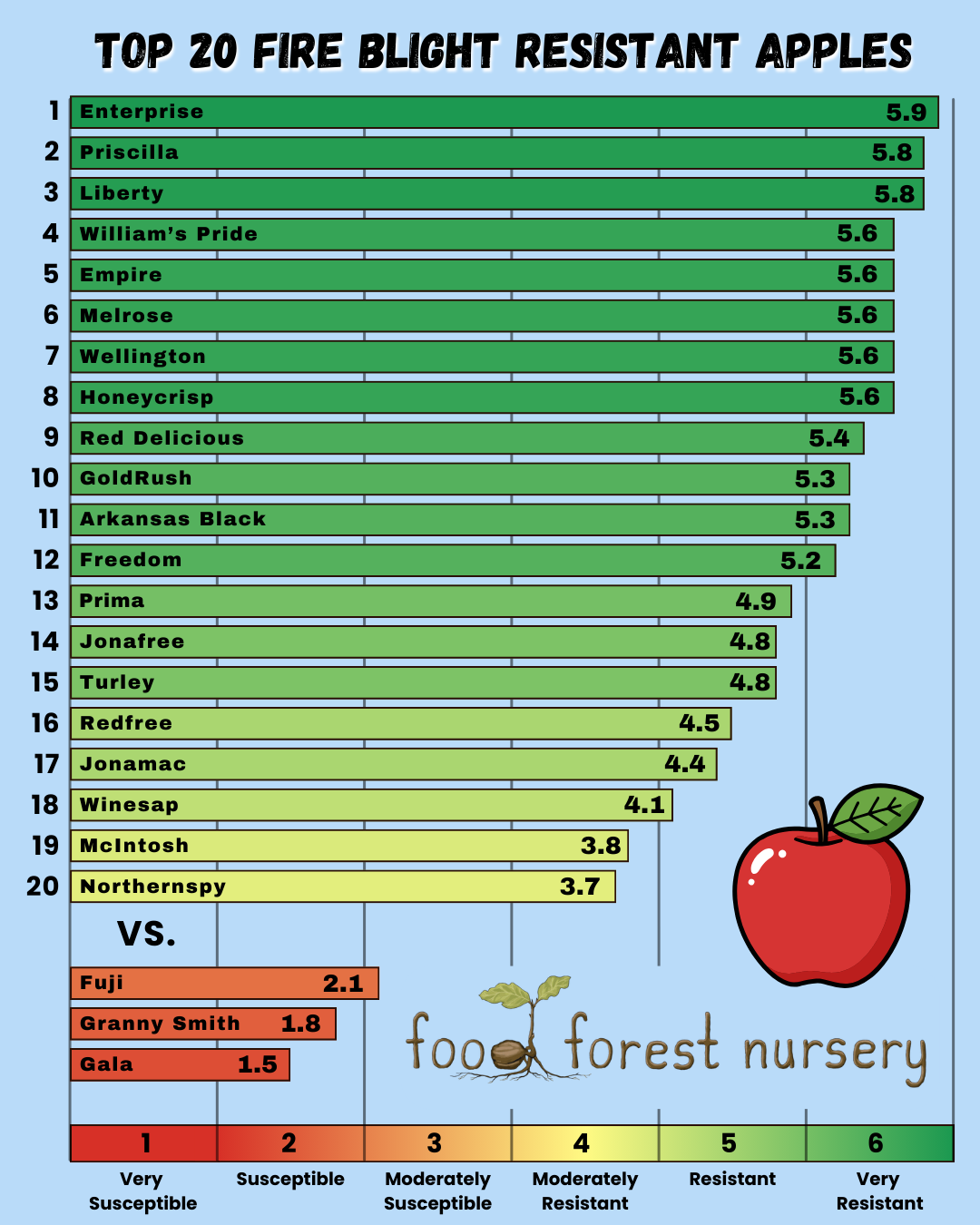
A few interesting notes from the data:

  • The “PRI” Dominance: The Purdue-Rutgers-Illinois breeding program effectively dominates the top of the list. You can see their signature naming convention in Enterprise (#1), Priscilla (#2), William’s Pride (#4), and Prima (#13), but they also developed GoldRush, Jonafree, and Redfree, which all made the Top 20.
  • Scion vs. Rootstock: It is worth remembering that this data tracks the resistance of the variety itself (the scion). While a resistant rootstock (like Geneva series) is vital for tree survival, a resistant scion is what saves the actual harvest/canopy.

Honorable Mentions

I wanted to add some honorable mentions that didn’t make the chart above because they were in fewer than 5 studies but had decent resistance scores and have at least 100 searches a month:

Frostbite, Keepsake, Haralson, Pristine, Cosmic Crisp, Fireside, Pixie Crunch, Red Fuji, Sunrise, Regent, State Fair, Pinova, Wolf River, Royal Gala, and Sundance.

If you want to dig through the database and all the numbers to sort by popularity, number of studies, or resistance score, I have the full list on my site.

Popularity vs. Resistance

I also ran another analysis that I found interesting. I ranked varieties based on general popularity (calculated from average monthly Google search volume) alongside their Fire Blight resistance scores. It really highlights the issue with people trying to grow common grocery store varieties or susceptible heirlooms.

Popularity Rank Variety Resistance Score
#1 Honeycrisp 5.6
#2 Fuji 2.1
#3 Granny Smith 1.8
#4 Gala 1.5
#12 Jonathan 1.2
#13 Yellow Transparent 1.2
#14 Idared 1.4

Questions for the group:

Do you know of any studies I did not include in my database? If so link to them below and I will add them to the database.

Does this ranking match your real-world experience? I’m particularly curious if anyone in high-pressure fire blight zones has seen failures with these Top 20 or honorable mentions or has had success with different varieties when all others failed?

For those using the Geneva series rootstock, have you noticed if they actually help the scion fight off strikes better than traditional rootstocks, or do they just prevent the tree from dying completely after a strike?

Do you find these resistant varieties allow you to skip sprays during bloom, or do you still treat them to be safe?
12 Likes

We get severe blight here. Oddly enough Fuji and Gala have not had issues so far. Dorsett Golden and Anna have had strikes. Rouville{highly blight resistant} died right off. Had about 15 varieties die off this last season. But many were from heat while I was out of action for a couple of months. I will have to go over the notes as a few died of blight.

Most of ours are heritage apples though. Blight strikes are not a big deal too us. Clip it promptly and the issue is settled.

2 Likes

Goldrush and Red delicious died of FB here…

Many others that were supposed to be disease resistant.

Any apple that is still blooming when we get 65-75 temps… it is getting FB in most blossom clusters and some limb tips.

My Novamac is a FG4 apple… starts blooming around April 1… it is rated by Purdue as very resistent.

It gets fire blight every year so far… I whack it back… and so far it is still surviving and producing some nice fruit. I am hoping it is getting more resistent each year. It did have less FB this year than last.

TNHunter

8 Likes

Exactly. FB predominately kills off grafts and some young whips here. So I try to keep them sprayed now.

@FoodForestNursery
There are distinct regions of fireblight strains and disease pressure in the USA. You included cultivars only if they occurred in at least 5 of the eleven studies. If a cultivar was only studied in similar regions, then your results are not helpful to those outside those areas.

I thought Rouville is best for cold climates I wonder if growing it in the south increased its susceptibility to fire blight?

1 Like

It could be. I thought Rouville on G.214 would have been a sure fire winner. But it died on M111 and P.2

Many of the blight resistant cultures are too high chill for use here. So we may never know. So far the only local Heritage variety totally un-phased here is Disharoon. Parks Pippin seems oblivious to blight. But scab on leaves are an issue. Foreign odballs “First of May” and Pionier also were not hit with blight.

There will never be consensus.

On the 1-6 scale, I’d give the Williams Pride a 3.5. Same for the Honeycrisp

I’d give the Winesap a 4.5

Yellow Delicious, 5.5.

Golden Delicious, 3.

Ark Black, 5.5.

Williams Favorite, 1.5

Lodi, 5

Black Twig mutated sport tree, 5.

So far, my new Swiss and Victoria Limbertwigs are doing great despite being newly planted on Bud 9s. Zero blight with carnage all around them.

5 Likes

We have one tree of each variety, planted 2018; Arkansas Black, McIntosh, Winesap, Granny Smith and Wolf River. All are semi-dwarf and there has been Zero Fire Blight on any of them- even though our “resistant” Kieffer pears and Seckel pear trees have Fire Blight every year. They are all planted 20 feet apart.

1 Like

Me too!!! I have a Granny Smith apple (90% sure it’s a Granny Smith) which is completely untouched by fireblight despite nearby pears dropping dead.

Actually, I just realized that my apple trees have barely been bothered while the Asian pears die left and right (and they are big trees). The Asian pears are hosui, Olympic giant, and probable chojuro.

2 Likes

Our Kieffer blighted out a few years back.

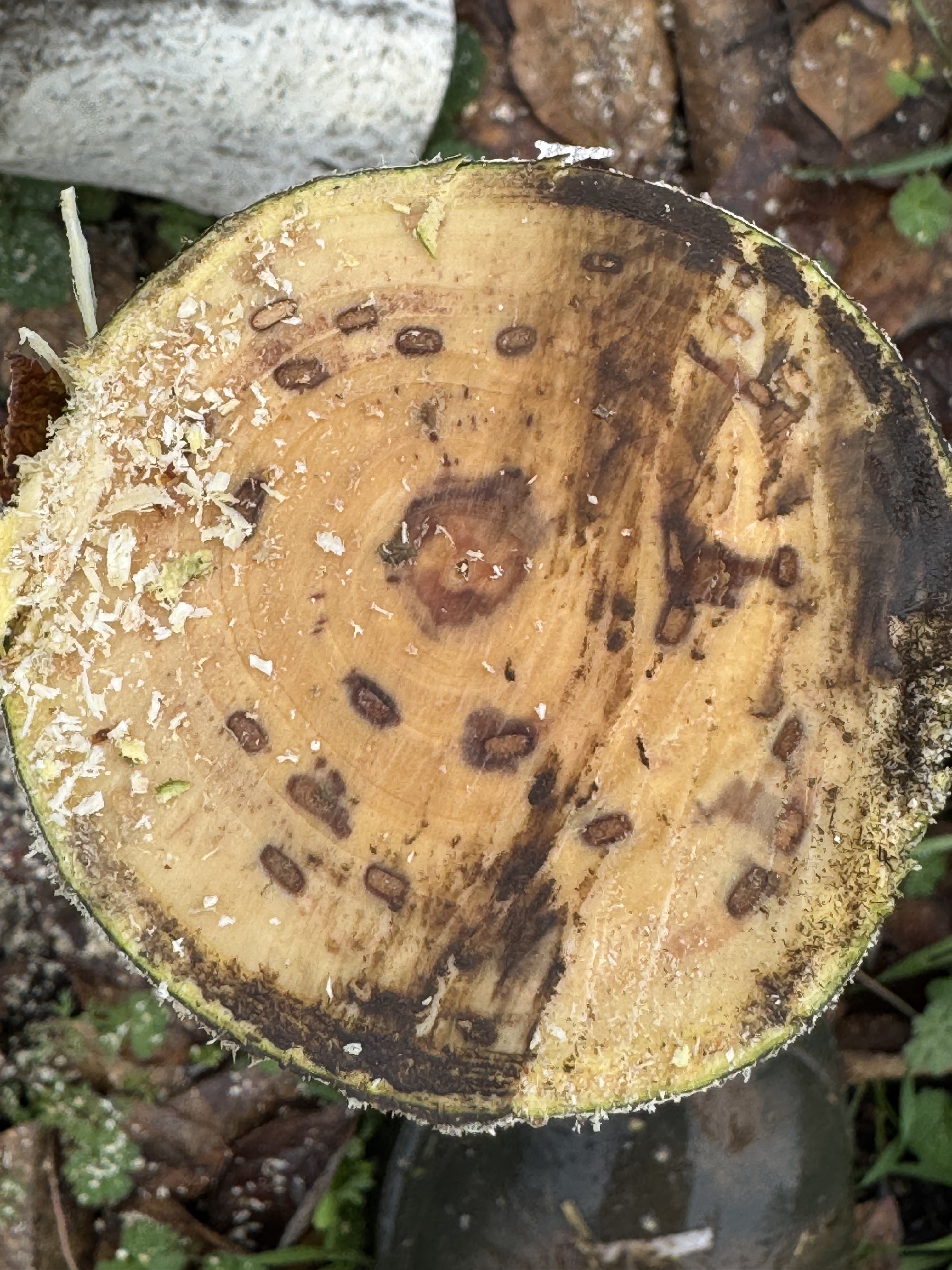
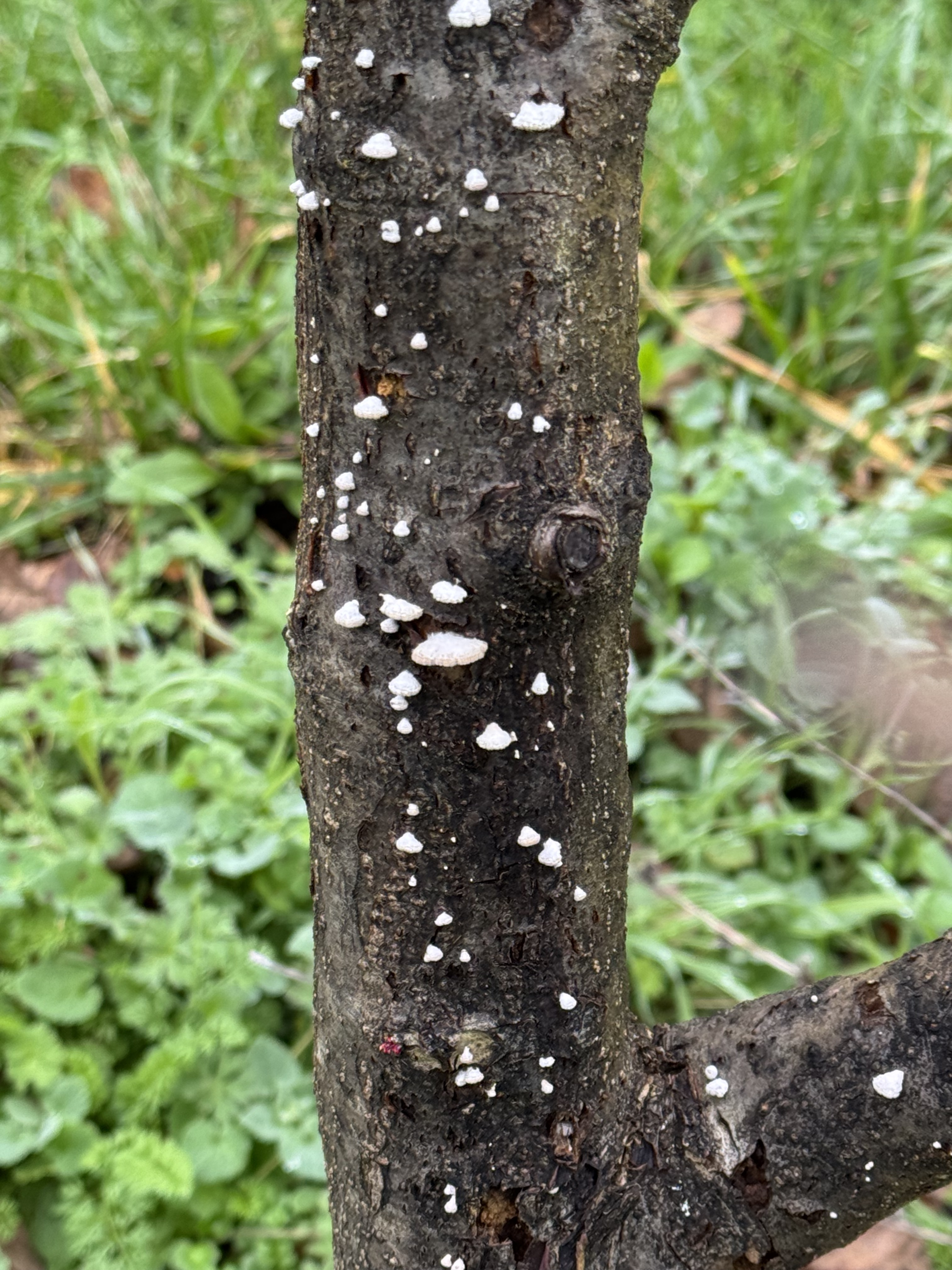
I got Enterprise for its Fireblight resistance in 2018, I think. Finally cut it down today because it’s had too much trouble with anthracnose. I would probably have tried to save the rootstock but it’s a leaning M7. I’ve been cutting out individual cankers for years now. Noticed shelf fungus growing and realized the anthracnose had gotten bad enough to rot the trunk.


I sawed it off quite a bit below all the damage I had hoped I cut out earlier this year. Just above where I cut it:

2 Likes

Bravo for pulling this data together. Ruby Rush (Enterprise x Goldrush) looks more and more promising for taste plus blight resistance. (I don’t grow it yet). Mystery remains blight’s middle name.

CHAT comes up with very contradictory evidence on the FB resistance of Honey Crisp. I got a lot of other information when asking CHAT for a list based on your criteria but I don’t want to pirate your topic with CHAT derived data. You might want to check it yourself, especially if you decide that this interpretation is legitimate.

From experience on both coasts, I also know that FB resistance doesn’t necessarily carry through from region to region at all. So Richard’s point seems spont on. Research done in one’s own region is likely to be more useful than a composite.

1. Honeycrisp is consistently rated as fire blight–susceptible

Across essentially every major North American evaluation system, Honeycrisp is placed in the S to HS (susceptible to highly susceptible) category.

Representative summaries (not cherry-picked):

  • Cornell / Khan Lab compiled ratings: Susceptible
  • Purdue Extension: Highly susceptible
  • Penn State Tree Fruit Production Guide: Susceptible
  • Midwest Regional Apple Trial summaries: Susceptible
  • Washington State evaluations: Susceptible

There is no credible body of data in which Honeycrisp trends toward resistance; variation only appears in how bad the susceptibility is, not whether it exists.


2. It also fails your “≥5 studies” requirement in the opposite direction

Ironically, Honeycrisp does appear in many studies — but they are negative confirmations, not resistant ones.

In other words:

  • Honeycrisp has been evaluated often
  • Those evaluations agree
  • They agree that it is not fire-blight resistant
2 Likes

I find it interesting that Europeans tend to breed for Scab and rot resistance. And flavor as a major factor. Things like Core Blimey, Park Farm Pippen and a few of the Hugh Ermen types tend to be flavor bombs that are easy growers.

While US types like Enterprise, Liberty or Freedom have good fireblight resistances; they likely will not win awards for high flavor. Typically leaning to tart(which I enjoy).

Is there a factor of blight resistance that impedes flavor?

1 Like

I love Liberty, which has a rose scent to it, and a slight rose flavor (if you close your eyes.) Not fond of Enterprise at all. It’s crisp and juicy, fairly uniform in shape, and my mom likes it. It’s not interesting to me. I have eaten Freedom from farm stands and feel it’s a lot like Enterprise. Pretty good, not my favorite.

it may be a time factor to some degree. theyve had longer to breed for their preferred resistance and then bring back flavor, whereas the u.s. is just a lot younger. Who knows

1 Like

Alan,

Your post does not appear to be accurate.

I tried to include screenshots of the sources below showing that they rate Honeycrisp as resistant but this forum will not let me upload images in my reply because I’m a relatively new user. So if you google the terms below you can find the sources and look for yourself.

Google:
“Clemson Fire Blight of Fruit Trees”
“Purdue BP-30-W”
“Purdue BP-132-W”
“Cornell Disease Susceptibility Ranking of Apples”

I tried using ChatGPT as well as other AI models to get this data originally. While I think AI is great for a lot of use cases, for specific things like this—where there isn’t a ton of data online and what exists is varied, as we’ve discussed—the results are not that great. It is this frustration that led me to compile these studies. I wanted to ensure the data was anchored to real research and wouldn’t be a hallucination from an AI model.

I include Cornell, Purdue, and Washington State University in my database. You can find this database by searching:

“Food Forest Nursery Fire blight Resistant Apple Varieties”

2 Likes