Trellising hardy kiwi?

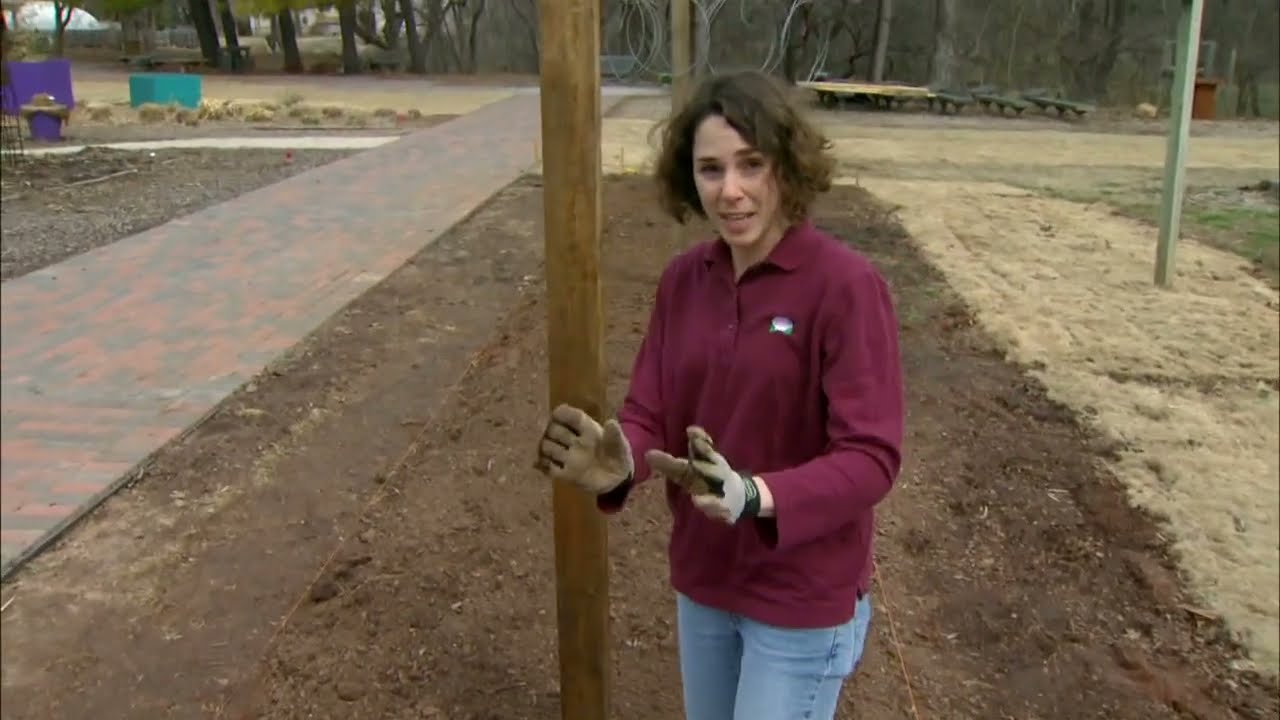
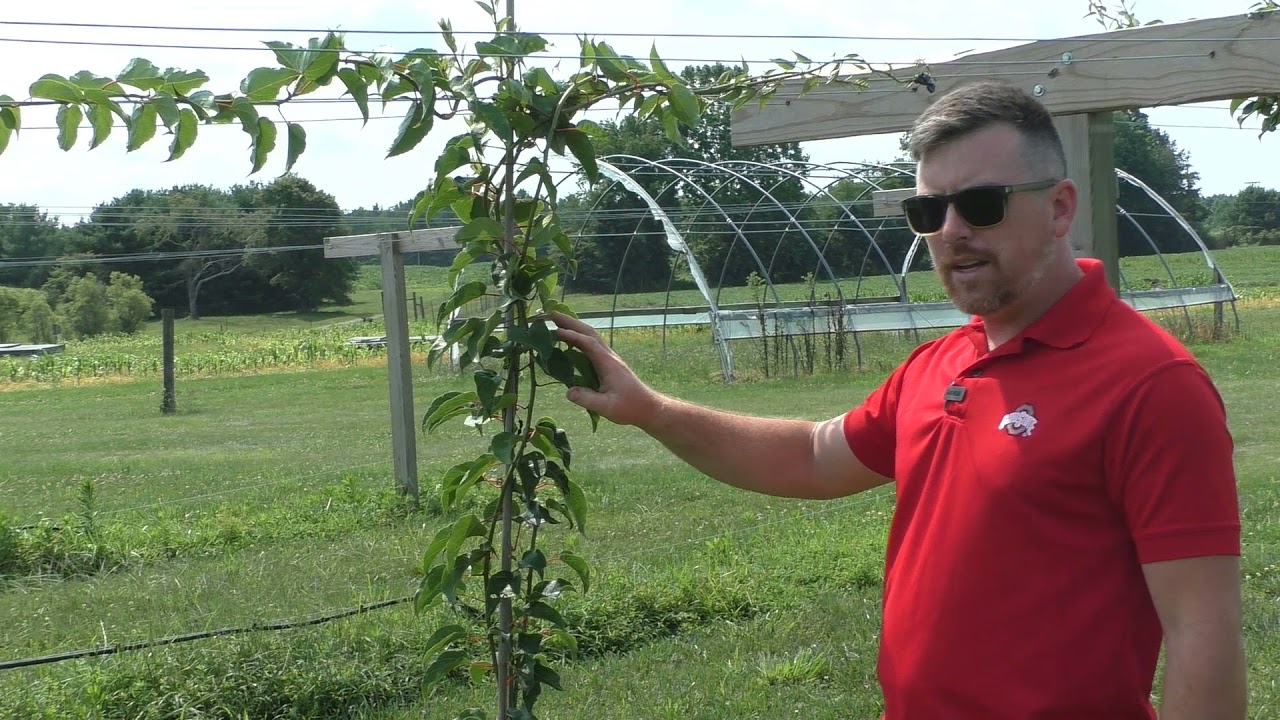
ran across this OSU video using multiple(2) shoots for the trunks. even bringing along a 3rd for insurance until its form is established. this seems to go against the common single trunk. any current growers have thoughts on this style?

a 3 layer trellis setup:

2 Likes

Eh, kiwiberry are weird. I wouldn’t intentionally plan on maintaining twin or tripple tunks, but sometimes you can end up with them.

Usually for a newly planted vine, it’ll first send up a small diameter trunk. Because of its small diameter, it will be all twisty and not straight, no matter how carefully you train it. Not something you’d want to keep long term as a trunk.

Eventually by mid summer it will re-sprout another growing point from lower down that will have much vigor and a fat diameter. This new growth will have so much more vigor than the original trunk, it will overtake it in a few weeks. At this point, you could cut out the original. Keeping them just results in a tangled mess. Sometimes, I don’t cut it off the original until later in the season, but pinch off its growing points, with the hope that retaining the extra photosynthetic area is helpful to the plant. Idk.

I’ve had some smaller diameter growth get winter killed, or die back after a hard frost. But it’s always been small diameter stuff. I’m not sure the benefit of keeping two or more trunks, when it makes more sense just to keep the largest, straightest one that you were able to establish in the season, since it’s the one that will have the most vigor the next spring anyway.

I think the only time I would keep multiple trunks is, when establishing new plants, I have a really weak growing vine. Say the 2nd and 3rd trunk it sends up are also small diameter and twisty. I have let all three stay over the winter, hoping the extra leaf area come spring helps build the root system stronger sooner, so it has the energy to then send up a shoot vigorous enough to actually form a quality trunk. But in this case, I’m not planning on any of small those trunks to ever be permanent.

6 Likes

Deer chew up anything they can reach from the back side of the fence. One vine got up into an oak tree where the deer couldn’t reach it, but neither could I.

1 Like

I saw a video of someone in Germany showing how the plants he got from nurseries are multiple trunks. Makes sense, I will grow mine as multistem.

2 Likes

Wanted to share what helped me overcome my fear and indecision about where to plant my kiwis, which had me keeping them in pots for years. I have a very small yard and can’t add shade of the sort a T-trellis would create anywhere.

Hardy kiwi are very much in in Europe at the moment. Since space is at a premium there in many countries, they are often grown espalier style, either in old vineyards on pre-existing structures, or along a fence. Until I searched YT and the web specifically for European content, I had so much anxiety about building a sturdy T trellis because the content that the algorithms fed me was US centric, where people simply have more space, larger yards, are more likely to live in a single family home, etc.
Tip: On Youtube, you can turn on closed captions, then, in settings have it auto-translate to your language.

Here are a few simple espalier examples:

Planting, shows off structures - he owns one of the foremost German A. Argua nurseries, his whole channel is about kiwis

Pruning and espalier training

Kiwi farm in Germany - this youtuber records in English and also shows off some of his own kiwis and where he planted them if you check his channel.

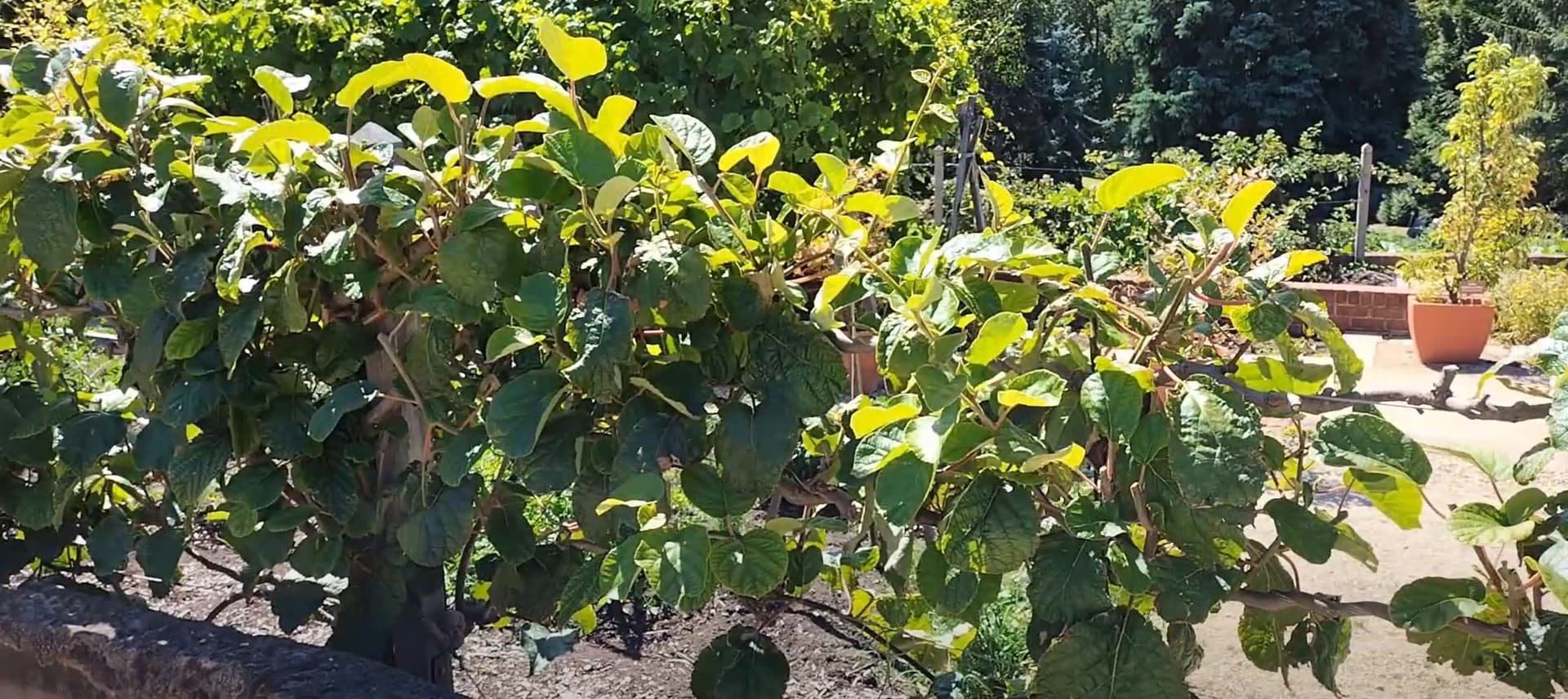
In this video, a picture of an espaliered old kiwi vine in a botanical garden is shown. Fuzzy kiwi, yes, but shows how simple and small an espalier one could aim for.

And lastly, this youtuber has one kiwi growing up entirely vertically, some are espaliered.

I recently planted my first 5 plants in ground after watching this content and am building a simple espalier support with metal fence posts and stainless wire. Will post pics once I have the wire. Sharing this because I read of others having anxiety over the need of a huge T Trellis :slight_smile:

I also highly recommend all the kiwi content of those Youtubers, and wish I coud get the Red Jumbo, Weiki and Improved Issai over here in the US.

8 Likes

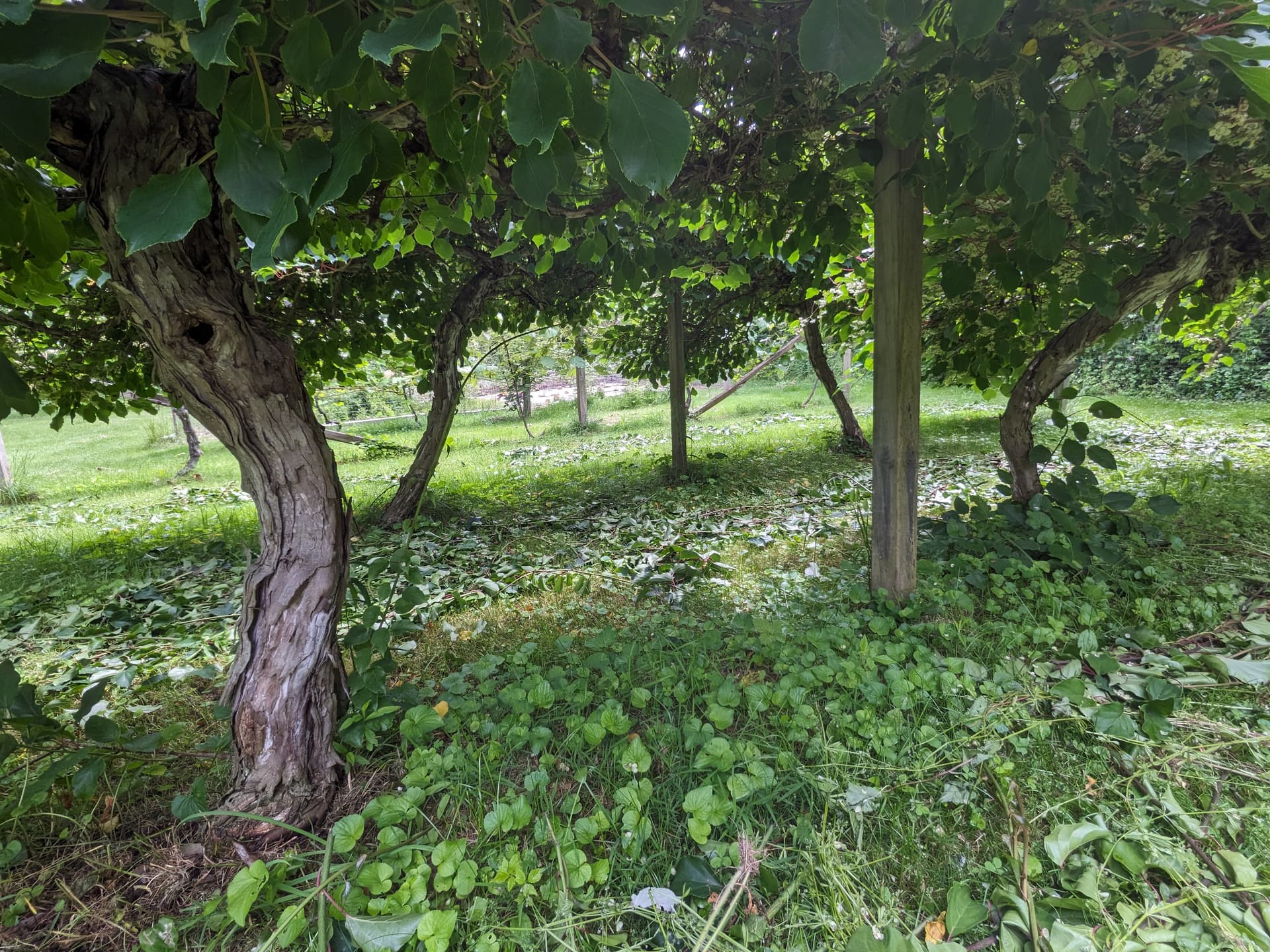
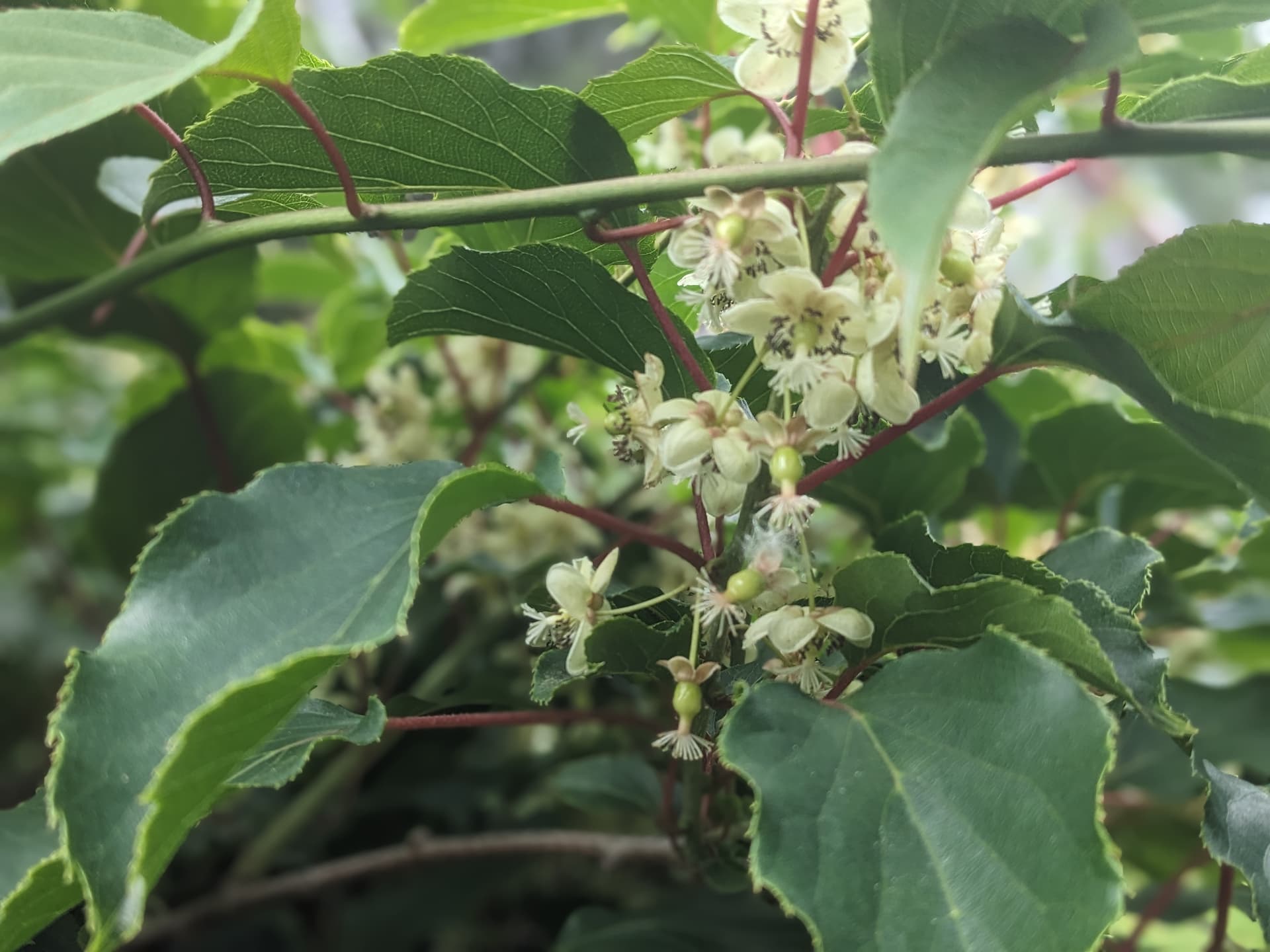
I thought about this thread over the weekend because the posts on my T-trellis need replacing. The vines and posts are roughly 25 years old. Nice flowers and nice smell for Father’s Day.


7 Likes

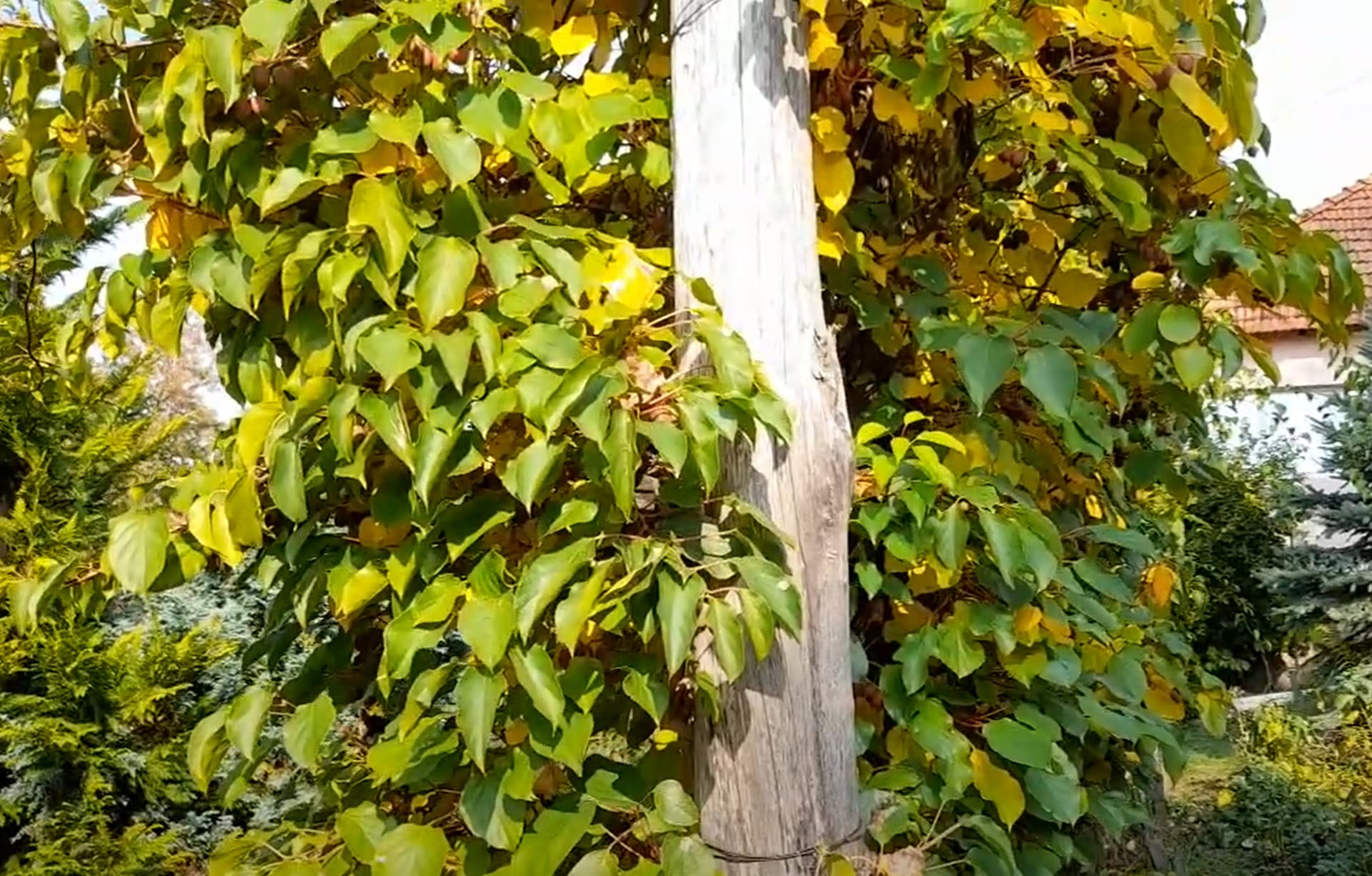
Fast forward 3 years and the male kiwi next to it has regrown and is now a monster, growing up a 10+ foot tall pole and growing outwards as much as I let it before I swing hedge trimmers at it.

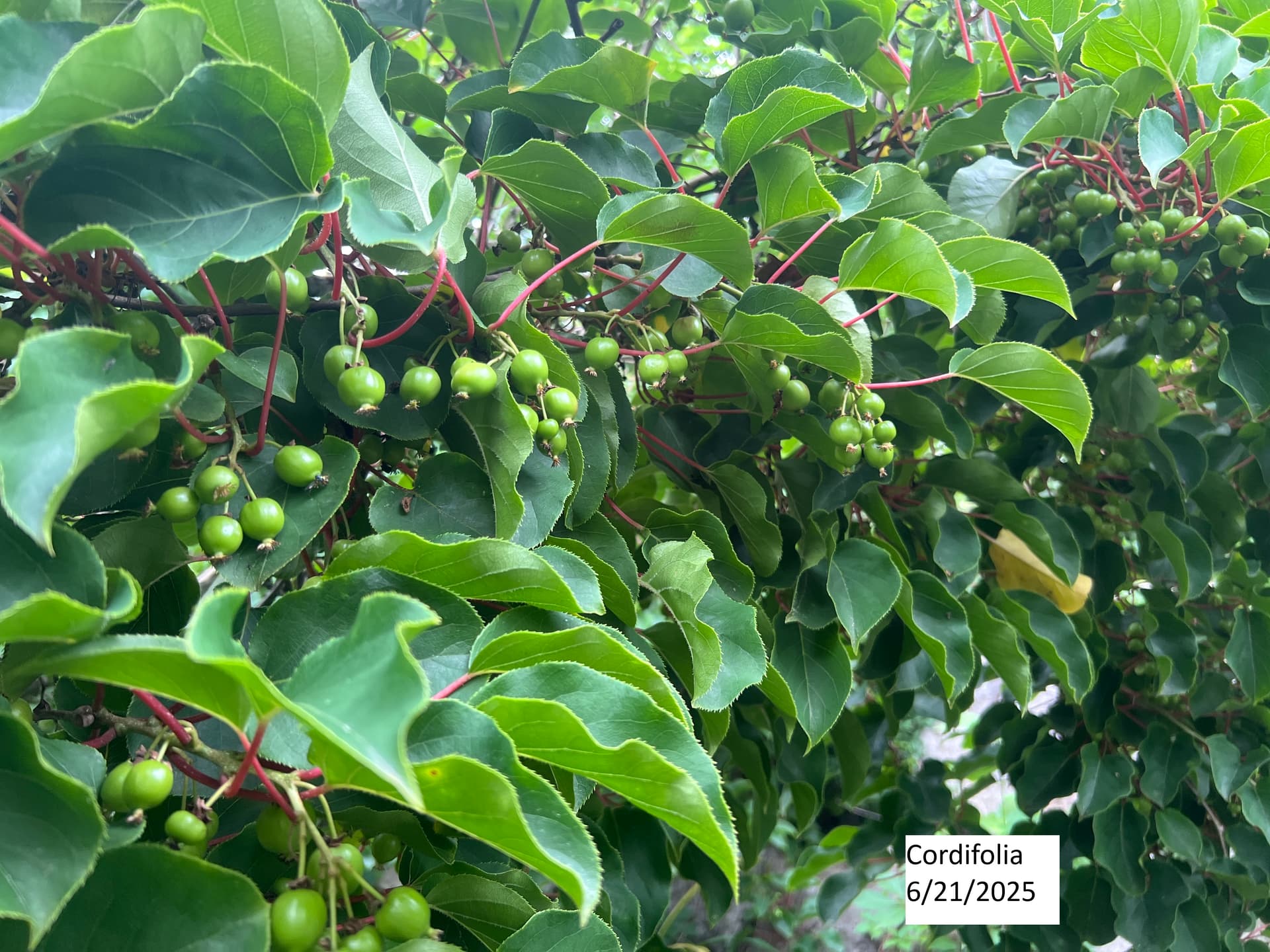
There is a very good fruit-set this year, all without me having to wave male flowers around by hand.

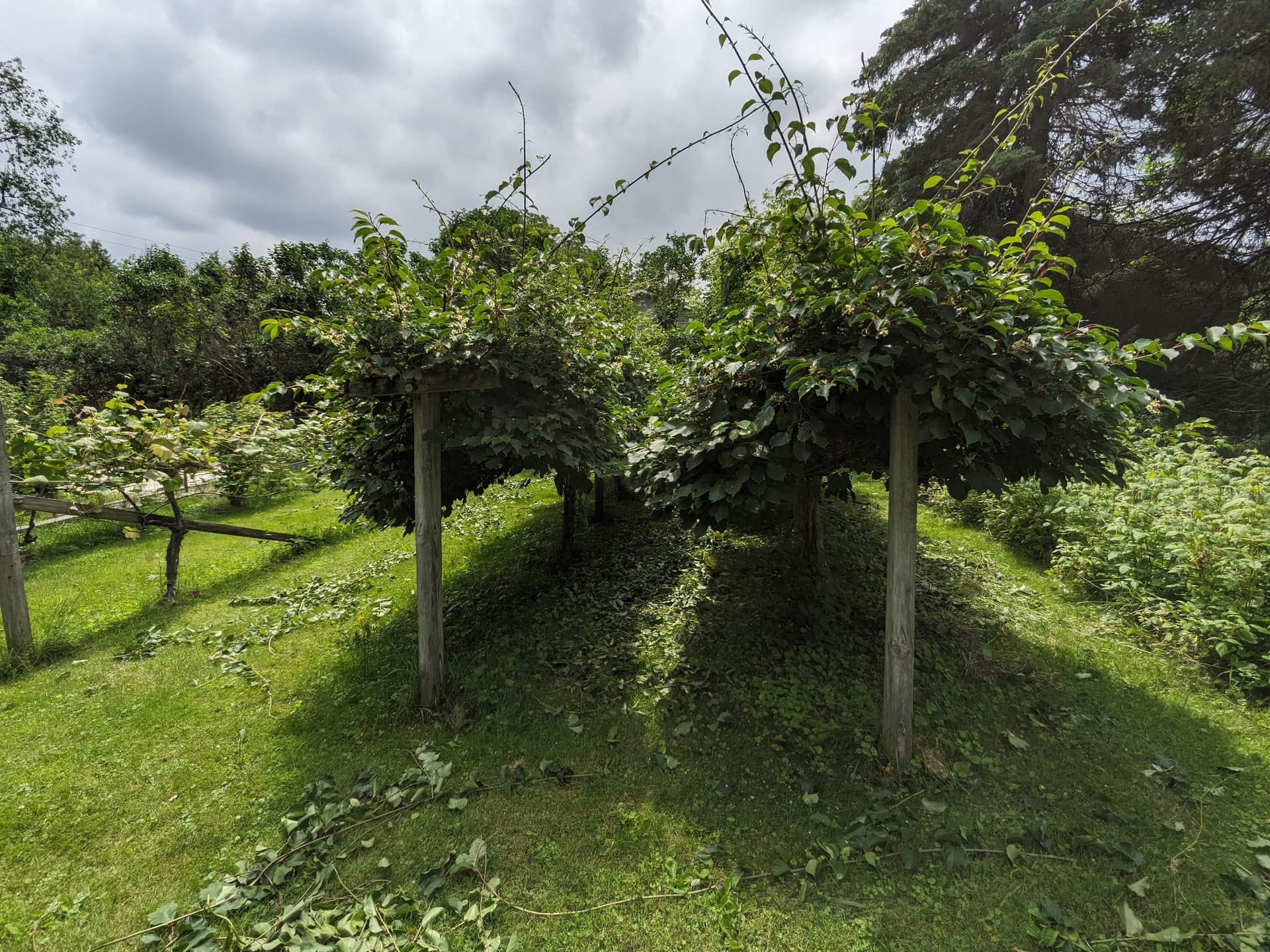
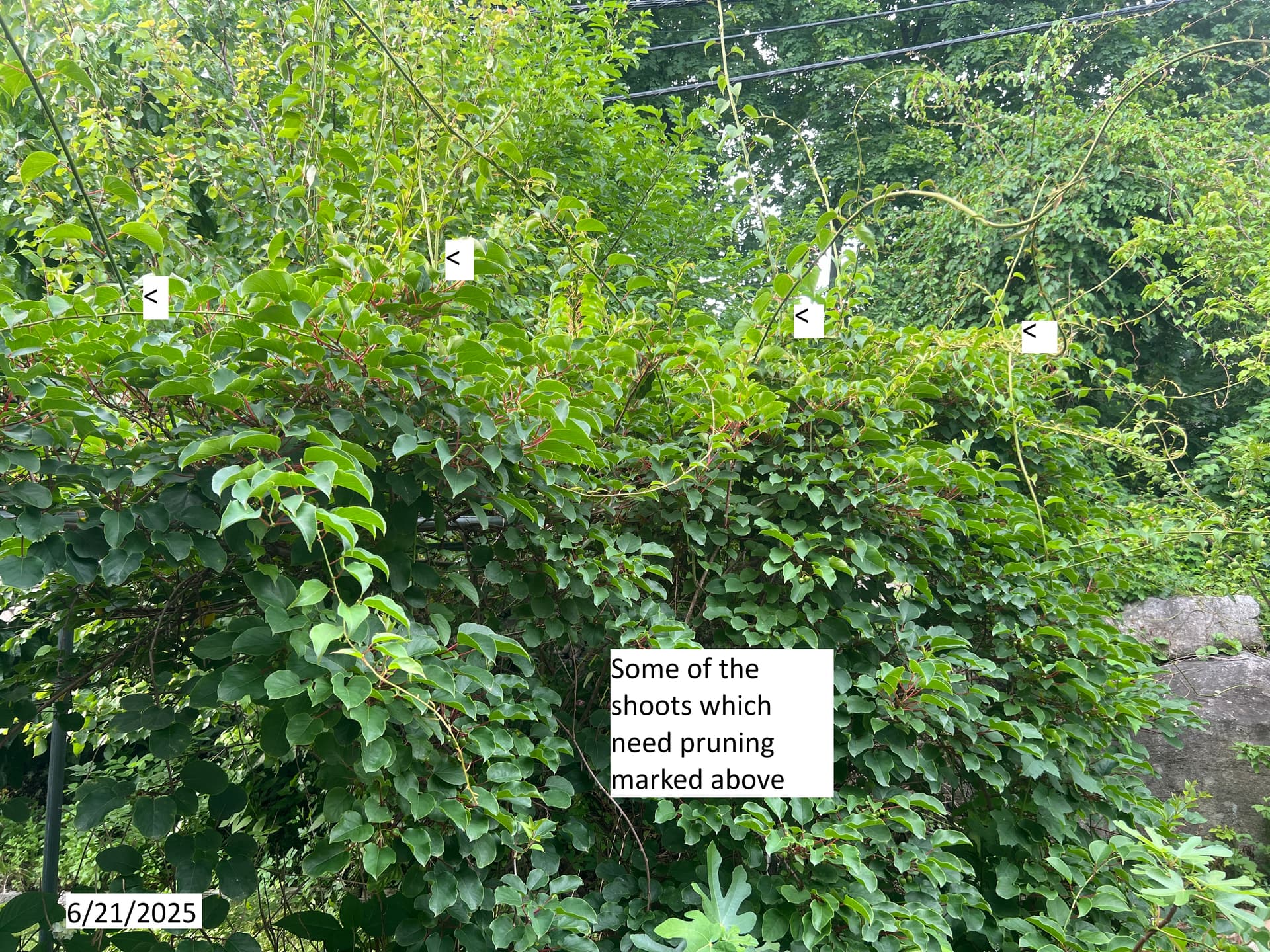
This is the one hardy kiwi which is actually reasonably manageable. It’s been about a month since I last pruned it and some of the suckers had grown 4-8’ tall. But mostly haven’t started winding around itself and making too much of a mess yet.

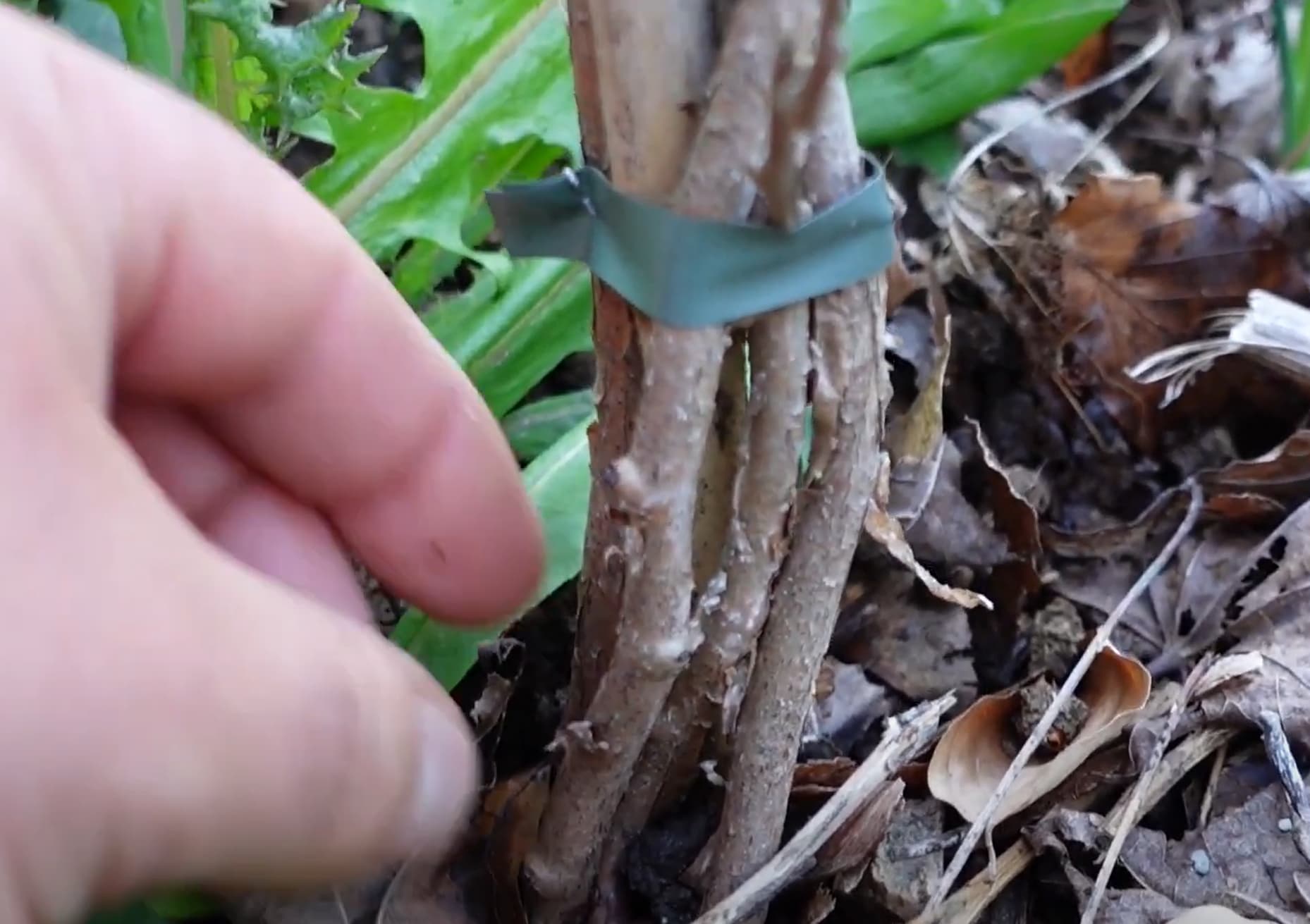
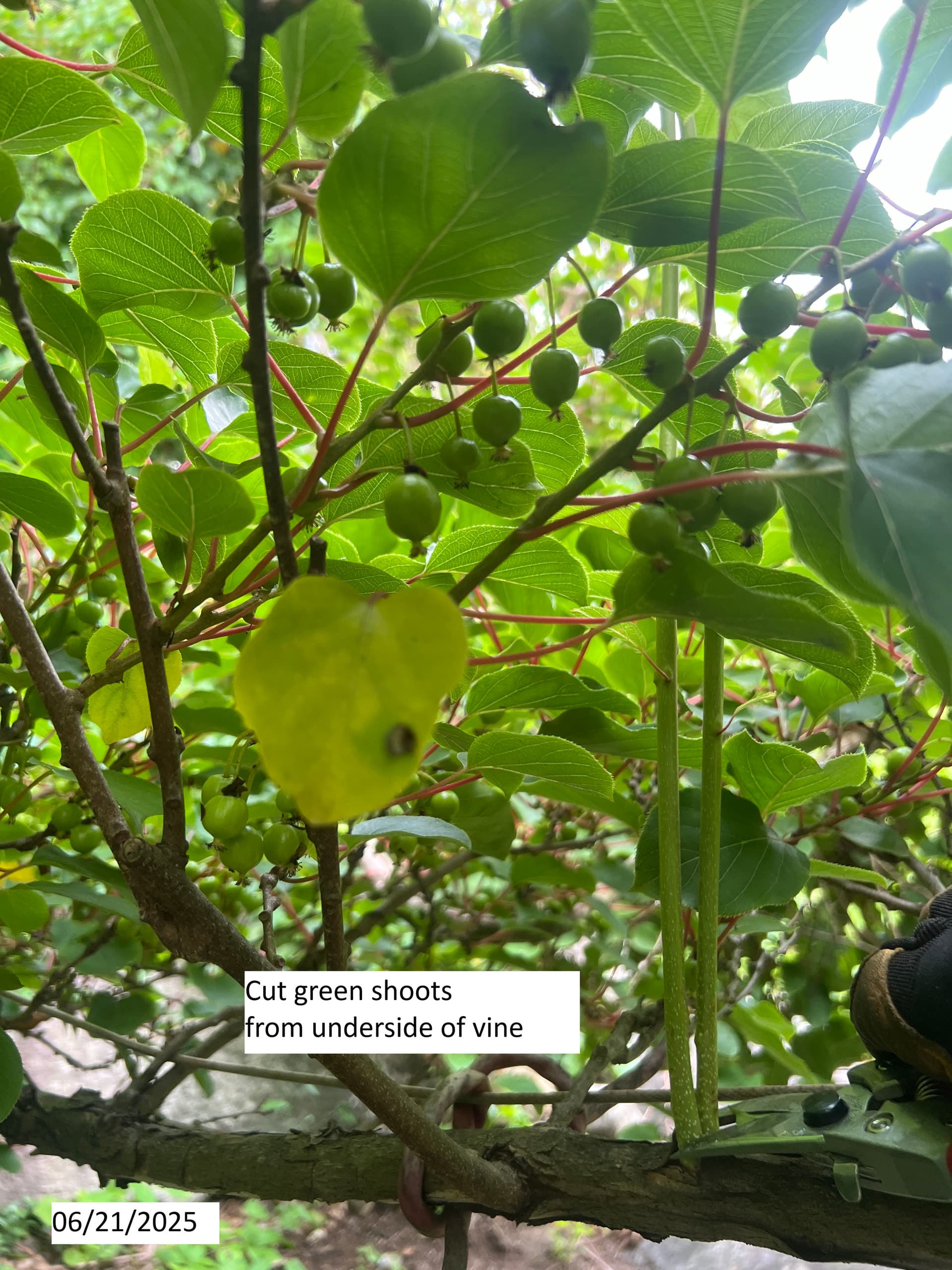
While some of the suckers are quite high, most of them start close to the trellis height of around 6’ or a bit higher. So I was able to get under the vine and clip off any green shoots, at their connection point with the vine, as shown in this pic. Then pull or push the cut part out of the kiwi. So, I didn’t even need a ladder and was able to prune the entire vine (~50+ feet of trellis) in about 20 minutes.

Meanwhile, I’ve been struggling with the big 20x10 trellis which has 4 vines on it (one at each corner). Last year I spent quite a while brutally hacking it back and found it needed even more this spring. I didn’t even look at it today- I’m sure it will be quite a mess. Though at least pruning it now let’s me see where the fruit is growing. Of course, I’ll feel bad when cutting it off, either by accident or because it really needs it…

That 20x10 is still much better than my original kiwi plantings, which have all been either somewhat removed (most fought back and are still growing) or cut back quite harshly for several years in a row.

But giving a kiwi 50+ feet of space seems to make the kiwi relatively manageable and productive. If my current efforts don’t work out, I may take the 20x10 structure and reduce it to 2 females and a truncated male (which also grows off the corner and out of the yard, so it doesn’t need much trellis space, since I don’t need to pick it…).

6 Likes

I recently found this video of a simple T trellis set up and wanted to get your opinion on dimensions- everywhere online people say 10ft is a good spacing but based on your recommendation I’ll likely do more (15 or 20 per vine, with 5 wires instead of 3).

If I have a single linear row of about 50ft for the two female kiwis, would you recommend the male go in the center, or a grafted vine, or something else?

Based on your advice, I’ll plant Cordifolia as a female along with hopefully a purple variety. Is there a male variety that is recommended (for low vigor maybe :thinking:)

I like that trellis, especially the wire vice, as I always found it a pain to try to maintain tension on wire systems. Twisting the support wires and securing the rebar also looks like a good idea. I used to just loop the wire through and tie it to large rocks, then try to nudge the boulder a bit further to get enough tension. Not a method I recommend.

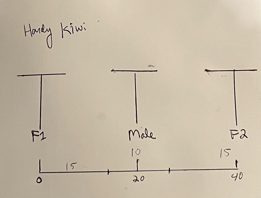
If they are saying 16-20 ft apart, I think the following is about as small as I’d want to go:
image

This gives each female vine 15 feet and the male in the middle 10 feet (and you can prune it harder if needed). To get a full 50 feet, you’d need another post, which isn’t a horrible idea, but you can probably get by without it if space and/or materials are limited.

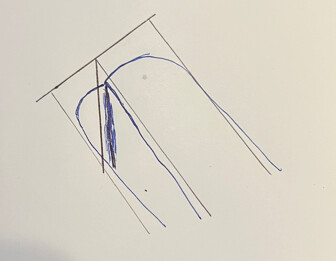
I feel like 3 would be plenty. Kiwi are pretty vigorous and the one thing you want to avoid with them is getting them tangled up on themselves. I’ve spent way way too much time trying to sort things out. Having 3 wires further apart seems a lot easier to maintain, rather than trying to fit 5 main cordon in there. This assumes that you are going to have the vine grow like this (trellis in black, vine in blue):
image

I shudder to think about trying to keep the side branches from jumping from one wire to another if they are that close together. I know that it would eventually be a sold mass. And once it is a solid mass, it gets hard to prune the water spouts that shoot up. And once that happens, it the whole fruiting area moves higher and higher. Eventually, it gets even harder to reach and less likely to get pruned, meanwhile any fruit is 8+ feet high. At that point, I spent a long time with hedge trimmers, swinging it wildly back and forth (quite a workout). Now that I just relived that nightmare, I could even be convinced to go with 2 wires instead of 3 :slight_smile: Semi-kidding…You can probably make it work with 3. Or maybe even 5 if you are way more attentive than me.

But, I guess it could also depend on how well kiwi grow in your area. While they are super vigorous for me, I’ve heard that they have trouble surviving from growers in places like Kansas. Keep in mind that 3 wires * 15 feet is still 45 feet of trellis space (plus a bit from the width of the T).

Male in the center makes sense to me- might as well make the pollinator central. You can also let it take more trellis space initially, then prune it back once it is more mature and consistently flowering.

The trellis in the video is 6’ tall, which is reasonable. I wouldn’t mind a bit higher, as I wouldn’t hit my head as much. At the same time, higher could make pruning difficult, as you need to regularly prune off any vertical growth. And by regularly, I mean whenever you walk by it. If you need to go get a ladder, that is enough of a barrier that it will make it less regular than it should be, so keeping it low enough to be within easy reach is important. I wouldn’t go any more than 6.5’ myself (speaking as someone who is ~6’ tall), as you may need to reach through the vine to get to the part you want to cut.

Where did you find a purple variety? I’ve been going back and forth on whether to transplant any hardy kiwi to the new yard. If I could find a purple variety, it would probably give me the push to move 1 cordifolia and 1 male. And maybe do a trellis like you showed above.

I know I’m not moving all of them. I’ve already told one of the guys at the farmers market that I’ve got some vines for him, if he wants to dig.

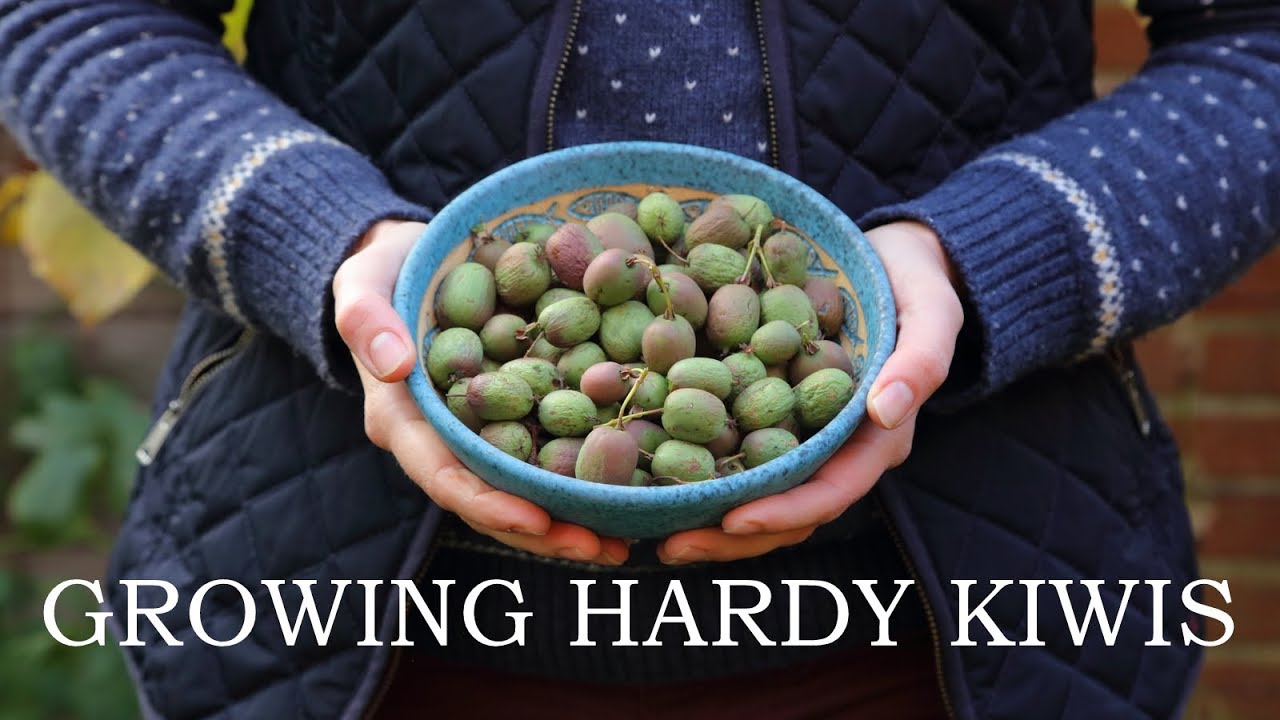
None that I know of. The only vine which was a bit lower in vigor was Issai, a female. Though, since it is partially self-fertile, maybe there are a few male flowers in there. I wouldn’t rely on that possibility though.
2 Likes

I don’t have a purple variety yet, but @LoveThoseTrees has a queue and has kindly added me to it. If you message him, he may be able to add you to his list. I’m also happy to provide you scions if mine comes and survives

If you’re needing to use up all 50 feet, I would consider more than 3 plants. Certainly a single plant will happily occupy 20 feet but it’ll take an extra year or two to get there. Closer spacing lets you get more fruit sooner, and have more that two varieties. Plus, if one were to die or get injured, it’s less impactful. Plants are basically free compared to the cost of the trellis, so why not put in 4 female and 1 male in the center? Or perhaps wiser, FMFMF and keep the males smaller, say 6 to 8 feet?

My plants are 10ft apart with 30 feet between posts. 30 feet between posts is about the max you can go.

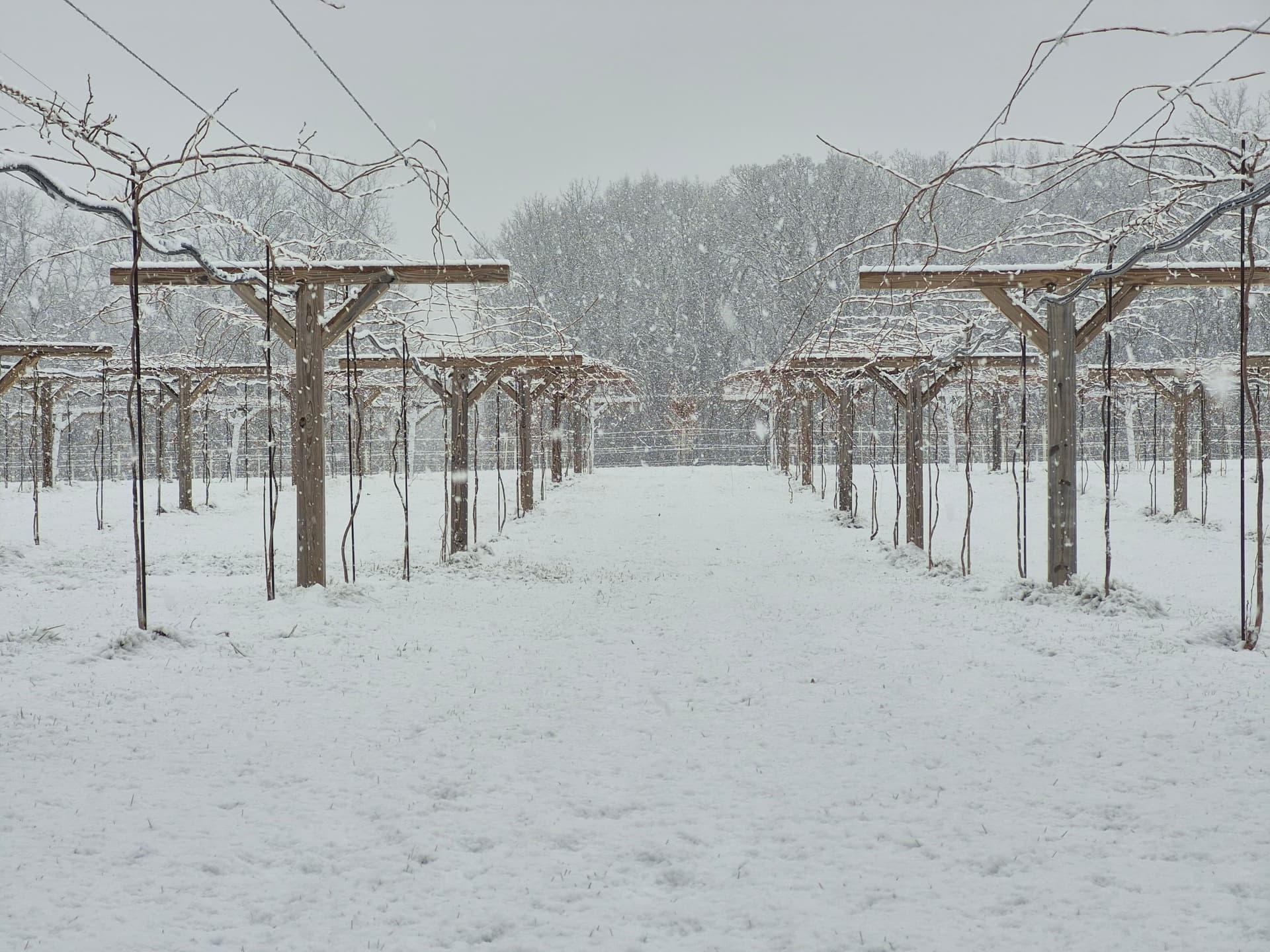
5 wires is good. Can go as narrow or wide as you want. My outer wires span 7 feet. Could easily go 8 feet. Some people go narrower…but I wouldn’t. If I build more trellis, I’ll position the center wire 3 to 6" lower than the other four. Better matches the angle the laterals come off the cordon.

Coincidentally, I took this photo 10 minutes before seeing this post. Beautiful snow today.

6 Likes

That is very impressive. You do a great job of keeping things in check.

Having more is always super tempting. And if starting over, I think I would even let myself get convinced, more as a safety policy, in case a vine just up and died. Though that is something which hasn’t happened to me with up to a dozen vines over a dozen years. In fact, they keep coming back when I try to get rid of them. :slight_smile:

But, I would approach it knowing that at some point I’d likely be cutting out or transplanting the extras. Seeing your tightly spaced and (I assume) very productive vines makes me think it can be done. But my experience in the last 10-15 years (I planted everything in the 2011-2013 range) makes me think it may be harder for casual growers than your pic makes it look.

That is a great pic. What variety are you growing? When I started, I could eat a large amount of hardy kiwi without issue. But now, I find that my mouth gets irritated after a few handfuls. I have the same issue with green kiwi from the store, but the red/yellow fuzzies seem much better. My kids have the issue, so there isn’t as much demand in the house for them as there used to be. Any suggestions on either other varieties, or cultivation methods which could make a difference? While very ripe fruit (wrinkled and a bit soft) doesn’t solve the issue, eating it less ripe than that point makes the gradual irritation almost immediate.

Thank you. They’re only 3 growing season old though, so they haven’t gotten to the crazy vigor and associated mega pruning part yet. It is going to be a very non-trivial amount of effort, as you are certainly aware. I’m sure your ~12 year old vines put on some serious growth!

I may eventually try removing every other vine for a 20ft spacing and see if it reduces pruning needs without impacting productivity. Regardless, starting with10ft spacing should boost production in earlier years.

I can definitely see casual growers struggling to keep up with the pruning needs. It’s somewhat complicated to learn and time consuming to implement. I still have much to learn about it.

It’s mostly Geneva 3 and Hardy Red, also a row of Anna, MSU, Ken’s Red.

Wow, sorry to hear about the kiwi allergies. I’ve read that perhaps 2-4% of people might be allergic. I haven’t been doing this long enough to know much about it, or if any cultivars are better. A quick AI query suggests that indeed the gold fuzzy kiwi are better. It also mentioned that heat (like cooking jam) basically gets rid of the allergen compounds. Have you tried that?

2 Likes

I guess it is a sort of allergy, but it isn’t a bad one like some people have with peanuts. Just an irritated mouth, which reduces my motivation to eat them. Nowhere near as bad as astringent persimmons though…

Yes, the Yellow/Red (which don’t actually have much red) fuzzy ones seem to be better. But, I do like the idea of not needing to peel the hardy ones. And I already have mature vines. Hence why I was thinking the purple ones might be better. At some point, I may try growing the red or yellow fuzzy ones. Especially if I can find a cultivar with large fruit size. If I have to peel, I don’t want to be peeling grapes :slight_smile:

2 Likes

I am out, but @speedengineer has some. If you contact him, he still has some left.

Kinghat, I’m worried that you are going to plant kiwis on a stockade fence; the weight would not be supported well by such a structure.

i ended up building a trellis for them:

1 Like

Phew! It would have ripped the fence to shreds!

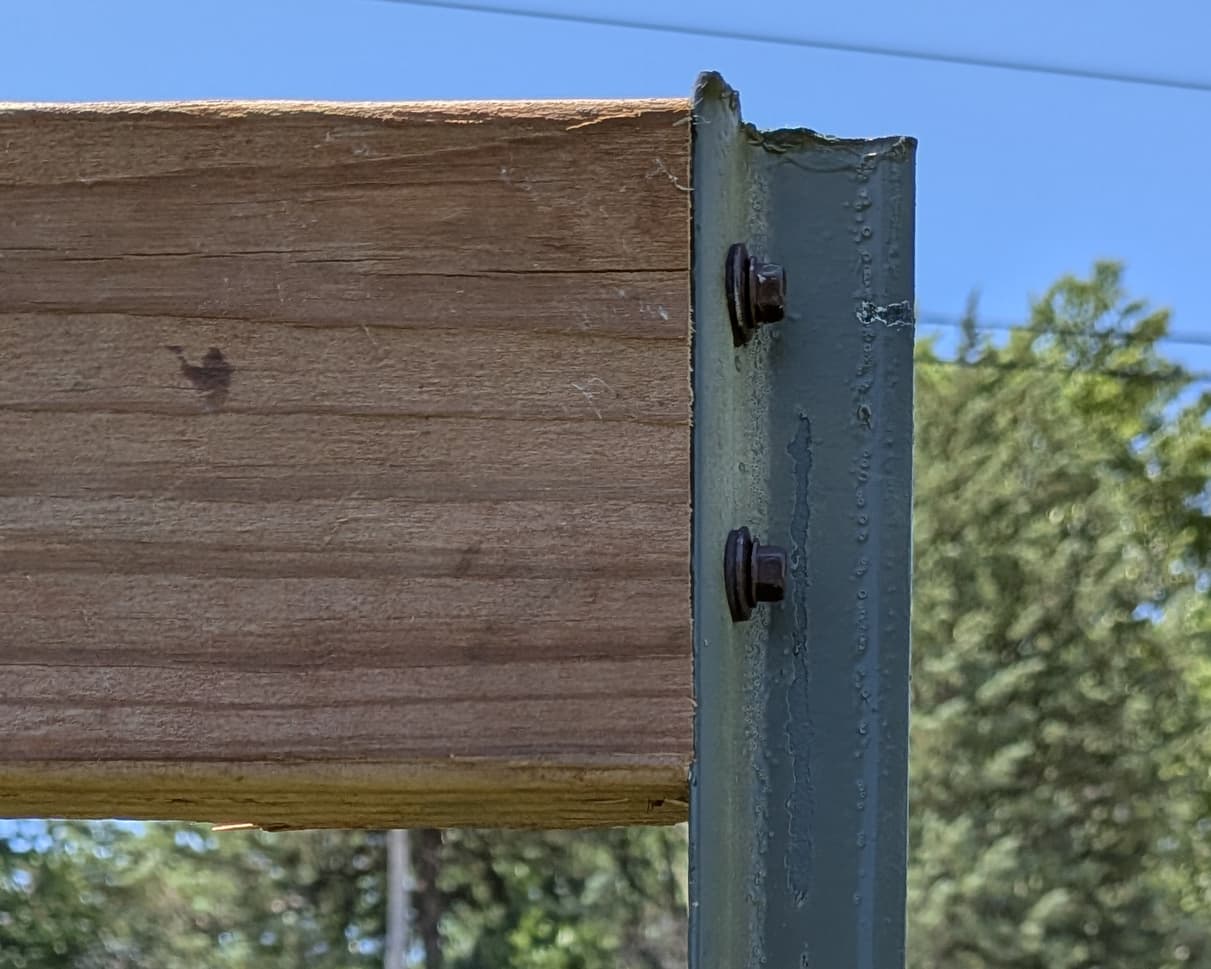
What hardware is holding the top wood to the T post at the ends?

some leftover tin roofing screws. they were longer, though. 2"-3" iirc. could use any stout screws.