Oh I was expecting a plate of some sort. I know next to nothing about wood working, but is that connection going with the grain strong enough not to split with kiwi weight?
1 Like
it should be more than strong enough. you could use a hanger that you bolt to the T post and then screw the 2x4 to the hanger if worried. lots of ways to do it. or use something other than wood like conduit or fencing top rail, etc.
2 Likes
I was considering using 4x4 wood posts instead of metal ones that you have there. I’m afraid the metal won’t be sturdy enough for the kiwis, but you also have them vertically and I was planning to have them on 3 wires horizontally, which would be more force I think
wood in the ground was out of the question for me. was either some form of T post(there are many) or galvanized metal(fencing/conduit). way easier to set and will last far longer and plenty strong enough. these are the forces on the structure:
the trellis is facing N → S and is inside of a privacy fence but im more worried about the plants acting like a sail and “wiggling” the tposts loose. they are 2’ in the ground so not a huge worry.
hopefully that didnt come off as snooty. i spent a lot of time going back and forth on how i was going to design it and what materials i was going to use. it was also my first attempt at building a trellis and growing kiwis. maybe it goes up in  if thats the case ill probably still go with metal but something stronger like fencing.
1 Like
Thats a beautiful photo! Most sites online say 20ft is the max, but I’ll feel comfortable around 20ft if you say 30 is possible!
You mentioned your wires span 7ft, Oklahoma suggested having 5 foot, but I’ll probably do 6 or up to 8 since I have the horizontal space and it’ll hopefully make it easier to prune.
Do you happen to know some of the dimensions of your trellis:
Are the posts 4x4 or 6x6? Is the cross bar a 2x4? And last are those diagonal supports about 2 feet?
I’m finishing a bill of materials now and am planning on using 4x4s with a 2x4 and some diagonal supports, but want to hear your 2cents as well
1 Like
No worries! I really appreciate the drawings and the photos as I was considering also “going light” and using T posts. And for the record I’ll probably do something similar for my brambles- wood rots and needs more maintenance than metal does. I did the same analysis for my grapes and I think I over engineered with 4x6s… Keep us updated! Success or failure we all get to learn!
1 Like
I’m told that as the vine trunks thicken, they help support some of the load. We’ll find out. There is more incentive to go with as wide a spacing as possible when you’re putting in a large planting. For a single row, no reason to push it, go the 20 or 25 foot.
They’ll push laterals 10ft long easy. Wider wires lets you support more, otherwise you’re pruning the excess off. Presumably less fruit. If I do this again, it’ll be 8 foot cross bars. Fewer posts per canopy area = less work and money to build, and less time spent pruning.
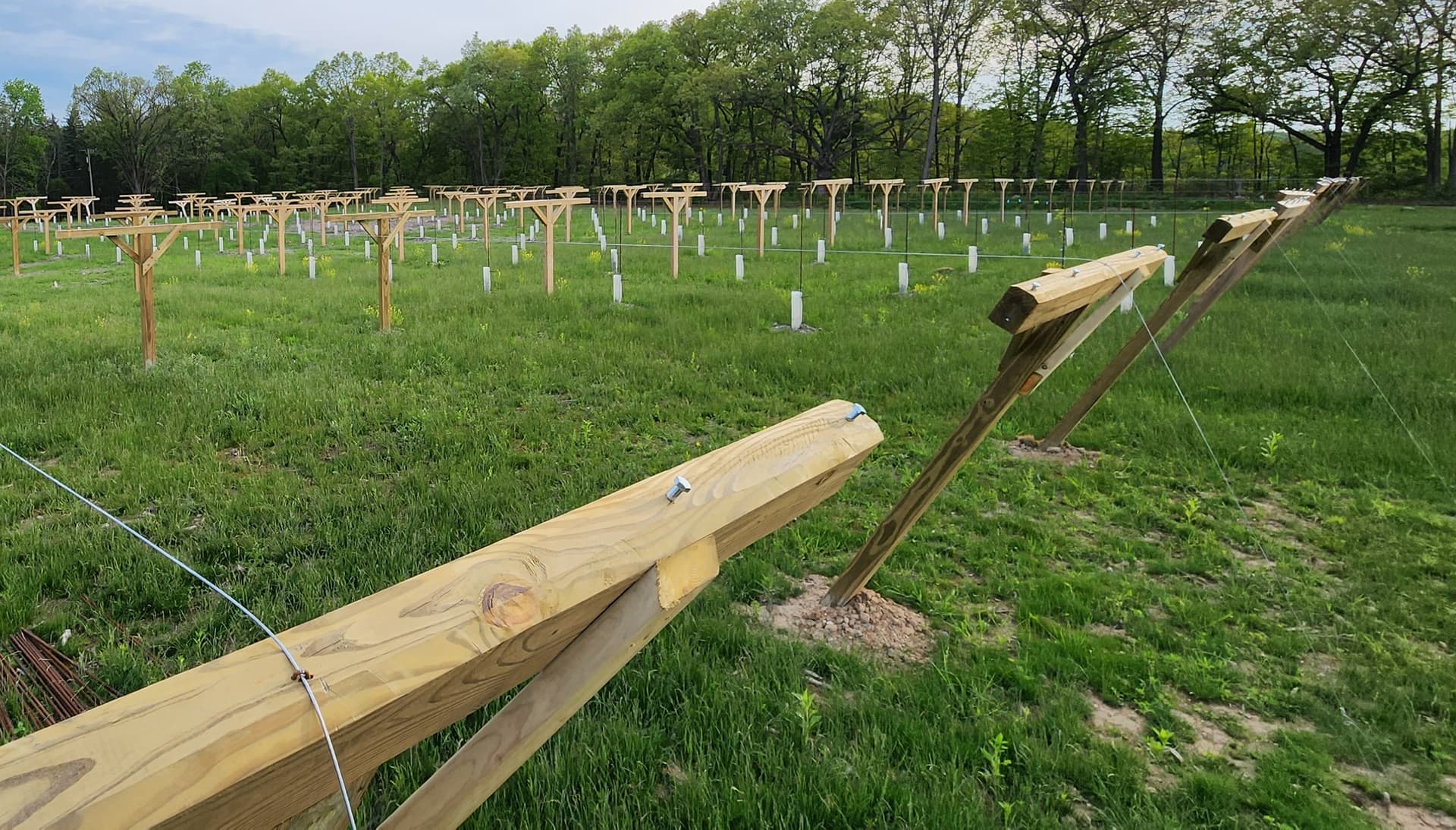
These are 4x6 treated posts with 4x4 crossbars (except end posts get a 4x6 crossbar). These trellises in the previous picture have the angle supports made of the same 4x4 material. The post, crossbar, and supports are all in the same plane. This used too many $$ timber screws. I have other trellises (like in photo the photo below) I made later where the supports are 2x4s screwed to the sides of the crossbar and post using decking screws. Much cheaper and faster to assemble.

End posts are angled 30 degrees back from vertical so the wires apply no net overturning force on the end post. Wires get tied off to a an upside down “U” shaped piece of rebar in some concrete, buried under ground. There’s plenty of other end post designs out there, but this was pretty easy and cheap and wastes minimal space. A bit of a pain digging the post holes at a 30 deg angle.
5 Likes
Thank you so much! Even your cable routes are interesting - I was planning on drilling holes in the wood and pull the wires through like they did in my video, but you seem to have used bolts and a wire holder/staple instead. Are bolts and wire holders better since they apply less wear to the wire, or is it easier to tension & replace this way?
Now I’m strongly considering using bolts and having the wires guided on top of the Ts instead of through them
There are so many ways to do it that all work. This is just what I settled on.
I used galvanized fencing staples to hold each wire to the crossbar of vertical posts. I did this because at my scale it would take forever to drill the holes and feed wire through. The staples work great and are cheap. I’ve also read its better to have the wire outside the wood for corrosion resistance.
For the end posts, all five wires bend over the crossbar. In the first trellis I ever made, I did pass the wire through drilled holes. A drilled hole is straight, so the wire tries to make a sharp 30 degree bend where it enters and exits the hole. This is makes it harder to tension (friction). Also it digs into the soft wood and looks ugly.
-Notice the chamfered corners on the end post crossbars, so the wire makes a smoother arc without digging into the wood
-Bolts are used, installed at a slight angle, for the 4 outer wires. Since the 5 wires all come together at the earth anchor, the 4 outer wires try to slide in towards the center, and I figured a bolt is more robust than a staple here.
3 Likes