An article suggesting ways to use apples -and they’re not all what you might expect:
9 Likes
get a good apple butter recipie. can be used as a jam or a side with pork or venison. warmed over a hot biscuits its phenominal. easy to make in a crock or instapot. dont even need to peel them. adjust sugar and spices for your type of apples. even with sour ,subpar apples it comes out great.
9 Likes
My plan is to use my excess apples for cider. In years where the juice is not potent enough for good cider, I will probably make it into apple brandy. I don’t know if Melrose is good for cider, but Cosmic Crisp and Porter’s Perfection are. I am planning to add Goldrush and Golden Russet for next season. I wanted to make sure that all of my fresh-eating apples were also good for either baking or cider.
3 Likes
i default to apple butter. it uses a lot, makes only a small amount, and is concentrated in flavor. has about a hundred ways to use it. lasts forever.
6 Likes
When I have a ton to process, I chop up and blend the apples for kind of a compromise apple sauce/butter. Sweeter, smoother, and richer than the former, but not as much a sugar bomb as the latter. A lot of nutrition is in the peel, but I don’t want to cook it long enough to dissolve it.
I also make and freeze some relatively low-ish carb apple breads and cakes, and can some more adventurous things in small batches. I also sneak apples into a lot of recipes, just like I sneak in zucchini.
I bought two LG kimchi refrigerators for the big drawer storage. After removing the lids the temperature in there is great for storing apples til spring for fresh eating.
4 Likes
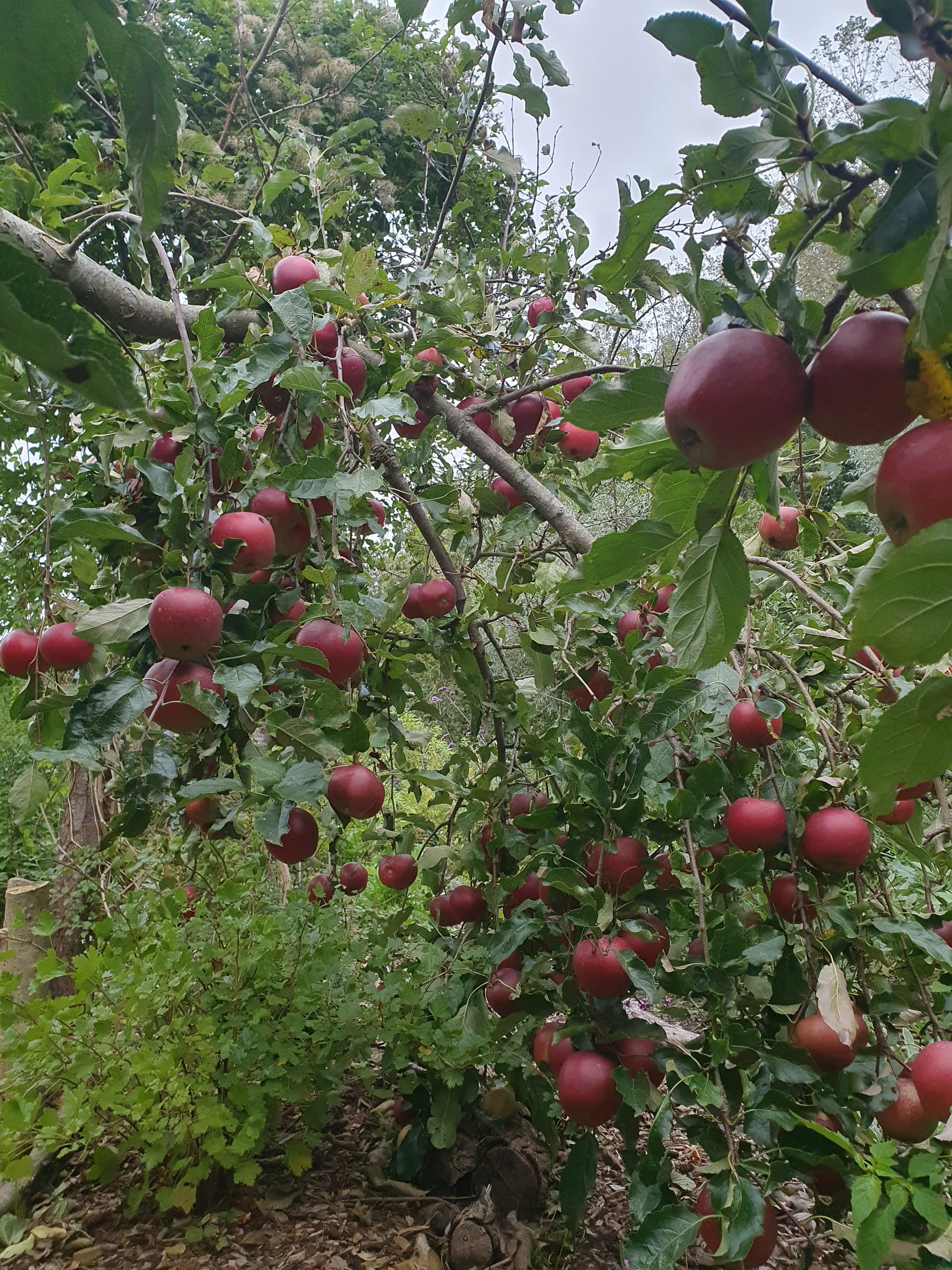
A few weeks ago our neighbours organised our first “street party”. It was just having drinks and snacks to meet the neighbours, most for the first time (social cohesion isn’t great here). Anyway, we brought a juicer and a box of apples from our trees, and people could fill their glasses straight from the tap. That was a hit!
(One of the apple trees:)
18 Likes
Very pretty apples. What variety are they?
2 Likes
just made 5 gal. of apple sauce from a mix of odysso, redfield, and big yellow dorothys delight. a local farm apple. also threw in a cup of black currants, maple syrup and some lemon juice with fall spices as well. its exceptionally good. just ate some warm for dessert with a scoop of vanilla ice cream.
6 Likes
When making apple sauce does leaving the peel on change the taste? I’ve been peeling, but it’s slow.
3 Likes
I leave the peels on when I make applesauce with Liberties. You get a lovely red tint and the taste is great - no sugar needed, cinnamon to taste. I use an immersion blender to disappear the peel (as I do when making plum jam, for that matter).
6 Likes
I use the Victorio strainer for apple sauce/butter. You halve and cook the apples with the peels on, then run them thru the strainer to remove skins and cores.
3 Likes
We’ve been drying a lot of apples and pears. The result is a pile of chewy, tasty little sticks. The flavor and sweetness are concentrated. A big bucket of apples is reduced to a baggie. And the baggie can be stored on a shelf.
2 Likes
Same here. We slice them into rounds, cut out the core, dip in pineapple juice and then into a dehydrator. I absolutely love them. Such a great snack!
3 Likes
It used to be that orchards sold two grades of apples, the second being “utility.” Only one commercial orchard around here still does. The others seem to pour all their excess apples into cider, either for their own or to sell to one of the many local cideries. So for them, the only excess apples are drops that they no longer put into cider.
3 Likes
I don’t really like applesauce notwithstanding I make a lot of it. I have a tall pressure cooker that doubles as a boiling-water cooker, which holds seven quart jars (1.75 gallons). One jar-processing cycle takes well over 45 minutes cold-to-cooldown, so that is the constraint on my daily output. More than about 3.5 gallons is infeasible for me. I think my folks used to put up a lot more in an afternoon, boiling the jars in a couple of what must have been immense enameled kettles on an outdoor kerosene stove. I lost track of their kettles long ago.
I use a spiral slicer to core the apples. This allows my paring knife easy access to the codling-moth tracks within. With the slicer I can leave the skin on or peel it off. Dark skinned apple varieties darken the sauce especially when cooked in aluminum. My short pressure-cooker is aluminum, and, for yield, I pressure-cook the raw apple slices at 5 pounds for 5 minutes (about a 30-minute cycle).
My stainless-steel pot is somewhat smaller, which is an additional constraint. I struggle to bring 1.25 gallons back to a simmer before jarring.
Before mashing the pomace, I let it drain in an aluminum colander for a minute or two. For taste, I add some of the juice to the sauce while bringing it back to a simmer. I reserve the remainder of the juice for jelly, which I process after the sauce in pints and cups (another 30-minute boiling-water cycle after cooking for about ten minutes). I use the same stainless-steel pan for cooking and the same short pot for processing the jelly under boiling-water.
Here is my Bible:
- Kuhn, Gerald D., et al., Ed. United States. USDA. National Institute of Food and Agriculture. Complete Guide to Home Canning. 2009. 2015. Bulletin No. 539. 21 Oct 2025 <https://www.healthycanning.com/wp-content/uploads/USDA-Complete-Guide-to-Home-Canning-2015-revision.pdf>.
3 Likes
I have been using all my excess apples over the years to make apple butter. Using a few different recipes to figure out which recipes we like better. They are all good, btw. Now that my trees are getting more mature they are producing a lot more apples. I am trying to give my excess apples to friends, family,and people around my area. The local food banks are getting very picky as to what produce they will receive. I have family members that told me " we really do not eat fruit", WHAT?
I would like to find an electric food press and strainer for all my apples to make apple butter with. I have a friend that makes applesauce with the apples I give them. She has her husband do the food mill by stirring and stirring the strainer part. I think if she has an electric food press and strainer her husband would be most appreciate.
I have seen some listed on ebay and amazon. Some negative reviews about a lot of plastic parts etc. I have way too many apples to buy one that breaks down. I have been doing the hand crank peeler/corer, spiral slicer for the last few years. Getting more and more apples is becoming very time consuming to do. I believe if I can find a good stainless steel food press and strainer that can do apples that will save me a lot of time in the future.
3 Likes
If only I knew! The tree was already there when I got the allotment. It hasn’t been pruned very well, with three scaffold branches that bend all the way down to the soil. It still produces a lot though, kind of easy-eating crunchy sweet apples. I prefer varieties with a bit more aroma and astringency, but I’ve never met anyone who didn’t like these red apples, and they don’t go mealy at all.
3 Likes
Apple butter definitely works to preserve a huge volume of apples. I’m from the region (Limburg) where apple butter originated, according to Wikipedia. There must have been independent inventions elsewhere, but it’s definitely part of our regional identity. Our apple butter (appelstroop) looks a bit different from what I see on US American websites. I see @SkillCult has a video where he shows some jars  . It is very dark, smooth, and thick, and it is made by boiling apples whole for quite a long time before pressing, and then boiling for a few more hours (in the cheaper versions with added sugar beet juice). Growing up we would eat it thinly spread on bread with cheese, with sliced meats, and with peanut butter (pindakaas). In secondary school I hardly had a day without a pindakaas-and-appelstroop sandwich! I guess a bit like PB&J, but Dutch peanut butter is always unsweetened. Plenty of sugar in the appelstroop anyway. Now I make my own!
Edit: unlike what the video suggests, the apples are actually boiled whole first, which extracts pectin and probably some more flavour as well, and then strained before boiling to a thick syrup.
3 Likes
Here they made several related products like that. Most of the accounts say it comes from the Pennsylvania Dutch here, which I think were actually German settlers. For apple butter they would make raw juice, then add a bunch of peeled and cored apples after it cooked down for a while. What would probably be equivalent to your applestroop there would be what is called cider jelly here. Boiling the apples first makes sense as I have not been able to get it to jell well and just end up with syrup. Apple syrup was made a lot too. It is just what it sounds like, boiled down juice of syrup consistency. There was also an apple cheese, which I think was probably basically like the apple butter, but cooked down to a sliceable slab that you can carry without a container, which makes sense given the times. I’ve had various people comment and contact me about similar products made elsewhere from different fruits. The commonalities being they are made with just fruit and or some flavorings, but no sugar or added pectin and they are shelf stable. A guy sent me some applestroop from holland. It is great. He said applestroop is often one of the first words kids learn there. But it is clearly made with out apple solids, while the apple butter they made here has a large proportion of apples in it.
9 Likes
Kitchenaid has an attachment for coring and peeling apples. They make a motor for the Victorio Strainer. Amazon.com: Kitchen Crop The Motor for Food Strainer and Grain Mill: Home & Kitchen
2 Likes