The only true oranges are mandarin. Keep in mind what we call oranges are mandarin x pomelo hybrids. That distinction is important since citrus readily hybridize. Good quality citrus like gold nugget, sugar bell, honey bell, cara cara etc. are hybrids and very much worth growing. I bring this up because hybrids are important to the citrus industry as they always have been. Sugar bell is showing some mild resistance to hlb. Creating more hybrids is very important. We may want hybrids for different reasons. In my case I would like to see more cold tolerance.
7 Likes
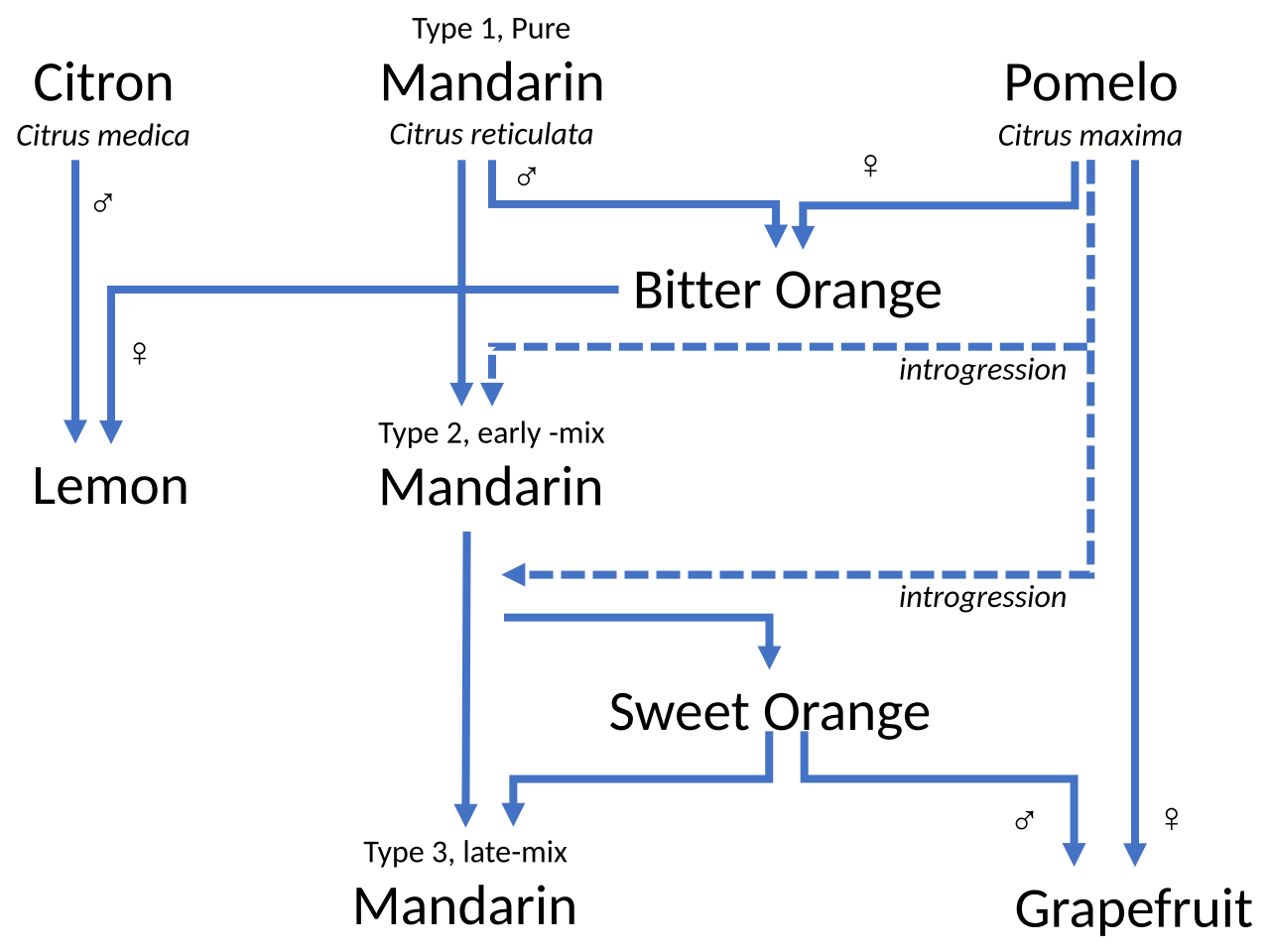
True oranges are the result of natural hybridization between mandarin (Citrus reticulata) and pomelo (Citrus maxima). There are two distinct types: sweet, and sour. Mandarins (aka Tangerines) are not oranges. However, several citrus fruit cultivars marketed today as “mandarin” or “tangerine” are actually human-bred interspecific citrus hybrids. As a side note: the term “tangerine” originated in Europe owing to the import of mandarins at the port of Tangers.
6 Likes
Whatever people call the hybrids which are typically called “sweet oranges , they used to look completely different in the past. In fact, oranges weren’t a naturally occurring fruit at all, and they wouldn’t exist as we know them without two other citrus relatives. Sweet oranges are the product of selective breeding over millennia, and they’re a hybrid resulting from the pomelo (citrus maxima) with the mandarin(citrus reticulata).
It turns out that exploring ancestral roots isn’t just for humans. Modern agrigenomics has allowed fruit and vegetable breeders to identify specific genes or traits, such as sweetness or seedlessness, and ensure that they are passed down to the next generation. By cross-breeding fruits, new fruit family trees emerge that play a unique role in agriculture and the ecosystem. As today’s cultivated sweet oranges can be traced to an original cross-pollination between the pomelo and the mandarin, the sweet orange and the pomelo have their own hybrid child, which is the grapefruit.”
Read More: Oranges Wouldn't Exist If It Wasn't For These Two Other Fruits
3 Likes
Funny that apart from Naval Oranges;Oranges have sort of left grocery store shelves here. Back in the day you could get a nice bag of Valencia’s or Hamlins for juicing rather affordably. No more though.
4 Likes
HLB was responsible for those oranges disappearing in Florida. HLB is sweeping through California now.
”According to the Florida Department of Agriculture and Consumer Services, Florida citrus land fell from 748,555 acres in 2004 to 274,705 acres in 2024. Groves are abandoned or converted to other uses. Orange production dropped to a fraction of its level in the early 2000s.
While most of the attention has focused on South and Central Florida, HLB has also made its way into North Florida, including parts of the Panhandle. Although commercial citrus operations are less common in this region, the disease has also been confirmed there, particularly in backyard and dooryard citrus trees along the Gulf Coast. Both the psyllid and signs of citrus greening have been documented in counties far beyond the traditional citrus heartland.
The widespread presence of citrus greening has reshaped Florida’s citrus landscape. Scientists continue to search for long-term solutions, including breeding disease-resistant trees and developing biological control methods for the psyllid.” Citrus greening disease in Florida: What to know » Emerging Pathogens Institute » University of Florida
4 Likes
Citrus greening and property development are a bad one, two punch in these parts.
There are new HLB tolerant true oranges releasing now. N14-10’ Hamlin is a new clone coming out. U of F has released Oll-4 that is a great juice orange that could replace Valencia.
Parson Brown and Donaldson still chug right along even with HLB. Though of course all of them will be carriers.
Citrus growing is still a strong new industry here and the farming public is engaged well with it.
8 Likes
In hindsight I wonder if HLB merely sped up the inevitable. Property development pretty much irreversibly changes land use and it will likely never slow down in FL so long as the US population continues to grow. Hurricanes and other disease issues were already convincing a lot of farmers to give in and sell to the developers, HLB hit the gas pedal, it didn’t touch the steering wheel which was already pointing the car in that direction.
My expectation is the deep South will be where the citrus industry eventually is centered in the US, at least for early and mid season varieties, especially since production out of California is basically all coming from a single county and, like pretty much everything in California since forever, is booming but it’s just a single misfortune away from getting wiped out. Stability and long term resilience just isn’t how they roll over there. And while these HLB resistance strategies should probably be able to keep the industry alive in Florida, I just don’t see how they will be price competitive outside of fresh fruit and later season varieties.
Just my hunch though.
6 Likes
Sweet oranges are a naturally occurring hybrid. They were discovered in nature, not bred by humans. They may not be a “species” but they are still naturally occuring. The modern day orange has been selected by humans, but so has the modern day citron, pummelo, mandarin and literally every other commonly eaten fruit.
Most citrus hybrids occured naturally in nature. They readily crossbreed and are all roughly from the same area. The big exception would be kumquat hybrids and many Australian citrus hybrids, which were more isolated than their relatives.
9 Likes
Canker was actually a bigger hit then HLB, but since it was a disease that hit its peak before social media and was mishandled by the government, it gets a lot less attention.
Unlike citrus greening (which farmers are allowed to have sick trees languish for infinity) canker came with a government program that required every tree within a certain radius to be removed. This made it significantly easier for growers to sell property, if you have to cut down and burn your whole grove anyways, might as well sell the land. It didn’t help that greening was right on its tail, which effects young and old plants significantly more then healthy middle aged plants, making it hard to establish new healthy groves.
We also went about 10 or so years where you basically weren’t allowed to own citrus at home. It wasn’t like an actual rule, but that program still applied to home owners, and if a tree was sick in a neighborhood, they would chop down all of the citrus. They also pretty much stopped selling citrus trees from the early 2000s (probably late 90s) through the early 2010s. I remember being surprised when Lowes started carrying citrus out of nowhere. It is still pretty difficult to get ahold of citrus (essentially, no matter where you buy from, the citrus comes from one of like 5-10 wholesalers, which are the only ones legally allowed to propagate citrus).
4 Likes
citrus family tree is confusing as hell. ive given up learning all of them.
4 Likes
This is false.
Both sweet and sour orange existed prior to human intervention. However, it is true that humans have further improved races of sweet orange.
There was no single cross fertilization event between two individuals, but rather a cross fertilization epoch between two populations. This is very clear from the genomic record.
Seedless orange began with a chance discovery of a sport branch on a tree in Riverside, CA. Clones of the branch were then propagated into additional mother trees to provide the genetic resource we have today. The same is true of a race of orange that bears in clusters, discovered in Redlands, CA.
Sour orange is an important rootstock for sweet orange in certain locations. Individual strains of it have been developed long ago worldwide.
1 Like
I don’t think I have ever seen that before. What cultivar/varieties have that? Are they oranges/tangors/tangelos? I may just not have been around large and productive enough citrus if it’s common.
2 Likes
Citrus canker has been around a very long time in Florida. When I was a teen grafting citrus trees it was known and an issue.
2 Likes
I guess it was the program itself that was going on in the late 90s early 2000s. The general public consensus is that the program did more harm then good, especially since its massive unpopularity made doing a similar program for greening nearly impossible.
Here is the link. Citrus Canker - UF/IFAS Statewide Citrus Research and Extension - University of Florida, Institute of Food and Agricultural Sciences - UF/IFAS
3 Likes
Thankfully we are voting to double the amount of farmland allowed to no longer be taxed for property value any more. It is designed to stop the wild development train taking away priceless arable land. Instead we farmers will just pay taxes on crops produced instead. Heck. Wish they had set it at a tripling of allowed land to 6000 acres.
6 Likes
Some of the confusion is how the authors of one article or another interpreted data. We know what we call an orange was a similar sweet orange grown in 314 BC by the Chinese.”The orange, also called sweet orange to distinguish it from the bitter orange (Citrus × aurantium), is the fruit of a tree in the family Rutaceae. Botanically, this is the hybrid Citrus × sinensis, between the pomelo (Citrus maxima) and the mandarin orange (Citrus reticulata). The chloroplast genome, and therefore the maternal line, is that of pomelo. Hybrids of the sweet orange form later types of mandarin and the grapefruit. The sweet orange has had its full genome sequenced.” if you believe many authors the sweet orange as we know it is a creation and not an accident Origin and de novo domestication of sweet orange | Nature Genetics . Looking for trustworthy data is challenging always with any research. You can analyze the data and make your own decision. In my case i read the material, they explicitly defined how it was created , what they claim makes sense. Does it make it true? It is hard to say if scientists are correct. I believe they likely are. Is there data that is better to the contrary? I have not read it, but I’m open to the possibility science is wrong.
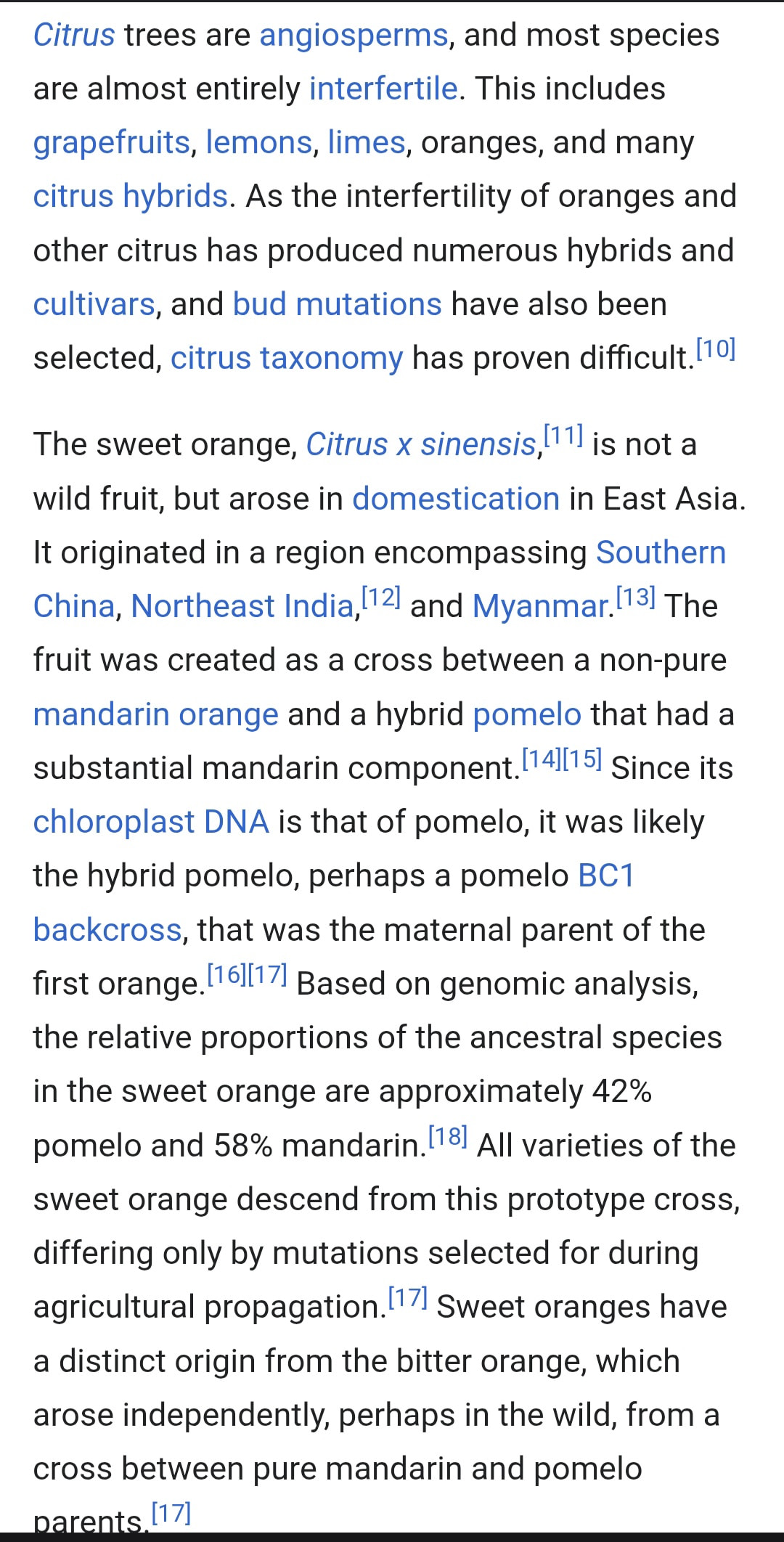
“The sweet orange, Citrus x sinensis,[11] is not a wild fruit, but arose in domestication in East Asia. It originated in a region encompassing Southern China, Northeast India,[12] and Myanmar.[13] The fruit was created as a cross between a non-pure mandarin orange and a hybrid pomelo that had a substantial mandarin component.[14][15] Since its chloroplast DNA is that of pomelo, it was likely the hybrid pomelo, perhaps a pomelo BC1 backcross, that was the maternal parent of the first orange.[16][17] Based on genomic analysis, the relative proportions of the ancestral species in the sweet orange are approximately 42% pomelo and 58% mandarin.[18] All varieties of the sweet orange descend from this prototype cross, differing only by mutations selected for during agricultural propagation.[17] Sweet oranges have a distinct origin from the bitter orange, which arose independently, perhaps in the wild, from a cross between pure mandarin and pomelo parents.[17]
Sweet oranges have in turn given rise to many further hybrids including the grapefruit, which arose from a sweet orange x pomelo backcross. Spontaneous and engineered backcrosses between the sweet orange and mandarin oranges or tangerines have produced the clementine and murcott. The ambersweet is a complex sweet orange x (Orlando tangelo x clementine) hybrid.[18][19] The citranges are a group of sweet orange x trifoliate orange (Citrus trifoliata) hybrids.[20] “
3 Likes
Interesting that the various fruit names for orange preceded using “orange” as a color description.
Apparently “persimmon” lost out.
I wonder what orange autumn foliage was called color-wise before the use of “orange”.
4 Likes
I believe it depends on culture but generally it was just called red or yellow in English. Funny enough theres research on different languages which have more or less words for colors and it actually effects what colors they view as different and can tell apart. So they probably didn’t even consider orange different from either red or yellow
3 Likes
@clarkinks
Historically, many US consumers (including yourself) have referred to any orange-colored Citrus as “oranges.” However, this has not been the case in some locales, nor in academic literature coming from Citrus research centers.
For reasons I’m not clear about you have created this thread, declaring that “true Oranges are Mandarins.” Perhaps it reflects an adjustment in your prior categorization of “oranges,” but I’m just speculating. Certainly though, the statement is incorrect.
In addition, you are proclaiming that sweet oranges are a human-bred strain of orange. While it is true that humans began cultivating the naturally-occuring orange about 6,000 B.C.E., the internal structural organization of sweet orange chromosomes indicate that they originated prior to intervention by humans. In view of this fact, I’ve no desire to further debate the subject of “oranges” in this thread.
Citrus ×sinensis is an outdated name with so called oranges, grapefruits and some cultivated mandarins (as well as other made up marketing names for various crosses between these) all belonging to the same hybrid group between C. maxima (pomelo) and C. reticulata (true non-hybrid mandarins).
Citrus ×aurantium is the currently accepted hybrid designation which encompasses them all. Yes, the percentage of madarin vs. pomelo varies between types, but hybrid botanical names are most correctly based on which founding species went into the mix with back crosses in either direction still belonging to the same group.
Given how freely Citrus species hybridize (aside from when they produce clonal seed), it’s kind of not super relevant how much of their historic intercrossing was intentional vs. accidental. The most probable answer is both factors have been in play for far too long to assign credit for modern hybrids to either explanation exclusively.
All this said, what I’m hearing from you @clarkinks is that you find Citrus fascinating and I think we’re all on the same page on that.
5 Likes