I have IKKJiro in year 3… that produced first fruits this year. They are absolutely delicious and the whole family loves them.
I have not seen my wife and kids get so excited about a new fruit … ever. They really like IKKJiro. Definately a big hit here.
My IKKJiro seems to be more of a mid season ripener. 2 fruit ripened late September… and the other 20 or so looks like they will ripen early to mid October.
I have a Cardinal (asian) persimmon in year 2 now. No fruit yet but per OGW it is supposed to ripen 2-3 weeks earlier than other asian persimmons. Hopefully this one covers the early season ripening for me.
I am wondering about adding one more tree like (IKKJ and Cardinal)… non-astringent asian, large fruit, seedless, delicious, hardy to 0F… that ripens late season (for me mid October- mid November.
Our first hard frost normally happens early to late November… in 2020 it happened on Dec 3.
Do any of you have a favorite asian persimmon (perhaps very similar to IKKJ/Cardinal) that ripens after IKKJ ?
That is what am looking for to extend the harvest time for my famalies new favorite fruit.
Be careful of winter hardiness. IKKJ is noted for being just that tiny bit more tolerant of winter than most other pure Asian persimmons. Fuyu should give you a 2 or 3 week offset in ripening.
I’m also a bit impressed with Saijo (astringent) which should ripen 2 or 3 weeks before IKKJ.
You’re swimming against the tide – one of the main goals of Japanese breeding has been earlier ripening. In any case, Japanese breeders do not make new introductions available for many years, so what’s discussed is often not available.
Taishu (1995) may be your best bet. In Japan it ripens in early November, a month after Soshu (2000), which is the earliest ripener there and may be a synonym for Cardinal.
Suruga (1959) ripens in Japan in mid-November, a week or two after Taishu. But it is probably not as tasty as Taishu.
Jiro and Fuyu are reportedly both late but I don’t have precise estimates. You could try plain Jiro, which will taste just like IKKJ but ripen a bit later. I have to think that plain Jiro is only slightly later than IKKJ.
I agree with the caution about cold hardiness. All of the PCNAs seem vulnerable at -5 F or below. IKKJ may be slightly more durable, perhaps due to a slightly delayed emergence from dormancy.
If you want to pursue it, Japanese breeders have published ripening data for their releases. I can try to find those papers. Unfortunately most of these names are not widely available. Suruga and Izu (1970) are exceptions; Izu is very early, mid-Oct in Japan. Taishu is becoming available. If Cardinal is Sushu (very early) then it may represent an end-around government restrictions.
My Jiro looks to be matching your IKKJ ripening prediction. Fuyu is still pretty much totally green and is only slightly later than Jiro. I’ve got five varieties of non-astringents with Fuyu being the latest. I don’t think there are many varieties ripening much later than Fuyu, but you don’t have to pick them all at the same time. Many people leave them on the tree and just pick them as they use them.
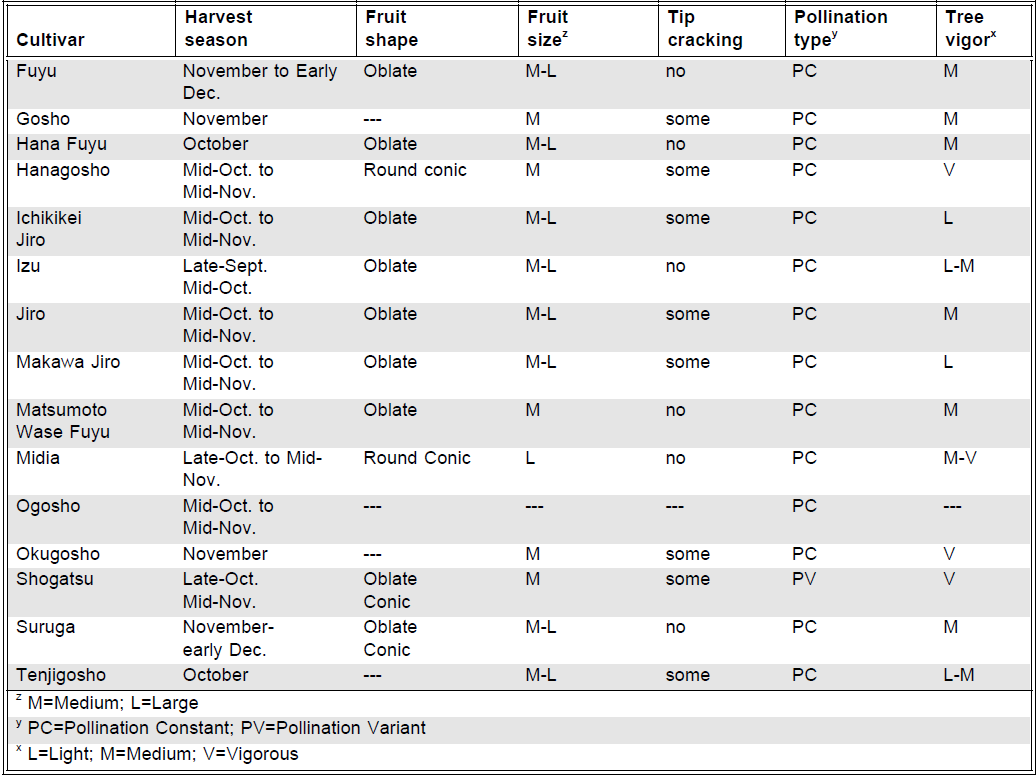
This has the order of a few varieties. Adjust ripening time for your zone. fruit_nut_chart_hg_2010.pdf (307.4 KB)
Also this.
From your pictures, it looks like you’re picking your IKKJ fruit when they’re soft and enjoy them that way. If you’re not planning on eating them firm, then there’s no need to limit yourself to non-astringents. I would recommend Tecumseh as a very late (Nov/Dec) and highly productive PCA variety. Giombo and Eureka are also late PCA persimmons and have larger fruit of high quality (though not as late and not as heavy bearing as Tecumseh).
One important part… that my wife insist on is seedless… like our IKKJiro is now… if that is possible.
I have 4 americans and 5 hybrids in my orchard.
3 asians… IKKJ, Cardinal, Saijo.
Saijo is in year 1 Cardinal year 2… they have not bloomed yet.
IKKJ has been completely seedless so far and my wife and kids love that.
Is it possible for one of my hybrids (kasandra, nakitas gift, journey, JT02, Dar Sofiyivky) to pollinate with (IKKJ, Cardinal, Saijo) and make them seeded ?
I hope not…
I have heard you all mention in the past that some normally female persimmons occasionally have male flowers… and that can cause your fruit to be seeded.
Is that likely to happen considering the hybrids and asians I have now ?
Are some of the later asians recommended so far better bets for seedless fruit in my asian crop ?
Where some may occasionally produce male flowers.
I know that some add males… to pollinate and hopefully produce fruit with better flavor. I can promise you all… that IKKJ grown here in southern TN has exceptional flavor. No improvements needed.
Some PCNAs (e.g., Taishu, Hanagosho) will produce male flowers. Even Fuyu sometimes produces a male flower. I don’t think the risk of seeded fruit is enough to worry about. Maybe you’ll get an occasional seed.
I also don’t think you have much to worry about from either Saijo or the hybrids.
On the other hand, a PVNA (e.g., Nishimura Wase) will routinely produce a ton of male flowers. If you don’t want seeds, avoid this type.
@ncdabbler … we have only had 2 fruits to ripen so far.
I am still trying to figure out exactly when best to pick them.
We tried one… when it had gone past orange to a reddish tint and was very very soft. Absolutely delicious.
We tried another when it was fully orange and showing just a bit of the red tint… it was soft but not extra soft like the first one. Again it was very very good. Not much different than the very soft one.
I have not tried one crunchy yet… that sort of goes against my instincts since i have eaten only american persimmons most of my life.
I will have to get the nerve up to try one crunchy soon.
Here in southern TN what I am seeing so far is that when they are part orange, part green they are still quite firm… would probably be crunchy.
Once fully orange… they are a bit soft already.
The tree is in year 3… perhaps that will change with more age.
Your right. Never heard of either American Midla or Asian Midia. Guess we both learned something today. @jrd51
From Google:
The ‘Midla’ persimmon is an early, named variety of American persimmon. In the mid-20th century, the United States Department of Agriculture (USDA) began a breeding program to develop improved, high-yielding American persimmon varieties. ‘Midla’ was a product of this research and was released as a new cultivar in the 1960s. The name ‘Midla’ is an acronym for the M ississippi I ntermediate D evelopment L and A griculture project, where the research was conducted.
In my experience growing PCA and PCNA kakis and kaki/american hybrids in an area where D. virginiana grows wild all around me is that all my hybrids are seeded, but my kakis are not. It’s only been since I’ve started growing Coffee Cake, Chocolate, and other PVNA types that produce a lot of male flowers that I’m starting to get seeds in my kaki fruit. I concur with @jrd51 that if you avoid those cultivars you won’t have any seeds in your kakis. My wife and kids all prefer the PCNAs like IKKJ at the crunchy yellow stage before they get soft. But if your family likes soft IKKJ, then I think they will like soft PCA types like Saijo even better. I agree with @Shuimitao - all my PCNA kakis ripen right around the same time. I added Suruga to extend my season, but it hasn’t fruited for me yet.
For me it’s like pears – you can eat one basically ripe but crunchy, or you can wait until it gets really ripe and soft. Crunchy is good but soft is better, sweeter and more flavorful. Nevertheless some people really prefer the crunchy texture.
Before they got slammed by cold in Feb '23, my IKKJ trees were yielding 80-120 fruits each. So you have a lot to look forward to. Personally, I agree that a fully ripe IKKJ is delicious. Partially dried even better.