Not even close to the way it was. I remember taking our first road trip down to key west during the Reagan administration. I was back there recently, making the same drive a few years ago, and the difference is radical. They managed to ruin a gorgeous place just like everywhere else. Florida is a shell of what it once was. Every place is.
At least people like you still exist, advocating for a greater balance between human needs, expectations and reality. Keep sharing the imagery like you did in your previous message. That’s probably the only time I’ve been inclined to visit Florida since I was a wee lad.
A part of my family is now in Ireland, having moved there from Coconut Grove (Miami). I had anticipated them missing the balmy climes, but that wasn’t the case at all. My aunt and her kin just can’t get enough of the grey, wet, misty island.
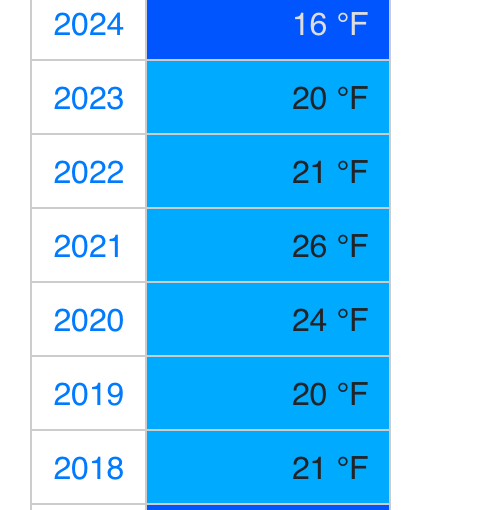
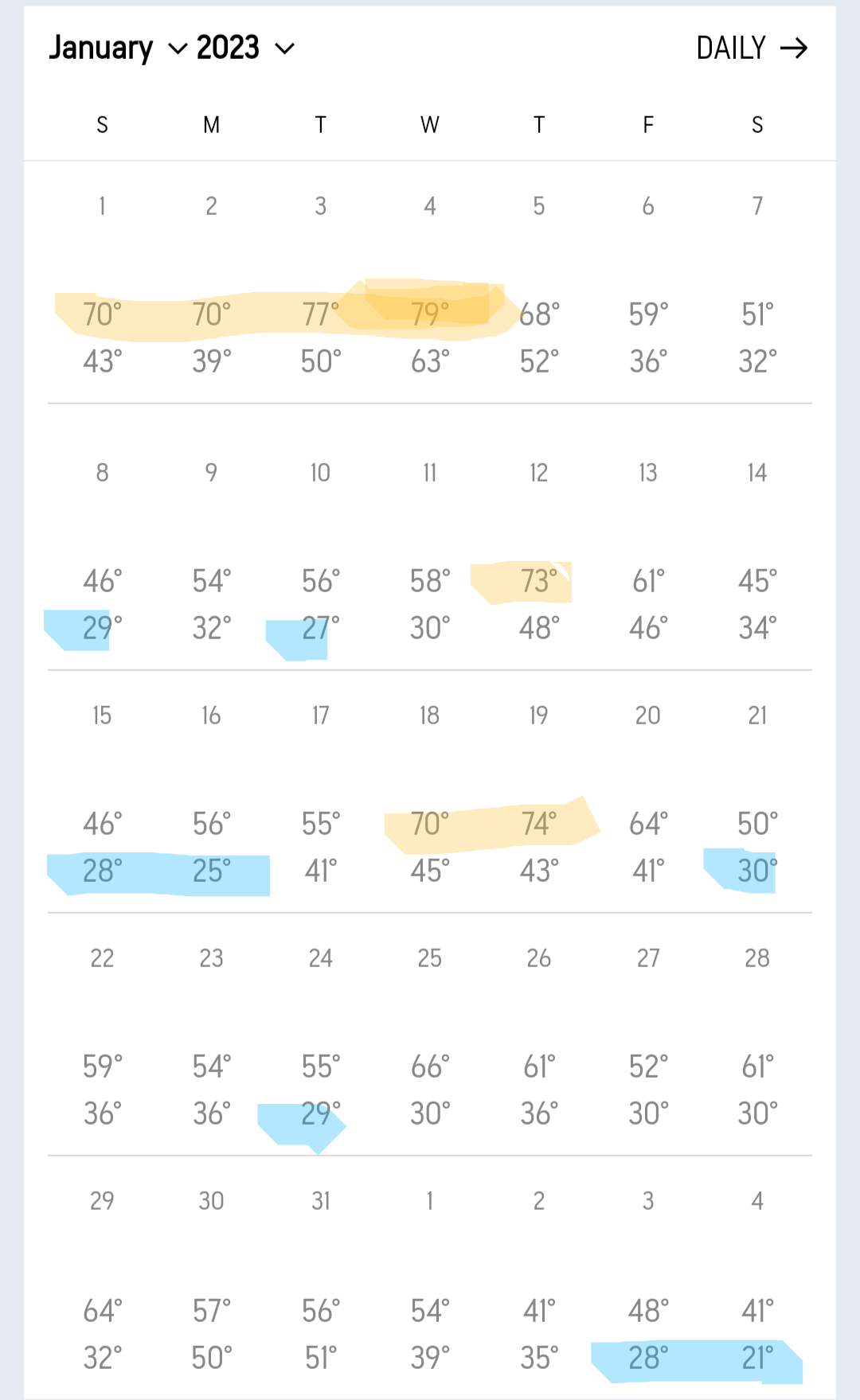
I have a Dunstan and some Satsumass too. I suppose the theory I presented in my previous message is correct. They all put on lots of growth in September and October. I mean LOTS! But then the cold, grey drizzle starts around Halloween, and when the first proper freeze rolls in around Thanksgiving they seem entirely unbothered. Even during last year’s deep freeze (for us) they had no issues. It was between 16 and 23 for a total of nearly 60 hours straight. At that point the typical subtropical air mass drifted back into the region and we climbed above freezing for the rest of the winter. We usually get one or two deep freezes each winter and the rest are superficial. Last January, none of our citrus trees had anything more than superficial damage, not even the Meyer lemons. I leave many out in the middle of the property to potentially get damaged, but we’ve been in a long warming trend for the last half decade. I’m sure our luck will change eventually. Our all time low on the hill here is -2 back in the 1950’s, so it’s probably inevitable we’ll see a night or two like that again. That most recent in the 1950’s was the freeze that destroyed the citrus industry in the region. Never recovered. They planted grapes instead, amongst the skeletons of the citrus trees, and made a fortune.
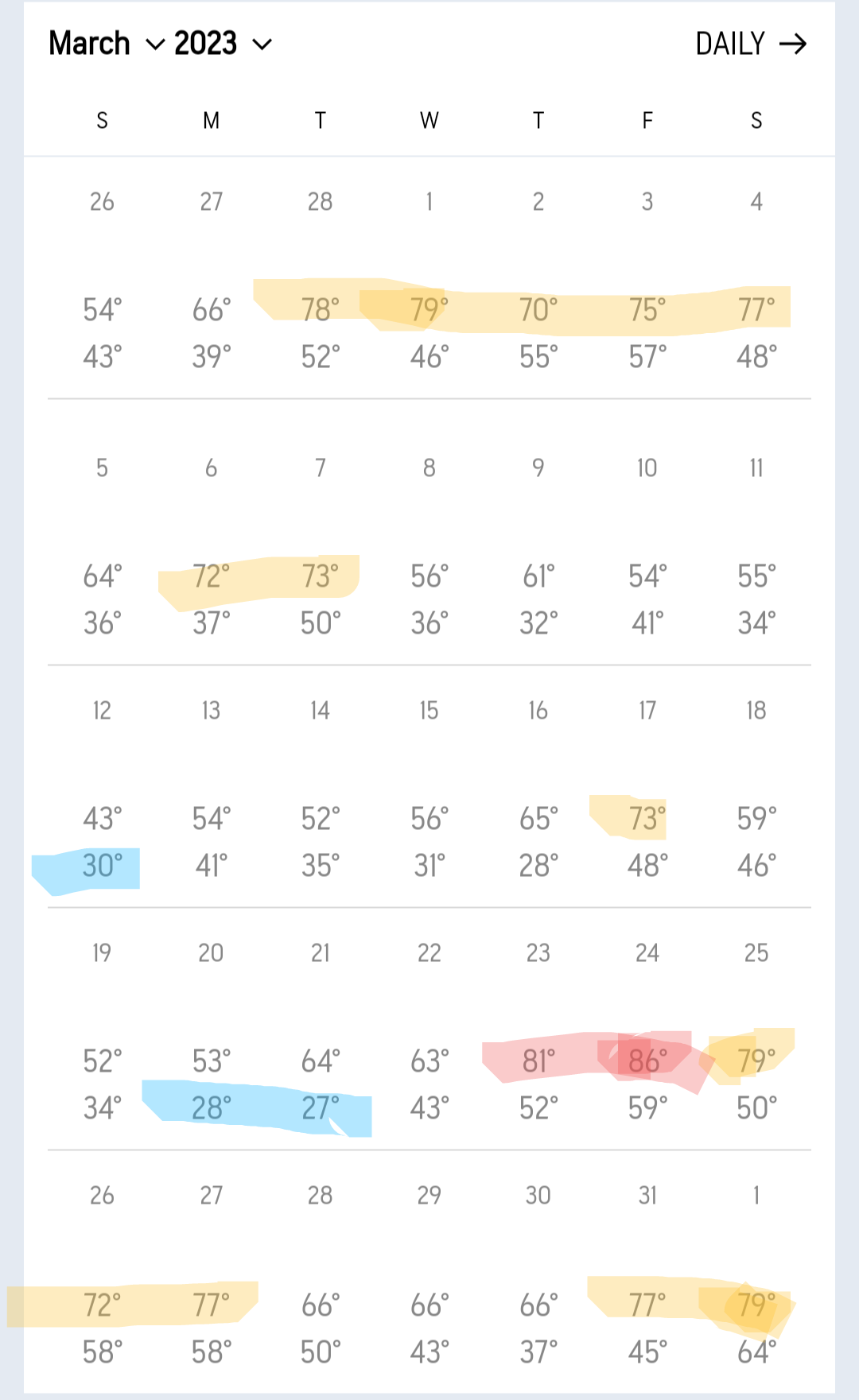
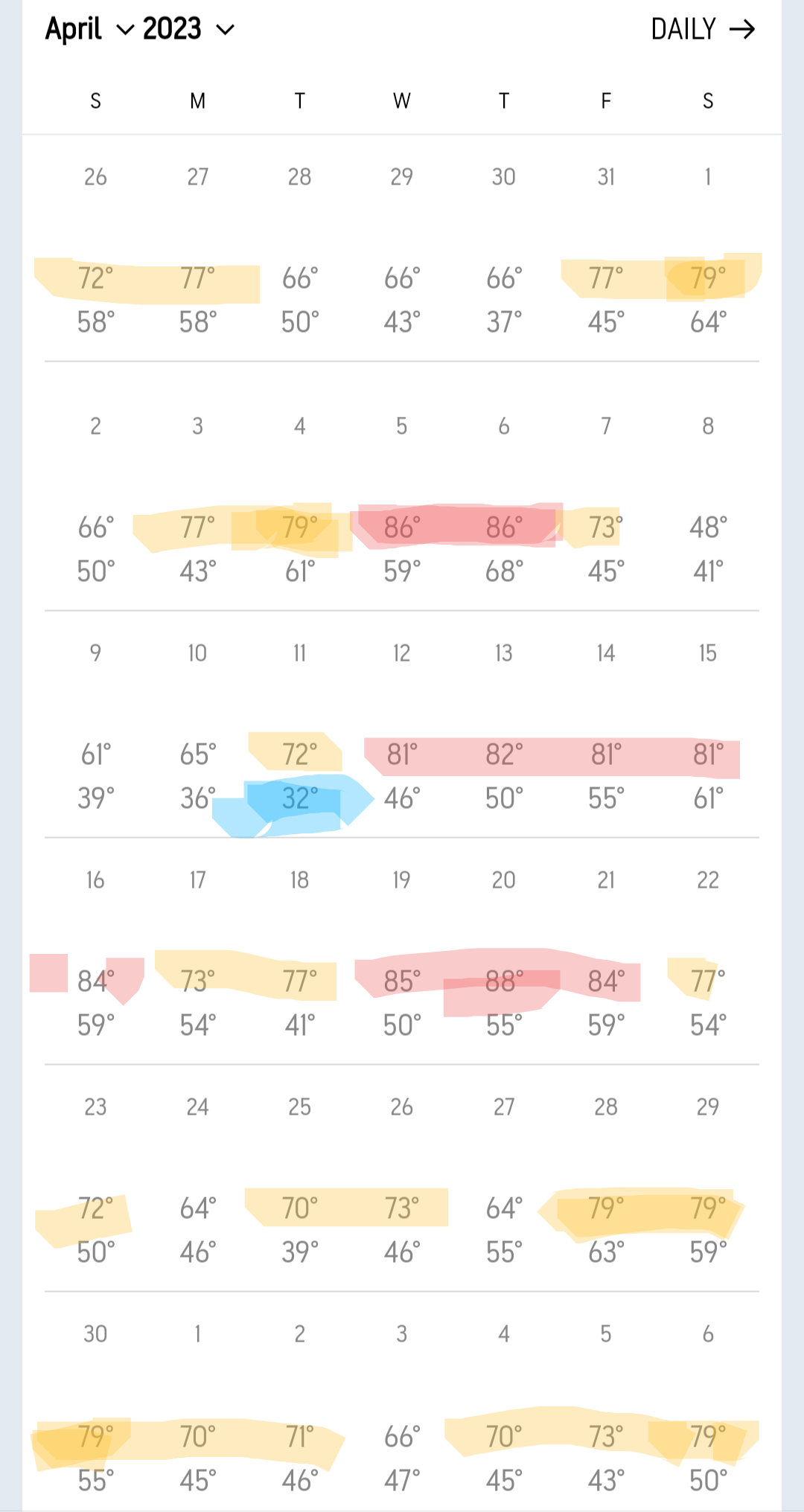
Here are the absolute lows from the last half decade since I planted the citrus and avocados.
That cold front in January was really unusual because we stayed so low for so long. I mean it is possible this year we already hit our low for the year a few weeks ago.
Maybe. We can hope! This location where I have been in Salem is a zone 9 during the last 7 years. Of course that won’t last forever. Or maybe it will. Perhaps the warming climate is going to remain in this region. I’m talking about the two place in the region where I grow crops (Mendo and Marion).
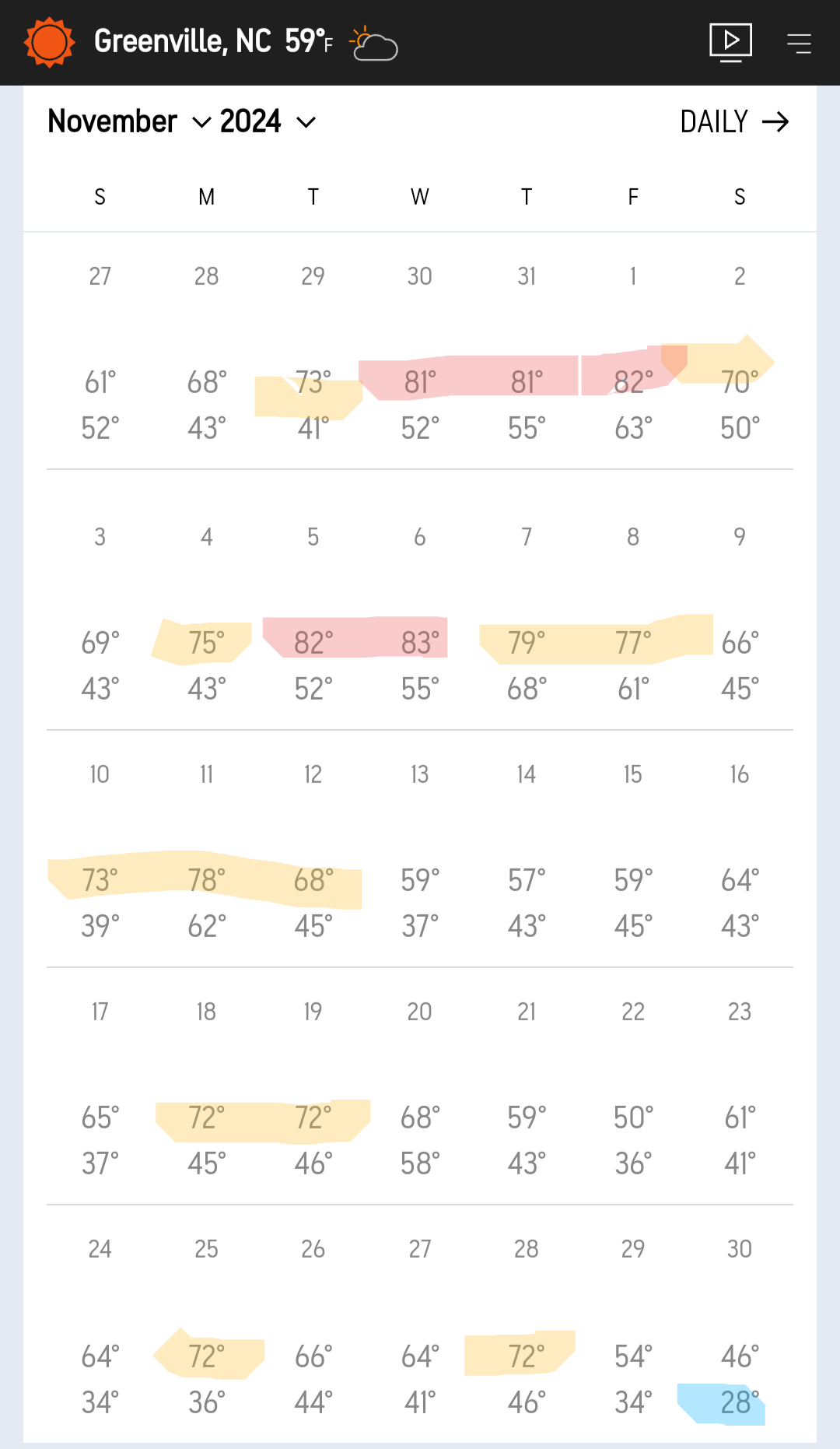
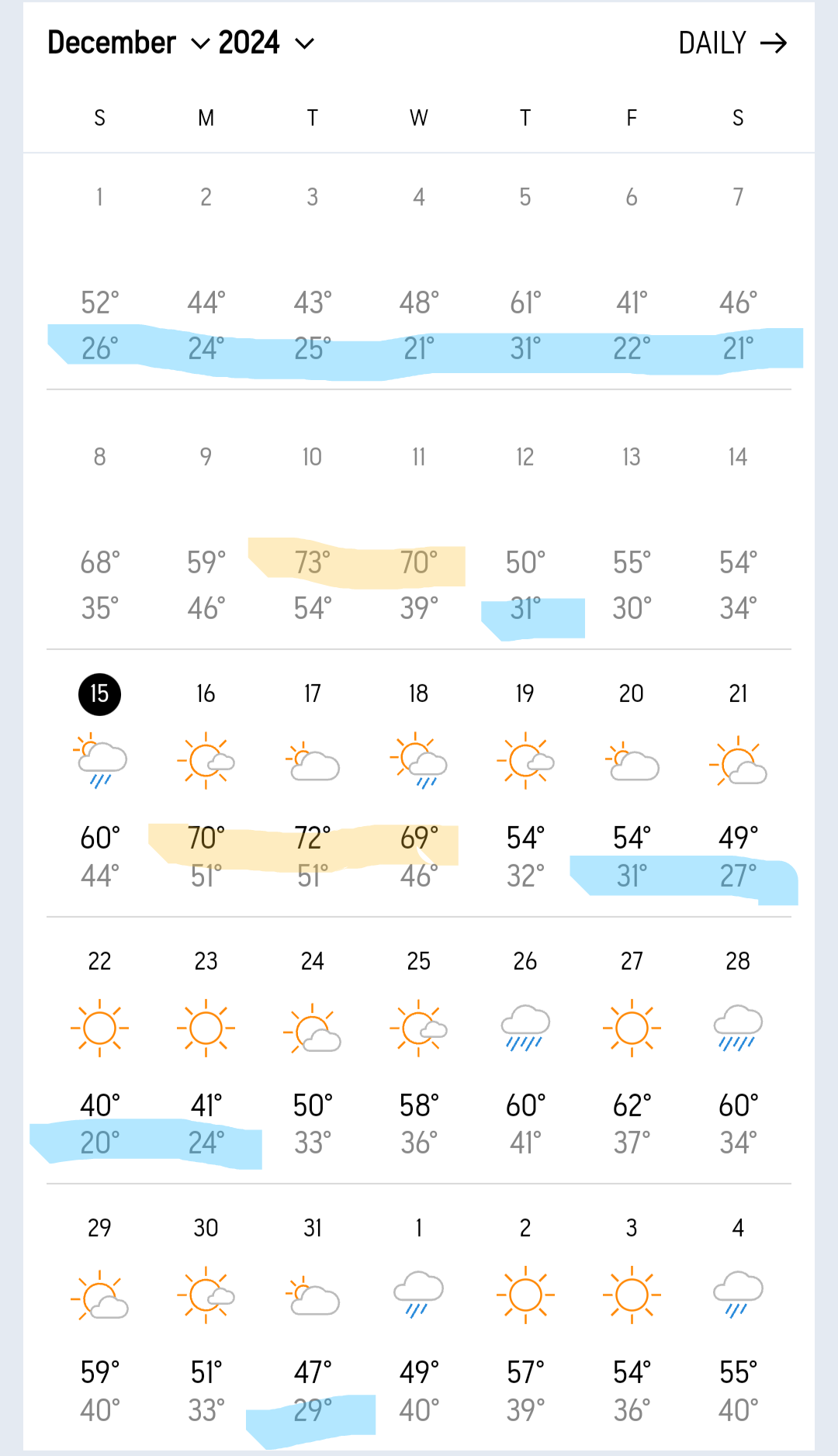
Yeah I think it’s a difference of climate more than anything. We don’t get frost until well after Thanksgiving usually, and it’s not unusual for weeks in the 70s to persist even into December (this week will be for example), but we get much colder freezes than you do (0 F six years ago…) so a lot of citrus put on growth really late but then get zapped hard when it hits the lower twenties or upper teens in early December.
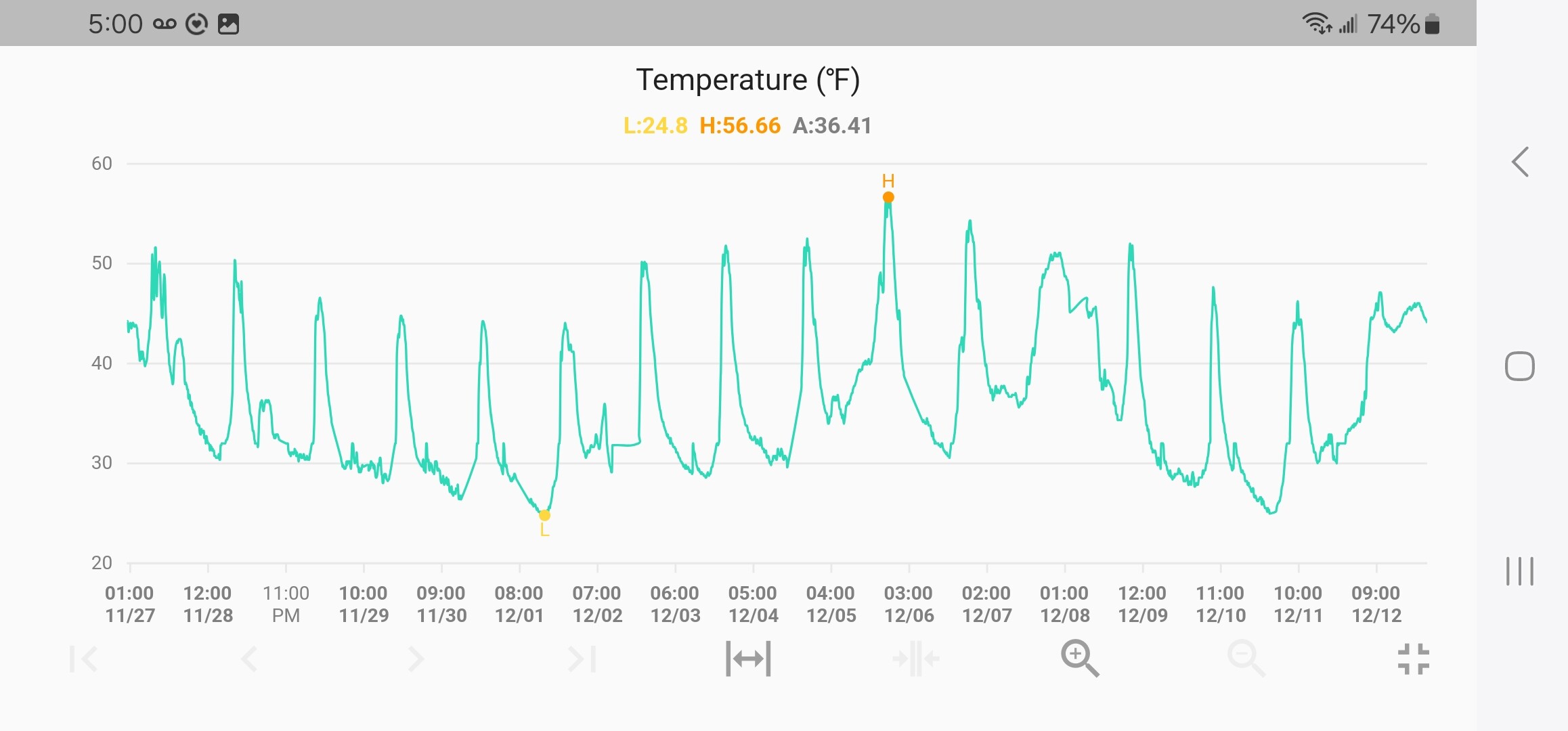
This is the temperature around the middle terrace of our property, most my citrus is at the top terrace for extra summer heat. I’ve been away in warmer places, but looking at multiple 24hr freezes has had me worried for my poor growing avos and citrus. Expecting the worse, we just had a friend check the upper terrace to see the damage. Surprisingly, the temperature gauge up there claims a low of only 28.8°f and he says everything looks good. He sent only this photo of my either Okitsu or Miho Wase:
Once they cross that threshold into an extended time below freezing it can become lethal. You never know what it is exactly. For me the meyers had the most damage when below freezing for those 2 days. The topmost leaves and the first inch of the topmost limbs got burned. The rest were fine. Dunstan, yuzu, sudachi and Carrizo had no damage.
This is only my second year of recording temps, and last winter was warm, but I believe we should get down to around 15°f at the very lowest. Of course, that is down at the house (lowest terrace) in the bottom the dark canyon, so I’d expect my new citrus (and avo) area to stay warmer.
The 24.8°f low is the lowest I’ve recorded on the property thus far. It was likely cooler at the house, but as said previously, still 4°f below my citrus area at 28.8°f.
In terms of longterm freezes, around 3 days maybe? But again, my subtropicals have been planted so that they’ll receive any scrap of afternoon heat my place can provide. I hope that can help subdue a daytime freeze.
What county are you in? Our family’s land is in Mendocino County, and the USDA map says it’s 9b. I’m not certain that’s correct, because my temperature recordings, dating back to 2002, have the lowest temp every winter between 20 and 23. There have been a few nights in the high teens too, maybe once a decade, during episodes when we get snow or ice.
Unless I’m mistakes, these readings cause it to be zone 9a, correct? Isn’t the 30 year average of the winter’s lowest low in a particular location what determines hardiness rating?
That seems to be what’s been happening the past few years. The winters here don’t allow the citrus to go fully dormant. For example, It’ll be 70 degrees on Tuesday. So a stretch of 70s and 60s, then down to 20 is what damages the plants down here. It’s not the absolute low, it’s that they’re actively growing. For that reason, the kumquat hybrids (citrangequat, orangequat) seem to do better than the Ichang type hybrids (Yuzu, Sudachi). That delayed dormancy helps a lot…
That April freeze was fortunately light, but still…
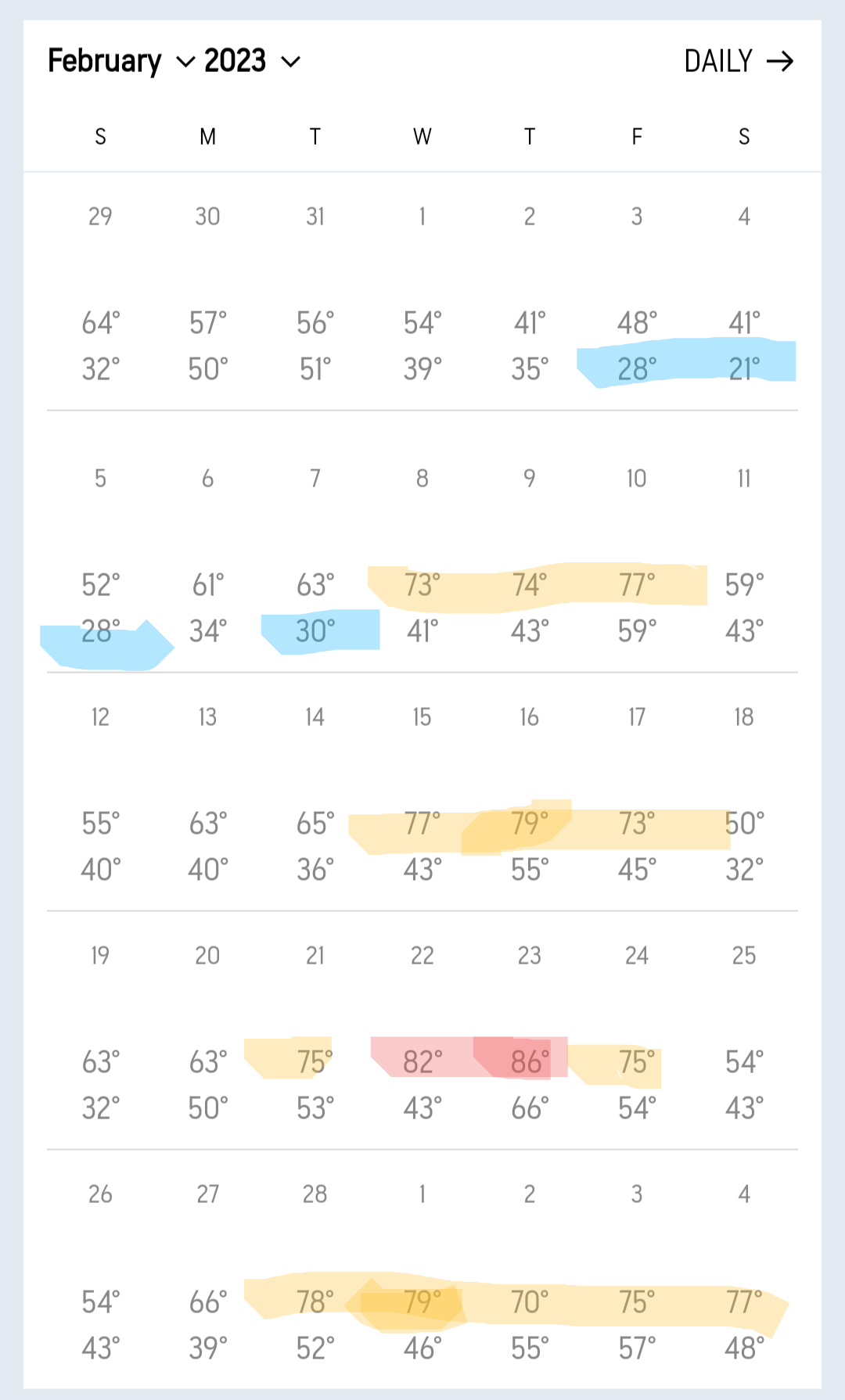
And the five weeks of frost free weather in the 70s and up, even almost hitting 90 F in February and then upper twenties all of a sudden. Ouch.
That being said, the heating bill is quite manageable, and winter is absolutely the most pleasant time to be outside and doing work or just relaxing. No bugs, just enough sun to be nice, and cool to warm days most of the time. It’s also pretty easy to keep indoors pleasant and adequately humid enough since the heat isn’t constantly running (even after cold nights the day temps plus sun is almost always warm enough to keep the house in the upper sixties to seventies).
Wow, you ain’t kidding. Like a rollercoaster. On the one hand that’s a pretty nice place to live in the winter. Recently here it’s been endless rain with high temperatures in the upper 40’s and lows only a few degrees cooler. A standard day reaches 48 around 3 pm and drops to 41 at 5 am. So the idea of a 75 degree sunny afternoon really sounds appealing.
How far south do you have to go in your region of the continent before the temps balance out. Are south Georgia and north Florida less volatile?
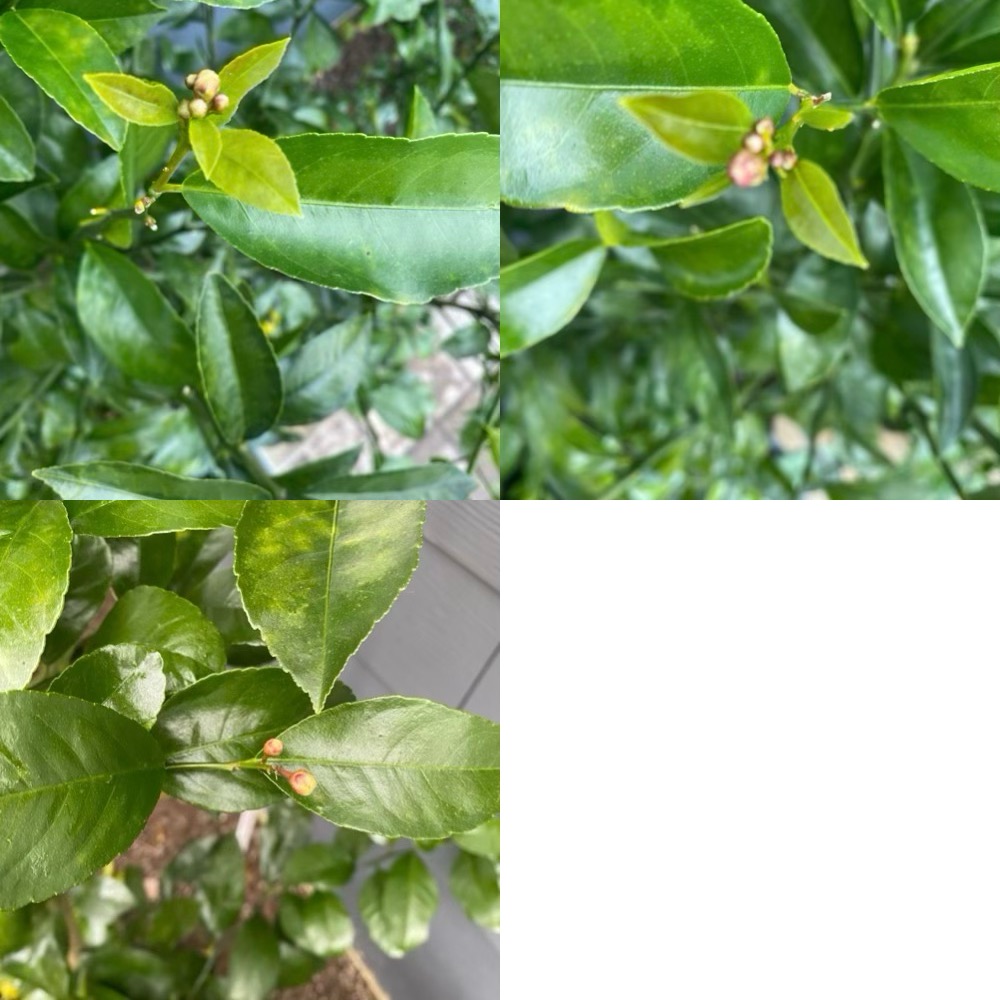
I don’t know what’s up with my largest Meyer lemon tree. Despite these relatively low temps the thing is still creating blooms. They aren’t opening, but they are still emerging from the fruiting wood. Has anyone else experienced this when temps are in the 40’s consistently? We have hit low 50’s a few times, but never back to back days. Even still the nights have been mid 30’s to mid 40’s since around Halloween.
These have all emerged in the last week. The lowest temp was 36 in that time frame:
I’m primarily trying to grow my citrus and avos in Del Norte County at our cabin off grid in the hills on 44 acres. The most accurate weather data to our property would probably be Gasquet. Their record low is 14°f. The USDA zone map puts us roughly in 9a, but I know it’s not accurate to whatever microclimates we have on the property. Lately we’ve gotten a warm January or February, followed by cold.
We also have a decaying gravenstein apple ranch in Sonoma County, Forestville.
Smith River is such a beautiful region. There’s a really nice campsite at Grassy Flats in the Madrone forest where I’ve stayed a few times. I really love that entire part of the west coast up to Curry County in Oregon.
On Tropical Fruit Forum I read about a guy in Hiouchi who has a few avocado trees that are over 20 feet tall. That’s not you is it?
What kinds of avocados are you trying? If you site them properly and have a method to protect and warm them on the super cold nights you should be able to get a fruiting tree in the more advantageous microclimates. The avocado lady on Vancouver Island gets lots of fruit. Recently I saw a video with her explaining that she is now growing bacons that have survived outside her greenhouse. My avocado trees are now approaching 8 feet in height. Hopefully some fruit is not far off.
I looked this up…sounds like it is good for cooler areas…but any idea on its actual cold hardiness? I get enough heat to ripen fruit, but possible teens is what I’m concerned about in my climate.
anyone growing silverhill satsuma? mine is too young to produce and has been in the greenhouse all winter, but was hoping it would be more cold hardy than owari.
my owari, murcott and clementine all seem to have about the same cold tolerance and defoliate in the low/mid 20s. they are all young trees though, so maybe i should not have put them in the ground.
I have Silverhill, Owari, and Kimbrough. All are two years in ground and roughly the same size. I’ve not seen any significant difference in cold hardiness between them. If there is any difference, it’s maybe a degree or two, nothing more.
I’m starting to think Yuzu might be a suitable rootstock atleast in cold wet climates like the PNW.
Apparently it was a preferred rootstock in Japan but seeds are much harder to get due to high demand for the fruit itself. So trifoliate became more common.
It is supposedly more resistant to root rot than trifoliate. Out here I lose citrus to root rot more often than anything else.