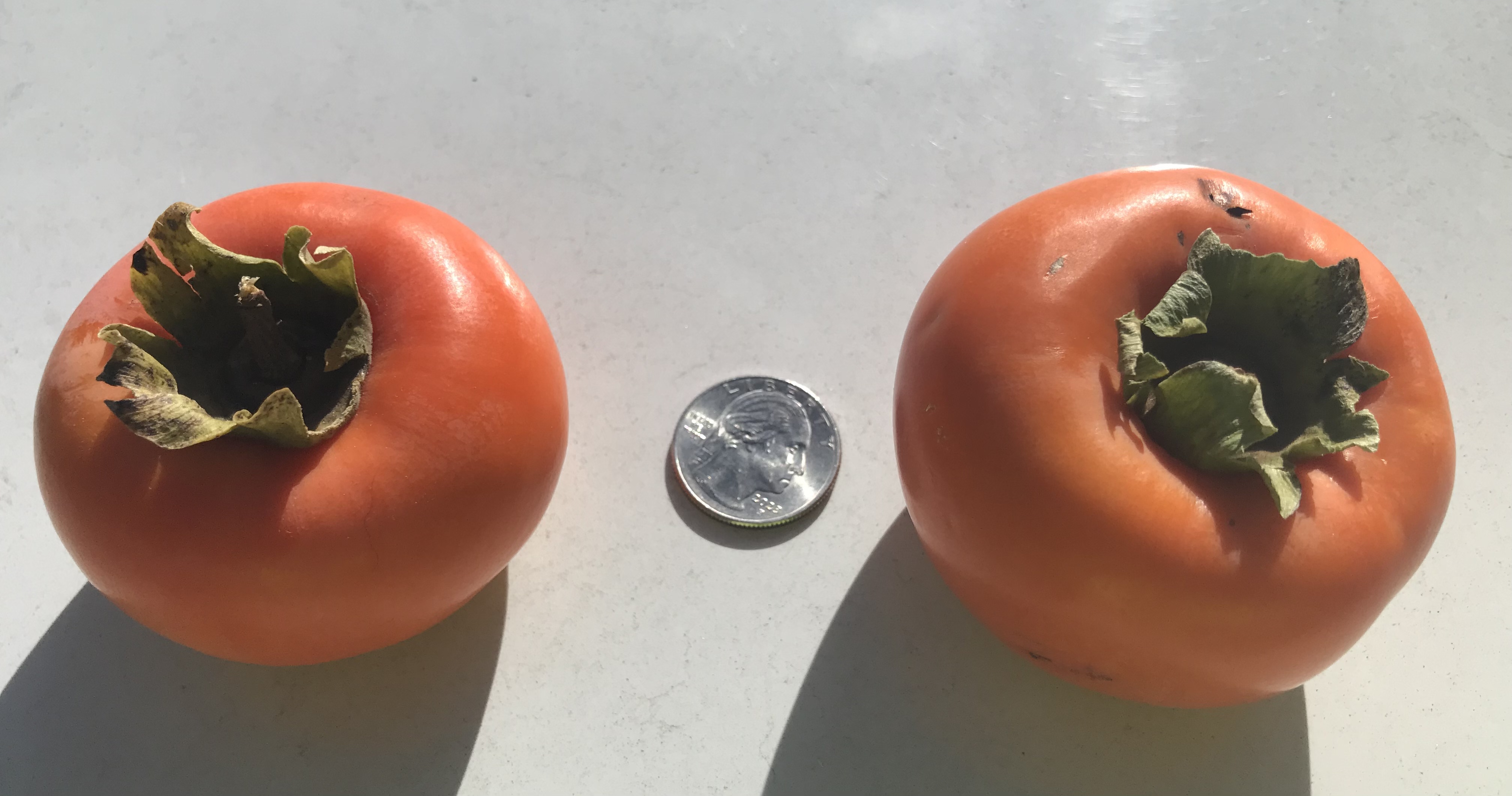
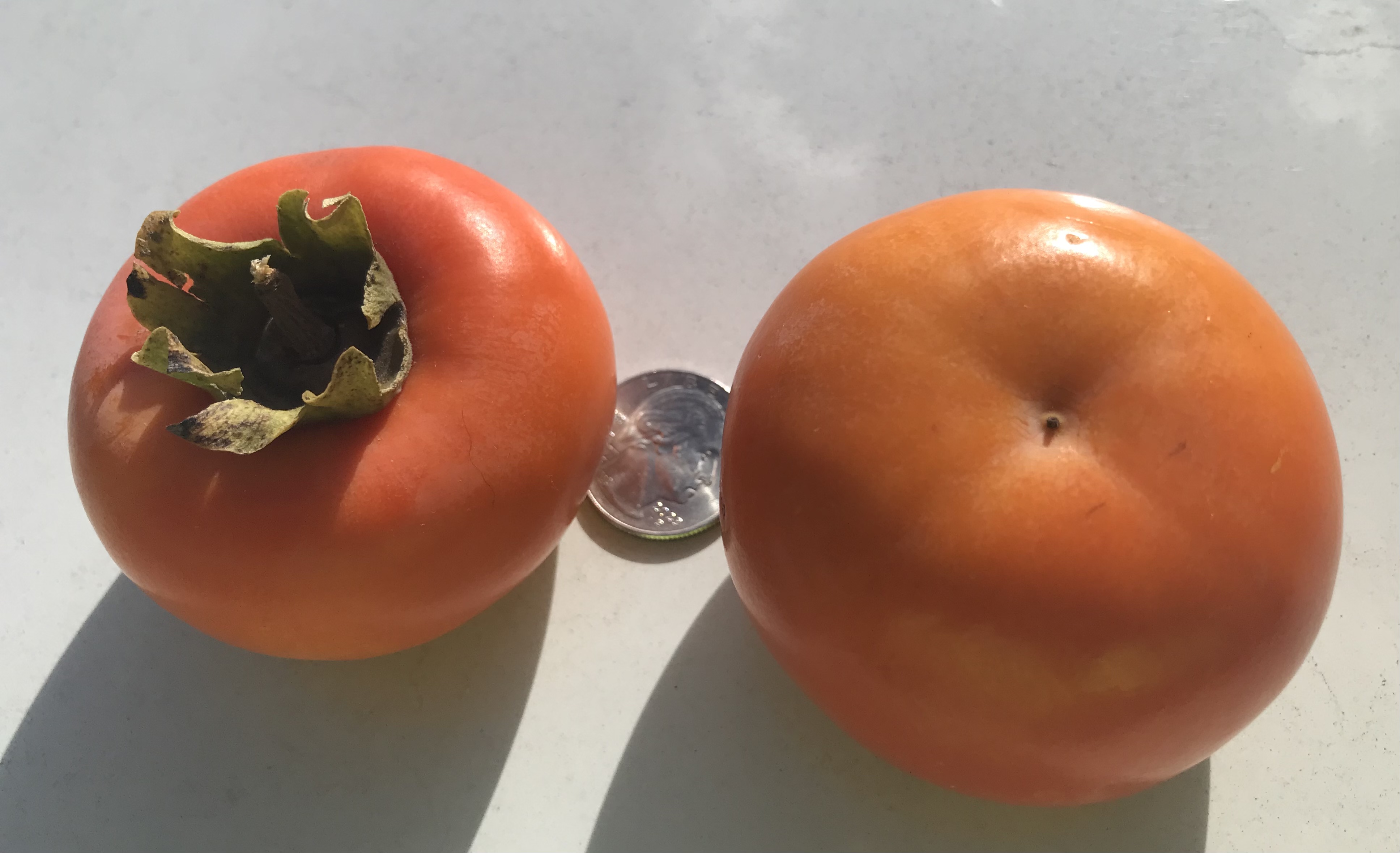
These are growing at a local school. Some university planted them as a ‘trial’ but everyone ive asked said nobody ever fools with them. Supposedly about 25 years old. Z6B most of those years. Any idea what they could be?
3 Likes
@krismoriah is the fruit astringent when firm? A lot of the non-astringent kaki varieties are indistinguishable except by relative ripening time. This picture looks like my Izu and Wase Fuyu because it has a roundish shape. My Ichi Ki Kei Jiro has a more square shape. Some of the astringent varieties have a similar round “tomato” shape, though. If this is astringent when firm, then it looks more like a small Eureka or a large Miss Kim fruit. Of course there are many more kaki persimmon cultivars that I don’t grow, so I can only compare it to the ones I have.
If it’s a non-astringent kaki variety that’s been growing for 25 years in Zone 6B, then I think you’d have a lot of people on this forum interested in scionwood.
4 Likes
Its not astringent.
looking thru the innerwebs Ichi-Ki-Kei-Jiro ticks alot of boxes.
Non Astringent
Most Cold Hardy
Its Seedless
Its sweet when firm.
Heat tolerant- we have had a really nasty summer this year.
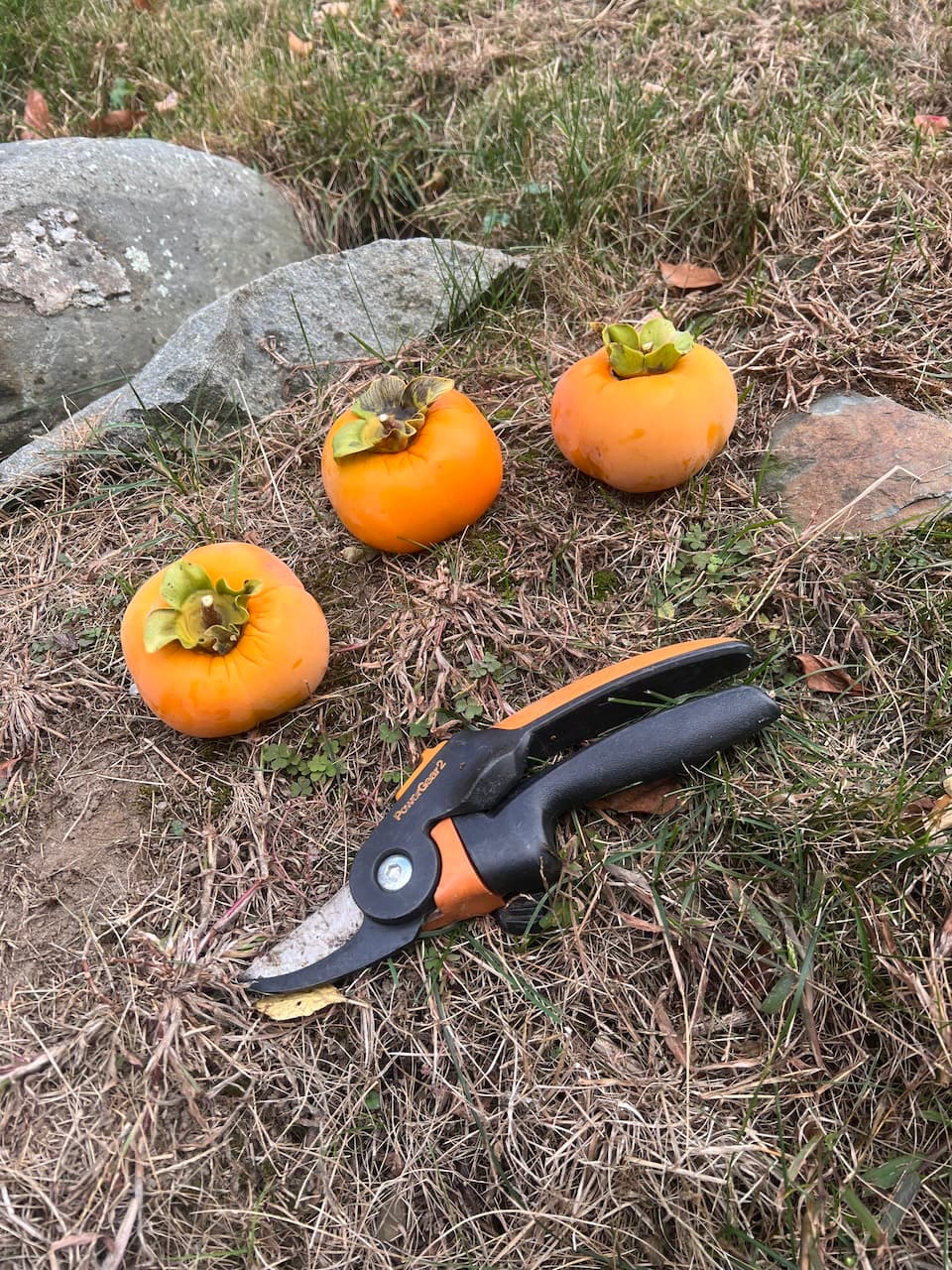
This is a pic from a backyard grower in about a week from now last year… Growing in PA Z6B from the social medias groups.
11/6/23


So to my eyes its close maybe the same… not to mention these i pictured could have hung another week or two probably.
No idea why a university would want to test these at a school…or even if that story is true.
3 Likes
25 years old I’m going more basic with Fuyu. Persimmon varieties were not as abundant and available back then.
2 Likes
Possibly… im into hybrids myself. Just found it neat that this one seems to thrive not far from me whereas most forums say 6B is tough for them to grow well.
Some places say that Ichi Jiro is the most cold hardy…whereas others say it dies in Z6B fairly easily when young.
2 Likes
6 Likes
.what local school would that be ?
We should graft some of those.
5 Likes
I think you’re probably right, especially since Fuyu seems to be the catch-all name for any non-astringent persimmon variety, whether it is a genuine Fuyu or not. I’ve grown six different non-astringent varieties, and the differences are all fairly subtle. A nursery sold me an “Izu” that turned out to be astringent and shaped like a Hachiya, so I know that one was wrong, but if it weren’t so obvious I wouldn’t have known if it was mislabeled. It would be nice to have a conclusive way to distinguish between the non-astringent (PCNA) varieties based on appearance/size/ripening time.
I agree with @jrd51 - my IKKJ fruit looks just like his (and so does Chinebuli). My Tam Kam fruit also had the same squared shape but were a bit larger on average (my tree died from KSDS a while back).
My Izu, Wase Fuyu and Maekawa Jiro fruit all look more rounded, like the fruit from the schoolyard in @krismoriah 's picture. Maybe they’re all just Fuyus, though. I’ve grafted Suruga, which is supposed to be later and a more distinctive non-astringent, but it hasn’t fruited for me yet.
1 Like
Most of those non astringents are pretty similar in taste with the ripening times being the difference. All of the jiro varieties are squared off while all the fuyu varieties are rounded. There are a couple that may not be connected to either of them, but I’m betting somewhere down the line they are. Pretty much two varieties dominate the non astringents.
2 Likes
Exactly, that is neat that it’s grown so well without any special care or attention. My zone has been recently reclassified as 8a, so I can’t say anything about winter hardiness of the different cultivars from personal experience, but because the PCNA varieties all seem so similar in most ways, I wonder if there really is much difference in cold hardiness between the common Fuyu and Jiro types that I’ve grown and fruited so far.
2 Likes
That’s been my experience too, though I’ve been told Suruga is an outlier. There’s also supposed to be a non-astringent variety from China that is genetically distinct from most PCNA types, but I’ve never seen it for sale in the lists from those selliing trees or scionwood. I’m forgetting the name, but I’m sure @jrd51 knows it since he’s mentioned it in his posts before.
1 Like
Think there is a Korean variety that breaks out of the fuyu/jiro line as well. Can’t remember if it was TamKam or another though.
2 Likes
The original Japanese PCNAs include Hanagosho, Okugosho, Fukurugosho (among others) along with all the Jiro and Fuyu sports. The Japanese breeding program has released a bunch of varieties that are basically a mix-and-match of these names. For example, @ncdabbler’s Suruga is Hanagosho x Okugosho, which is probably why it is described as “more distinctive.” What this means is that there is a little more genetic diversity than just Fuyu and Jiro, but not much.
There are no indigenous Korean persimmons. All the persimmons there were imported, mainly from Japan but also from China. So a Korean PCNA is either a synonym of a Japanese variety or a cross between two Japanese varieties. Only a very few PCNAs make male flowers, so the options are very limited.
Edit: I found a note stating that "Parents used in 1982-89 [Japanese breeding] were all derived from only six PCNA cultivars (Fuyuu, Jirou, Okugosho, Hanagosho, Fukurugosho and Tenjinggosho) and one PVNA (Nishimurawse). Moreover, 82% of them were derived from only five cultivars.
This is why PCNAs all seems so similar. The main result of the breeding program was some early-ripening varieties, such as Izu and Soshu. Arguably there was also some modest improvement in fruit quality.
2 Likes
It’s been established to my satisfaction that Chinebuli is Jiro. For unknown reasons, it was renamed in Eastern Europe or the Caucasus or whatever.
3 Likes
Wish they sold more of those other varieties here. I’d be interested to see if there are any that offer something different. I’ve got 6 different non astringent varieties that are all related to fuyu/jiro and pretty much all taste the same.
2 Likes
The various Goshos are available from USDA quite easily.
2 Likes
There could be others also (not sure of the story of the university trialing them)… as most stories lose truth over the years as they are re-told.
I will PM you the location… and we have to figure a way to get some kind of permission… and hopefully at some point the true story of how they got there.
2 Likes
Hanagosho and Okugosho both produce male flowers and have been critical to the Japanese breeding program. This trait has been passed down to offspring, most notably Taishu.
So be careful what you wish for. You could end up with seeded fruit. On the other hand, the seeds might produce a wonderful new variety.
I googled it, and the Chinese non-astringent variety I was thinking of is ‘Luotiantianshi’ –
NATIVE NON-ASTRINGENT PERSIMMONS IN CHINA.
1 Like
Fruitwood Nursery sells scionwood for Hana Gosho, Oku Gosho, and several other Goshos if you want to try them.
1 Like