I have located about 2 dozen Callery Pear Seedlings/Suckers growing around where I work. I am planning on digging them up to graft onto next spring. The issue I have is the car I drive is small and some of these are 4’ tall. Can the taller ones be cut off shorter so I can transport them?
2 Likes
Take trash bags to bag the dirty roots and just bend them to make them fit. Your car will fit a five foot person easily and should have no problem with these.
1 Like
That’s a good idea! I never thought of that!
1 Like
I have dug them up before. You will find out they have a deep tap root, and they are very hard to dig up. I had to cut the tap root, after digging around the tree. You might want to take something to cut the tap root.
4 Likes
Well that was an utter failure! All of them were suckers coming off a larger root with no roots of their own.
1 Like
May not be a total waste of time. Given the right conditions the suckers may still set roots down on their own over time.
1 Like
A few years back… I dug up a couple of callery in the edge of my woods… and transplanted them out in my orchard (did this in January).
Below pics showing one of those.
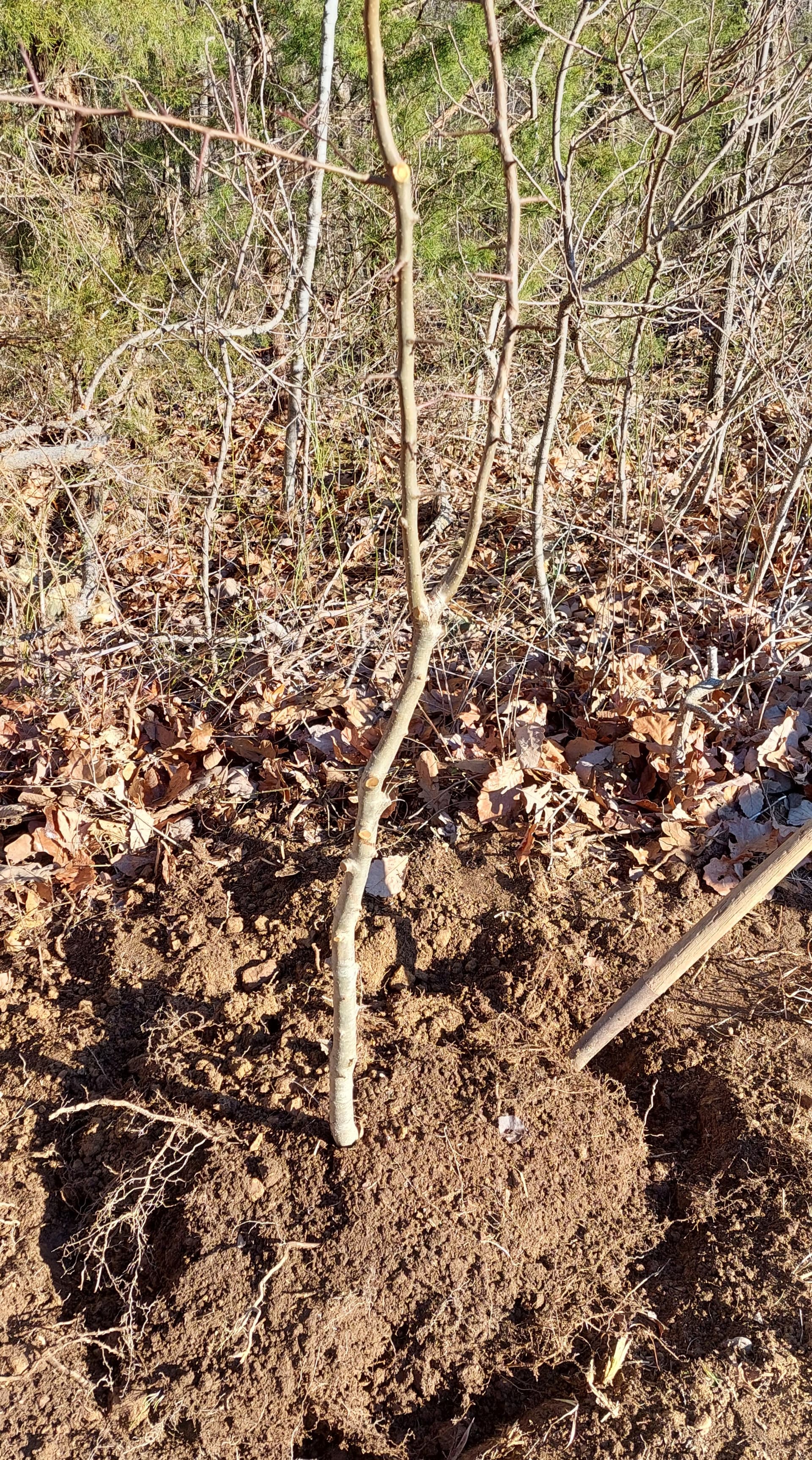
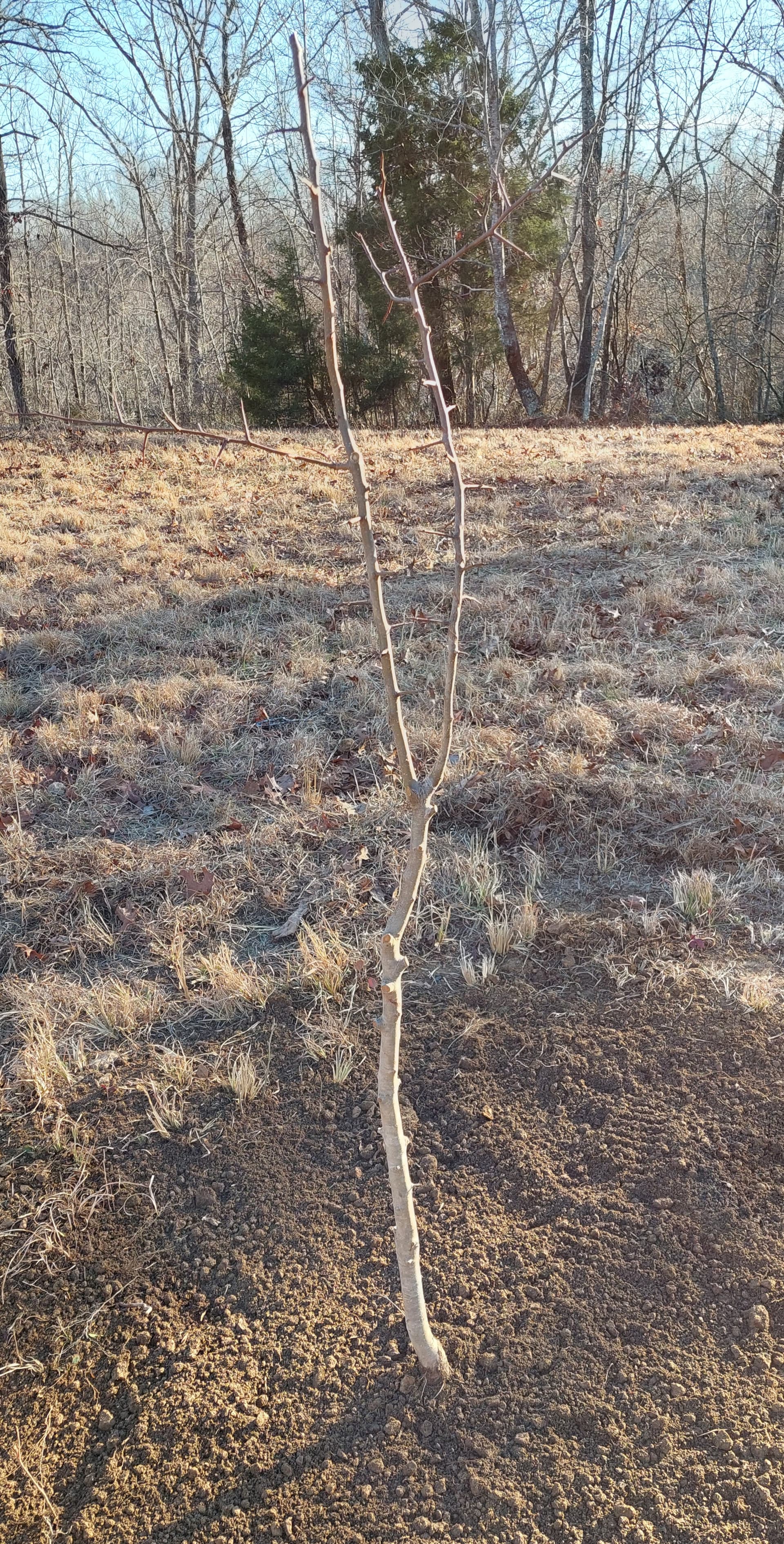
Later that spring I grafted Kiefer and Improved Kiefer pear scion to them.
Today they are 10 ft tall with some nice scaffold branches started.
TNHunter
3 Likes
I will keep my eye on them!
I planned to use these to practice grafting on them next spring. My neighbor has a Bartlett Pear and I am going to order some other pear scions and some OHxF 87 rootstocks.
1 Like
Come to Ohio and get all the Callery Pear rootstocks you want to dig up. They are taking over every piece of land that can sprout their demon seeds.
3 Likes
Same for Kentucky. 
3 Likes
I’m going to point out the obvious about callery which is that it is a great rootstock. Fireblight resistant, pollution resistant, fast growing etc. That is how it got to the USA in the first place. My opinion is callery is here to stay.
" Callery pear: Ornamental favorite or invasive menace?
April 5, 2024

Callery pear (Pyrus calleryana), better known as ‘Bradford’ pear, has been blooming across Illinois. Over the years, it has been a popular tree to plant, especially in residential areas. Trees will reach 30 to 40 feet in height and produce numerous white flowers in the spring. Trees also have attractive glossy leaves that will turn a brilliant red-orange in the fall. However, they are also becoming increasingly problematic across Illinois and the United States.
How did Callery Pear get here?
Callery pear has been imported to the U.S. multiple times. It was originally imported from Asia in 1909 to the Arnold Arboretum (Harvard University) and again in 1916 by the U.S. Department of Agriculture for the development of fire blight resistance in the common pear (Pyrus communis), which was a serious problem in the commercial pear industry at that time.
Callery pear was used as a rootstock for edible pears before gaining interest as an ornamental plant. In the 1950s, the ornamental value and hardiness of Callery pears were recognized, leading to the development of several cultivars, including the most well-known ‘Bradford’. By the 1980s, Bradford pear had become the second most popular tree in the U.S.
It has been widely planted due to its quick growth, adaptability to a wide range of soils, and pollution and drought tolerance. The trees also have a symmetrical to round shape that many people find desirable in addition to their abundant spring floral display.
The problem(s) with Callery pear
Unfortunately, Callery pear has several negatives. They have narrow branch angles, and this, along with their rapid growth, makes them rather weak. Trees often split and break apart during storms and frequently don’t last longer than 20 years before they begin to split apart. Additionally, while the floral display may be impressive, the smell is not. The fragrance of Callery pears has been described as smelling like dead fish, vomit, urine, and other undesirable things.
When ‘Bradford’ pears were originally introduced to the landscape trade, they were touted as having sterile fruit. This is because they are self-incompatible, meaning they require cross-pollination from another cultivar to produce seeds. Since most of the Callery pear trees that were originally planted were ‘Bradford,’ there was very little pollination occurring (unless they were planted near another cultivar).
However, new cultivars have been introduced, such as ‘Cleveland Select,’ ‘Aristocrat,’ and ‘Redspire.’ The introduction of these new cultivars meant greater chances for cross-pollination and, therefore, seed production.
Now that several cultivars are being grown in landscapes and trees have been able to produce viable seeds, Callery pear has escaped into the environment. Birds and other wildlife will consume the fruits from trees and disperse them. Callery pear is now showing up in disturbed areas, as well as natural areas. Driving along highways and interstates, you can often see thickets of Callery pears in fields along the roadside (along with bush honeysuckle). Callery pears can quickly become established in an area due to their rapid growth as well as their ability to produce large amounts of seed. Once they become established, Callery pears can form dense thickets that push out native species that cannot compete with them.
Image

With the introduction of new cultivars, Callery pears have been able to produce fruit and seed, which has led to their spread.
Image

Callery pears have escaped cultivation and can often be seen forming thickets along roadways.
Body
What should I do with my Callery pear?
Callery pear is considered invasive in many states and can no longer be purchased or planted. Some states and communities have bounty or buyback programs in place to encourage residents to get rid of their Callery pear trees. In these programs, if residents show proof that they have cut down a Callery pear, they will receive a replacement tree.
While Callery pear can still be purchased in Illinois (as of this writing, it is not listed in the Illinois Exotic Weed Act, which regulates invasive species), it is not a plant we should be planting in our landscapes. If you have a Callery pear in your landscape, consider removing it. For smaller trees, a foliar or basal herbicide (glyphosate or triclopyr) can be applied to the plants. Larger trees should be cut down, and an herbicide (glyphosate or triclopyr) should be applied to the cut stump. Learn more about managing invasive species in the Management of Invasive Plants and Pests of Illinois guide.
If you are considering planting a tree or would like to replace your Callery pear, consider alternative trees such as flowering dogwood (Cornus florida), redbud (Cercis Canadensis), serviceberry (Amelanchier spp.), and American plum (Prunus americana). These trees have characteristics similar to Callery pears, such as low maintenance, small stature, and beautiful spring blossoms without the invasiveness of Callery pears.
Good Growing Fact of the Week: While Callery pear cultivars such as ‘Bradford’ were bred to be thornless, the seedlings from these thornless cultivars are not. The thorns are sharp enough to puncture tires and can make the management of thickets of Callery pears difficult.
Bonus Fact of the Week: Many plants pollinated by flies smell bad, and Callery pears are primarily pollinated by flies, which helps explain their less-than-desirable scent.
Resources and for more information
Culley, Theresa M. The Rise and Fall of the Ornamental Callery Pear Tree. Arnoldia, 74(3): 2–11.
Management of Invasive Plants and Pests of Illinois
Want to get notified when new Good Growing posts are available? SIGN ME UP!
Give us feedback! How helpful was this information (click one): Very helpful | Somewhat helpful | Not very helpful
MEET THE AUTHOR
Ken Johnson is a Horticulture Educator with University of Illinois Extension, serving Calhoun, Cass, Greene, Morgan, and Scott counties since 2013. Ken provides horticulture programming with an emphasis on fruit and vegetable production, pest management, and beneficial insects. Through his programming, he aims to increase backyard food production and foster a greater appreciation of insects."
1 Like
Ya we have a ton around here too, I just have not been able to find any seedlings. So far only suckers that don’t have their own viable roots. I actually have a larger tree in my back yard. I have contemplated air layering some branches.

Where did you find an Improved Kiefer pear to purchase?
@Hopelovesfruit … over winter here on the growingfruit board… members execute trades…
You can post your trades list… what you want and what you have to share.
For example… I have a apple that some one wants scion of… and they have improved kieffer pear that I need scion of.
We trade and both get what we wanted.
That is how I got kieffer and improved kieffer.
Some people will send you scion wood if you will pay postage (with no trade).
If you need improved kieffer… let me know… i can send you scion (early January).
TNHunter
1 Like
That sounds great!
How would you say the improved Kieffer differs?
1 Like
@Hopelovesfruit … found the details below with google search.
…
The main difference between Kieffer and Improved Kieffer pears is when they ripen:
- Kieffer pears
These large, golden-colored pears with a crimson blush are ready to pick when mature but still hard. They should be stored in a cool place to ripen for two to three weeks, when their skins will turn slightly yellow and their juices will develop.
- Improved Kieffer pears
These large, long pears ripen in late September–October. They have a crisp texture that makes them ideal for baking and canning.
Kieffer pear trees are heavy-bearing, drought- and flood-tolerant, and resistant to fire blight.
…
I grafted my two trees a couple years ago… this year they developed some nice scaffold branches. Hopefully fruit in the next 2-3 years.
In my county here in the hot humid south east fireblight is a real problem on apples and pears. Not just damage to the tree but death.
Over the years I have lost 5 or 6 apple and pear trees to fireblight.
The only variety of pear that you can find at old homestead sites… is kieffer.
We like them and mostly make pear preserves with them. We do eat some fresh after ripening properly in the basement.
Next spring I plan to add a few grafts of Bell, Potomac, Warren (and a pollinator for Warren)… to my two kieffer trees.
These are also supposed to be very resistent to fireblight… and many here consider them to be very good pears.
TNHunter
1 Like
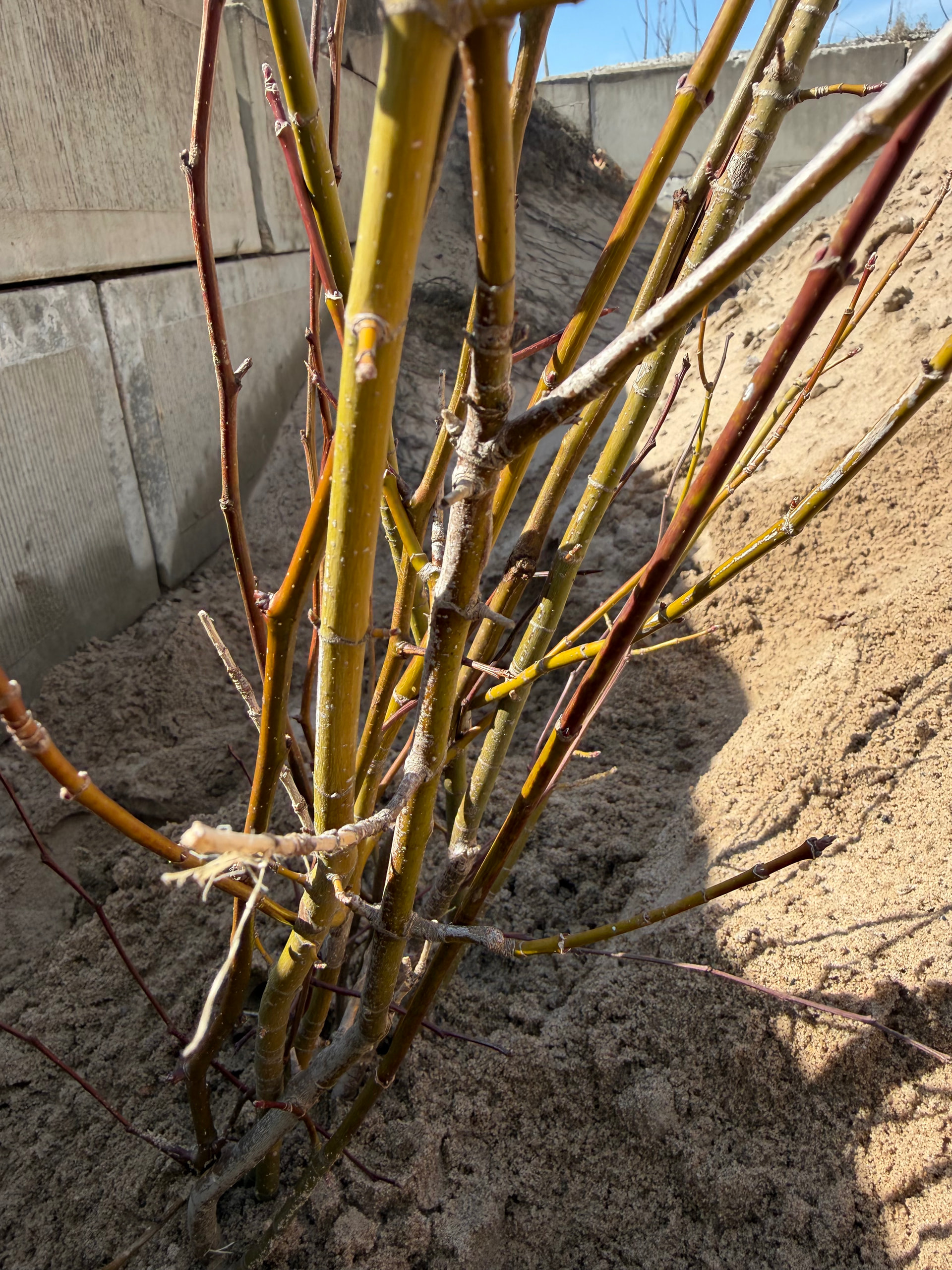
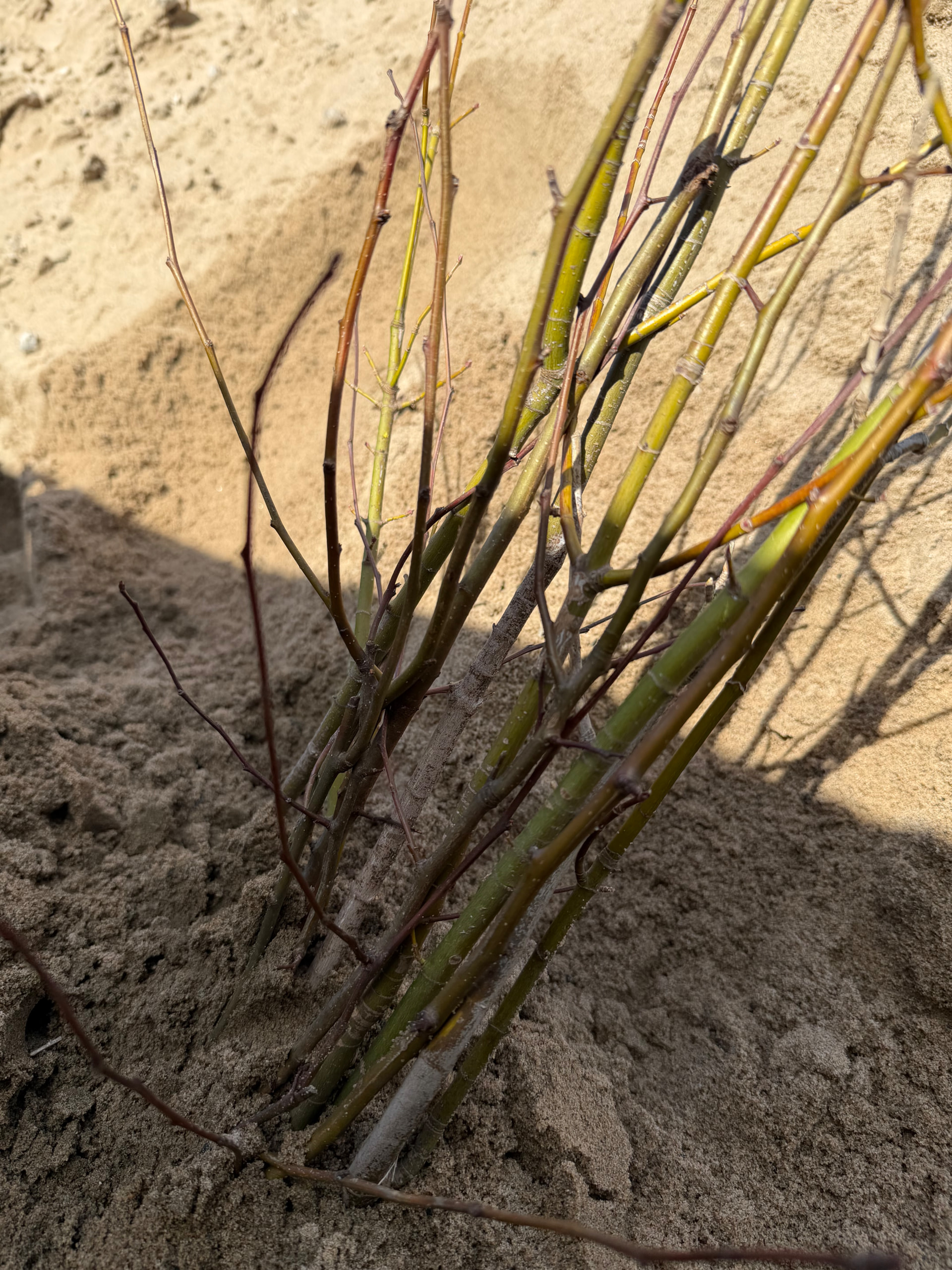
I have been back on the search around work for some more Callery suckers. I found a stand of bigger trees with what I think are suckers. Some of them are a lot more green that I thought Callery pears are. Can anyone confirm if these are actually Callery or not? I have them heeled into a pile of sand for now.
1 Like
Those don’t look like pears to me but I can’t see all of them clearly in the photo. Those appear to have opposite buds but callery are alternating. Most of the callery around here have nasty thorns when that size.
I don’t recognize what those actually are but they do not look anything like the Callery pear I find coming up whenever. The only thing I can think of that would have bark anywhere near that green would be boxelder, but those don’t look like that to me.
I dig your bin blocks.
The ones I see around here have a thorny look to them, dug a couple this winter
1 Like