Do you taste astringency in ripe PCNA persimmons

In the Persimmons 2025 thread, various views have been presented about residual astringency in ripe PCNA persimmons. One statement attributed to a Japanese grower implies that PCNAs cannot be grown in Japan much north of Tokyo, where the climate is subtropical. Another statement by a Taiwanese grower asserts that residual astringency can be tasted in PCNAs grown in some unspecified Middle Atlantic states (NY, NJ, Delaware, PA, MD, VA, WV) in the U.S, which are mostly not sub-tropical. A third statement from a grower in the Pacific Northwest says that it is impossible to grow PCNA’s anywhere where the climate is not ā€œhot.ā€

For my part, I have apparent success growing PCNAs in coastal RI. I’m gonna keep on, but I don’t want to see other growers give up on the idea of growing PCNAs north of the Mason-Dixon Line. But to settle the issue, we need more data.

If you have grown PCNA persimmons north of 39 degreed north latitude, please relate your experience – success or failure. Did you manage to ripen non-astringent fruit? Routinely? Did it matter whether the fruit was eaten firm or soft? Did you taste any astringency at all? Did this result vary by variety? And anything else you may think relevant. Thanks!

6 Likes

I will participate.

Please define ā€œripeā€ and/or ā€œripenā€ in this context.

3 Likes

LOL, I don’t know. People differ in their preferences – some like a ā€œfirm ripeā€ persimmon, others like a ā€œsoft ripeā€ persimmon. Both are orange, though a very soft ripe persimmon will be orange-red. For PCNAs, both should be non-astringent.

ā€œRipenā€ is the process of changing from green to (a) firm ripe, then (b) soft ripe.

I suppose I’d like to know especially whether a grower’s persimmons are non-astringent when (a) firm ripe and (b) soft-ripe (two questions).

1 Like

areyou willing to sponsor me buying some local fruit here in ny :slight_smile: i see it on fb marketplace :grin:

1 Like

I have Izu, Matsumoto Wase, and probably Jiro or IKKJ. They lose astringency at some point when they are fully orange and before getting mushy. There still is some bite or crunch, but maybe not reliably when they are crispy.

This is based on 1-3 seasons each, so not a big sample and our growing seasons vary year to year.

I don’t have enough data to describe what they typically do here. But I wouldn’t be surprised if some years some or all of them are palatable while very firm. I think they always lose astringency by the time they have the texture at which PCA will have lost astringency.

I tend to like PCNA as they just start to soften, when there is a little give, maybe like the neck of a mature Euro pear when mature enough to pick. You still need to cut it, can’t spoon it or squish it with fingers.

2 Likes

I can contribute to this.

As a climacteric fruit, persimmon can still ripen after being harvested from the tree.
This causes ambiguity in the term ripen when talking about climacteric fruits.

Using another climacteric fruit, banana, as an example — exact numbers may vary.

Banana will ripen on the tree around 90 days after flowering.
If you harvest a banana at 70 DAF, it is still green,
but when treated with ethylene, it will start to turn yellow and ripen.

However, a banana harvested at 60 DAF won’t respond to ethylene and will never ripen.

Commercial bananas are usually harvested at around 70 DAF,
when they are capable of ripening with ethylene but are still green and firm for easy handling.

Sorry, I don’t know if there’s a specific word to differentiate between the ripen and ripe stages.

Back to persimmons — almost every variety (PCA, PCNA, PVA, etc.) loses astringency after ethylene treatment.
The mechanism is believed to be the polymerization of tannins.
Ps i do met some odd ball that are still astringent when soft ripen.the horror !.

And if a PCNA variety stay astringent on the tree when color is changed due to cold climate,
this theory predicts that it will still lose astringency when it fully softens,
whether it happens naturally on the tree or through ethylene treatment.

Matsumoto Wase is a PVNA variety .
It lose astringency by the magic of seed.
And will lose it even without ethylene.

Exact biochemistry is unclear but maybe something to do with Acetaldehyde.that is what makes it magic.

I have no idea if this mechanism interact with cold climate like PCNA does.

On tree alcohol treatment can replace seed to let PVNA lose astringency.

That is what Japanese do to seedless flat to create these seedless blck persimmons.
No seed needed.

alcohol probably will work on PCA and PCNA too.

But i don’t know for sure.

7 Likes

I grow numerous PCNA persimmons at approx 47.5N latitude.
With the possible exception of Izu and Gil Ya, none of them fully color up on the tree unless damaged by a bird peck or something else. If fruit is eaten firm they are inedible because of lingering astringency. All PCNA varieties without exception have lingering astringency. Izu, Suruga, Hana, Jiro, Gil Ya.
Once allowed to get soft (roughly avocado texture) many lose astringency and become delicious. I’ve measured brix at > 20 in home grown Jiro which is far higher than grocery store Jiro. Suruga is too late to ripen here with much sweetness however.
By comparison NONE of my PVNA varieties have ANY lingering astringency even if picked somewhat green and eaten if they are pollinated.

If you were referring to my comments in other threads, this is a gross mischaracterization. See above.

As a side comment, I will reiterate that if folks in cooler climates prefer home grown kaki persimmons in crunchy state, they might be happier with PVNA varieties than PCNA as there is likely far less astringency. PVNA varieties have a more complex flavor and have generally been preferred nearly universally by everyone who taste tests them side by side at my home tastings.

Moreover if you want crunchy Jiro persimmons - buy them at the grocery store. Out here they are about $0.59/lb at the Asian store. In California they are sometimes $0.19/lb at the store and often people just give them away because they don’t want to throw them in the trash.

Grow the high value gourmet varieties instead.

2 Likes

A side note.
BRIX meter actually can’t tell the differt between sugar acid and tannins.
All it does is measure how much solid is dissolved in liquids.

It implicitly assum all dissolved soild is sugar,and approximate it as sugar content.

if i test an un ripen PCA,it will have an improbablely high 25-35 brix.

When this happens 怔an improbable high brix怕i will just taste it orally.
To make sure it really is sugar and not tannins.

Taiwanese hate PVNA for their seed.if there is a seed in persimmons Instantly disqualify.

No one i met ever rank PVNA higher then PCNA.

It is very enlighten to know other’s like PVNA for what they truly are and not judging it by seed.

Oh and the blackening of PVNA flash actually make it harder and crunchy er.

If u somehow stop pvna from having seed.or u have a pvna fruit that has not enough seed and therefor only partially blacken.
The light color and blacken part will have differt texture.(of course the light part will be astringent )

The act of de-astingcy and blacken, make the flsh become crunchy and hard. In some variety too hard it’s uneatable.(Taste like pear stone cell)

1 Like

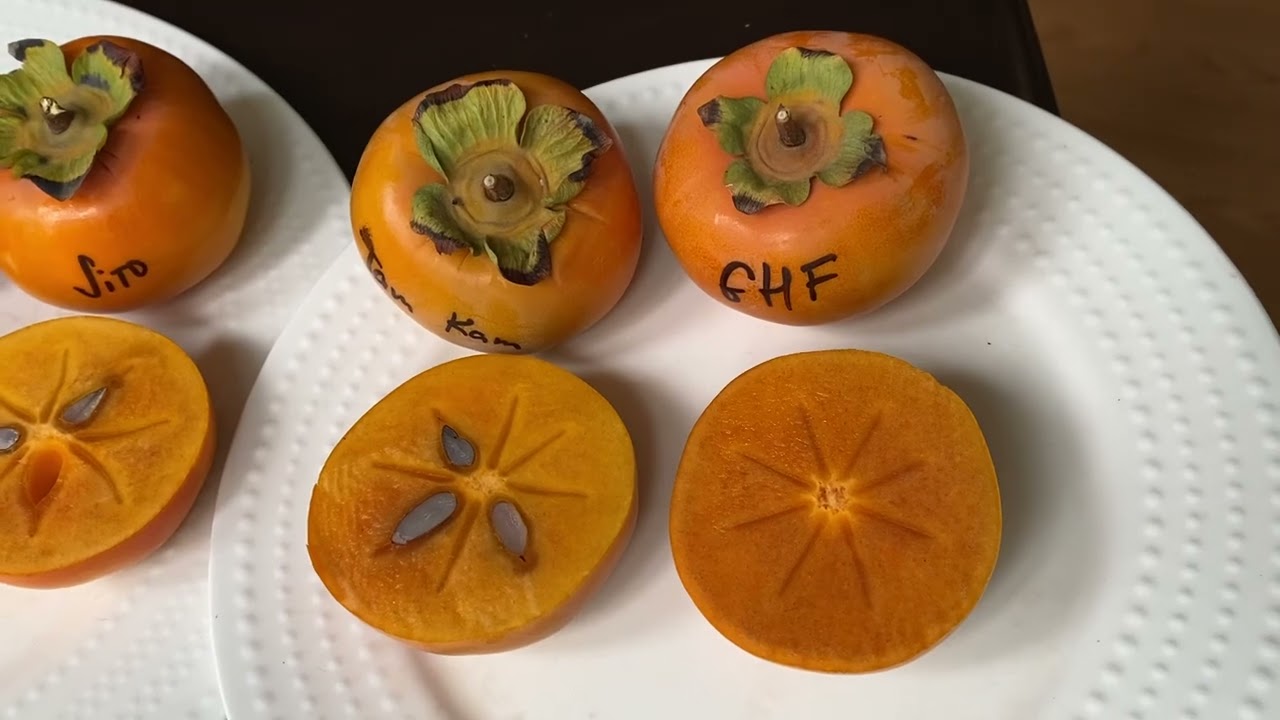
One data point from me: I just cut up and ate this Taishu fruit, grown here in RI in a very moderate (not hot) growing season. I picked it two days ago. As you can see, it was ā€œfirm ripeā€ except for a corner that was soft.

Neither I nor my wife detected even a hint of astringency.

Sorry for the repetition but I also posted this picture in the Persimmons 2025 thread.

1 Like

OK, a mischaracterization but maybe not gross.

It was @kohinoor_0612 who quoted a Japanese source saying that we could not grow PCNA north of sub-tropical Tokyo. What you said was:

<< None of the PCNA persimmons lose astringency until fully soft. This includes Izu and Jiro.

Ditch all PCNA varieties. This is a PSA to those that are enamored of PCNA varieties in climates that are not hot. >>

So to restate and paraphrase, you are saying that we cannot grow PCNA persimmons in a cool climate expecting to eat them when still firm (i.e., ā€œfirm ripeā€).

I have eaten Izu, Jiro, and Taishu (see above) – all grown here in ā€œnot hotā€ RI – when ā€œfirm ripe.ā€ None has been astringent. A friend 30 miles north has done the same, as recently as 2 days ago. So your experiences and mine differ. The question is why.

Maybe if we collect data from lots of growers, we’ll get closer to an answer.

Please see Figure 3.

What it shows is that the soluble tannins in three PCNA varieties (Jiro, Hana Fuyu, and O’gosho) start out low and drift lower as the fruit grows. In general, the tannins in PCNA fruit are lower at the green stage (!) than in PVA, PCA, or PCNA at the orange / orange-red stage.

If we take this result at face value, it implies that a firm-ripe PCNA fruit should be LESS astringent that a fully ripe PVNA, PVA, or PCA. The question I would ask on Ram’s behalf is not why his PCNAs fail to lose astringency until soft-ripe but why those PCNAs have much astringency in the first place.

As I said, maybe if we collect data from lots of growers, we’ll get closer to an answer.

Persimmon fruit development.pdf (1.2 MB)

1 Like

Are you mixing this up with Nishimura Wase (Coffeecake)?

Matsumoto Wase is an earlier-ripening sport of Fuyu.

Great post BTW, you got at what I was trying to help clarify with my request for the definition of ā€œripeā€.

P.S. I forgot, I also have Fuyugaki, but its on a runty tree.

1 Like

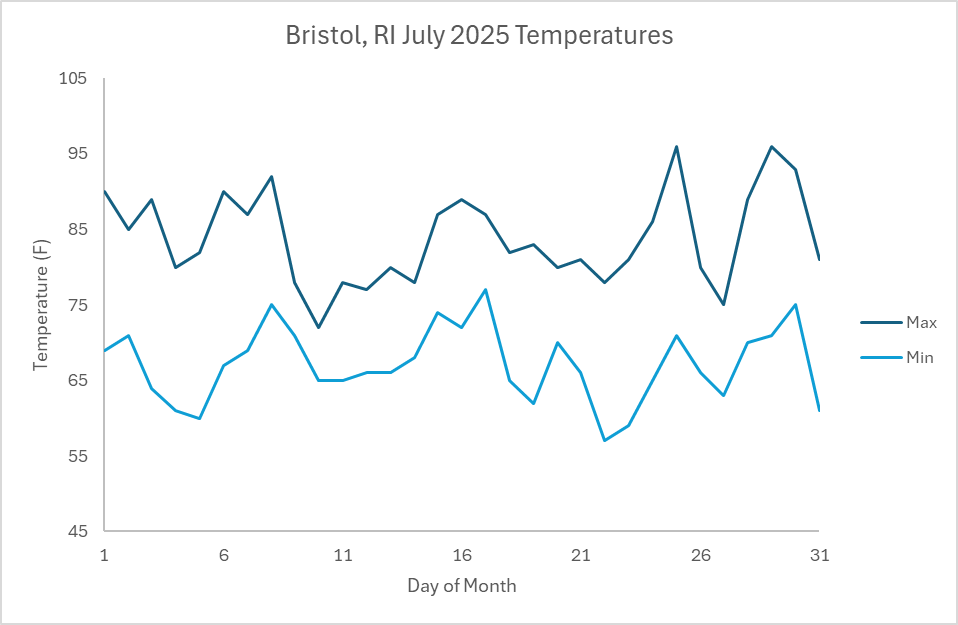
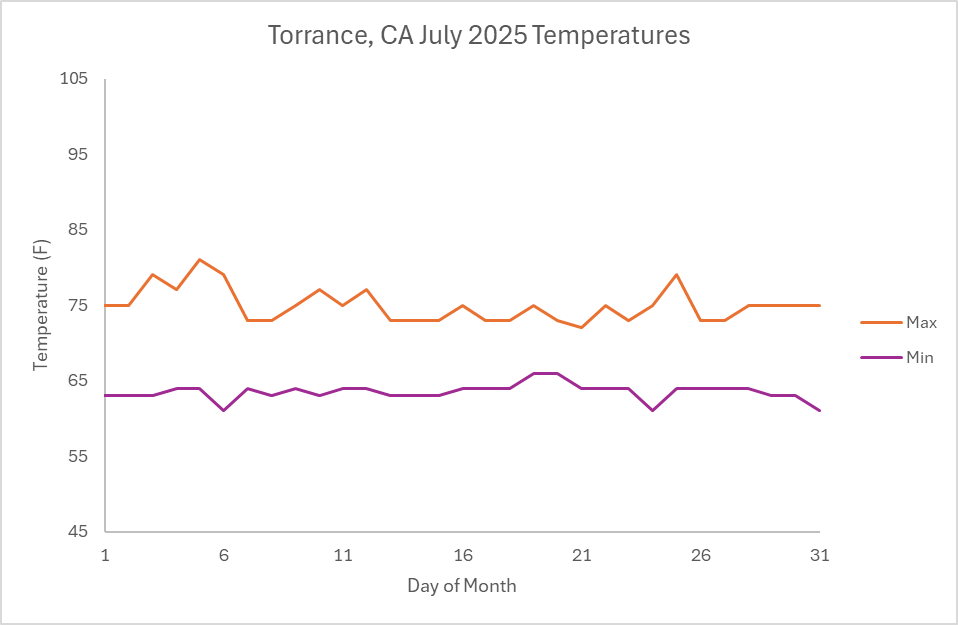
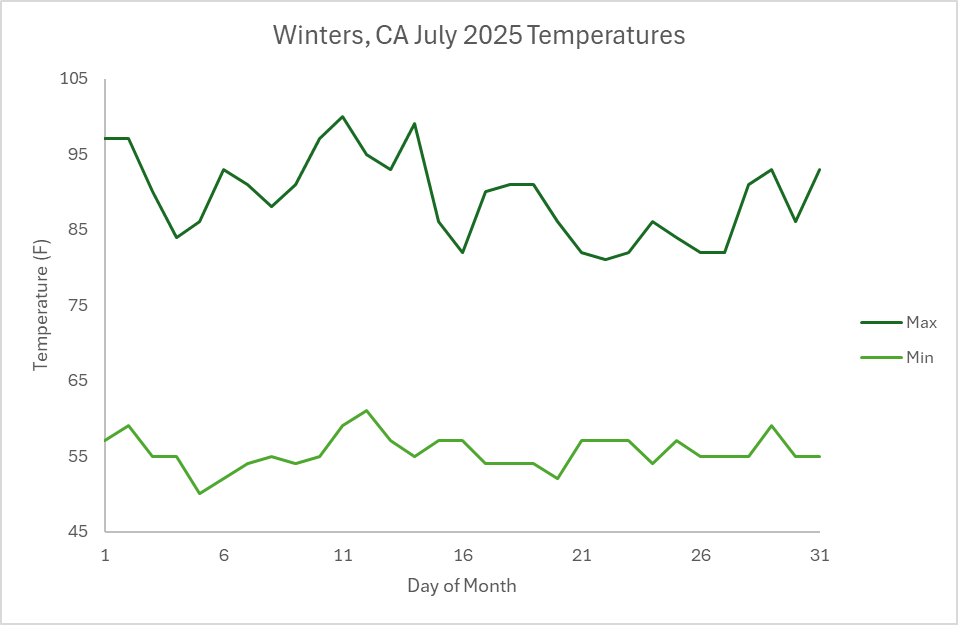
Looking at July temperatures in your area this year, you’re definitely warmer than many parts along the west coast, especially at night. In fact, summer nighttime temperatures anywhere east of the Rockies are going to be higher on average than in much of the west coast.
Compare these three charts with data I pulled from Weather Underground:
Here’s Bristol:


Torrance CA, where Fuyu can maintain astringency into ripeness:

Winters, CA, where the USDA persimmon collection is located:

3 Likes

Thanks for your helpful post. You make a great point regarding night time temperatures.
Even in Northern California, Jiro is slightly astringent when eaten hard.

1 Like

@GrapeNut @ramv We’re diving down a rabbit hole. Here’s Jerry’s observation and my response. But please see my last paragraph so we can get back on track. . . .

Well, I tried to make exactly that point in the Persimmons 2025 thread. Look at Posts 930-931. I wrote:

But then Ram claimed to be in a similarly warm area:

One final quibble: My location is on the coast, facing west. We generally have a breeze coming at us over the water. Summer temperatures here tend to be 5-10 F lower than even a mile inland. So consider data from Bristol weather stations biased high.

Permit me to sum up: We have observations from various observers that various PCNA varieties may be astringent even when ā€œsoft ripeā€ depending on growing temperatures. We need data to flesh out (1) which PCNA varieties show this astringency, and (2) what temperatures produce it.

2 Likes

Which observers? Not me. Once they soften there is no astringency.
I apologize for being so nit picky. It is important to be very clear about defining ripeness. Persimmon can be eaten crunchy ripe or soft ripe.

This video from Marta is worth watching. She detects astringency even in softening PCNA - like Izu.

1 Like

I’ve also been wondering about the effects of hang time, water availability and sunlight on tannin content. It’s my understanding that with grapes, for instance, ripening doesn’t necessarily correspond to reductions in tannins. Ie. ripening quickly in high heat simply leads to very sweet grapes with harsh tannins.

I’m also wondering if this is really a question of polyphenols more broadly, not just tannins. Are anthocyanins also responsible for astringency in persimmons? If so, can cooler temperatures with intense sunlight increase astringency?

I don’t know a lot about persimmon phytochemistry, so I hope these aren’t terribly stupid questions, but I am finding this whole question of how climate affects astringency fascinating, so hopefully more people can provide data.

1 Like

@ramv – See below from the Persimmons 2025 thread. @kohinoor_0612 piggy-backed on your comments, making no distinction between ā€œfirm ripeā€ and ā€œsoft ripe.ā€

I occasionally encounter it in store bought PCNA fruits, presumably from California. Never enough to significantly detract from the experience, but definitely there.

I decided to attempt to generate some ideas by asking ChatGPT to list factors promoting astringency in PCNAs, in order of importance most to least.

I did this with ā€œeyes wide openā€ that ChatGPT often makes mistakes. I’m not taking any of this as gospel. It’s just a way to promote thought.

Here’s the list:

  1. Maturity at harvest. Premature harvest retards tannin polymerization.

  2. Temperature and seasonal conditions. Cool or cloudy weather slow enzymatic conversion of soluble to insoluble tannins.

  3. Sunlight exposure within the canopy. Shaded fruit retain higher tannin levels.

  4. Varietal differences:
    a. Izu, Jiro – very low risk
    b. Fuyu (Gosho), Matsumoto Wase Fuyu – moderate risk if early picked.
    c. Suruga – sometimes shows faint astringency even when colored.

  5. Rootstock vigor. Overly vigorous trees delay fruit maturity and maintain higher tannin levels longer.

  6. Post-harvest handling. Storage at low temperatures can pause tannin polymerization.

  7. Water stress. Stress can interfere with tannin polymerization.

  8. Tree age and crop load. Young trees and light crop loads can produce higher tannin concentrations due to enhanced vegetative vigor.

As stated, I realize that ChatGPT can often be inaccurate, so I take this list with a grain of salt. Nevertheless, I have some thoughts:

– Some of these factors such as #5 (rootstock vigor) impact astringency by affecting the timing of ripening. The grower can adversely influence this factor by fertilizing. It seems, however, that we are controlling for these timing variations by looking primarily at persimmons that are already ripe, whether ā€œfirm ripeā€ or ā€œsoft ripe.ā€

– Other factors such as #8 (tree age, crop load) can impact astringency by boosting synthesis. The grower can adversely impact this factor by aggressive thinning.

– Many factors such as #2 (weather), #3 (sunlight), and #7 (water) impact astringency by reducing polymerization of tannins to insoluble forms. The grower can adversely impact these factors by, for example, planting in shade or providing inadequate water.

– Finally, two factors relate to grower practice at / after harvesting – #1 (harvesting before ripeness) and #6 (refrigerating before ripeness). Growers can adversely impact these two factors in the obvious ways.

Does the mention of any of these risk factors (other than #2, which has been discussed) set off any alarms?

Finally I’ll ask the obvious more specific question: Do growers who perceive astringency have a practice of picking the fruit early and/or refrigerating it. It occurs to me that these may be common practice for commercial, store-bought fruit. The rest of us may think, ā€œI can pick the fruit before it is ripe, refrigerate it until I need it, then ripen it on the kitchen counter. No harm, no foul!ā€ But that could be wrong.