@candyflipper
Please provide more details. I will update the list if necessary.
1 Like
I’m curious what your source is for Chuchupaka heading both male and female flowers. It’s the first mention I’ve seen of that. In fact, some reports suggest it requires a pollinator. But it’s all been very murky, so I’d be glad of any clarifying info you have on that front.
@Richard @Barkslip worked hard getting this list together i hope we continue to maintain the spreadsheets.
2 Likes
My chuchupaka from Cliff produced very heavily last year. No male flowers.
This year it is taking a break. I have another graft of that same piece of scionwood that has a lot of fruit. No male flowers.
Also my large in-ground chuchupaka from Dax has a lot of fruit this year. No male flowers.
2 Likes
Thanks, that’s in line with what I’ve read elsewhere. As always, I’m happy to be proven wrong, but the both sexes claim caught me by surprise.
Several persimmon varieties are known that do not produce male flowers until the tree is older. Taishu iirc is known to produce mostly male flowers after 25 years old, to the point where it is considered uneconomic due to too few fruits being produced.
5 Likes
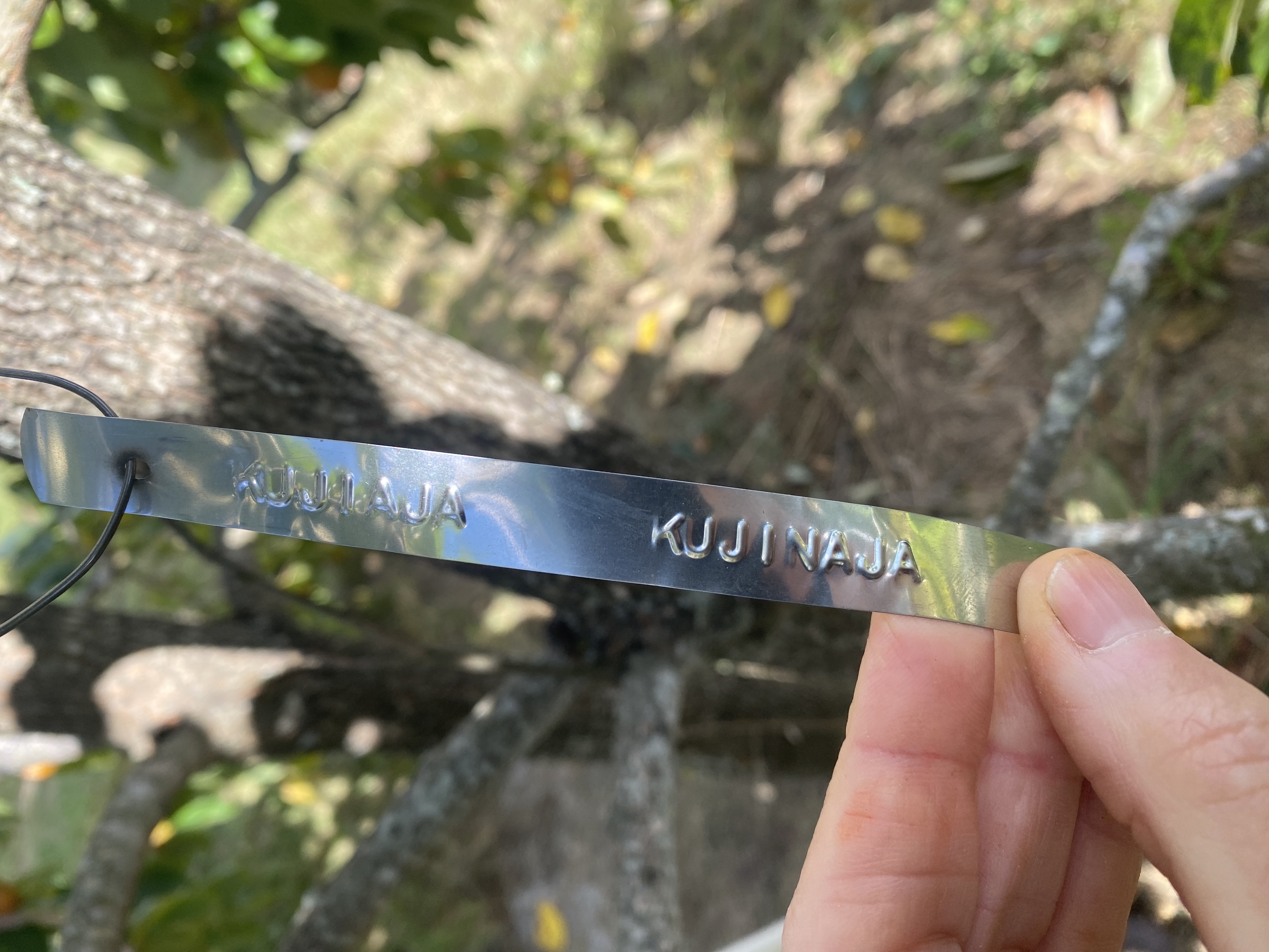
The hybrid PVNA is spelled Kujinaja, attaching the picture of the tree tag I took yesterday at the England’s orchard
6 Likes
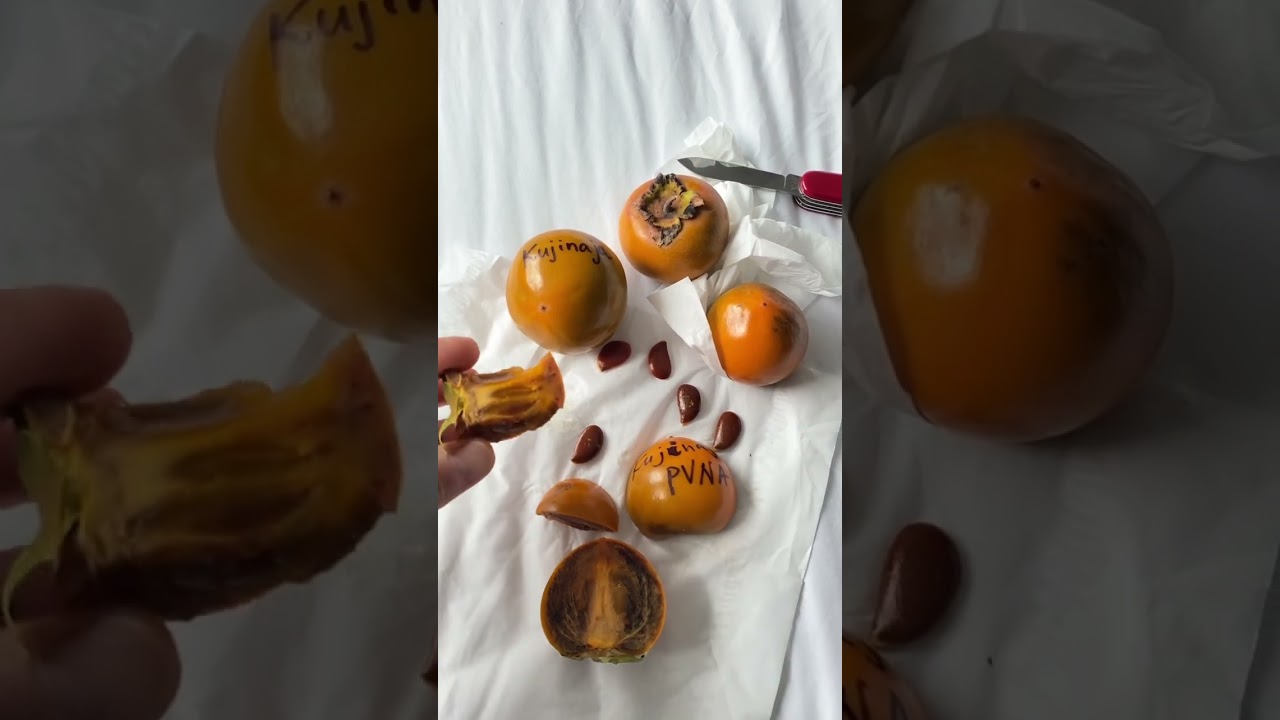
The video of the fruit https://youtube.com/shorts/4Nj-YQUrKPk?si=FuqKT-Ie-D86JtpH
It was hard to believe that this is a hybrid and not pure kaki, but Cliff confirmed to me that this is a hybrid
3 Likes
Reportedly, Kujinaja is a cross between the PVA Kaki Costata variety and a male hybrid Rosseyanka, which makes it a hybrid (though not F1). And while it may have inherited some PV characteristics from Costata, the Rosseyanka parent could not have contributed any PV genes. So Kujinaja cannot be PVNA. It may be a PVA variety, if it inherited the PV gene from Costa, meaning that pollination may improve its eating quality by reducing astringency. PVA is a sort of PVNA-lite.
Edit: See correction below. The cross between Costata x Rosseyanka male is apparently the mother of Kujinaja, not Kujinaja itself. Cliff assumes that the father is another nearby Rossey male. I think it’s more likely another male-flowering variety with the PVA/PVNA trait.
2 Likes
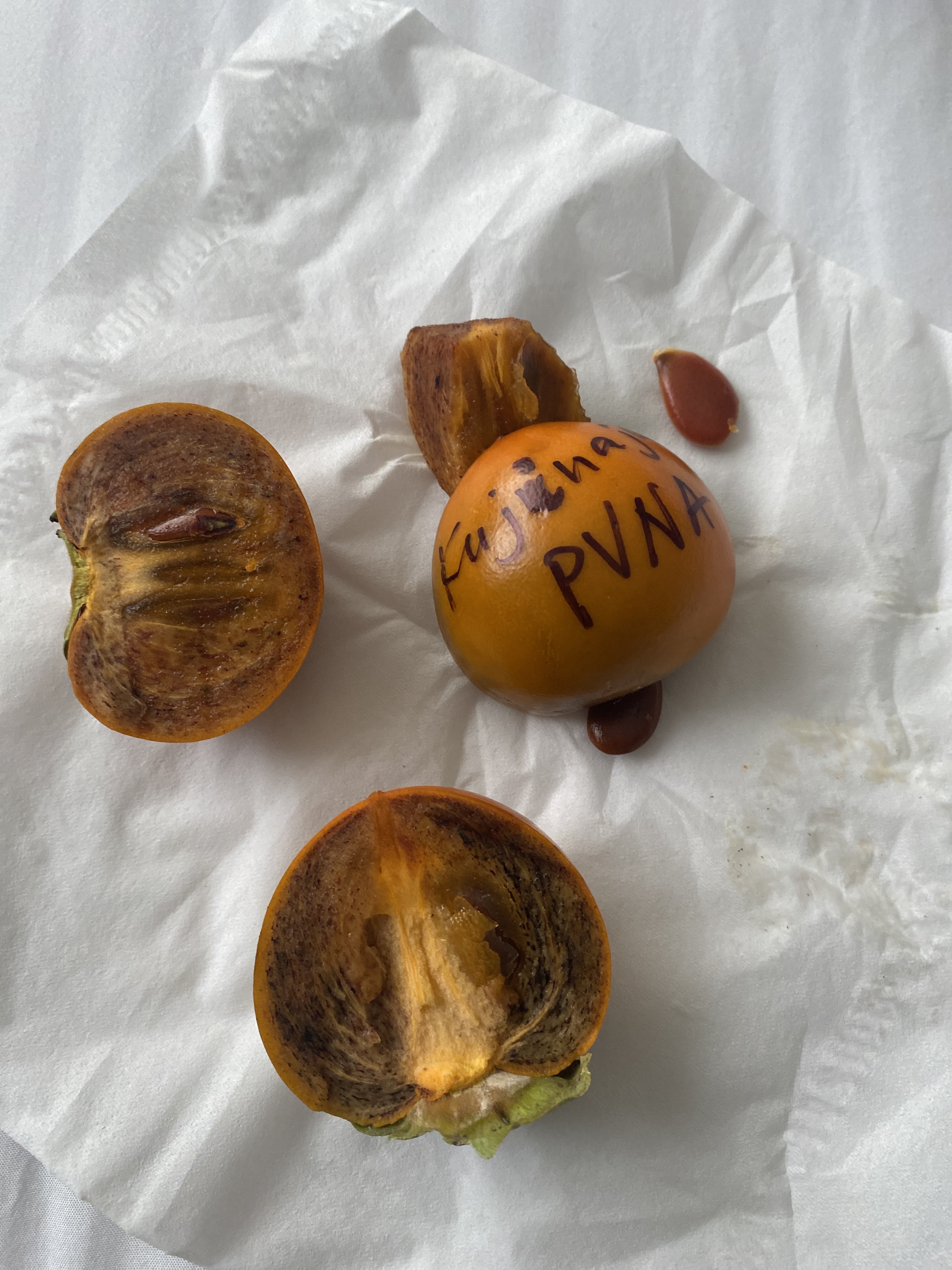
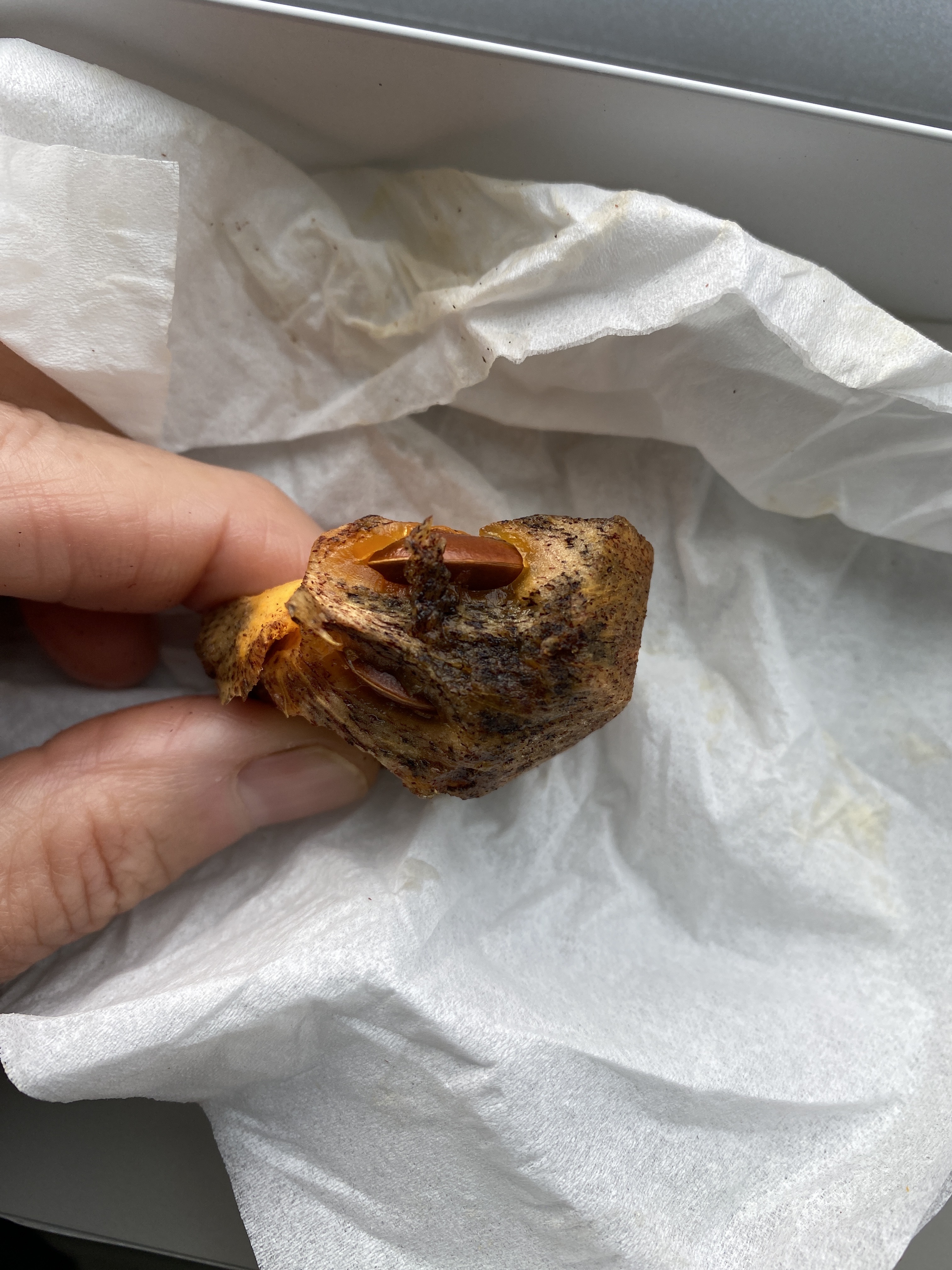
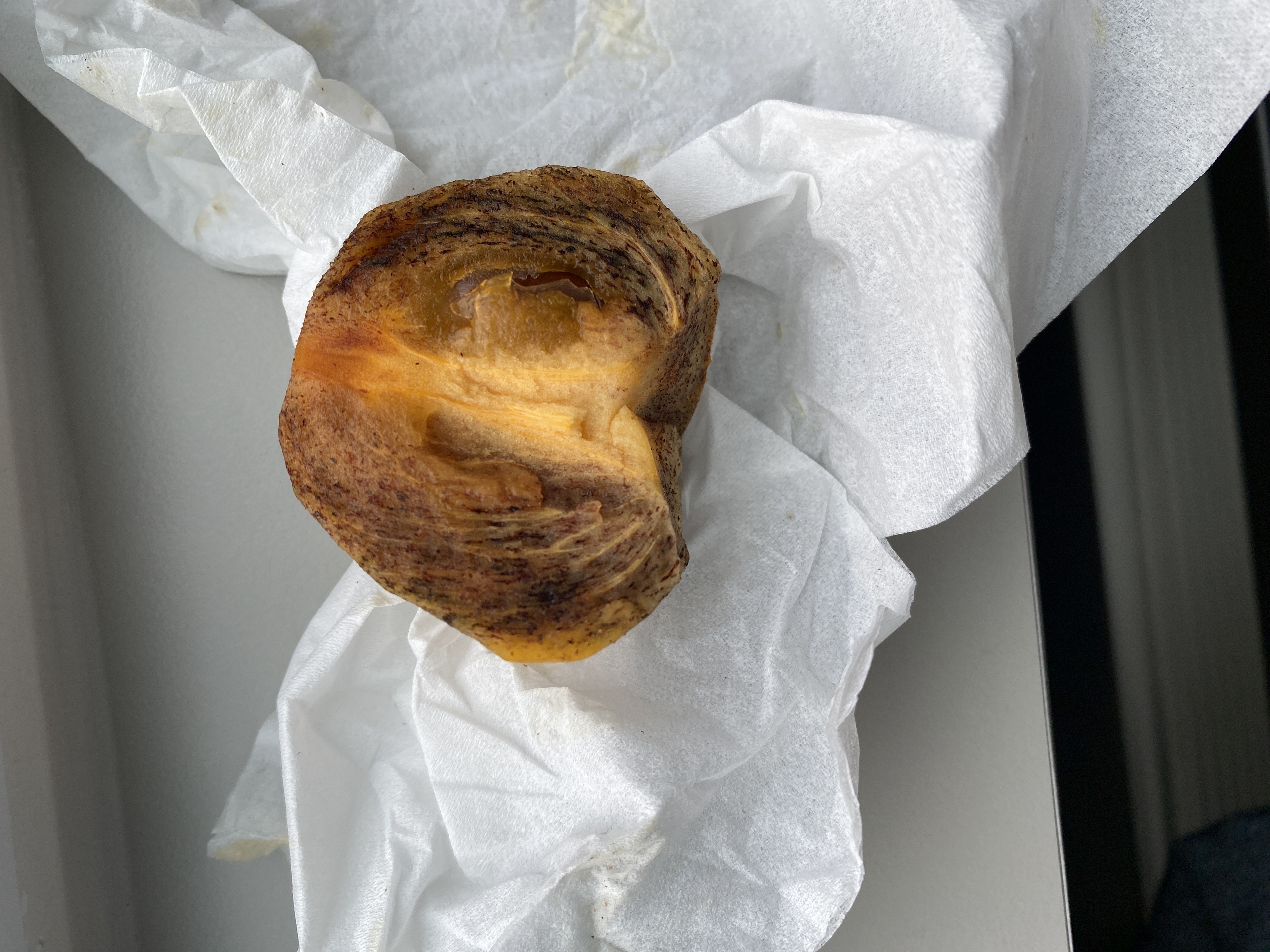
I ate a number of hard fleshed brown inside fruits from Kujinaja yesterday. Some fruits were not pollinated and orange inside and I had to spit those as they were astringent (or so I thought, I tried to spit fast if I didn’t see brown). I’m eating another fruit of it right now
4 Likes
How was the taste compared with something like Coffee Cake or Maru? Equally sweet?
Yes, very sweet and chocolaty. Just smaller fruit. Made another video. I was hoping that I had a non-pollinated fruit with me, but no. I tried to pick yesterday those that were brown on the outside too
4 Likes
My graft of it failed this Spring. I may buy the scion from Cliff again to test the cold hardness in Z5 Omaha.
Tony
Maybe you can ask Cliff what he thinks the parent varieties are?
Notes:
-
It’s never been proven that the PVNA gene has any impact in hybrids with partly DV metabolism. It that’s what’s happening here, it would be a monumental discovery.
-
Costata is not PVNA. If Cliff’s Kujinaja is PVNA, then the obvious question is: Where did Kujinaja gets the PVNA genes? I don’t see a plausible answer other than: Not from the female Costata (which is PVA not PVNA) or the hybrid Rossey male (which is not at all PVA/PVNA) . Of course, some PVNA varieties (e.g. Chocolate) are notorious pollinators. I have to wonder if there is any chance that some actual PVNA variety is the actual pollen donor. That would mean that the actual cross is Costata (female) x PVNA (male), which would mean that Kujinaja is 100% kaki.
Can we prove paternity? Is it plausible that there is a PVNA male pollen donor?
Your evidence seems to verify that the variety is PVNA. If it is a hybrid and is PVNA, then we should execute more Hybrid x PVNA crosses because this category of cross would seem a very direct route to cold hardy non-astringent hybrids.
1 Like
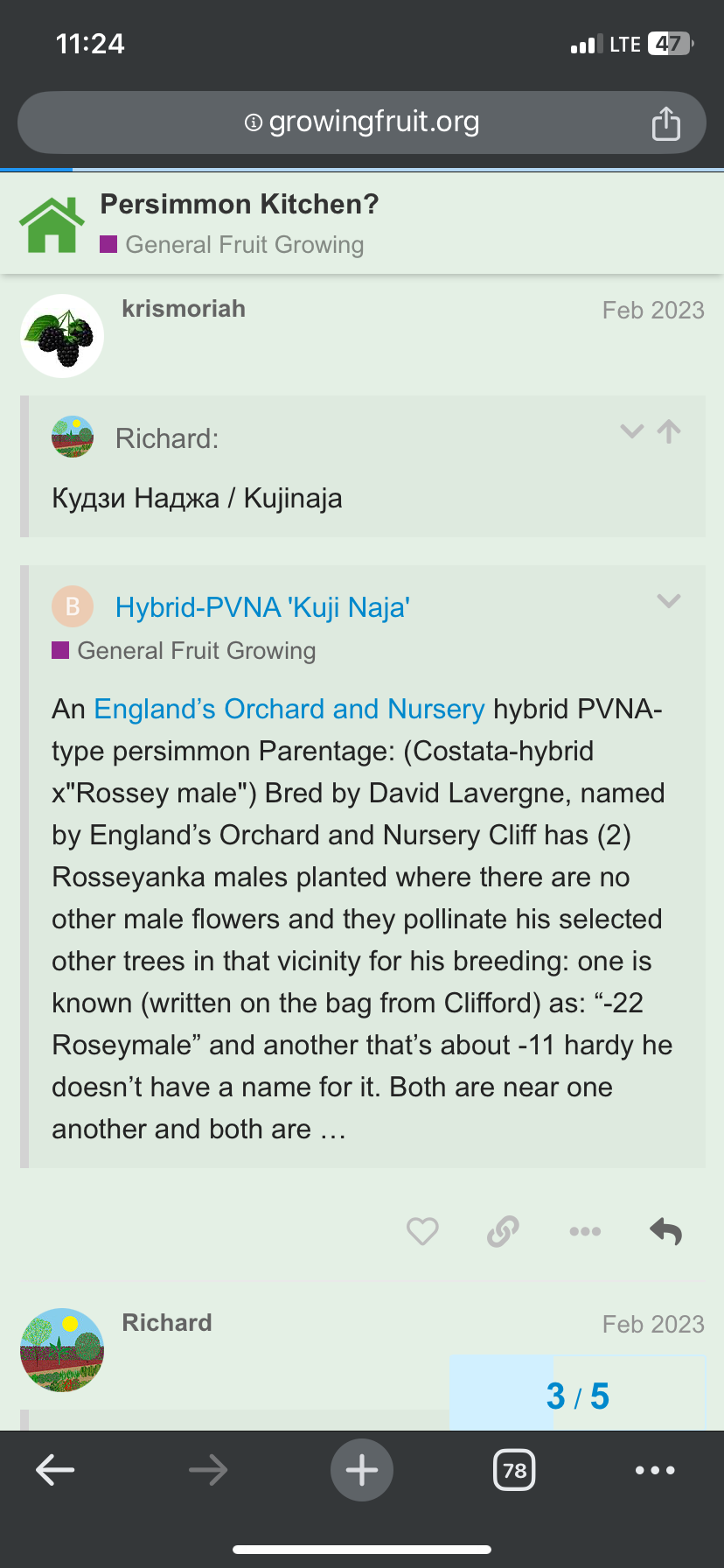
It seem it was Costata hybrid (? With what species) with Rossey Male, see screenshot from another thread
1 Like
I’m not here to argue, but to learn. That said, in your statement above -
It appears there are some assumptions made about your understanding of heritability and genetics in general which don’t correspond to what appears to be reality. There is so much more at play than I believe any of us have the ability to understand within the current bounds of scientific knowledge. I’m hopeful the work being done to sequence the genome will help us understand more.
More or less, I’ve come to understand that PVNA and PCNA are likely to be inherited by parents expressing those traits, but in some cases, there are a few very special outliers ‘we’ cannot explain with current information.
I’m no geneticist, but it would appear that planting more seeds will continue to get us better fruit, so that’s the plan! Cliff and many others have done some fantastic work already.
My Taishu produced male flowers at the very first flowering in the ratio of 1/3
(male/female) two years after grafting. It keeps this ratio 3 years in a row.
4 Likes
Can you name the exceptions? I’ve seen a lot of exaggeration, mischaracterization, and hype over the years about specific names. For example, some people claimed that Morris Burton is non-astringent. That claim is clearly false.
Can you point out where my assumptions contradict reality? There is one detail about PVNA genetics where I rely on my own inference, but not assumption. Specifically, it seems clear to me from published reported of the results of experiments crossing persimmon varieties that (1) the PVA trait results from the presence of 1 PVNA allele (out of 6), whereas (2) the full PVNA trait results from the presence of 2 or more PVNA alleles. Costata (PVA) presumably has one PVNA allele. So my question boils down to: Where did the other PVNA allele come from? Not Rosseyanka!
Finally, it appears from Richard’s excerpt above that Kujinaja is not itself a cross of Costata x Rossey Male, rather that (a) this cross is the mother and (b) Cliff claims another Rossey male is the father. Two follow up points: (1) This clarification makes it even less likely that the PVNA trait was passed down from Costata to Kujinaja; and (2) Cliff did not pollinate the mother himself! Rather, he is assuming that one of the nearby Rossey males supplied the pollen.
It seems much more likely that the PVA variety Costata supplied one PVNA gene and any one of a large number of male-flowering varieties (not Rosseyanka) supplied the other. Ask yourself: Which is more likely: (1) Kujinaja is a miraculous exception to the laws of genetics, as we understand them; or (2) some make flowering Kaki PVA/PVNA variety slipped in some pollen?
Re your final point, I totally agree. Planting more seeds will likely produce better fruit. This is a great example – if Kujinaja turns out to be full PVNA, tastes great, and has any other desirable traits such as cold hardiness, then that’d be awesome. My quibble is just that it is likely to be 25% Rosseyanka, not 75% as Cliff assumes. That would make it 12.5% DV and 87.5% Kaki, with an unknown Kaki pollen donor.
1 Like
All I can say we need the species specific DNA markers. If I get time, I’ll work on it
1 Like