Major problem with Geneva rootstocks?

Little video I watched on the various rootstocks.

some great data to look at comparing rootstocks

Looks like G.890 in this trial made consistently large fruits and higher yields than other rootstocks, though it is less efficient with the space.

The guy in the video said it is precocious, but I am sure that still means 2 -3 years to come to bearing.

1 Like

Less efficient with space?

Yeah, they have a lower canopy to fruit ratio. More dwarfing rootstocks like g.11 or g.41 will have more productivity per square foot.

I thought I would chime in again about g890. I responded about it in another thread also. I have about 40 trees on G890 between 2-4 years old. About 20 of them are in an area of my yard with poor soil. Only a few inches of topsoil, then a few inches of clay, then very hard subsoil. I did not stake any of them and all are doing well. I have heavily mulched all of them every year. All of them are kept at about 8 feet tall.

For the first 2 years I kept them watered whenever we’ve had dry periods.

I don’t think I had any failed grafts.

5 Likes

I grafted five G30 rootstocks about 10 years ago. All but one have snapped off clean in various high wind events, half with no fruit load.
Additionally I don’t find G30 to compete well with the turf type grass at my farm, even when regularly mowed.
I’ve since switched to M111 and Antanovka but haven’t had any high wind events since to compare with.

1 Like

Same here, I have just about all M 111 and have not had any snap off at the graft area. We have had a lot of high winds over the years and no issues with the M111’s with those winds.

Not been active here lately, but wanted to pop in to report that I just had a third leaf Victoria Limbertwig, cleft grafted to G.969, snap clean at the union in a heavy rain—not even bad wind. The tree was pruned openly, kept low, lightly staked with heavy bamboo, and had three or four small apples that I looked forward to sampling.

I’ve got several trees on these damned stocks—also G.202 and G.890. Well, I started experimenting with a few M.111/Bud.9 interstems this year. And it looks like I’ll be ripping these bastard things out and replacing them with those. It’s a setback and a horrible disappointment—and I really wish I’d listened to the earlier warnings.

Well, here’s another warning on the pile: Avoid the G series rootstocks! Apparently, many of the series have brittle graft unions—and not just when budded. Shame on Cummins for peddling this garbage.

2 Likes

I’m new to this, so I don’t have experience to be upset as you are. But, I was irked as I got Triumph on G.41 from Cummins this spring, and then I learned about some of the graft failure issues. On their website, it says they know it’s a problem and because of it, they exclusively graft whip and tongue to G.41. Except, mine is definitely bud and they confirmed that. However, they took no issue with the fact it was grafted wrong and just told me to stake it…hoping for the best.

Those are some lousy business ethics on the part of Cummins. I would’ve demanded my money back. They sent you a plant prepared contrary to their very own guidelines . . . and then had the nerve to tell you to just deal with it.

Not that a regular graft necessarily would’ve been strong either—since we’re seeing reports of those failing, too. Anyway, just off the top of my head, there are reports of catastrophic union failures with G.969, G.890, G.202, G.11, G.935, and of course G.41—and I wouldn’t be surprised if there are more. Maybe it’s a virus sensitivity issue. Many of the breaks (including mine) are clean and flatish, almost (as another member, I think, once put it) like an asparagus spear that’s been snapped off. And that definitely suggests some sort of incompatibility issue. But even if the incompatibility is latent virus-based and can be avoided by using virus-indexed scions, that makes the stocks (whatever their virtues) useless to most home orchardists, and probably to many commercial ones, too.

Cummins must be getting more and more complaints because they’re starting to hedge their catalog copy. Regarding G.969, they now say:

Recent trials suggest that G.969 develops a brittle graft union with the following varieties when chip budded: Chestnut Crab, Cox’s Orange Pippin, Cortland, Fuji, Jonagold, Sansa, Wickson Crab. This issue can be avoided by using whip and tongue grafts.

[Color me skeptical regarding that last sentence. Why would a well-healed whip-and-tongue be stronger than a well-healed cleft? And why would a rootstock that makes a brittle union with chip-buds not also make an at least somewhat brittle union when grafted using other methods?]

Regarding G.890:

Although we have had no reports of virus problems, we do strongly recommend that only virus-free scion wood is used.

[Gee, wonder why that might be?]

Of course, they still tout both as free-standing stocks. (Not that permanent support would necessarily save you either, as we have reports of staked and trellised Genevas snapping.)

I guess I feel lucky that I only have 12 or so of these stupid things planted out—and am only three years in. Others have taken much, much harder hits (see, for instance, @Chikn’s horrible experiences above). And at least I learned a couple of hard lessons, which are: 1.) Never believe the catalog copy of any business, however supposedly respectable; and 2.) if you care about results (for instance, you want to grow fruit for yourself and those you love, and are not just looking to ā€œexperimentā€ for the sake of novelty and diversion—not that there’s anything wrong with that, if that’s what you enjoy), then stick to what is tried and true and don’t waste your time, money and energy trialing something untested . . . even if the copy sounds great.
3 Likes

FWIW I have 40+ M111/G.41 interstem trees, mostly whip-and-tongue grafted myself. So two W&T grafts against the G.41 interstem piece per tree. When the winds from Hurricane Helene came through my area it was by far the worst I’d seen, at least in the ~10 years since I’ve had a home orchard. A dozen or more trees were blown down and essentially laying flat on the ground. Luckily none broke either at the graft union or elsewhere.

A few where I only had very small scion wood were splice grafted, no tongue. Time will tell if any of those give me grief in the future…

After the Helene wind event last year I did have one tree snap this spring. The G.41 interstem piece broke in the middle, between the two graft unions. Pretty sure a turkey buzzard landed in it and being a young/small tree was more than it could support.

Hate to hear of others issues, just wanting to point out though that it’s not all doom-and-gloom.

3 Likes

No doubt. Some will probably never fail—and I hope your trees continue to do well. Perhaps only certain viruses or soil conditions or a certain something else causes the weakness, and where that’s absent, there’s no problem. For my part, though, I’d rather just start over with some of these cultivars than risk having a tree load of apples snap years down the road. The Victoria LT shearing off like that just doesn’t bode well for G.969 here—especially when considered in light of numerous reports of similar Geneva failures. I’ll probably leave a couple of other G series stocks in place, though, just to see what they do. I will never plant another one, though.

2 Likes

Just curious, is geneva really that much better than Bud 9? I have several of each (Bud 9 and G11) but my backyard orchard is young and I haven’t seen enough to compare them yet.

I haven’t had any issues with g890 yet, but they’re still only a couple years old. They were all W&T’d by myself. I probably have a couple dozen of them.

2 Likes

I have close to 200 trees on Geneva root stocks and only 1-2 graft union failures.

4 Likes

It probably wouldn’t.
But it WOULD be stronger than budding, and that makes perfect sense to me. Why? You’re actually setting wood from one onto wood from the other

With chip budding there’s almost nothing cambium from the scion, if there is some sort of incompatibility between the rootstock and that cambium it would obviously be weaker than a stick inside a stick that had tissue grown entirely around it (maybe the lack of uniformity/asymmetry also makes cleft grafts weaker)

1 Like

Question- I have the triumph chip bud grafted on G.41 in a container. When I repot it, should I burying the graft union? Can you do that and not suffocate the roots?

I am very happy with the M111/ B 9 interstem. I like the size and growing abilities of this rootstock combination. I wish I had used these in my entire orchard.
I did plant two G890 and one G969. Not that I wanted to but that was the only rootstock that was available with the apple variety I was looking for. It is more of an experiment than anything else. I have had not too good of luck with the G series rootstocks. Very runty with two of them. Only one has done well and looks okay. I have two others that are just doing okay but I like the size of them and I get enough fruit to keep them in the ground.
Like someone stated Cummins makes a lot of claims about how great the G series is.

3 Likes

Hey @MikeC so you have any pictures of your interstem trees? I’d love to see how those look and know the benefits, very intrigued by the idea

2 Likes

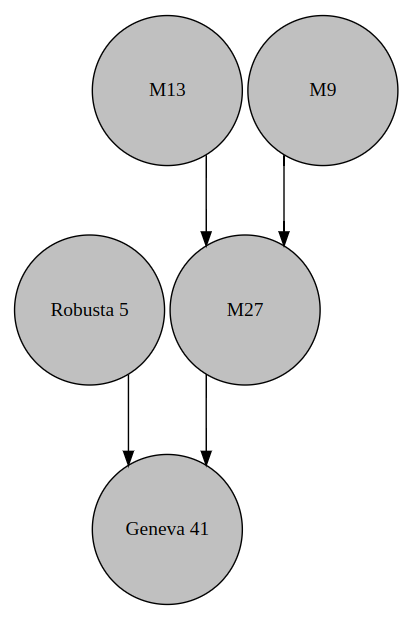
Is there a correlation between the rootstock’s parent’s virus sensitivity, and/or brittle graft union? I think M.9 and Robusta 4 or something were parents of most of them?

I had never thought to look that up… But then an apple rootstock, is simply an apple tree… So stands to reason the apple pedigree tool on NAFEX might have them. I use and like G.41 and according to them:

image

1 Like