It may be difficult to incorporate more peat, if you have planted already. Half peat is a good amount already. I would take the above recommendation and fertilize with ammonium sulfate. It will over time help to keep the pH low and there is no danger of build up of aluminum (which can be toxic) and no risk of getting the pH too low. You could also add a little more elemental sulfur (maybe one tablespoon per plant, incorporated gently into the top two inches. But you have to be careful to not overdo it, because sulfur can lower the pH to extreme low levels. I would also heavily mulch, a mix of pine wood chips and needles would be ideal (lowers the pH, preserves moisture), but any wood chips will do.
1 Like
I bought some cheap ph paper off amazon (Short range ph paper) and use it all the time. I used to be carefully measuring the soil and water but after someone told me it is not likely to matter, I found it really didn’t. I just take the dirt, mix with water, let it sit for 30 min (I mix a couple times if it’s a lot of stuff) then test.
If I’m feeling fussy, I do have more accurate ways of testing, but the method above has been plenty accurate for plant growing purposes when I’ve checked.
The water test strips that also have ph and hardness etc can tell you about the buffering thing if you have those. But they are annoying and harder to read for ph.
2 Likes
Ok, good to know. Should I worry about the nitrogen getting too high though if I already put down the bloodmeal? I have access to plenty of ammonium sulfate with my husband being a farmer but it’s pretty strong stuff! 
Not precisely. I tested a couple years ago and it was slightly alkaline I believe, but again, I watered very little last year. But maybe it was still enough to build up.  We have our own well which is close to my garden so I would think it would be about what my vegetable garden tested.
1 Like
I think this virus I’m currently battling must be frying my brain because I completely forgot I did have a different company test that raised bed last year. It showed the calcium in the medium range. I did fertilize with HyBrix Fruit and Berry fertilizer since then as well as the fast acting sulfur.
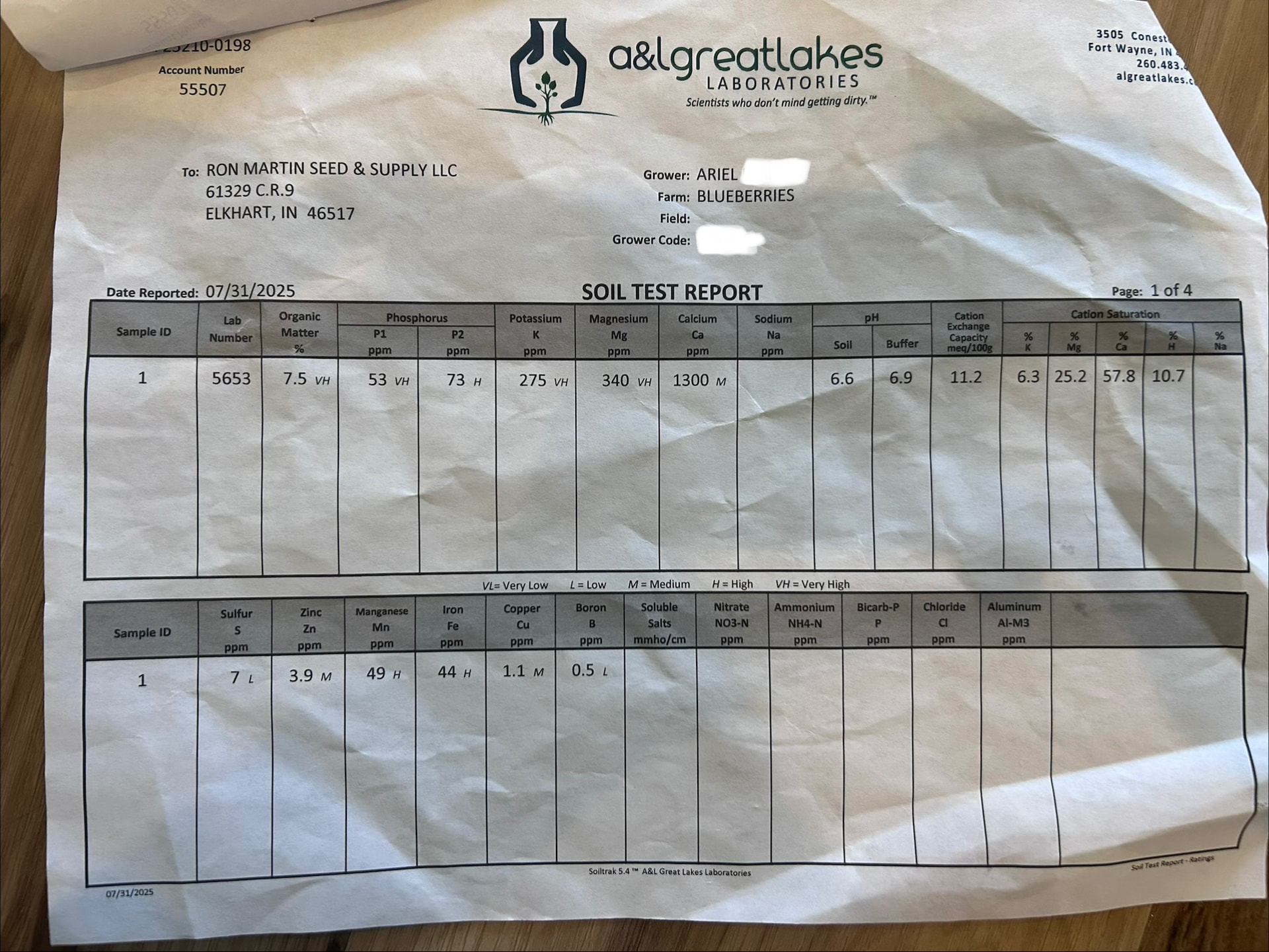
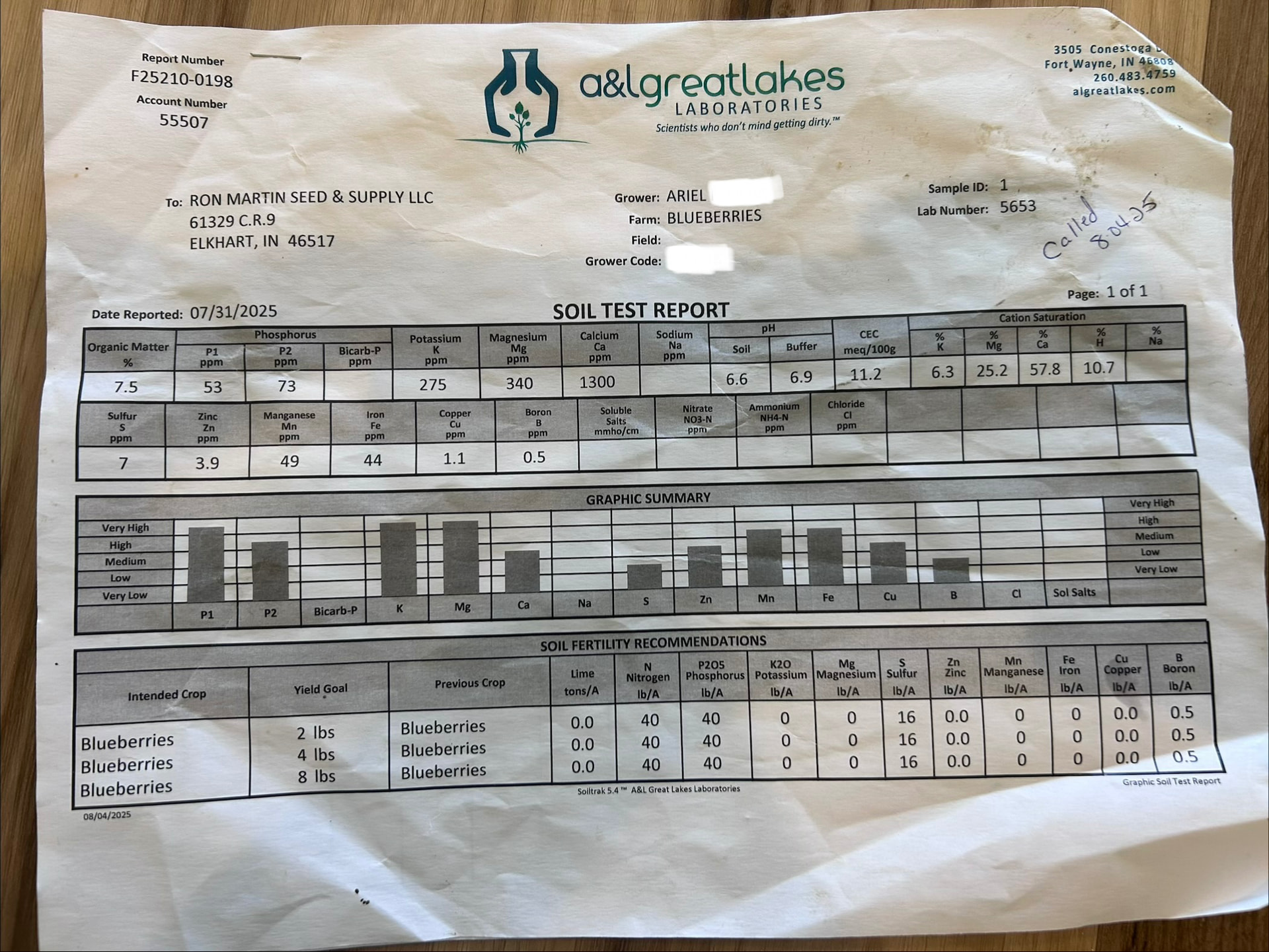
I would just use ammonium sulfate in regular fertilizations from now on. Your Blueberries are probably going to tolerate 6.2 pH, with all the peat moss in there, you’ll just want to lower pH over time.
2 Likes
Peat moss releases organic acids, as it degrades, and the sulfur that you added will be over time oxidized to sulfuric acid. These effects create micro pH gradients that support nutrient uptake by blueberries. Or said simpler, there will be pockets in your soil that have lower pH, where the blueberry roots have optimal conditions.
2 Likes
I’m with you there! The soil I put in my blueberry beds has a natural ph of 6.8, and my well water 7.8. I hope to eventually have rain barrels and a small pump to move the water to the blueberries, but until then I’m going to avoid watering as much as possible and pray that the elemental sulfur and ammonium sulfate act quickly. I’ll also experiment to see if I can lower my water’s ph with vinegar so I can water them without hurting them (I have 5g buckets with spouts that I can use).
In the meantime, I had a new blueberry’s leaves turning red, and I gave it a gallon of liquid fert (mixed with water at about 1.5x normal concentration), and the reddening stopped. I’m going to give it another gallon today to see what happens. I’m hoping the easy-access fertilizer will pull it through.
I didn’t have much choice, as I was going to container them until I could get the soil right, but we ran out of money, and soil for blueberries is EXPENSIVE.
1 Like
Would you happen to know anything about the Coast of Maine acidic loving plant soil and/or more southern Ohio soil types? I am located in south central Ohio and filled in both my blueberry plants’ holes with the CoM soil and when I water I use creek water. This is my first year growing blueberries, or much of anything perennial honestly, so I’m not sure how well they’ll end up liking everything but I have high hopes, just figured you may have some insight.
Both my berries are red-leaved. Is this a sign of nutrient deficiency or something of that nature? I was told that directly after transplanting blueberries that their leaves can turn a little red due to stress so I was hoping it’d go away on its own, should I be giving them anything special?
I don’t think adding vinegar to your water will help much as it will only lower the pH, but the carbonates which cause your problems will still be there.
We would burn up carbonates in irrigation water by using and injecting pure sulfuric acid. It’s over kill for a home owner and has some hazardous concerns to the user and their equipment.
I’ve been watching Market place for Reverse Osmosis units for my maple syrup production. You can find them used around $150. People use them for fish tanks. You could fill a barrel or use it for drip irrigation if the flow is great enough or with a small booster pump. It will remove the carbonates and iron.
7.8 pH is pretty high and is probably pretty hard. We would treat water from irrigation runoff ponds that would often be pH 8 and tons of carbonates due to the limestone beds the plants sat on.
My experience with red/purple leaves signal the lack of phosphorus, but I don’t know a lot about blueberry production.
My blueberry leaves (they are newly planted from Park Seed) also turned very red. They were clearly grown where it was much warmer than here as they already had berries on them and the one bush that I had (same variety) was just leafing out. We had some cold nights (one was below freezing) so I imagine that’s at least one of the reasons. Cold soil can inhibit phosphorus uptake.
Something that I’m hoping to play around with is some Korean natural farming and Jadam organic farming things to hopefully help give the soil a boost and start working on that sulfur faster. I have zero experience with any of it so I can’t say it will do anything but it makes me feel like I’m getting the ball rolling faster!  I have some Jadam Microbial solution brewing currently.
I’m no expert, but this is what I’ve read:
It’s a sign of stress, and is normal for a bit after transplant. However, if the PH is too high, it can cause stress because they cannot get the nutrients they need, which will cause red leaves as well. I had a blueberry in-ground that always had mostly red leaves, no matter what I did. When I finally found a ph and nutrients test kit that works for my clay soil, it said the ph for that blueberry was 6.0, so I know my efforts had some effect (soil going in was 6.5); nitrogen and whatever bonemeal gives were near 0. That blueberry died last summer because I forgot to water it due to more pressing responsibilities.
For my new blueberries, I added way more sulfur this time, and am hoping to keep them alive until the ph level drops. I am afraid to water them because of how very alkaline our well water is, so I’m doing my best and praying.
It is hard water, yes. We have a house filter to help with the worst of it, but we don’t have an RO system, nor do we want one. Rain water collection is my plan for future when I can save up for the container and figure out a pump (our house is 120’ from the blueberry patch, and is the closest roof).
My goal with the vinegar is to keep the water from raising the ph; I know it won’t make a dent in loweringc it. There is an in-line filter for the hose that’s also supposed to help with the calcium. I’m hoping it will all work together to keep the blueberries alive until next year, when I will hopefully get a rain catchment system in.
You can try citric acid which is available at grocery stores (with canning supplies) and is a bit stronger than vinegar.
Sulfuric acid is difficult to use with small volumes of water so I’d avoid if but if you can get it in pool supply stores.
1 Like
Last year I took the leap into trying sulfuric acid in my containerized blueberries. Our soil here (a former corn field) is ph 7+ so my several years of attempting to use heavily peat-amended (ph tested to make sure it was truly acidic peat) soil, and vinegar, resulted in nothing but slow decline and death for several blueberries.
Last year I bought the drain cleaner sulfuric acid at local ace. I had a 5 liter lab container (HDPE I think?) that I filled with rainwater, and added I think it was 100ml acid. So that was 1/2 percent acid by volume. That gets it down to a dilution that felt pretty safe to work with in large and awkward volume, to me. I’d further dilute it by mixing it in a watering can, in no particular ratio. Possibly 1/4 acid water to 3/4 rainwater? That step was very ad-hoc each time. I used this to water 8 container blueberries, plus an in-ground azalea. At the same time I sprinkled on some pelletized acid plant fertilizer I got at Lowes I think.
The beneficial effect was nearly immediate, in my eyes. All the plants greened up and put out fresh growth last year, the likes of which I’d never seen from any of them previously. Before that each year they looked less vigorous than the last year, and most of the blueberries left were almost certainly within a couple years of death. The blueberries sent out new canes, and the azalea put on new leaves last fall, and all flowered this spring, which the azalea had never done in the previous 3 or 4 years I’d had it, and the blueberries only meagerly, and less and less each year.
So, all this to say, I’m a pretty strong believer in sulfuric acid now. It appears very quick to take effect, though, the addition of fertilizer at the same time weakens the causality link. And the acid does come with it’s risks of course. And there’s still the question of what precisely is in hardware store drain cleaner acid. But now that I’m convinced it works well and doesn’t take a lot, I’d be more willing to spend more money for a more pure acid.
My take-away is to reinforce what folkert and others have said - I don’t think you need to change the entire soil bed to acidic. I think the blueberries get the critical otherwise-lacking nutrients from fairly localized ph changes near the roots, which are attainable fairly swiftly with pretty dilute sulfuric acid, from what I’ve seen.
2 Likes
If you add vinegar, the vinegar will protonate the carbonate to carbonic acid, which will fall apart to water and CO2, the latter is a gas and will dissipate. You end up with calcium acetate and a lower pH.
Oh interesting!
I have some sulphuric acid on hand from titrating pH in aeroponic setups (though not as professional as that word makes it sound) and might try it if I get chlorotic plants again this summer. I’d never seen any guidelines for garden use other than ‘it theoretically works, but don’t try’, so your experience is very helpful!
Mine was labeled ‘battery acid’ from the auto parts store. I keep a tiny little pipette with it and use it by the drop. 1-2 drops drops the pH of a gallon of my RO aeroponic water by around one point of pH. It will probably do less on my very hard well water.
You would ideally use a pH electrode for careful pH monitoring, while you add sulfuric acid. That is because using such a strong acid, you run the risk of getting very low pH. Acetic acid is a weak acid, but strong enough to remove carbonate, and there is no risk of getting very low pH.
Isn’t the problem with acetic acid that it breaks down quickly and the ph goes back to where it was? Versus sulfuric acid permanently changing the carbonate to gypsum?