I suspected as much.
1 Like
I have never had an MM111 lean. Maybe I dont have that much wind here.
2 Likes
I am sorry to hear about your M111/M9 rootstocks. I have 5 of those rootstock combinations and they are doing great here in my orchard. I wish I had more of the M111/M9 apple combinations in my orchard. They are the perfect height to spray and to pick the fruit from. No ladders needed. None of mine are straight and not leaning at all. My M111 are straight as well. The only rootstocks i am having issues with are the M7’s. One was almost leaning at a 45 degree angle, like your M111/M9 rootstocks. I had to brace it back up with a thick wooden stake and put it angled back up to almost upright. If I had pushed it upright any more than what I did I was afraid the trunk would break. Another of my M7 rootstocks is leaning now as well, just not as much. Hopefully I will not have to brace that one up as much.
That performance really means nothing about M111 by itself. The combination subdues root growth enough to create a dwarf tree about the vigor of M26. A dwarf tree is a weak tree. Its top growth is a direct result of the relative vigor of its root growth.
It is very interesting how an interstem is able to do this- I don’t remember ever reading about the science of it. The difference in inherent vigor of scion varieties is easier to fathom- the more a variety concentrates on early and heavy fruiting, the less its relative vigor.
I would guess that the interstem restricts the flow of carbos to the roots somehow.
2 Likes
I’ve got Redfield and one other apple on M111 that are leaning.
(The Redfield took 6 years for the 2-year bare root at planting time to bloom.)
The other one still hasn’t. Actually have one that I bought in a tree pot that is almost straight, and it’s on M111. My older M111’s seemed straight before they died or got cut…planted 1992 to 1977.
I think every M7 I’ve ever had leaned some, but I did not straighten any of them, and I’ve lost none to falling or breaking.
Part of the issue is the loose dirt in the planting hole, then the breezes from the prevailing direction hitting pretty hard.
Still, same location, seedling and Antanovka rootstock trees are straight.
3 Likes
I just planted two G890’s this year. I hope they do not lean or have any other issues. I took a chance with this rootstock. My other G series rootstocks were not very good. Runted.
1 Like
I only have one tree on G890 in-ground, others are still in 2 and 3 gallon pots, a couple 5’s.
Had some trees that failed to leaf out, or died after leafing out this spring…on various roots…I think it stems from damage from the X-mass ‘flash freeze’ last December.
(Losses include Jefferies and Triumph on G890 and Red Astrachan on Antonovka…all 2021 grafts I think.)
1 Like
Lucky you, no golden delicious!
Time to graft it with something good like Pink Lady or @SkillCult 's awesome new Red-Fleshed apples! Or a Clark’s Crabapple! I want that one too!
1 Like
Are you able to keep MM111 productive and at 10-12 feet tall? Enough for me to pick with a short ladder.
I’ve mostly dealt with dwarf apples, but I have 2 on MM111, since that was the only rootstock I could get them on at the time (Crunch a Bunch and Baker’s Delight). They are planted at a rental, maybe 12’ apart, next to the parking area.
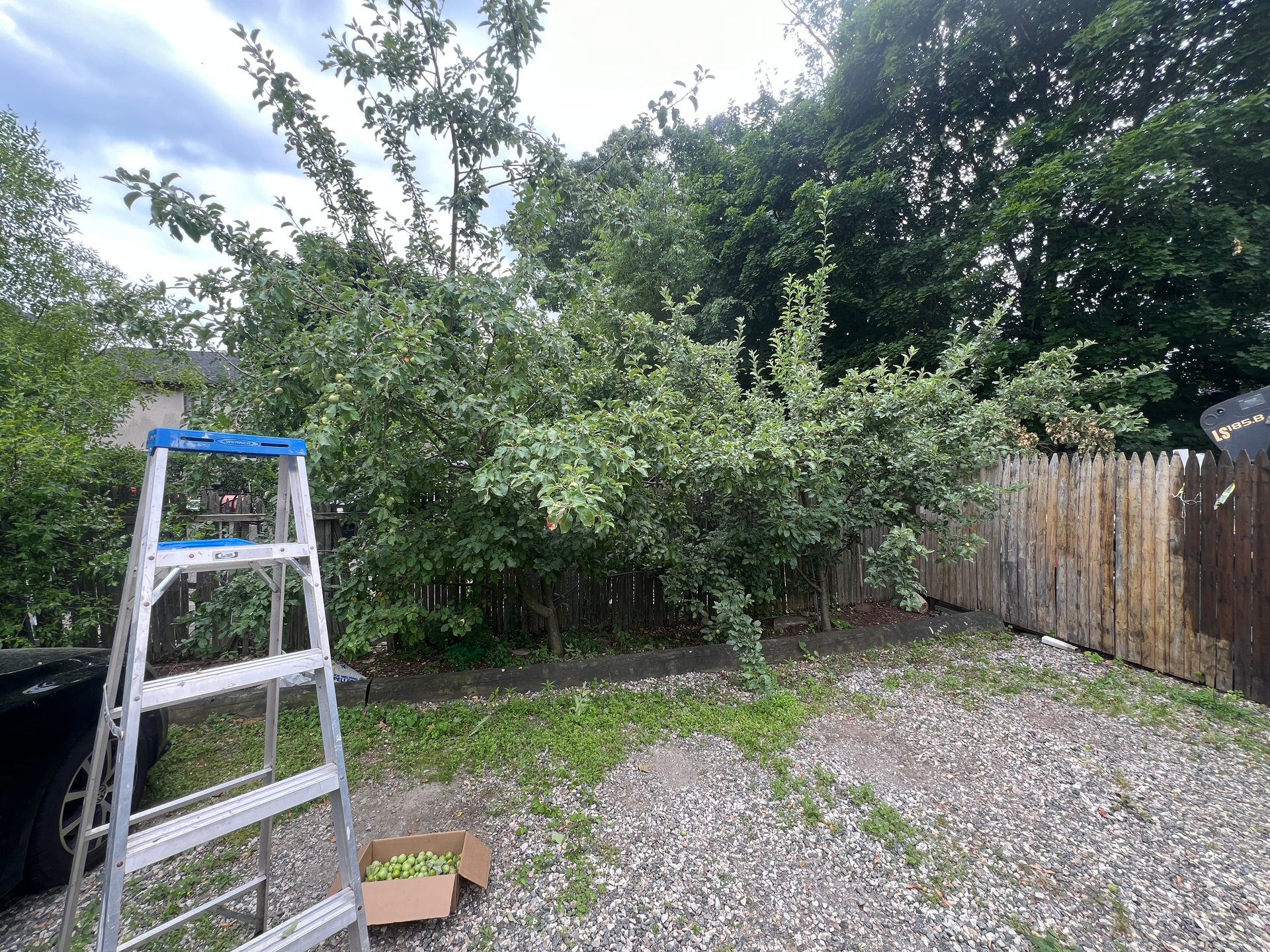
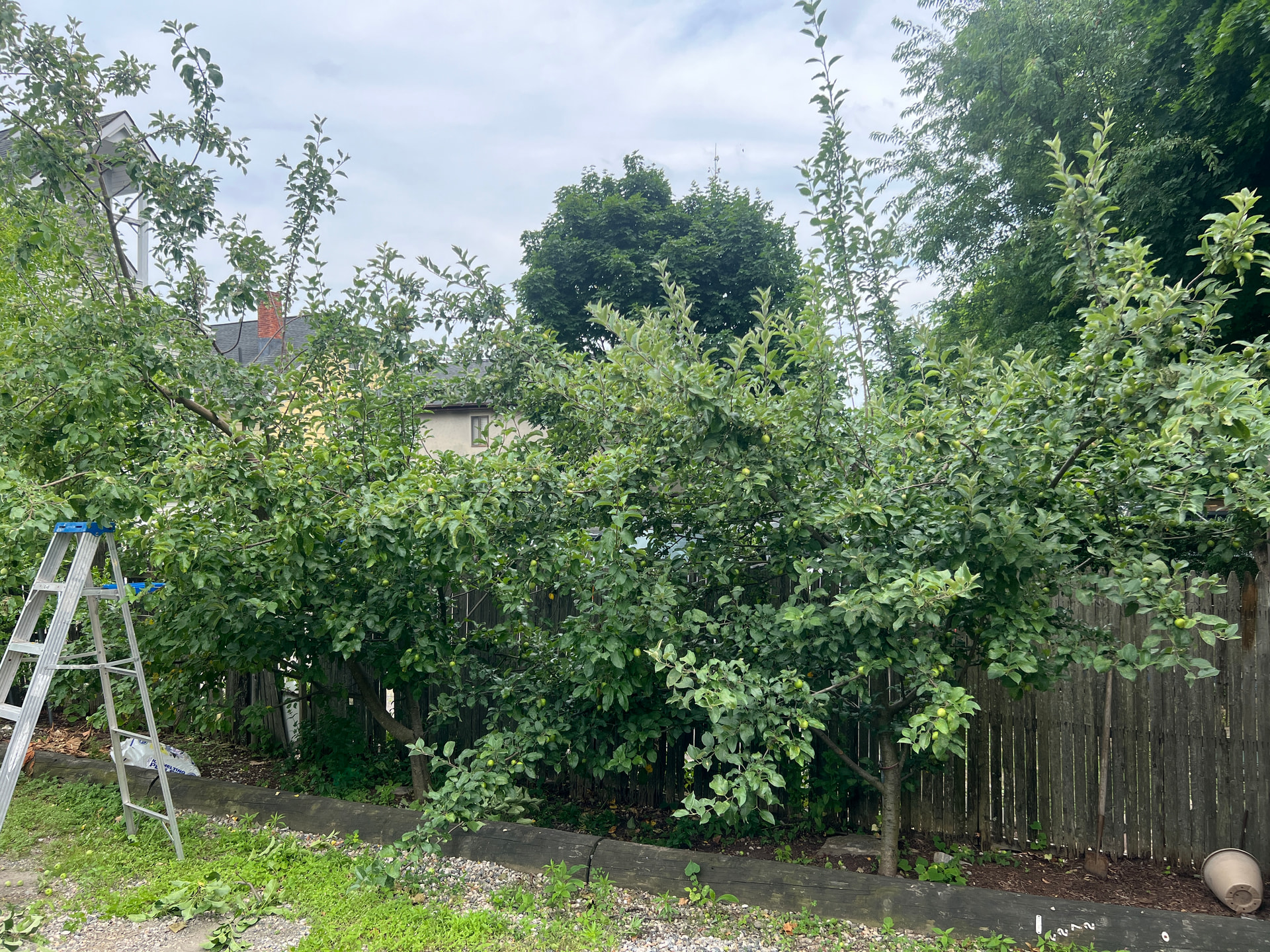
So far, I’ve been hacking off anything that gets too tall and thinning the branches a bit. They were planted almost 10 years ago and it’s made apples for a few years now, though I haven’t thinned enough (until this year, I think).
There have been a few grafts on them, but I think I may have made a mistake last spring. I grafted 3 varieties onto each. That isn’t the problem, so much as where I put them. On top, roughly 9 feet up. 2 are limbertwigs, so maybe I’ll be able to bend them down and tie them. But, short of letting the trees get out-of-control tall, that is my only idea. Aside from cutting them off next spring and re-grafting them elsewhere.
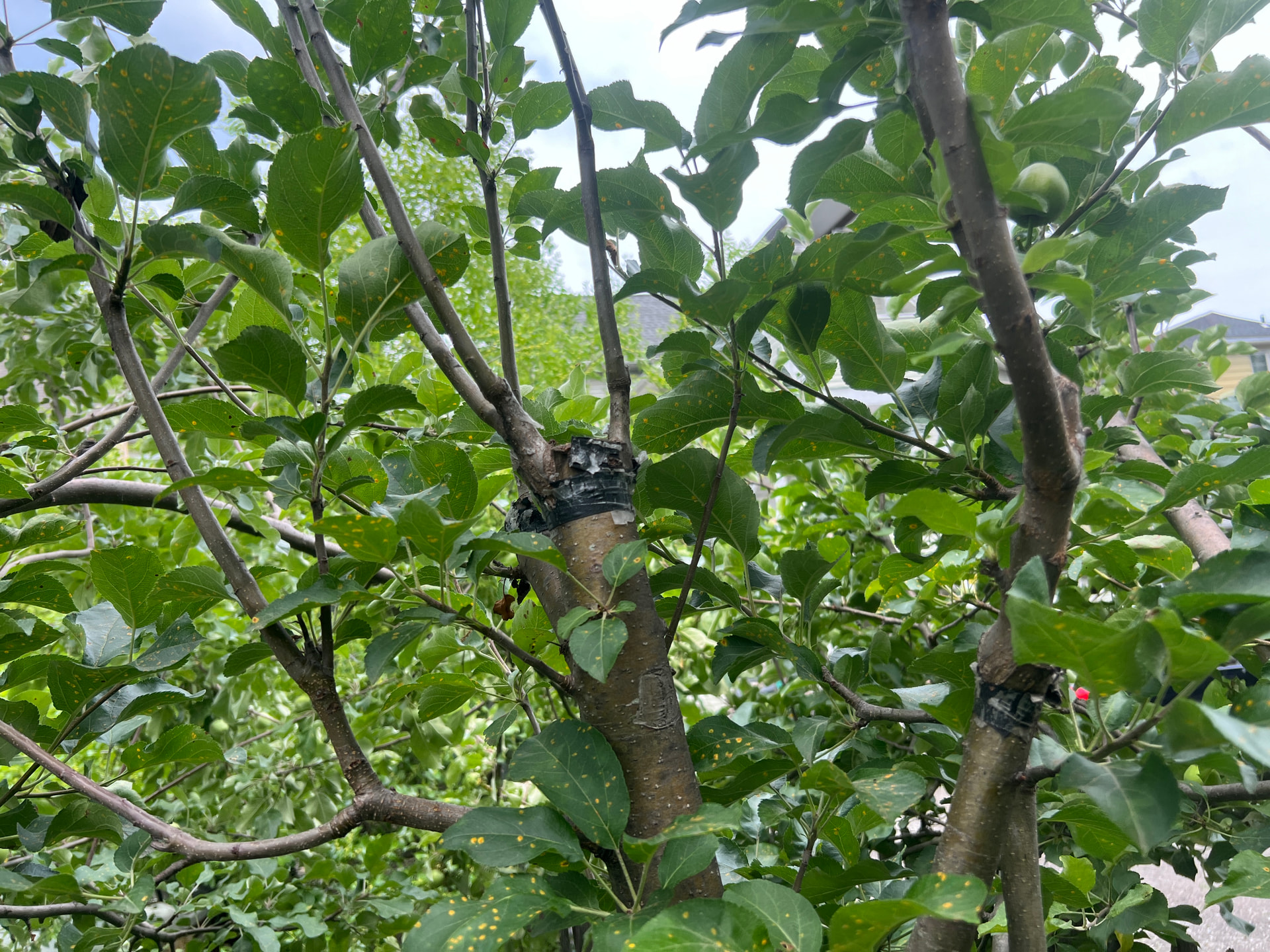
So, 2 main questions- Any hope of keeping it productive and under 12’? Best way to save those 9’ high grafts?
3 Likes
Training the upper tier to a weep is a good strategy anyway and that will allow them to fruit quickly. I use electric tape often and just tape the upper tier branch down while it’s young enough to be limber- or hinge it to make it bend without breaking (usually). The tree needn’t be taller than where the upper tier leaves the trunk. Of course grafts have to be placed where there is good light so no wonder you put them there. During the growing season I need to prune two or three times to provide lower grafts with adequate light in some trees.
6 Likes
So I’ve only seen a couple of full size trees kept low and they had an open center dwarf style pruning with extremely heavy horizontal branches reaching out away from the trunk in 4 or 5 directions.
Probably a delayed open center like @skillcult teaches is the way to go, but that would have been years ago. M111 is definitely a full size tree and what you want to do is not easy even from the start, unless you are consistent and successful in training your tree nearly perfectly.
2 Likes
I’ve got roughly 1 dozen trees on MM.111 and B.118, and the site is very windy. All my trees need support to prevent leaning, including apple, pear, mulberry, persimmon. I had a big European plum (President) and a nice apple (Golden Russet) blow completely over,. and an Illinois Everbearing split down the middle. So I tie every tree to the ground on the west side. And I try to prune to allow air to flow through the canopy.
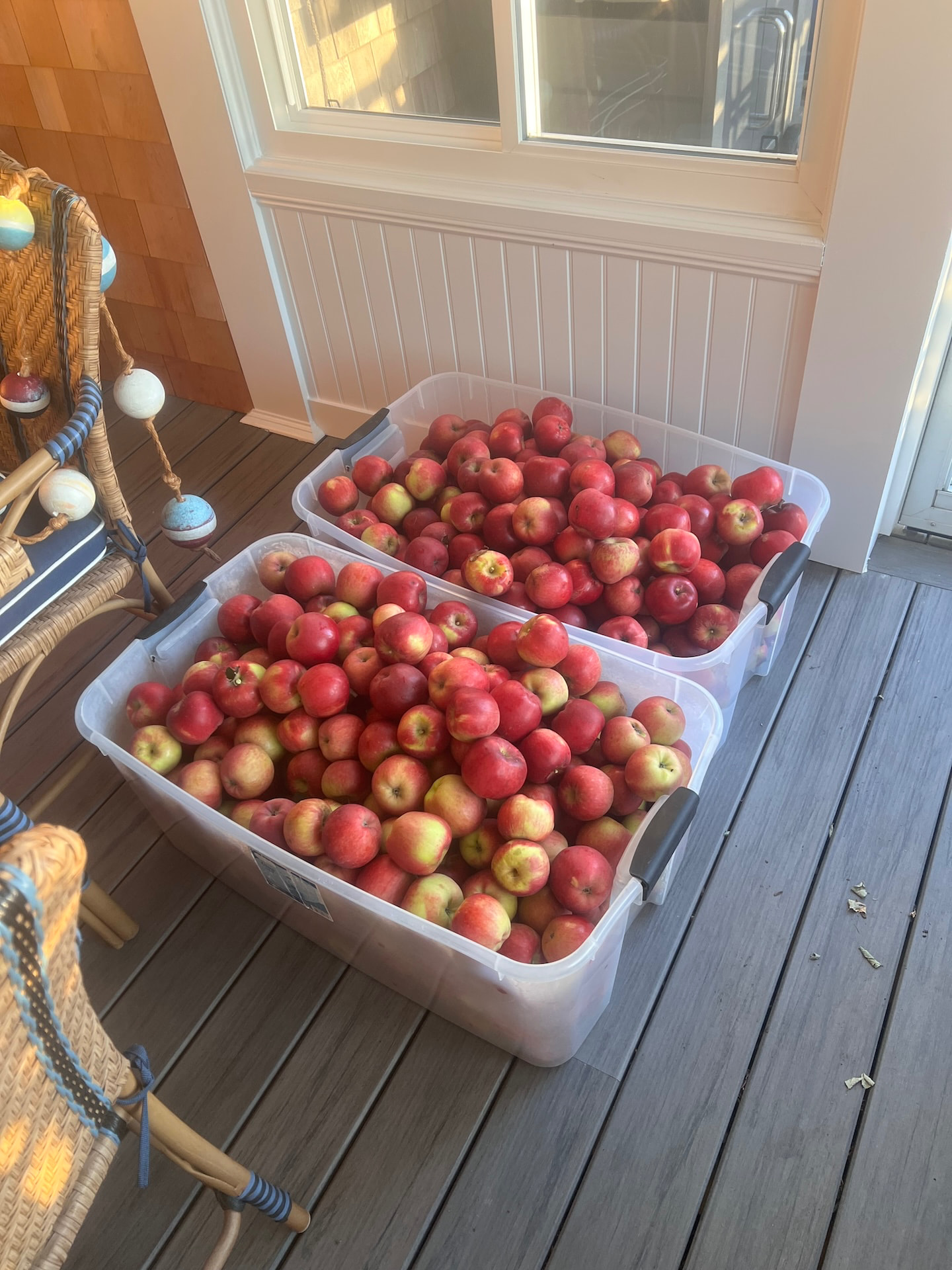
To answer the question, yes these trees become extremely productive even when pruned to ~10-12 feet. In all honesty, I have taller branches but the mass of each tree would fit in a box 16-20’ wide and 10-15’ tall. I harvest everything from a step ladder, though I do climb into the tree occasionally. The trees are roughly 10 years old. See below the harvest from Winesap (MM.111). I get similar from Redfield (B.118), Rox Russet (MM.111), Enterprise (MM.111) . . . . Dabinette (B.118) is loaded this year. Last year I made 25 gallons of cider.
Like Alan, I love pruning and hate thinning. Annually I simply remove any growth that goes too high. Also any growth that clutters up the middle. For me, removing branches is pre-thinning.
8 Likes
The commercial nursery industry used to use M111 as a root stock to limit the suckering of crabapple in the 90’s and 2000’s.
When I started most trees were t budded onto domestic apple seedlings. They were vigorous and we could often produce a 1.5” tree from a whip liner in 2 years. Problem was the suckers were a never ending problem as they got older, especially with the introduction of glyphosate as weed control, opposed to hand and hoe.
When they started using M111 we were all on board. With time it was a disaster. The crabs lost a lot if their vigor, tended to need stakes to correct leaning trees, (we never staked trees with seedling rootstocks) so this was a new issue. With the loss of vigor, I felt they became more susceptible to disease and certain insects. The biggest problem was the loss of vigor and the lack of the ability to make a profit. I probably planted 20,000 crabs on M111 over the years and it was remarkable how it changed the crabapple market. I remember clearing a field of trees, all types, after 6-7 years and there would still be 1.5” crabs left over while everything else left over, maples and oaks were 3-4” and gone.
They looked bad and scruffy as they aged. Especially varieties that were weak like Prairiefire. It took what was one of our best selling group of trees and made people ask for other varieties.
The industry eventually went to a rootstock called Sproutfree which had more vigor and much fewer suckers than domestic. It was a cultivar of Springsnow crabapple, which was a fruitless and triplod crabapple. It tended to have a lot of problems with cracking trunks over the winter. Maybe sometimes like 60% loss. It was vigorous but fell out of favor with the industry due to the cracking issue. There was some suspect that gyphosate was the cause of cracking but never proven. Springsnow had a cracking issue due to thin skin to begin with.
It was eventually replaced with a rootstock, at least what I bought from J F Schmidt nursery with a proprietary system of rootstock called right root which seemed ok.
When I started my personal orchard about 14 years ago most of my trees were on M7. They are sucker factories and almost all have a lean from 5 degrees to 90. I’ve had to cable up the bad leaners but they produce well.
I shied away from M111 due to my past experiences. I ended up with several.
They seem somewhat vigorous compared in an orchard setting. If I have the space I use them, i got a few free ones too. I haven’t seen their final size but they seem manageable as far as vigor, but still lean without staking when young. They seem to stand pretty well once they get older and need no stakes. M7 has a much bigger problem with leaning in the first 5-6 years.
I stake all my trees in the first few years, with fiberglass rods since 2022 (It’s easier to stake a tree, than to fix a crooked one or leaner later on) The M111 seems to stand once I remove the stake. I just had to restake with t post, G969, and numerous M7 trees that were planted in 2022. They leaned with the fiberglass stake, but I should have sunk the stakes deeper. They just didn’t have the supporting roots in the upper soil zone.
It’s funny how M111 seems to be vigorous now in my orchard compared to the others, except the 3 standard Granny Smith I have. I don’t want anymore standards. I have G11, G16, G210, G890, G969, G935, G214, G41 and all are fairly young and untested.
M7 and M111 as older trees the M111 seems to freestand fairly often when staked early.
I think a lot goes into the fact of free standing trees rather than just the root stock. Especially your site’s, soil conditions, wind conditions, and your cultural practices.
7 Likes
I can confirm M111 isn’t a problem in a dry and sandy soil environment. I have only 1 apple tree with that root stock. It has been 3 years and the vigor is not even there. It’s a dwarf compare to a seedling apple. Pruning isn’t required and a ladder is not needed to pick apples.
2 Likes
Absolutely love this thread and wish I found it sooner! I planted an orchard in March of 2025 that consisted mostly of potted M7 trees on their 5th leaf (or more) and bare root trees from ACN (M.111, few G.890s, a single G.35). Absolutely blown away at how much growth these M.111s like Arkanas Black or Enterprise have put on. I always assumed I could manage them down to the 12-14’ range.
My trees on G.890 have had mixed results. The Franklin Cider Apple grew to 12 feet tall in just 12 months, but the Nittany and Granny Smith have not been nearly as prolific.
@ribs1 I would love to see what your M.111 trees look like now. Earlier this week I was going through the ringer trying to find pictures and scions grown on M.111 to truly comprehend what I have gotten myself into haha.
1 Like
Interesting, I intentionally got my sister some trees on m111 because her orchard are almost a swamp and most of the trees are planted on a mound just so that the roots of less happy varieties don’t suffocate entirely.
So m111 is great in the wet, but I’ve heard it’s a big enough rootstock that it’s good in the dry too.
I think my preferred method would be Antonovka seedling rootstock with a partially buried interstem of at least 16 inches which is picked for ideal disease resistance and the desired dwarfing effect.
1 Like
I don’t expect rain from June to early October. That’s how dry we can get. Everything is city water. The m111 is good enough to survive and not thrive. There is no big apple orchard here.
1 Like
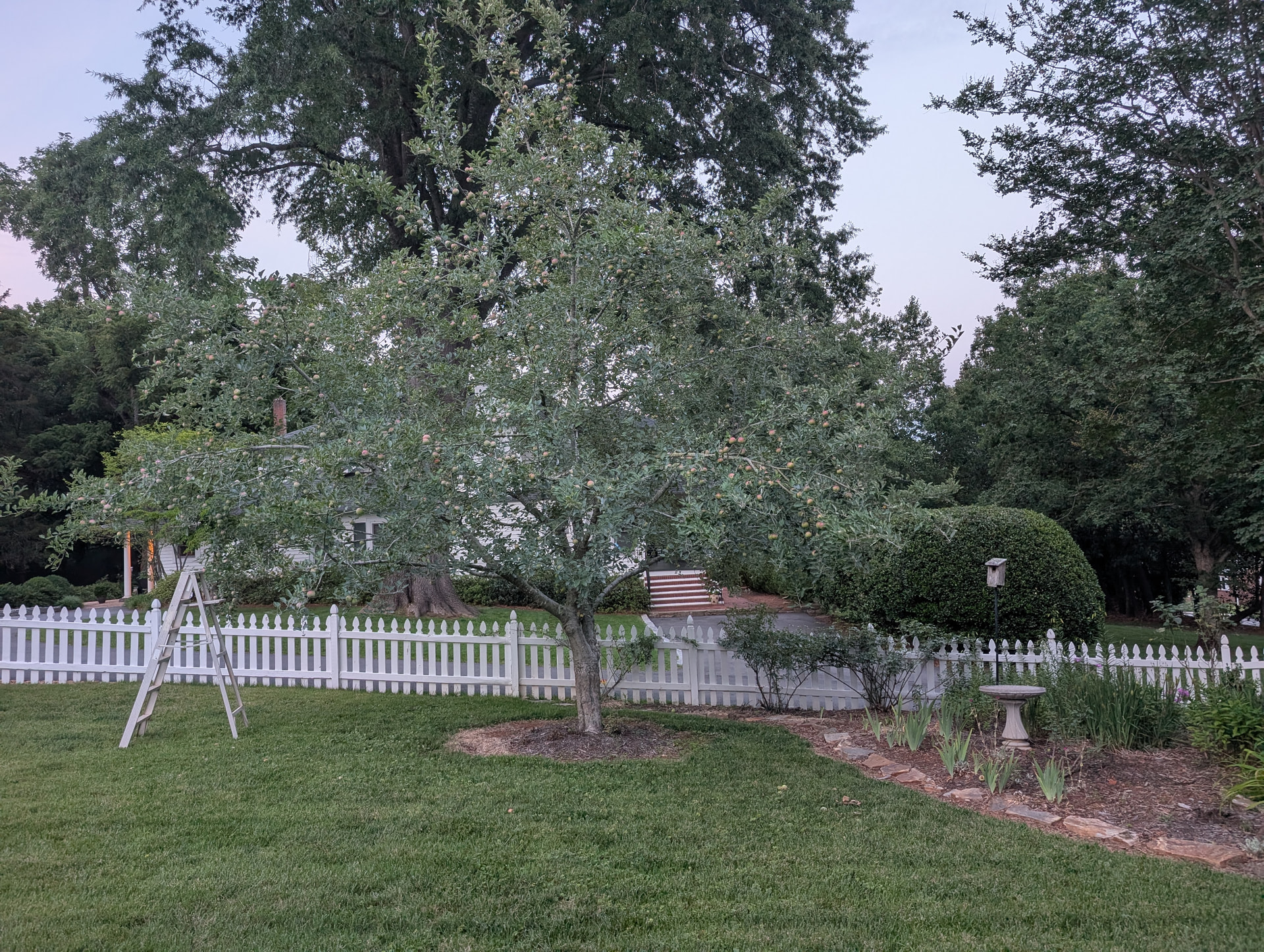
I have an 18 year old Ark Black on an M111. Too much tree for me! It takes hours and hours to prune and a limb chipper is must if you live in town where burning is not allowed.
This is an 18 year old Ark Black on an M111. It is 26’ wide and about 20’ tall. The step ladder is 6’
12 Likes
I hear Antonovka is the best at drought resistance too, but probably any seedling with a taproot is about the same like northern spy or wolf river, but I think there’s an Antonovka tree that’s almost 500 years old! So that’s amazing, and maybe it is some sort of super survivor.
My Goldrush on MM111 in northern FL is quite vigorous, about 12 feet high in the 4th year. Sandy soil, with not a lot of watering in dry spells.
2 Likes