I was reviewing some old emails and realized I got most of my pawpaws in 2012 from John/Lisa Brittain. I was reading that John passed away. Did anyone else get pawpaws from him?
1 Like
I got several trees from him spring of 2020. Bare root, grafted, a couple died back to the rootstock(since regrafted and fruiting now). Unsuprisingly the ones in better soil did much better and produced faster than the ones in poor soil(potted trees planted at the same time have been fruiting a couple years now. I have a Susquehanna and a Tallahatchie that still have his grafts on them. Wish I had taken the time to go there and meet him, he was into all kinds of cool stuff.
3 Likes
I’m in NJ. It went from 40s/50s until Mid May and then 90s overnight for a week. We have not had those 75F days and above 50F nights prime grafting days. I actually did quite a few grafts (~30) when it was 90F and most of them have taken. I’m waiting on like 6 of them.
How do you know when the rootstock stops growing for the season?
1 Like
Itll put out a terminal bud instead of an actively growing tip. Glad you had success, ive grafted in august and still had takes. 80s is ideal but not neccessarily a requirement. If you have scion and rootstock id keep grafting.
2 Likes
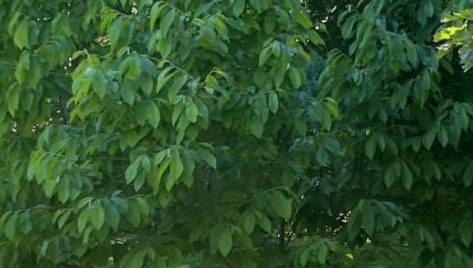
Dutchess County NY Z6A…got only .21 inch rain out of strong cold front that went thru the other day…that is all the rain we got here in June so far…should be 1.82 inches so far in June…May was better but still dry…about 2.7 inches out of about 3.75 inches expected…grass is already starting to burn in very exposed areas and this is only June…bad things ahead for pawpaws in the northeast if things do not change…lawn guy laid out the hose down to the patch the other day so I can water soon if no rain…trees still look great but I’m not going to wait too long this time…Beemster
…
2 Likes
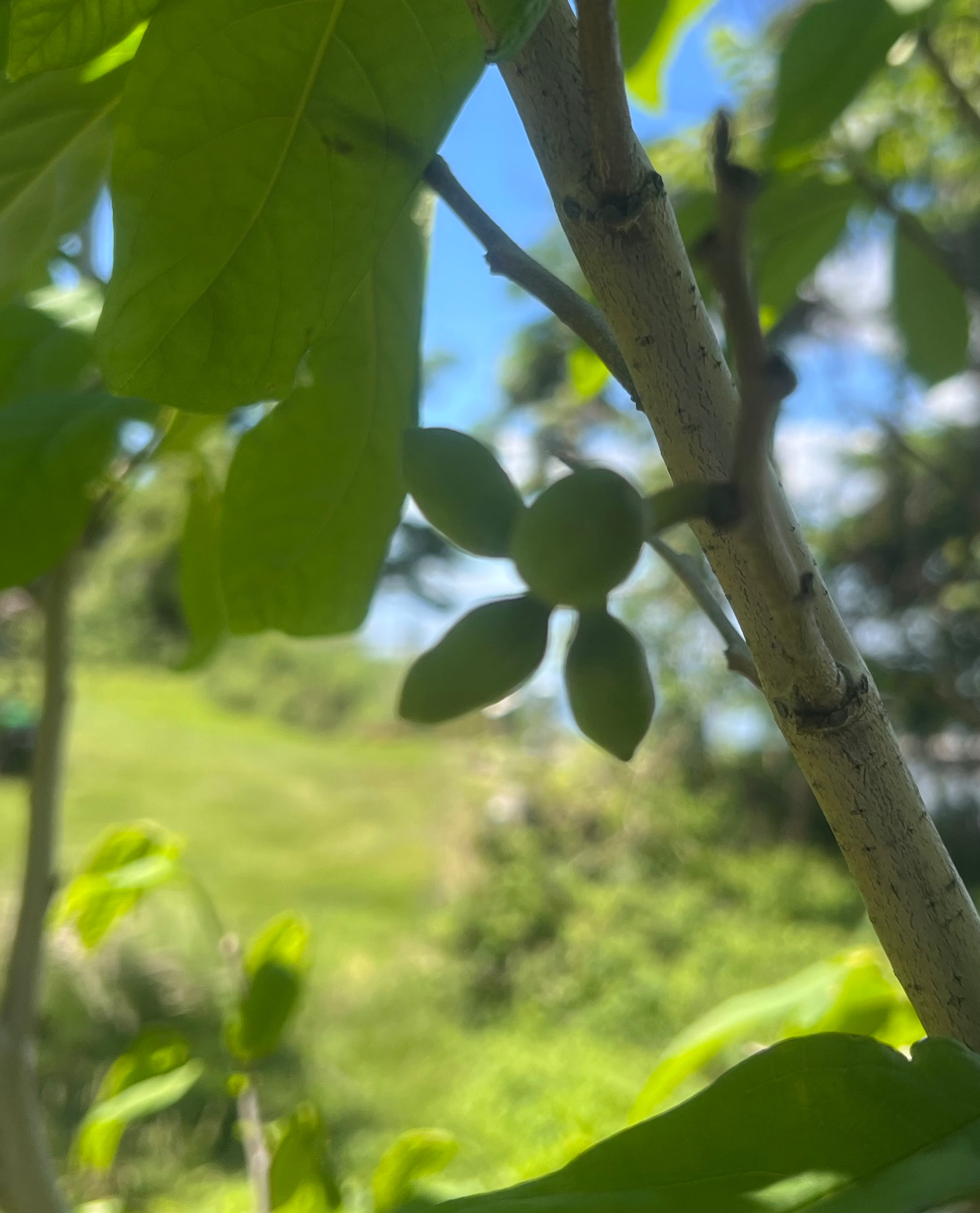
My first adventure in hand pollinating pawpaws seems to be a success. The tree set lots of fruit. Recently, it self-thinned so what were bunches of 5-6 are now usually 1-2. But here’s a nice bunch of 4, next to another set of 3 (not shown). If half of the current crop ripen, I’ll be very happy.
9 Likes
Grafted Pawpaw Sales Open at 9pm EST tonight: Grafted Pawpaw Trees For Sale (Asimina triloba) | Peaceful Heritage
5 Likes
picked up one Mammoth X Pawpaw from Blake just as his site went live…Blake says they are huuuuge and tasty too!
…
Huge, high quality fruit on this green beast! Fruits weighing over 1 lb are common on this one, can produce fruit 1.5 lbs each or more. Delicious flavor and low seed weight. Rare!
…
anxious to see how big they can get on what I consider an ideal site…only question is will I live long enough to see…Beemster
2 Likes
Got a KSU Benson 3 gal from Bob Wells Nursery, it’ll arrive tomorrow, what are the best tips for planting? (Should I amend the site with compost, should I make it more shallow/deep, etc.)
Thanks!
Cole 6B/7A South-Central Ohio
Also have you or anyone you know attempted to transplant a pawpaw tree while it’s out of dormancy (June, July, August, September)? If so how’d it go?
I saw you said you bought 1 pawpaw. Do you have another one?, as you need 2 pawpaws next to each other for pollination.
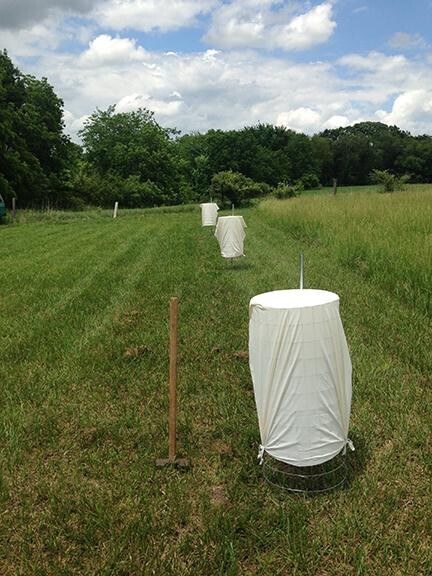
Maybe keep it shaded the 1st year under a shade cloth surrounding a tomato cage. if you google ‘pawpaw shade cloth’ you’ll find some pics for ideas how to do that:
2 Likes
Just thought i’d post some info i found on reddit on a newer variety from Canada:
“AL Horn White is rather a mild monlithic Coconut Chemimoya, at 17Brix
Florence is around 22Brix very complex & is more or s pear like texture & fruity.
Gran Blanc is 28Brix & the sweetest recorded pawpaw it’s flavor profile is similar to KSU Pomper’s choice but lots more pineapple tones.
Vincent Renaud the President of PawPaw Quebec & PawPaw Canada has been in pawpaw his entire life & says Gran Blanc is by far the best pawpaw he has ever tasted.
Nobody in the USA has tasted it yet & one a handful of people grafted scions this year.
Currently they are grafting as many trees as possible in Quebec the place of origin.”
Giant 1 LB “Gran Blanc” is from a member of Canadian PawPaw Growers.
Extraordinarily intense: (Cherimoya, Pineapple, Casaba, Honey) with almost zero Banana!
always close to 1 LB, only 2% seeds & 28 brix, which is sweeter than Susquehanna!
“Gran Blanc” is from Zone (4b to 5a) & ripens midseason.
A chance seedling in a grove of seedling from Neal Peterson’s cultivars.
“Gran Blanc” has heavy yields of 1LB fruits in very cold environments, unlike anything else!
Limited supply, as only 2 graftings in USA, so there will be about a dozen scions in January.
“Gran Blanc” is the biggest, sweetest, juiciest, most aromatic of all White PawPaw bar none, plus nearly seedless.
1 Like
I intend to transplant three or four natives (as far as I know, a neighbor up the road relatively near where I found them had grown many pawpaw trees, but sadly they all got removed). I was told in another thread that it was possible to transplant them during dormancy and even cut their tap root (not that I intend to). I had found them covered in briars and vines, and a tulip poplar cluster was invading their space, I cleaned out all the briars and the made sure they had as much sunlight as possible, which is still not much as they’re largely shaded out by a tree near them, I believe they’re at least around five years to six years old because the neighbor had moved by then and I don’t see how they could’ve gotten there other than from him. I have a spot picked out for the KSU Benson that gets a good bit of shade and in mid-April or somewhere thereabouts I will go up and dig as big a hole as I can and put three or four of the ones from the woods in a sunnier spot near the named one. I read online that pawpaw roots will rot before spring if they were transplanted during dormancy due to inability to callous any root loss, so I’d like to time it relatively close to warmer weather to ease concern about it. The source online is a bit unreliable; would you happen to have any knowledge on the subject?
1 Like
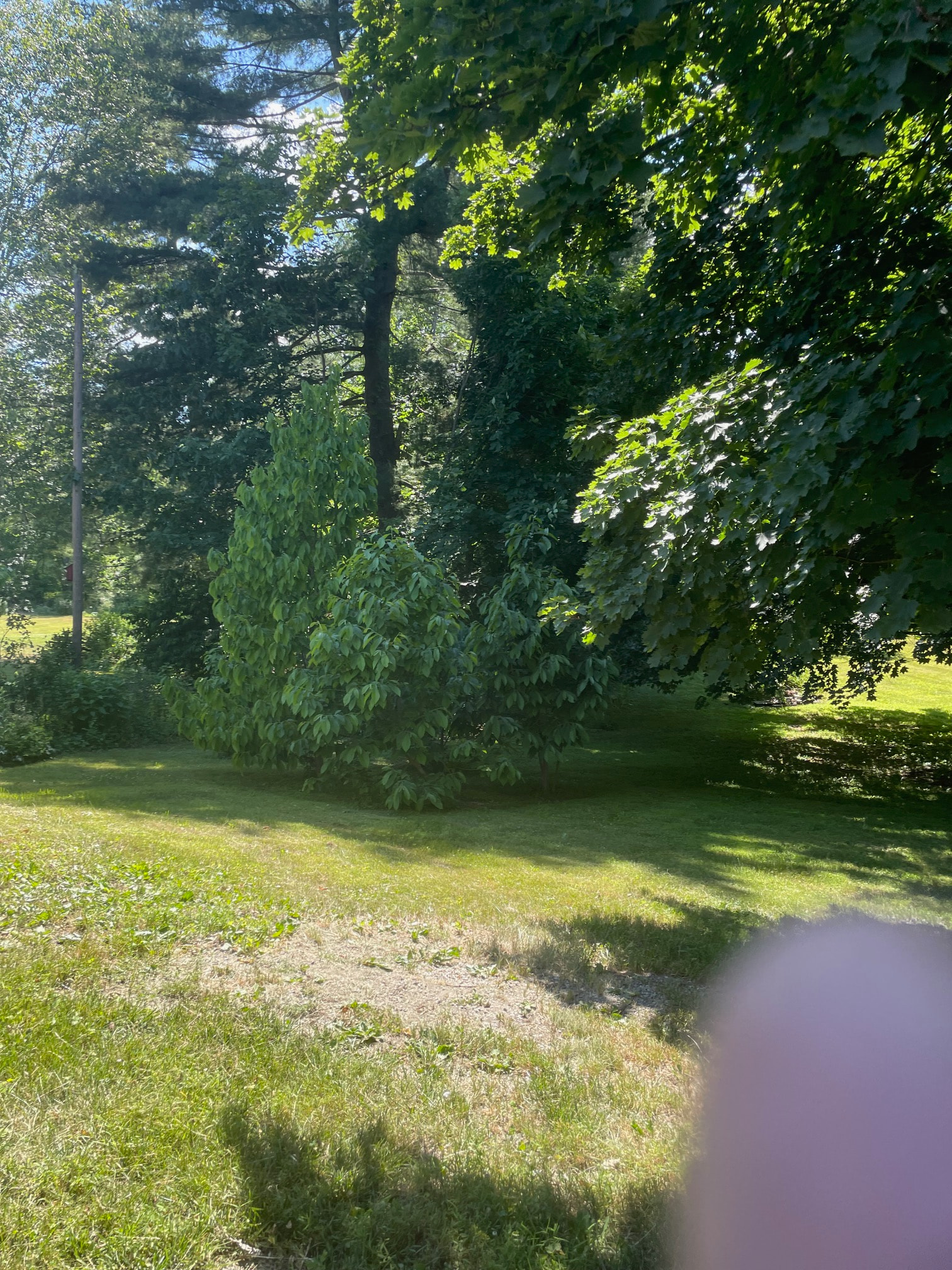
Dutchess County NY Z6A…well I’m no expert but I will say it is most important not to disturb the root ball while extricating the tree from the pot and lowering it into hole…if you do disturb the roots, you could considerably set back your tree…give some thought on location…my personal opinion is to try to locate the tree where it will get full morning sun and full sun till 3PM…if the tree can transfer to shade after that (via a tree line to its west, I think it helps the tree get thru stressful hot / dry periods .(see the photo which shows pawpaws in shade after 3PM due to large trees to the west)…contrast that photo to the other photo which shows the pawpaws in full morning sun at 7:30AM.
…

…
…of course good rich deep soil that does not easily dry out helps a lot…consider these points from Gemini LLM…good luck
…
…
1. Minimal Root Disturbance (The #1 Rule)
Pawpaws have an incredibly sensitive, brittle taproot system and delicate secondary feeder roots.
HGIC@clemson.edu - Clemson University
- Do not tease the roots: Unlike apples or peaches where you might vigorously untangle or score a root ball, you want to keep the potting soil intact.
Stark Bro’s
- The Method: Carefully cut the plastic pot away if the tree doesn’t slide out easily. Support the root ball fully as you transfer it to the hole.
2. Planting Depth: Match the Pot
- Do not plant deep: Planting a pawpaw too deep will suffocate the roots and cause collar rot.
Restoring Eden
- The Goal: Dig the hole 2 to 3 times wider than the container, but exactly the same depth. When set in the hole, the root flare (where the trunk widens at the soil line) should be perfectly level with or slightly above the surrounding native soil.
Restoring Eden
3. Soil Amendments: Avoid the “Bathtub Effect”
- Backfill with native soil: Do not heavily amend the planting hole itself with pure compost or peat moss if you have heavy soil. This creates a “bathtub effect,” where water pools in the loose, amended hole and rots the roots.
- The right way to use compost: Backfill primarily with your native topsoil. Instead of burying the compost, apply a 2-inch layer of high-quality compost on top of the soil around the tree after planting, then cover that with 3 inches of wood chip mulch. This mimics the natural forest floor leaf-litter environment they crave. Keep mulch an inch away from the bark.
4. Immediate Sun & Wind Protection
Even though a 3-gallon tree has some size and maturity, young pawpaws (especially grafted cultivars like KSU Benson) are highly sensitive to intense UV light and strong winds during their first one to two seasons.
TN Nursery
- Provide Shade: If you are planting it in an open orchard layout or full sun, you must provide temporary shade. A simple three-sided structure wrapped in 50% shade cloth, or using a tall tree protector shield, will prevent the large leaves from scorching while the root system establishes.
Stark Bro’s
5. Establish an Immediate Watering Routine
Water the tree deeply immediately after planting to settle the soil and eliminate air pockets. For the first two seasons, pawpaws need consistent moisture—aim for a deep watering once or twice a week during dry spells. Once that taproot finds the water table, they become remarkably low-maintenance.
Kentucky State University+ 1
A Quick Reminder on Pollination: KSU Benson is a dependable, heavy-yielding, early-season performer, but it is not self-fertile. To get fruit in a few years, it will need a genetically distinct pawpaw variety planted within 30 feet to cross-pollinate.
Want to look at companion cultivars that bloom at the same time for pollination?
Because pawpaws (Asimina triloba) are self-incompatible and exhibit protogynous dichogamy—meaning the female parts of the flower mature and shed before the male parts drop pollen—timing is everything.
While pawpaw blooms overlap extensively over a 3-to-4-week window in mid-spring, KSU Benson is uniquely classified as a highly precocious, early to mid-season ripening cultivar. To ensure robust fruit set, it is best paired with companion cultivars that align with this earlier developmental window.
The following cultivars make outstanding cross-pollination matches for KSU Benson:
1. The Ideal Genetic Stablemates (KSU Releases)
- KSU-Chappell™: This is arguably the best overall companion. It is a vigorous, fast-growing tree that matches Benson’s mid-spring bloom timeline perfectly. Chappell ripens early-to-mid season, offering large, high-quality fruit with a distinct mild banana-pineapple flavor that pairs beautifully with Benson’s rounder, mango-toned fruits.
- KSU-Atwood®: As Kentucky State’s first official release, Atwood is exceptionally reliable. It leans mid-season but its bloom period heavily blankets Benson’s window. It is highly productive and brings a rich, mango-heavy flavor profile to the orchard.
2. The Peterson Performance Matches
- Allegheny®: One of Neal Peterson’s best early-ripening selections. Allegheny is an excellent pollinator for Benson because it hits peak bloom right as Benson is active. It is highly precocious and productive, yielding smaller but numerous fruits with a smooth, sweet texture.
- Shenandoah®: While it ripens just slightly after Benson, its bloom window overlaps seamlessly. Shenandoah is a great structural companion because it produces large, mild-flavored, low-seed fruits on a upright, sturdy tree.
3. Early Northern Standards
- NC-1: A classic, proven performer that initiates growth and blooms early. Because it handles cooler spring margins well, its pollen is dependable right when Benson’s early blossoms are receptive.
- ProLific: Known for its long, heavy blooming habit, this cultivar serves as an excellent “pollen factory” in any home orchard, ensuring that even the earliest or latest anomalous flowers on your Benson get covered.
Planting Placement for Maximum Set
Because pawpaws rely on carrion flies and beetles rather than honeybees, pollen transfer is inefficient.
- Proximity: For optimal fruit set, plant your companion cultivar 10 to 15 feet away from the KSU Benson, and no further than 30 feet.
- The Multi-Graft Alternative: If you are short on physical space, you can let the 3-gallon Benson establish for a year, and then top-work or chip-bud a scion of KSU-Chappell or Allegheny directly onto a secondary scaffold branch of the Benson next spring.
Orchardist Tip: Since natural pollinators can be sparse in early spring, keeping a small pile of decaying organic matter or hanging a piece of raw meat near the trees when the maroon flowers open will draw in the specific flies needed to move pollen between the two varieties.
1 Like
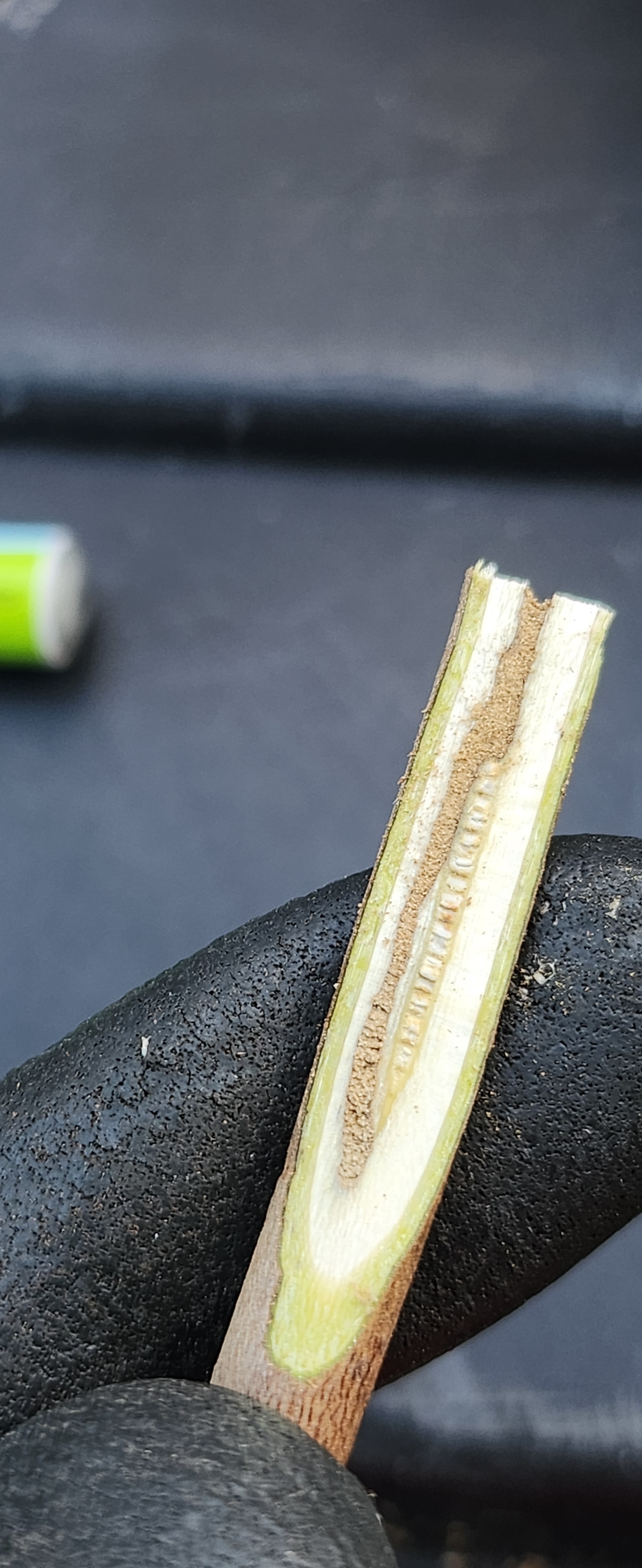
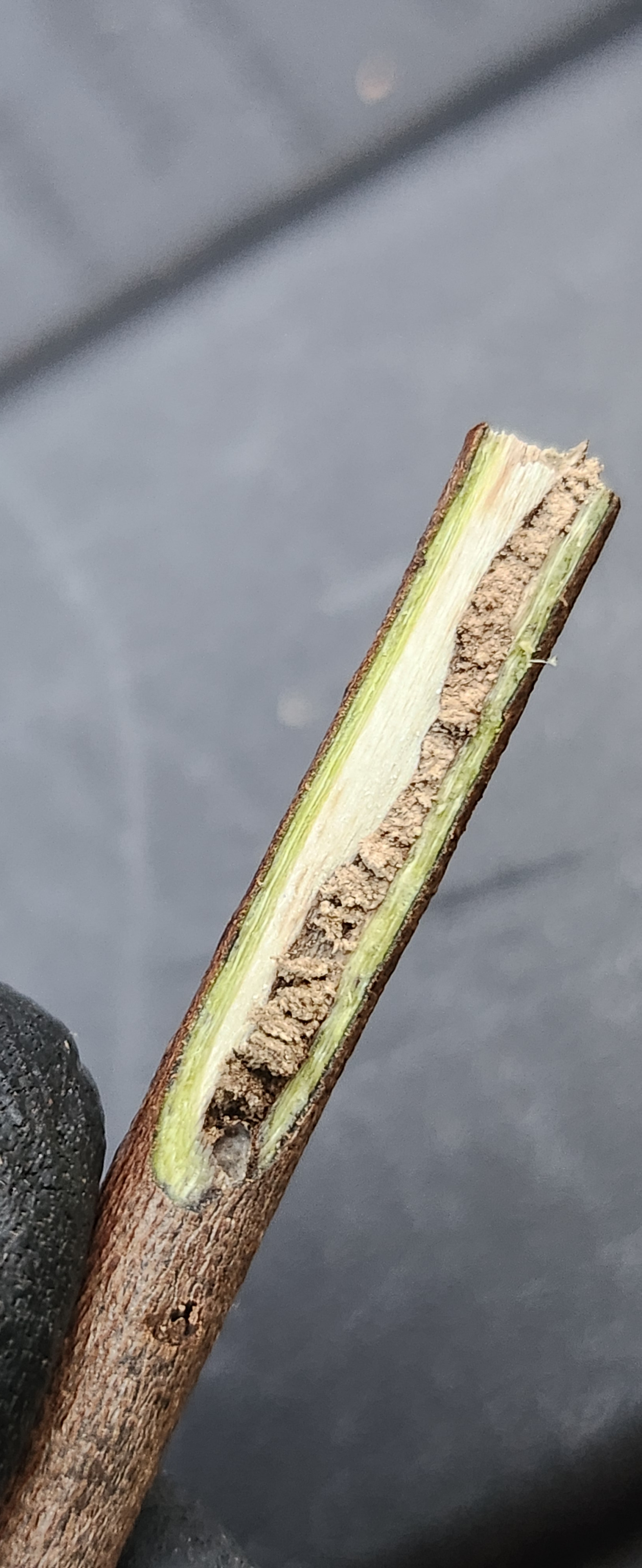
Unless its something you really cant live without I probably wouldnt use it. Might be OK with a chip bud since youd be able to see if the borer got into that part of the scion.
1 Like
Looking forward to grafting that one next year along with 610, another good looking white fleshed fruit. I am curious how they will perform in a hotter climate.
2 Likes
Those are grown by Vincent in QB right?
Hopefully they’re white fleshed and not underripe. 
1 Like
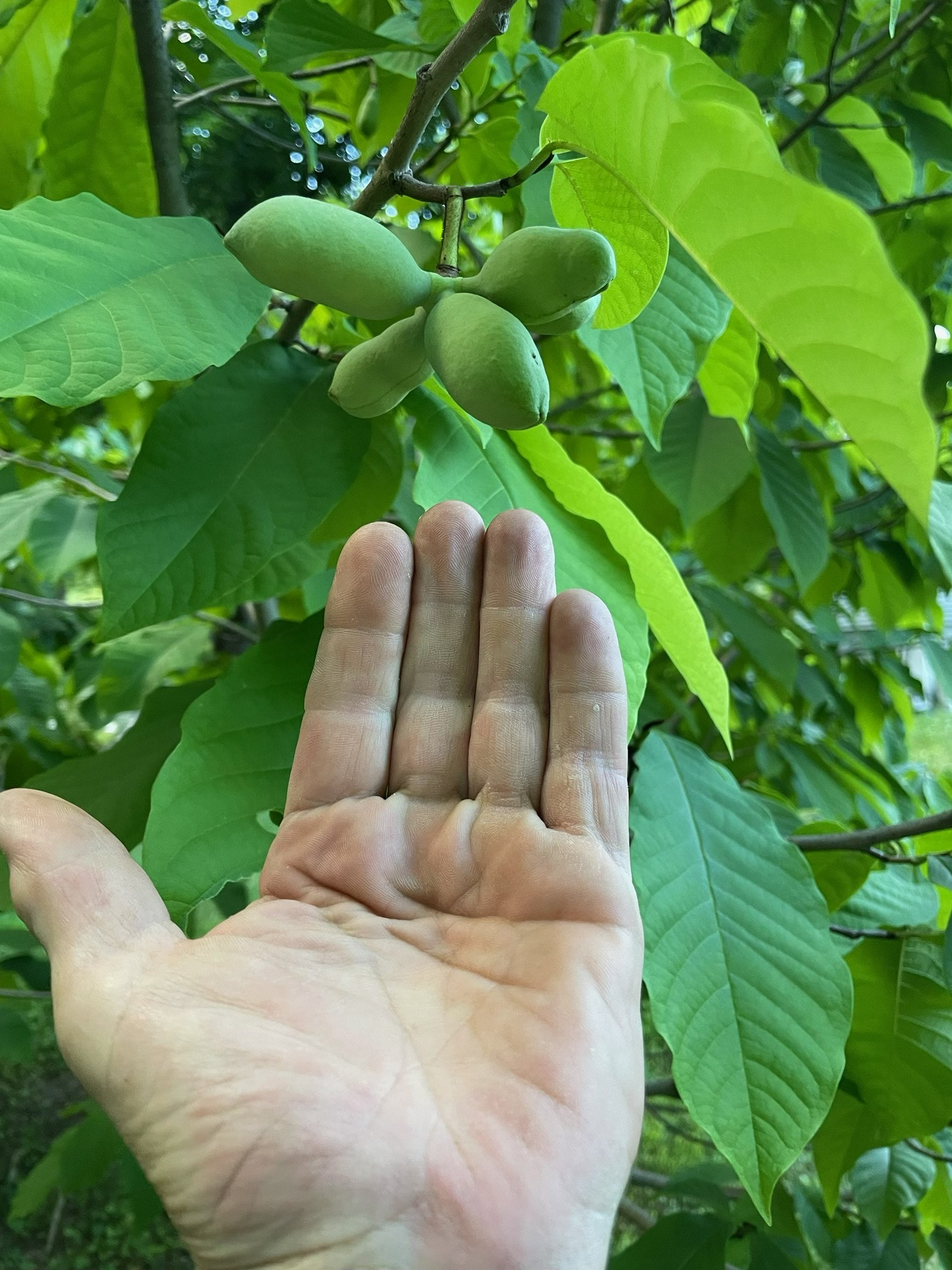
Dutchess County NY 6A…my lawn guy took this photo today…originally planted 6 trees in 2019 (Chappell / Atwood / Susquehanna / Shenandoah / Allegheny / Potomac))…lost one…somehow lost the map which IDed which was which…positively IDed Chappell and Allegheny last year by the fruit and growth characteristics of the tree…this photo from one of the other three which is fruiting for the first time…could this be Susquehanna by the shape of the leaf?..hope so…it’s the one in the foreground of the patch shot… appears to be growing most vigorously again after getting hit by a downed spruce tree two years ago from the tree line to the west…almost catching up with Chappell behind it…opinions / guesses / anyone??..Beemster
…
…
3 Likes
I agree with most of the advice you’ve gotten so far. Especially, about protection from harsh afternoon sun.
I have transplanted pawpaw at non-optimal times. I dug them up and moved them from one place on my property to another - so not out of a pot. I was pretty rough on the roots (would not recommend) and yet they somehow lived. I have a lot more experience moving them around in early spring which usually goes fine.
Pawpaw seem to grow very slowly the first year or two until they establish. Any disturbance seems to reset this.
Also, I finally set up irrigation on my pawpaws after two dry summers. It’s really helped them having consistent watering, even the mature ones, so I’d definitely suggest that.
If you still find you need some pawpaw seedlings for your pollinators let me know later - I always dig up and pot some. You can also graft a branch of the one you have with a second variety then you don’t have to get a second tree.
I’m not sure about this. Mostly I transplanted mine in March -they were not growing or showing signs of growing but spring was near! April also seemed to work okay. I’ve moved a few as late as July. I don’t know if they lived because I coddled them, or was lucky, or if you can actually just move them in July.
I have never tried moving them in Aug-Jan or Early Feb.
2 Likes