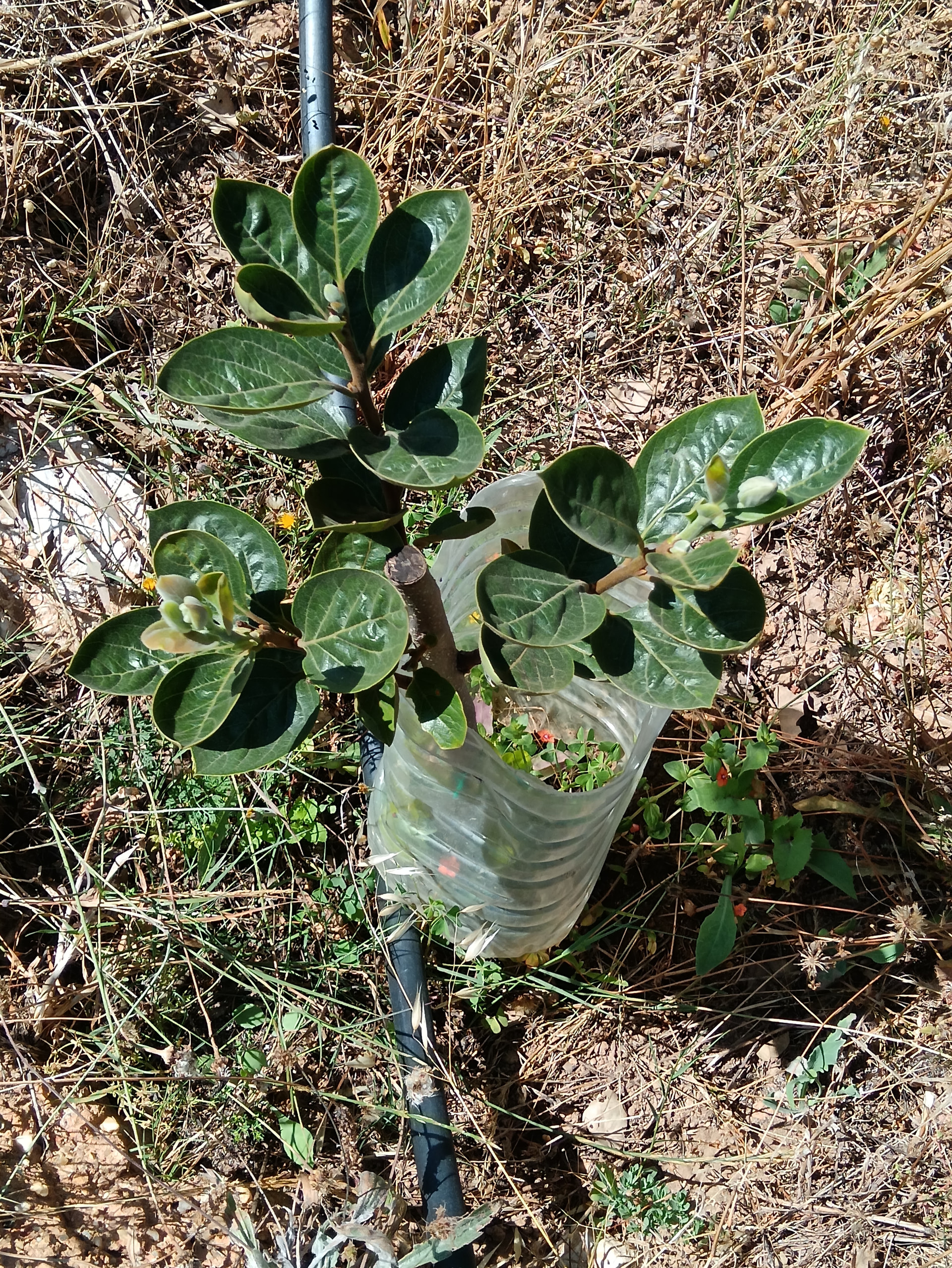
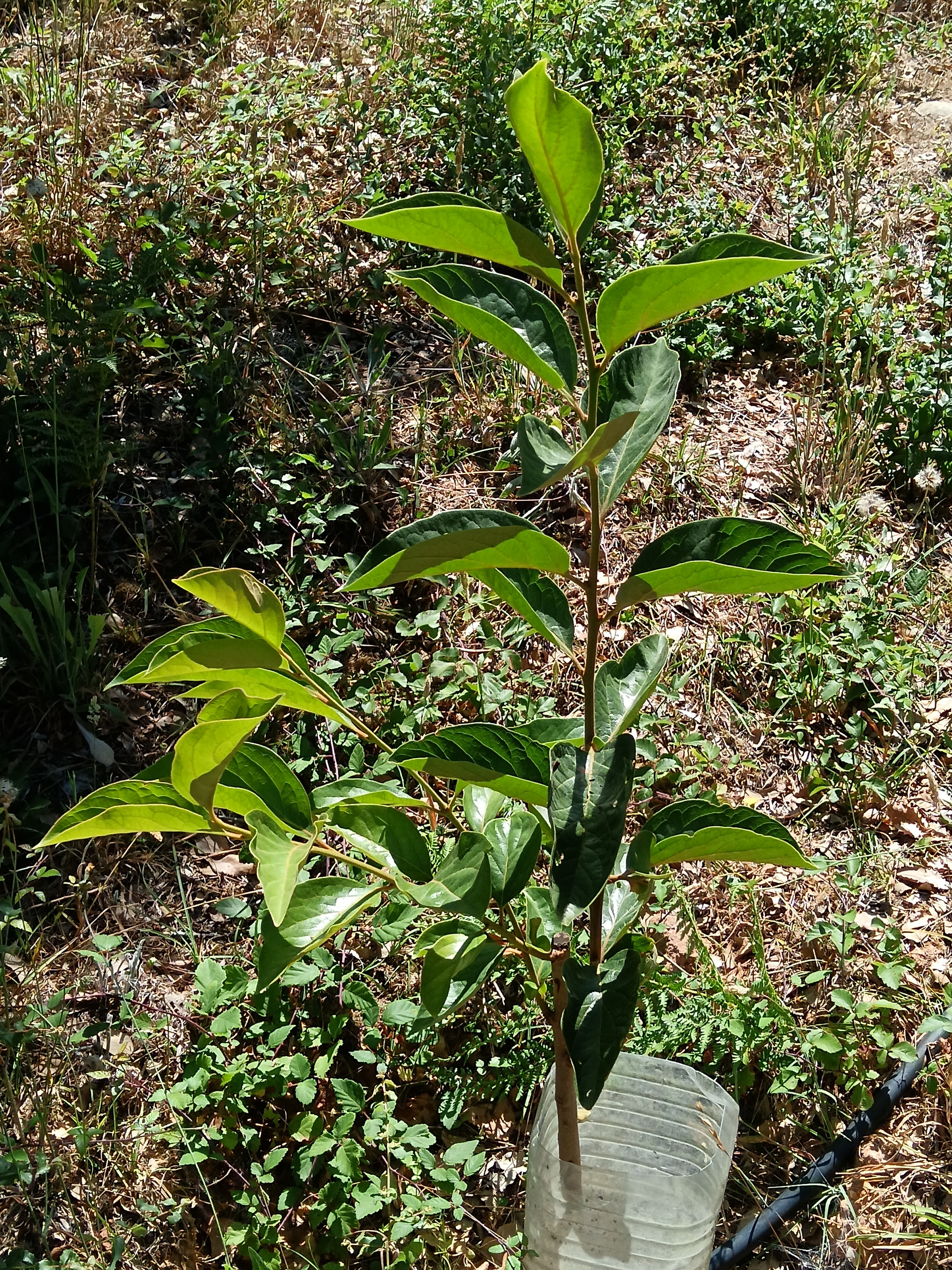
I wonder if the ones coming up in my yard are seedlings or from the root system on my other trees.
How do you trim for more production?
Is it trim the ends off during winter?
It’s not been proven that skds is spread by insects. If fact no one knows much at all about it. I have my DV and Kaki all mixed together. I’ve lost two trees to skds, but if it were insects you would think all the kaki would eventually be infected and that hasn’t happened. The two I lost contracted it after I grafted on them. At least that’s my theory of how they got it.
4 Likes
You would think that black leaves or wood it gets, that a university could just just it under a microscope and see what it is… Bacteria etc.
Any universites doing persimmon research the same way Kentucky doing pawpaw research?
1 Like
@CarolinaZone .. the wild dv that just pop up and grow in my fields…. Have established root systems on them.
They will come up and grow a foot or more in 2 weeks.
If you are seeing growth like that.. not likely to be seedlings.
TNHunter
1 Like
There was a university looking at it, but they came up empty handed on any information. Seems to be a mystery.
2 Likes

1 Like
This! Aliens brought all these plant viruses to earth! They did it!
1 Like
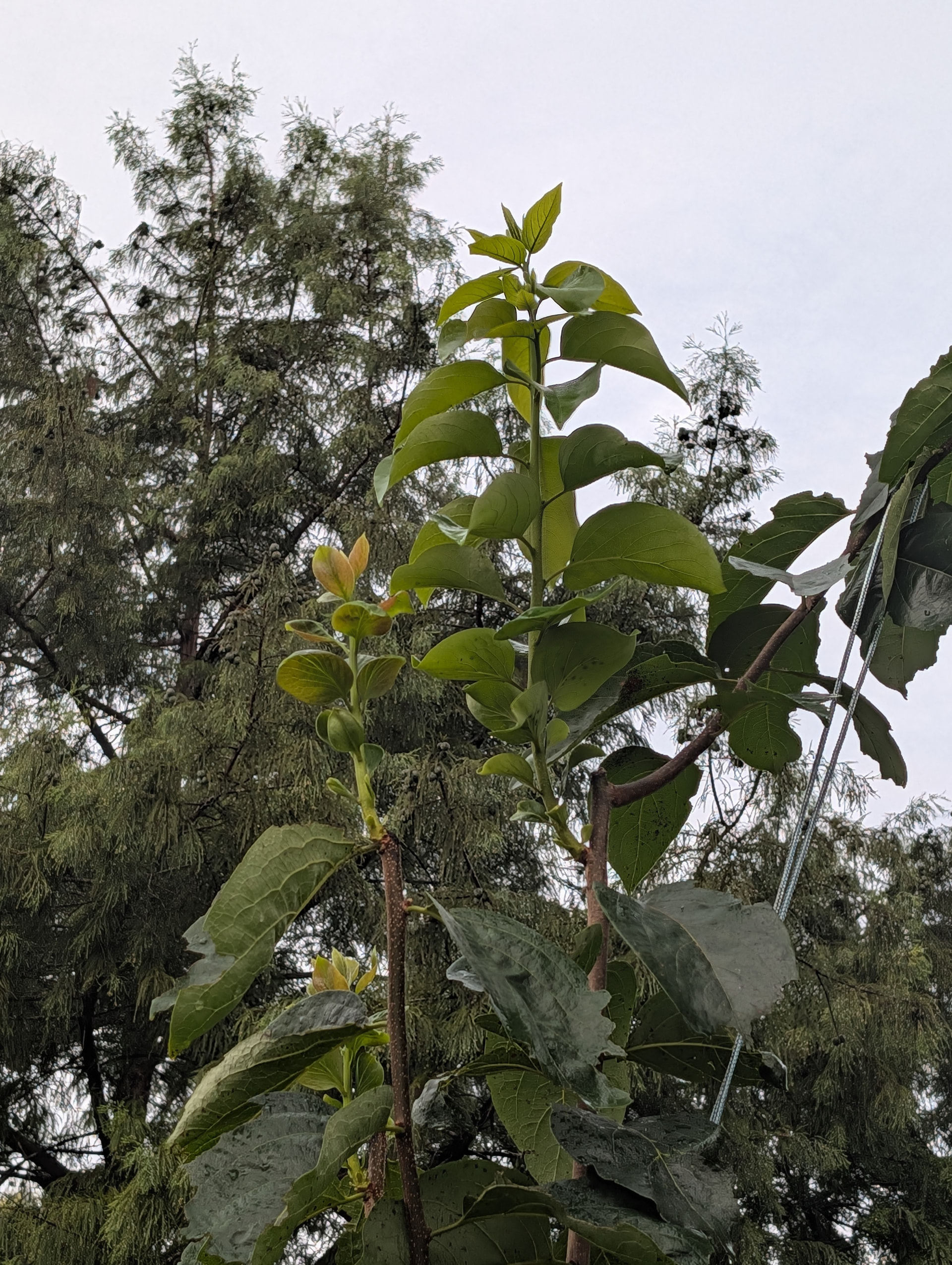
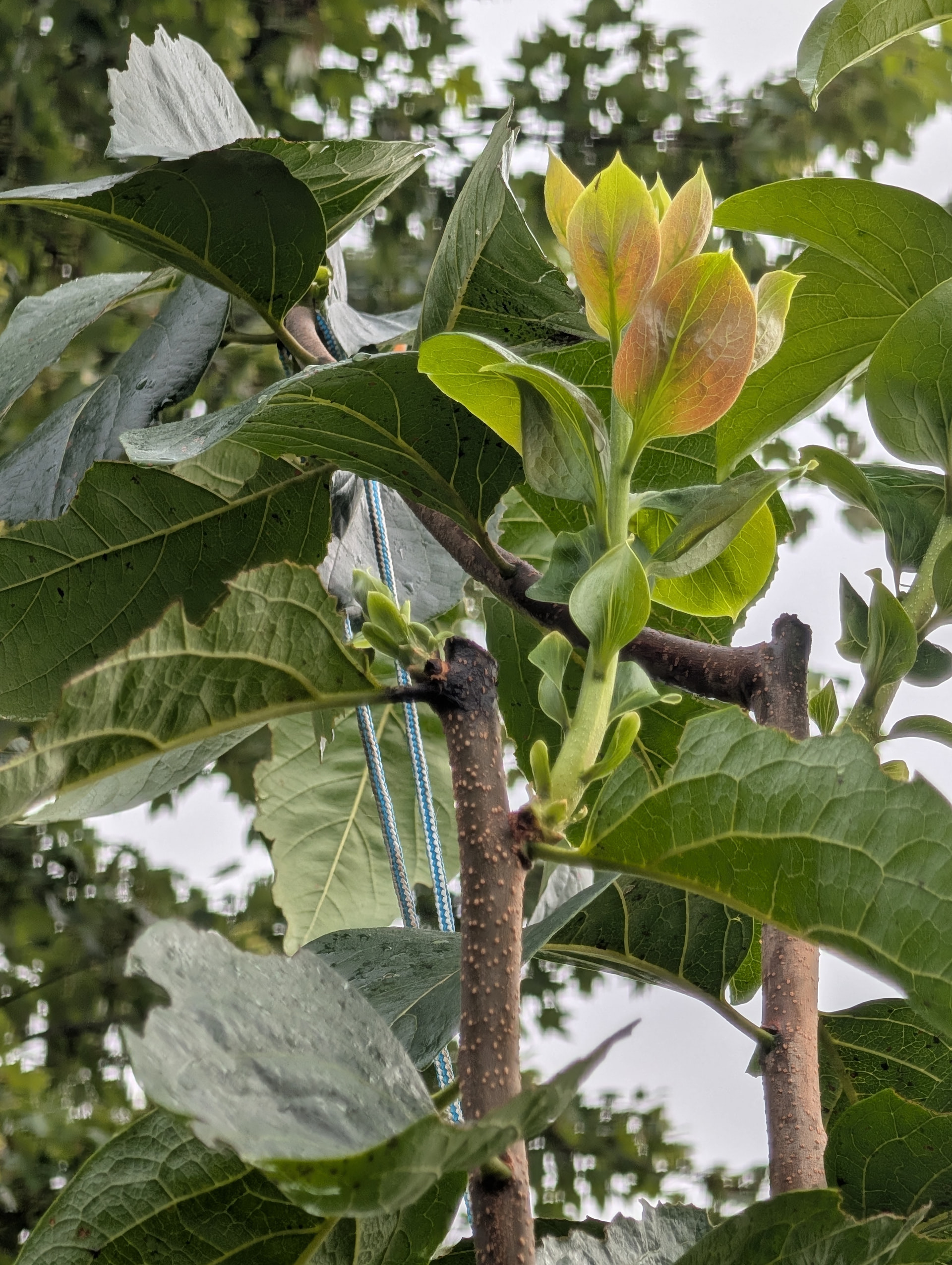
This is the tree I made a thread about. I have now reduced all bark grafts(3 took) to one bud each. All three have been topped. All now have bud growth. I guess I should just allow all these to grow unless someone tells me differently. Also, on on of my bark grafts, only one scion took, so I am letting the native buds at that cut line grow in the hopes it helps with healing. I can always remove them later. Two are Nikita’s Gift and one is Rosseyanka.
4 Likes
Mistake I Made/Hope it Helps Others: I had a nice 6 year old Wase Fuyu onto one branch of which I grafted three DV cultivars. Two years later, Wase Fuyu died from SKDS. I bet it was those DV grafts. Kicking myself; didn’t know enough about the disease a couple years ago.
1 Like
Correct me if I am wrong isn’t d.v. one of the preferred rootstocks in the US. The other I believe is d.lotus. I would think someone would have noticed if d.v. was the reason if it was the only one to carry the “pathogen”.
1 Like
It is highly probable that D.v. is tolerant of the virus while the grafted D.k. scions are susceptible. This is known to happen with Persian walnut grafted onto a black walnut rootstock when the rootstock is infected with cherry leaf roll virus. Given how widespread cherry leaf roll virus is, there is a very good chance it is the cause of SKDS. Don’t take that to the bank, it is just one possibility.
3 Likes
There are a few factors complicating the situation. First, not all DV is infected. So some Kaki and Hybrid scions grafted to DV perform perfectly well. Second, the insect vector(s) of the pathogen seem to be regional. So for example, I seem to have imported KSDS on purchased rootstock and/or scions, now infecting one big DV tree. But as far as I know, it has never spread to other trees on DV rootstock. Third, grafting is difficult. If a graft fails, it’s not immediately obvious that the rootstock is to blame.
2 Likes
I see. I have had some graft failures. I always assumed that ot was either bad luck or bad cuts(uneven cambium contact). I posted a picture of the second most common failure I have but tbh I can’t say I have been suffereg from KSDS because all my Asian/hybrid trees are doing well. Japanese trees/scions are susceptible but what about Korean? Maybe some cultivars are more susceptible than others.
2 Likes
It’s entirely possible that some varieties are more susceptible than others, but there’s nothing special about Korean varieties. In fact, there are no indigenous Korean persimmons. Every persimmon with recent Korean ancestry came originally from Japan or China. Or if it was bred in Korea, its ancestors came from Japan or China.
3 Likes
Yes. All my persimmon trees are mature. Not many fuyu this year, as I think it’s the off-year (issues with biennial bearing), but my Coffee Cake is loaded. Last year fuyu was loaded, but damn squirrel got every single one before ripe.
1 Like
Maybe my young FUYU tree grafted last year has a chance to ripen here before winter, still have to wait a few years.
For squirrel riddance you need to consider the Squirrelinator. I had a lot of them to frustrate me before I started catching them and exporting them across a local river for release. Now I rarely see a squirrel. I bait mine with peanuts in the shell and some crunchy crackers. One day I had 3 in the trap at once!
1 Like
You eat yours roasted or fried and smothered in gravy? Don’t act like y’all don’t eat squirrel out there. It ain’t just us Southerners
What’s the trick for preventing alternate bearing? More water, mulching, fertilizer?
Is this guy full of it https://www.youtube.com/watch?v=k1WI1o-yeH4
1 Like
I think this video is pretty much right on target for his soil condition which he says is alkaline, so he uses pine bark to create acidity. A AI search states”Persimmons thrive in slightly acidic to neutral soil, with an ideal pH range of 6.0 to 6.5, though they can tolerate levels up to 7.5. They are relatively adaptable but require excellent drainage to prevent root rot.”
Here my soils are acidic so I concentrate on adding organics to assure they have plenty of nutrients. I add leaf mulch each year and use bark chips about 6” deep from the trunk out to the drip line. I inoculated the chips with mychorizae that I obtain from the nearby forest floor. As the mychorizae breaks down the chips into nutrients they exchange those for the tree’s photosynthesis products as a symbiotic exchange between the michorizae and the tree roots. This breakdown of the woodchips provides all the nutrients needed to keep trees healthy. The symbiotic relationship between trees and mycorrhizal fungi is a mutually beneficial partnership where the fungi attach to the tree roots. The trees provide the fungi with sugars and carbon produced via photosynthesis, while the fungi expand the root network to absorb water, nitrogen, and phosphorus from the soil.
I understand why he prepares such a large deep planting hole. Rather than use his planting process, I rely on my 6” of mulch to create the feeding zone for all lateral roots as they grow out to the drip line. Typically if I dig down an inch below the mulch layer there is a mat of feeder roots. Like the strange fellow in your video, I feel “if you feed your soil, it will nourish your tree!”
1 Like