Row orientation in new orchard

We’ve recently purchased a new (1 acre, 150’ x 300’) property, with the goal of eventually moving into it (possibly as early as next spring when my youngest graduates, possibly later). It has a lot of trees to clear, which I am getting quotes for now (big $$ here… :frowning: ).

Meantime though, I’m working on mapping out how I should plant things. I know N-S rows are most efficient from a solar standpoint. But, regrettably the plot isn’t oriented that way. It’s probably easiest to just go with straight rows, parallel to the property lines. That would make them tilted 21 degrees counter-clockwise (21 deg W of N to 21 deg E of S).
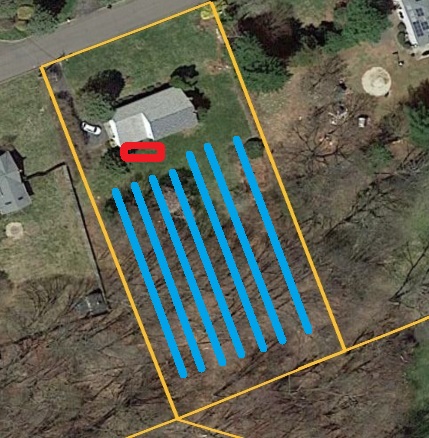
New_straight

I could do North-South rows, but feel like this wouldn’t be the best use of space, as well as harder to measure things out.
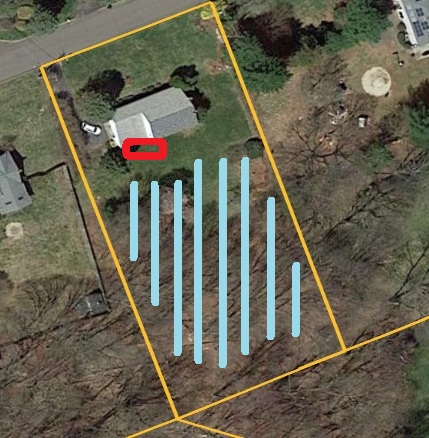
New_NS

I’ve been speaking to neighbors and 3 of the 4 are very agreeable to let me take out trees which are slightly over the borders into their yards. 1 of the 4 is not, so I’ll have trees on the SSE side. There will also be a bit of shade on the East from a couple big trees which are 40-60 feet into the neighbors yard. Though I don’t think those will be that bad. But, the Southmost part of the yard will likely be shadier than the part closer to the house.

So, it’s also occurred to me to plant things which can take a bit of shade (still more than half sun) like hardy kiwi, blackberry, and black currant there. That could look something like this.
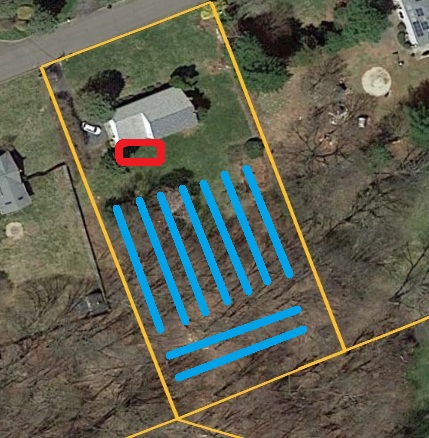
New_combo

The shadiest part of the bottom of that yard (TBD exactly where that is until once the trees are cut), will also get the compost pile, which will need to be decent sized for a yard like this. I’m thinking to make 2 of them out of left-over logs from the tree cutting. I could then fill one up, before starting to fill the 2nd. By the time the 2nd pile is full, hopefully the 1st would be ready to use. Right now, I have a single compost pile, so it is a bit tricky to find the part which is properly decayed and ready for use.

From what I’ve seen before, orientation can also depend on slope. So far, in walking the property, it seems pretty flat. When I looked on Google Earth, I was surprised to see that there is a 17 foot difference between the high and low points, though that is over spread over 300’ (lowest to the SE corner, highest in the NW). Median slope going NS is 1-2 degrees, while going EW is more like 4-6 degrees.

Current plan is to use mostly 15’ rows, with in-row spacing varying by fruit:
5- Blackberry, Black Currant
8- apple (pruned thin, slender spindle), bush sour cherry
12- Jujube, Persimmon, Euro & Asian pears, Fig*
15- Hazelnut, Peach/Nectarine, Plum, Pluot, Apricot

*- Though most figs will be along the S side of the house. The red square is where I’d eventually like to put up a greenhouse as well.

Some of the tighter in-row spacings (Blackberries, Sour Cherries, Black Currants) and muscadine & kiwi trellis probably don’t need 15 foot row spacings. So, I may have 1-2 rows with 12’ spacing.

It’s also occurred to me to space a row of jujube or persimmons (two fruits that don’t need spraying) a bit wider (say 15’ instead of 12’ and put a Black currant in between each. I’m not sure if I’ll do that though, as I’ve been thinking of protecting black currants from birds and that would be much easier if I keep them together in a row.

The front yard is open in this diagram, but the current plan is an alternating double row of chestnuts (seedling of Qing, a semi-dwarf Chinese variety) and a few mulberries. Basically, the bigger trees in the North of the property. I will need to work out what to do about deer, as I’ve seen as many as 4 at one time when walking in the backyard.

I’m planning to put a fence up in the back, but the front will be trickier.

4 Likes

Your property alignment is the same as mine, although the lot is square. My rows and columns are parallel with the property lines. I haven’t had any issues with sun exposure.

5 Likes

Congrats on the new property!

orientation
I think it will matter more how you arrange things in your rows than whether they are exactly north-south. I like the layout with the two rows at the end for things that don’t love super full sun like the blackberries.

You also may change your mind on how you want to lay things out once the trees are cut down and you get a better sense of the property and what you can see out the windows and where the drainage is.

ugh deer. ugh fences
Definitely definitely worry about the deer. You can always put a cage of wire around a tree if it’s not in a fenced area. But then you have to really really want that tree because it’s a pain to go in and maintain the little caged area. (You started one of my favorite threads ever: 5 rules to reduce maintenance ) so I’m sure you have thought about this. You can also grow the trees so they are tall with scaffolds that start high. Then you have to think about ladders and such, but you can mow under them and there isn’t a cage to fuss with.

compost!!! yay!
The compost question is near and dear to my heart (as I am currently changing my compost strategy yet again). I started with a two bin system but I ended up needing more than two bins. I was running out of bin space and needed to either speed up the compost (by flipping and/or changing my strategy) or have another bin to fill.

tree clearing!
When they’re clearing your trees if they bring a giant hydraulic chipper, encourage them to chip as much as they want and leave the chips in a giant unsightly pile and not worry about hauling them.

My significant other was super annoyed about the giant unsightly chip pile. But I have been so happy. Also, 1.5 years later they are gone and spread around and decomposed.

Also, if any of your trees are big and straight with no side branches and of a desirable type, you may be able to have them removed by someone who wants the wood. I was surprised that I was able to get 3 big cedars removed for free by a guy who occasionally took stuff to a sawmill.

The downside to this was that I had to do all the cleanup of the parts he didn’t want, but it may be cheaper to have that cleaned up than to have the big trees taken down.

1 Like

I did an in depth analysis about 30 years ago of the difference between pecan trees in rows north/south, east/west, and at various angles. Believe it or not, the optimum is actually rows slanted from southeast to northwest. Why? Because the critical time for nut maturity is in September and October when the sun is already slanted pretty far to the south. Orienting rows southeast to northwest allows the trees to optimize solar exposure at this time of year by capturing late evening sun. I could give a lot more detail including the math behind the analysis and it would translate very well to other species besides pecan, but there is really not much reason to do so. One thing I can tell you is to separate trees in the row a bit further apart than the distance between rows. For example, 30 feet between trees in the row and 25 feet between the rows works out pretty well until the trees get very large. Why? Because the sun at a low angle to the southwest shines between trees in the row hitting trees in the next row over. Either a triangle or quincunx planting pattern works very well for this setup.

I can give another example of something that is counterintuitive for sun angle. Vertical fixed mount solar panels work better in winter than panels mounted at any angle from vertical for northern tier states. How can this possibly be so? The sun rises in winter near the horizon and shines on the vertical panels at an angle close enough to optimum that the panels produce more power over the course of a day than panels that are directly facing the sun at noon. Direct facing panels make more power during the noon period, but early morning and late evening lose their advantage. The vertical mounted panels capture power early, noon, and late giving them an overall greater output. Alas, this does not work as well in mid-summer.

4 Likes

I recommend planting your latest ripening fruit as far away from the southeast trees as possible. This time of year (October, November) I have apples that don’t see sun until late afternoon because the low sun is blocked by trees. If I could do it again I’d plant the earlier fruit near those trees (cherries, apricots) and the late-ripening apples far away.

I have since reference a simple phone app called “SunCalc” that shows where the sun will be on any given day at my property.

4 Likes

I checked and my current lot is the same general tilt (a bit counterclockwise on the map), but 27 degrees, instead of 21.

Being in CA, you have more sun (sunny weather) to start with :slight_smile:

Definitely- clearing should hopefully start next week. Though I did tromp around a bit more over the last few days and most of the property is pretty flat. There is a bit of a low spot in the SE corner, which will also likely get the most shade. A good candidate for compost and a pile of woodchips.

Hah- if they left all the chips, it would be a pile you could see from space. And it would risk falling over and killing me. I told the tree cutter I could use a couple truckloads (big dump-truck), but not all of them.

I should have asked- maybe a few would be useful to someone. The biggest look to be oaks and tulip, along with some medium to large maples. But, if it was a matter of getting a lot of people in to each take a few trees, then I’d rather just get it taken care of in one go. This way definitely adds some economy of scale. The cutter counted 40 big trees and said the rest was effectively free, as taking them out helps him get at the big ones. When I went around counting, I saw about 32 (hard to not re-count anything…) which were at least 1.5-2’ diameter, with some into the 4’+ range.

I assume those are pecan spacings? I don’t plan to put anything that far apart, even chestnuts and mulberries. The chestnut seedlings will be from Qing, which tends to be a bit small for a chestnut. I was already planning to have it in 2 offset rows in the front yard.

X----X----X----X----X
—X----X----X----X----X

Is this what you mean by quincunx? Though with more rows it would be:

X----X----X----X----X
—X----X----X----X----X
X----X----X----X----X
—X----X----X----X----X
X----X----X----X----X

Yes, I checked and the sun doesn’t even get above 40.3 degrees on Oct 15 and 34.4 degrees by November 1st (around our first frost). There could be parts of the property that get little, if any sun by that point, though close to the house (greenhouse location :slight_smile: ) should still get close to full sun, at least the middle 8 of the 10 hours of daylight. Dawn and dusk are hard to get fully, just due to distant (150’+) trees, house, fences, etc.

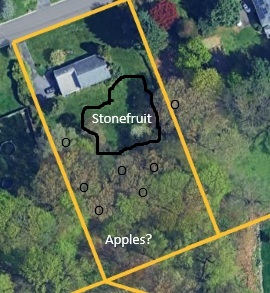
I like this idea, but there is a bit of a complication- there are a number of oaks in the woods being cleared. From what I’ve read, stone fruit is particularly susceptible to oak root rot, which is left-over after large oaks are cut and their roots decay. I was looking around today and as best I can tell (some of the trees are tall enough it is hard to see the leaves) this is where the oaks are, marked with “O”.

I’m not sure how much an an issue ORR is in practice, but I think I should put a decent amount of the stonefruit in the sunny area near the house, even if the late sun is wasted for some of it. Maybe put a few late apples and jujubes in this area as well.

New_Oak_

As far as I can tell, jujubes aren’t affected by ORR and persimmons and pears are resistant, so they should take up a lot of the middle. Maybe some Sour Cherries in the SW, with the apples, as they are ripe pretty early in the season. Any idea if the Romance series of sour cherries is also susceptible to ORR? I’ve seen “stonefruit” in general considered vulnerable, but bush cherries are reputed to be pretty tough…

Of course, now that I think about it, I removed a big 80’ tall oak in my current yard and planted peaches under it’s dripline. One of them is still alive and productive 10+ years later. Maybe it isn’t as much of an issue as long as the soil is well drained.

Thanks- I’ll have to check that out. I’ve been using https://shademap.app/ for a similar purpose. It can also show you the shadows from current objects. It’s a bit tougher to project after tree-cutting, but you can zero out heights in certain areas.

I’ve also been using the bubble-level app to measure the height of the tree-cover at various compass headings (tipping the phone to point in the various directions). With that, you can get a sense for how much sun it will get at various points in the year.

2 Likes

That’s a poor assumption about my location.

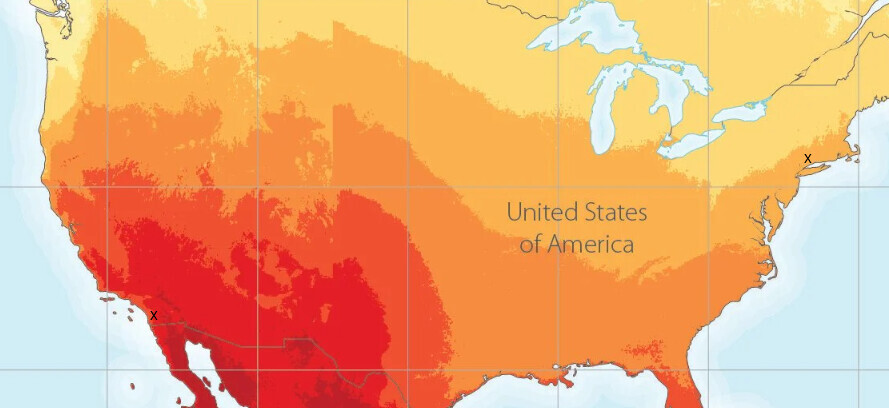
Seems like the map supports my assumption :slight_smile:

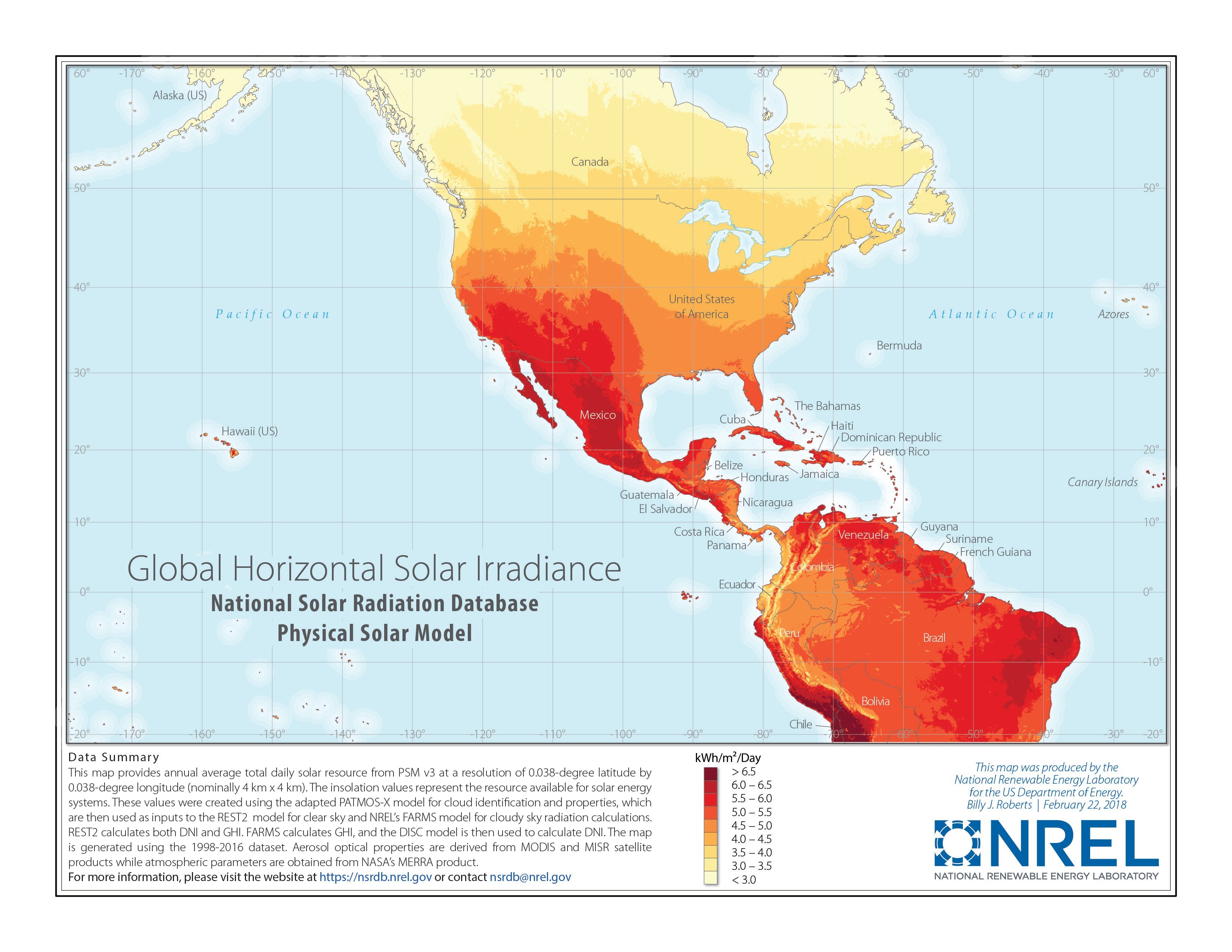
I’m not sure if Vista is inland enough to be in the 5.5 kwh/m2/day category, but it is at least in the 5.0. I’m lower end of the 4.0 band, so you’ve got more sun, at least on average.

For the full map, with key:

1 Like

The map does not account for our local marine layer.

1 Like

Looked on the heat zone map and I believe you are actually in a lower heat zone than him as well, ocean currents are so powerful!

1 Like

Today I learned something new: Marine layer - Wikipedia

June gloom.

The sun rises in the Northeast and sets in the Northwest after making a big arc in summer. July 01 in Bridgeport sunrise is at compass heading 58 and sunset heading 302. Noon the sun is 72 degrees above the horizon. 50’ vertical trees would cast a shadow 50/tan(72) = 18 feet across the ground. You could plant up to 20’ from the affected south edge and store things down there. I also think you could consider adding a foot between rows to allow more sunlight into rows at a 360-22=338 compass heading.

Other plants to the south rows that are “early” and so will get enough light from the sun clocking around even if they are a couple weeks late to harvest with lower yield:

Gooseberry (natives grow in understory).
Goumi berry (still fruits in shade).
Haskap.
Bush cherry, esp. native Prunus besseyi (harvests late in shade).
Mid-bush or Lowbush Blueberry.
Juneberry Saskatoon (not a tall tree, so produces in shade at low yield).
Hazelnut.

2 Likes

In contrast to the west Atlantic current, the east Pacific current runs south from the Gulf of Alaska along the western coast of North America. Coastal water temperatures here in north San Diego county are often the same or lower than those in Connecticut.

2 Likes

If you have held dice before, you know what quincunx is. It is like the 5 spot on dice. Plant four trees in a square, then plant one tree right in the middle of the four.

1 Like

If only there were penguins in the northern hemisphere to take advantage :smile:

1 Like

I remember my first visit to San Diego where I went to La Jolla to look at the sea lions. I was coming from from Miami and expected warmer ocean water. That water was COOOLD!

1 Like

Cool! I did this pattern and didn’t realize it was a real thing much less a historical way of planting. I thought of it as “offset rows”. When I did the “offset rows” I wasn’t even thinking about light, but it will certainly help with that. I was thinking about making the most space between the trees and also what I wanted to look at when I was sitting on my porch.

I’m not disputing that your area is colder than more inland parts of CA. And may even have a cooler summer than we do here. But there is more sun, at least as collected for that map. It says that it takes into account the cloud cover and I see other parts of the map (like Seattle being lower, while inland is higher) where that seems reflected. Some of it could just be the lower latitude (mid 30’s vs low 40’s), which impacts sun angles and day length.

July 1st is close to the longest day (~June 21), so most of the growing season will get less sun and at lower angles

You are saying “at noon”, but most of the day won’t get sun there. Keep in mind that it isn’t a single tree, but most of the Southern border.

I checked on Google Earth and the elevation difference between the trees and the ground ranges from 50 to 75’ over the border. So, even at noon (solar noon, 1pm with DST) that’s 25’ of shade. 2 hours later (or earlier) has a sun angle of 59 degrees (sun still coming from SE or SW, so passing over that line), resulting in shade of 45 feet.

That means that on one of the sunniest days of the year, there is only 5 hours of strong sun for 45 feet from the fence. And a month later it is 51’, while on September 1st (still solidly in the growing season) it is 70 feet. It isn’t quite as bad, as some of the fence line is only shaded by 50’ tall trees, so those figures become 30’, 34’, and 46’. And there could be dappled sun though the branches for some of the time. And, as you said, there could be a few hours of early morning or late afternoon sun, during mid-summer.

But, I’m glad you brought this up, as I was tentatively thinking of planting black currants 12’ from the fence and another row (Sour cherry or blackberry) at 24’. After looking at the numbers, I don’t think there is much point in that. I should probably start at 20 or 30’ from the fence-line for the shady stuff and maybe 60-70’ for the sun-loving.

I wasn’t originally planning to move the gooseberries, as they are generally an afterthought for me. But, they can be OK (Especially Jeanne and Hinomaki Red) and I guess that the 1st row isn’t that useful otherwise.

I have a Goumi and while small and tart (and eaten quickly by the birds), it isn’t bad. Maybe I should start some cuttings.

I’ve got several Haskap/Honeyberry as well. They rarely make much fruit and what there is gets eaten by birds good. But, it would hurt to move them into the bottom row too.

I tried growing these for several years and got a few bland berries. I moved them to a partial shade location at a rental, just to free up the space. In the ~8 years since then, they grow fine, but the few fruit they produce get horrible fungal growths (rust?). Combination of marginal fruit and disease issues kills this one for me.

I just planted some hazelnuts this spring at my current house and am planning to move them, and probably buy a few more. But, from what I’ve seen online, while they can be healthy in shade, it dramatically reduces yield. I’ll probably put them in a better, though not necessarily ideal spot.

You made your assumption before looking at a map. That map shows solar irradiance, not unobstructed sunlight hours per day, nor air temperature. It does not distinguish between seasons, nor does it have enough resolution to illustrate our local marine layer effect. Due to our specific location in NW Vista, you’d need to find a map with measurements for central Oceanside, CA.

That said, we could measure solar intensity at zenith on a day that we both have clear sky at the time. We would find a higher value here. This fact is important when considering application of solar cells. However, it is of limited importance with deciduous trees because their leaf cells regulate solar energy input.