There are a couple of old threads dealing with this. I’d like to find out who summer prunes - and what your experience is? I like the ability to limit spring ‘runaway’ growth - and the ability to thicken limbs. However - has disease introduction been a problem for you? Thanks for your input.
1 Like
I do most of my pruning in the summer. For stone fruit trees that is the preferred time. Even with apples and pears I do a lot of summer pruning to keep the tree size small.
Disease has not been an issue, but best to only do your pruning in dry weather to lower the chances of infection.
9 Likes
Exactly as @tbg9b said!
In addition, summer pruning of apples promotes creation of fruiting buds.
Summer pruned my vigorous Cox Orange Pippin on M111 last summer and got nice crop this summer.
I highly recommend to watch Orin Martin’s videos on summer pruning https://www.youtube.com/watch?v=9ioGcl7gHgc
9 Likes
Yes, thanks, @ukie . And thanks @tbg9b, too.
I have watched that video of Orin Martin’s, and found it so informative. However . . . . he is in ‘perfect’ California. And not on the soupy east coast. And his seasons fall a little differently than mine on the east coast. So - that’s why I put the question out there for a broader consensus. I am trying to get to all of my trees, using Orin’s 3-bud rule, but still feel that ‘pruning hesitancy thing’ - (probably because of all the fireblight warnings).
Thanks for sharing the link! I know many of our members will find it VERY useful.
3 Likes
There are plenty of articles in the ASHS journals on summer pruning of apples comparing various varieties to see if fruit size and color of fruit are increased. Mostly all positive once you take into account the initial vigor of the trees you prune.
3 Likes
Drews techniques to me… are what i want to accomplish for my own orchards. I think he prunes several times a year… with seemingly great results.
2 Likes
About 6 weeks ago I watched this guys two part videos on summer pruning. I decided to give it a try on some apple and pear trees to see how well it would work. He does a great job of explaining which made it easy to prune. My goal was to develop more fruit buds sooner and slow the overall growth.

5 Likes
Good video!.. i just read this article the other day… seems to be the foundation of the video written by the same guy 10 yrs ago.
4 Likes
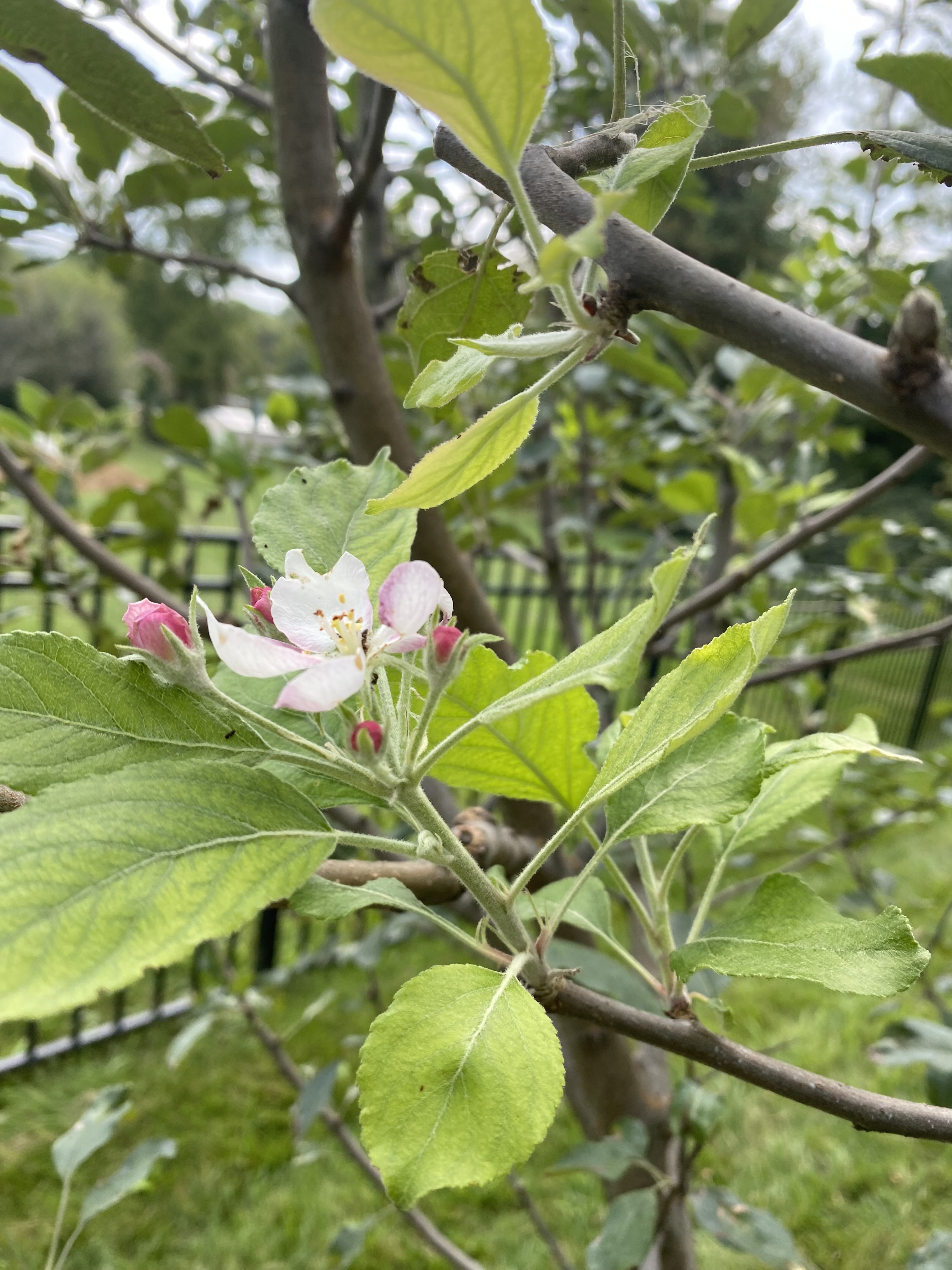
Yes, summer pruning helps with both: more fruit buds and less growth. Expect some apple bloom in couple weeks, you may even get some fruit set.
Edit: here’s a pic from Sept 9th last year, fall apple bloom
4 Likes
Thank you for that article! It’s fun to watch the videos . . . but I like to hold the info in my hand and go over it, making notes if I’d like to. Orin Martin explains things simply and thoroughly. He is one of my favorite go-to teachers online.
4 Likes
I summer pruned my apple tree couple of weeks back. I see some growth forming on pruned branches and can’t tell if they are fruit buds or vegetative growth.

2 Likes
I have a person I know that his family had a huge fruit orchard ( mainly apples) and he says he never prunes in the summer. He states that disease and bugs do more damage at that time. He was taught to always prune in December. He was/is pretty adamant about that. I was getting ready to do some summer pruning and he about had a fit when I told him that. So I guess I will just do winter pruning unless something really is wrong on a tree that needs some pruning in the summer.
2 Likes
For almost 50 years I’ve been pruning all of my fruit trees and vines whenever I see some unwanted growth or have the time to do it. This happens any time of the year; but most pruning is done shortly after harvesting the fruit, so mainly in the summer. I’ve never noticed any problems associated with the pruning.
I prefer to prune green growth because I compost all material small enough to cut up with a hand pruner, and the green material breaks down a lot faster than dormant material.
7 Likes
Never take advice from a person telling you something from the vantage point of always having done it. When I first started my business I made a point to meet local commercial fruit growers after I’d already immersed myself in research based literature about fruit tree pruning.
Unlike your friend with a huge family orchard, Cornell’s advice at the time was that the ideal time to prune was in late March, but when that advice was given it never contained a why.
A second generation commercial grower near me told me that he knew several growers in the Hudson Valley who always prune their orchards immediately after harvest in mid-fall, because the harvest crew was there to do the work then.
Alex Shigo, an often worshipped arboriculture guru suggested that pruning at that time is the very worst thing for trees because they are tying up their energy hardening off for winter leaving the healing process underfunded at that time.
Meanwhile, experts on managing espaliers have always done most of their pruning in mid-summer.
How is one to deal with so much conflicting advice?
I am a professional fruit tree pruner who has probably done more fruit tree pruning than any commercial fruit grower in this planet, but with that kind of hubristic statement, maybe you should take my advice with a grain of salt. The most reliable gurus tend to be modest and self-deprecating- folks often don’t listen to braggarts. Not that I’m really bragging, it’s just that pruning is the number one job of my orchard managing business and I’m actively pruning fruit trees for about 7 months of the year. Most commercial orchards are pruned within a 3 month time frame, and the trees all tend to be relatively young these days.
But I don’t care if you listen to my advice very much- most of the pleasure is in the writing of it for me.
Why the Cornell recommendation for pruning after winter’s harshest weather? Because their gurus are experienced in rather harsh winter conditions and recent pruning wounds can be injured by freezes that go below a certain point- generally -20 F or below that.
However, I have done major pruning on big old apple trees several times when temps have gone to about -20F within days without harm, and generally old apple trees of the hardy varieties most frequently grown in the northeast would likely need temps below about -25F to suffer damage around recently made pruning cuts. Pruning in the fall allows the wounds to harden up but I’m not sure how much time the process takes- I’m told about 2 weeks. As a general rule, older trees are less likely to suffer cold injury from winter pruning than young ones and in all my years of winter pruning I’ve only seen consequences from pruning peach trees right before an unpredicted deep freeze in early Feb. My mistake cost the lives of a couple very young peach trees and injured several others. Peaches are the most tender of species I manage and should be the last trees you prune if you are in a cold climate. Best to prune them around bloom anyway, if canker is an issue in your region.
Whether or not you should summer prune depends on many things, including what the hell you mean by summer pruning. You need to know that every individual fruit needs about 30 of its own well exposed leaves to produce a high quality piece of fruit. If you are pruning leaves that serve fruit you may be damaging the quality of the crop, but if you are pruning shoots that shade those leaves you may be improving it- otherwise espalier trees would not be known for producing high quality fruit.
As far as summer pruning to induce flowering in apples or pears, that is a tricky matter. Different varieties are likely to respond much differently and if you cut back annual wood you may actually be encouraging vegetative growth at the expense of developing fruit buds. I’ve not seen research on this topic, but it may be that if you make the cuts 2 or 3 times during the growing season it is helpful in getting shoots to make flower buds but that is an experiment I’ve never observed.
Another unanswered question about summer pruning is whether reducing the canopy doesn’t cause the roots to deliver too much water to the remaining tree, thereby reducing brix even as getting sun to leaves near fruit increases it. Home growers can hedge their bets by pruning through spring and summer to discourage excessive root growth and such an imbalance, if it is, in fact, a problem. Also, if you don’t get much summer rain, you can probably solve this problem, if it is real, by watering less. Whether a tree is on dwarf, semi-dwarf or near standard root stock may also play a role on outcomes.
At any rate, I manage apple and pear trees by summer pruning only, winter or early spring pruning only, winter and summer pruning and even spring summer and winter (or early spring) pruning. My own orchard gets the latter treatment.
I still don’t know which method produces the best, highest sugar fruit because of all the variables involved
OK, that’s about all for this morning, folks. If you really want to know about summer pruning learn about the physiological aspects of it. I suggest the book, Arboriculture, by Richard Harris as a starting point. You can find a used version of the 2nd or 3rd edition on line for a reasonable price.
14 Likes
I summer pruned my apples and sour cherry. Now they are all blooming again! The flowers are half the size of normal flowers. Does this go with summer pruning as well?
1 Like
I don’t know the answer to your question because I’ve never observed that to happen as a cause and affect. It is common for that to happen some years with many tree species including apples regardless of pruning regimen. For the fun of it, I decided to ask Chat.
can summer pruning induce flowering immediately after pruning?
ChatGPT said:
ChatGPT
Pruning fruit trees, especially during the summer, generally does not immediately induce flowering. Flowering is typically regulated by the tree’s natural growth cycle, which includes dormancy periods and preparation for the next growing season. Here are a few points to clarify:
- Timing of Flower Bud Formation: In most fruit trees, flower buds are formed in the previous growing season. Summer pruning can influence the formation of these buds, but it won’t cause the tree to bloom right away.
- Stress-Induced Flowering: In rare cases, severe pruning or stress (like drought or extreme defoliation) might trigger a stress response that causes the tree to flower prematurely. However, this is not a common or predictable outcome, and such stress-induced flowering often results in poor fruit set or quality.
- Exceptions: Certain tropical or subtropical fruit trees (e.g., some citrus varieties) might flower more than once a year, and pruning at the right time can influence a flowering cycle. However, this is specific to those climates and species.
In general, while summer pruning can influence next season’s flowering, it won’t typically cause immediate flowering right after pruning.
1 Like
My Akane and Hudson Golden Gem trees had not one fruit spur in year 3… i watched that vid… and summer pruned them… the next summer… there was still not one fruit spur on either one… i summer pruned them again… the next summer i could see fruit spurs had developed… and quite a few.
Unfortunately the next spring (this spring) was the worst fireblight year I have seen so far.
Akane and HGG are later bloomers (FG3 &4) best I remember… and some of their earlier blossoms set nice fruit… but the later blossoms… almost all of them got hits of FB.
All those fruit spurs I had summer pruned to encourage development all blossoms and leaves blasted with FB.
My little Novamac tree on B9 (Espellar) is a FG4 tree… and the same thing happened to it… its early blossoms set fruit… but the later ones all got blasted with FB.
I ended up removing many fruit spurs, shoots and most of the two bottom scaffold branches.
It did recover somewhat… and a few of those early set apples ripened. Very good.

TNHunter
5 Likes
Pretty apples. Which ones are these?
2 Likes
Novamac…
Here in southern TN… Novamac apples ripened late July to Aug 3.
They dropped when ripe.
2 Likes
I should add that pruning during dormancy generally is less dwarfing than pruning during the growing season. Pinch pruning to help train young trees is probably all you should do during the growing season if you want trees to fill out and bear as soon as possible. All pruning of vegetative wood is dwarfing (but not spur wood or fruiting wood, necessarily), and it is most dwarfing in mid spring after the tree has used all its stored energy and has started to gather a surplus that is used to grow the tree larger.
The exception is shaded wood- if a leaf gets less than 30% light exposure it becomes an energy drain for the tree and is presumably a dwarfing influence. After a certain period of time, probably about a month, the leaves of a shaded branch permanently lose the power to harvest light, so summer pruning probably should take that into account both to prevent that from happening and also to remove useless energy draining twigs. Winter pruning needs to open up the tree enough that such shaded wood is limited within the tree even without summer pruning. .
2 Likes