That is so strange that’s the exact thing that happened to my Ayers in 2025. The tree looks kind of freaky now with a giant hole in the middle but seems to be doing OK.
1 Like
Yes, pineapple is highly resistant you must have got that new strain we are all fighting at times. My fireblight was gone after I fought it several years.
Are good pears! Lazy J is resistant to fireblight and a reliable producer. I enjoy the taste of Lazy J. New World Is a great Asian Pear. Nothing wrong with those pears. I did not add them to my top pears this year.
@clarkinks
Glad to hear about Dutchess D’Angouleme. I added that and Douglas based on your recs. How is Douglas going for you?
Wondering if you have any recommendations to add for favorites (that aren’t super FB susceptible) as you have a lot of pear interest.
At this point, I’m less about FB resistance and more interested in avoiding things that are known to be super susceptible (unless there is some very special reason I want to try them). I figure if they’re resistant this year, they might not be next year but at least avoiding things that are known problems should help.
2 Likes
Douglas is one of my favorites for its apple like taste. It is given to overbearing. Try Clara frijs if you want a very good non fire blight resistant pear.
1 Like
Thanks! (I did topwork two trees with Clara Frijs - and they are rather far from my other trees.)
It’s not that I want a non-fireblight resistant pear… but I feel like I need to temper my expectations in regards to fireblight resistance since it seems to be a moving target.
1 Like
Beierschmitt is worth a look. It is thought to be a Bartlett seedling with much better fireblight tolerance. Shinko is a surprisingly good Asian variety with good fireblight tolerance.
2 Likes
Well thanks to this thread I ordered harrow delight and harrow crisp this morning and a piece of scion for harrow sweet. From the sound of it can’t go wrong with them!
1 Like
I think you will like this thread
These are the 25 pears from the harrow station.
HW 600 unamed above
HW 601 unamed above
HW 602 harvest queen
HW 603 harrow delight
HW 604 unamed above
HW 605 unamed above
HW 606 bliss
HW 607
HW 608 delicious
HW 609 harrow sweet
HW 610 harrow crisp
HW 611 unreleased
HW 612
HW 613
HW 614 sundown
HW 615 unreleased
HW 616 harrow gold
HW 617 unreleased
HW 618
HW 619 unreleased
HW 620 unamed above
HW 621 unreleased
HW 622 unreleased
HW 623 happi
HW 624 dew drop
This was the Canadian pear breeding program before harrow
3 Likes
I must ask, For the sake of Alaska and other cold clime fruit growers, if anybody has ripening dates and cold hardiness for this list?
1 Like
I can help a little bit with that list but it is a very different list. Maybe call Bob and let him know what you are after. I won’t focus on the Russian pears or all the ones everyone in Alaska already knows about. I will mention them at the bottom from past discussions. If you want to revisit those topics no problem we have them on the forum. @Bernie was the importer of the Russian pears into Canada and they have made there way into Alaska. Years ago a guy I know used to be a fruit tree importer in Alaska. Bob eventually stopped doing his import business and moved to Idaho. The thing is he is very aware of the cold hardiness required in colder locations and focuses on that. Bob is also a prominent member of NAFEX Pears - Purvis Nursery and Orchard
Here are some of his cold hardy pears and his descriptions. Douglas came from just down the road from me. If things do well in Canada or Alaska they will do well in Kansas and typically vice versa.
Douglas: Fruit is large, slightly tart, few grit cells, firm texture, excellent for canning, keeps well. Tree has upright to spreading growth habit. Flower buds hardy to at least -34F; tree is productive in SW Minnesota and very resistant to fire blight.
Ewart: Introduced in Ohio, 1928. Tree is precocious and very productive, somewhat more fire blight resistant than Bartlett, willowy growth habit, flower buds hardy to at least -34F. Fruits are medium sized, flesh fine-textured, melting, juicy, flavor and quality are excellent. Ewart will pollenize Bartlett and somewhat resembles it although it ripens 10-20 days later.
Harrow 604: Somewhat spreading growth habit, well spurred, low vigor, very precocious, early ripening, slightly fire blight susceptible, hardy in Zone 4, injured at -33F. Fruit has long neck, yellow, size small to medium, outstanding flavor, ripe early August in SW MN.
Harrow Sweet (Harrow 609): Medium sized tree, moderately precocious, somewhat spreading growth habit, hardy in SW Minnesota to at least -34F, resistant to fire blight, very productive. Fruit ripens 3-1/2 weeks after Bartlett, yellow with red blush, sweet and juicy with excellent taste, keeps about 3 months in cold storage.
Honeysweet: Self-fertile seedling of Seckel, hardy to at least -35F, very productive. Fruit resembles Seckel being very sweet. Larger and keeps better than Seckel. Tree has spreading growth habit, high resistance to fire blight, ripens about Sept. 4 in east-central Minnesota.
Luscious: Medium sized fruits, good flavor, tree has somewhat spreading growth habit and sterile pollen. Hardy in Zone 3.
Stacyville: St. Lawrence introduction, very sturdy tree, hardy in USDA Zone 2, tree is productive. Fruit size medium, sweet, but needs to be picked before fully mature. Keeps for about a month. Popular with customers at the farmers’ market in SW Minnesota.
Savignac: as grown in central WA, tree is spreading, low to medium vigor, precocious, hardy in zone 2. Fruit ripe about Sept. 10-15 in central WA. Sweet, juicy, size medium to large, coarse flesh, few grit cells.
Summercrisp: Tree is upright to spreading, fairly precocious, and very well spurred, an excellent pollenizer for early-ripening pears. Good resistance to fire blight. Fruits medium sized, best eaten when crisp. Hardy well into Zone 2.
Ubileen: Tree is upright to spreading, flower buds not hardy below about -25F. Fruits large, very flavorful and of high quality, ripens early August and keeps about a month. One of the best pears in the Corvallis collection, precocity is average.
Nova: St. Lawrence Nurseries introduction. Tree is spreading, low vigor, precocious. Fruit is large, round, melting, and juicy, of good quality, and may be used either green or ripe. Tree is supposedly self-fruitful. Hardy to about -45F.
Not resistant to fireblight
Comptesse Clara Frijs: Dessert pear from Denmark, 19th century, solid rugged hardy tree. Fruit size medium, shape oblong, yellow-green with a blush of red, rather thick skin. Flesh firm but not crisp, juicy but not dripping, flavor a cross of honey with vanilla. Tree very productive, flower buds hardy to at least -34F, fruit very popular at SW Minnesota farmers’ market.
Concorde: A British cross of Conference x Comice. Tree growth habit upright to spreading, moderate vigor, precocious, grower friendly, some resistance to fire blight, spurs up well, fully winter-hardy at –34F in SW Minnesota. Fruits are large with long necks, excellent sweet flavor, and keep till April in cold storage. Skin easily damaged in long-distance shipping.
Beurre Giffard: Tree has reddish new growth, willowy growth habit, precocious in bearing, blossoms with Summercrisp. Tree not hardy below –30F. Fruits are medium sized, somewhat pyriform, good tasting even when slightly unripe, sweet with vinous flavor notes, but keep only a month or two at best. One of the best of the summer pears, grown commercially in southern Quebec.
From my link above on Harrow pears

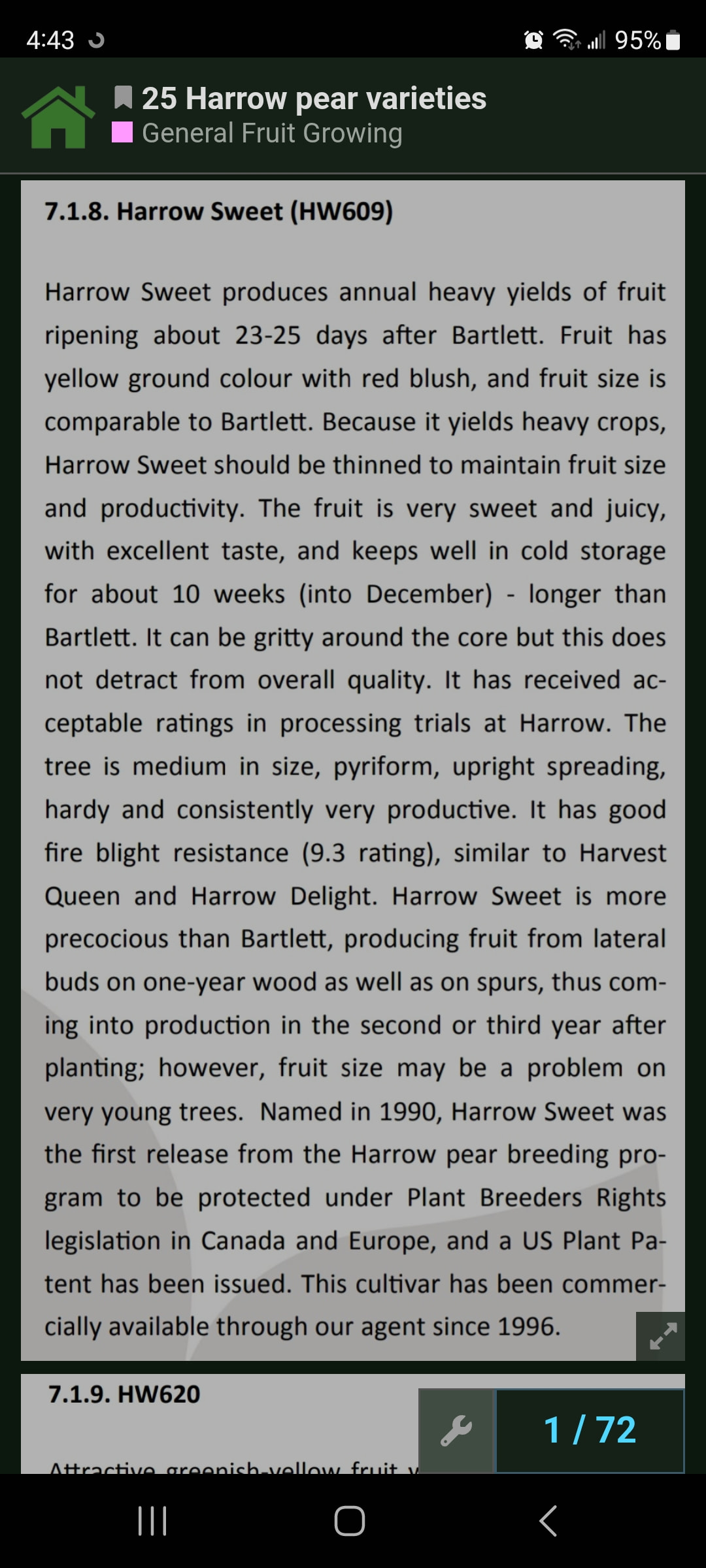
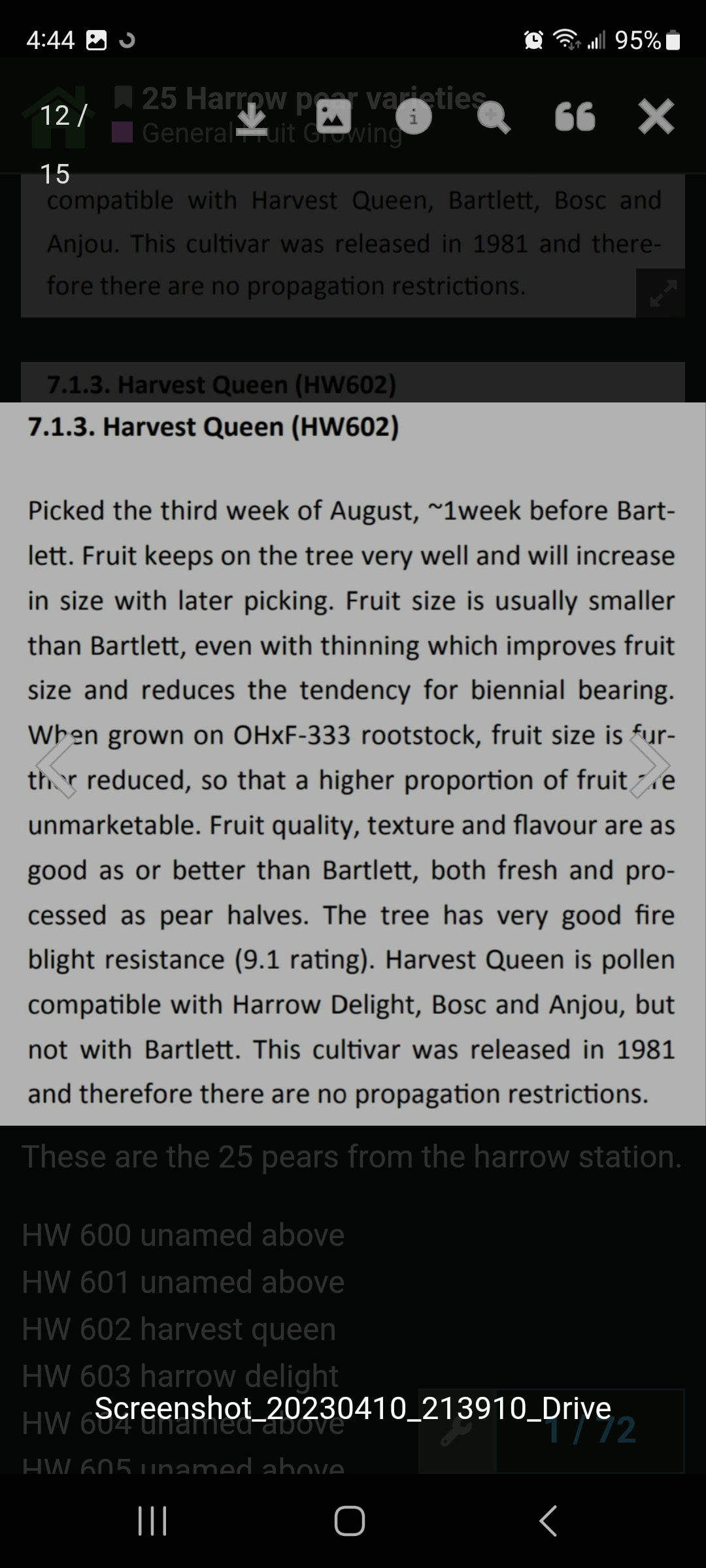
@VicJ would likely want to give some input on his experience.
I really like what they are doing in Canada with pears
2 Likes
Montana Fruit Tree Company focuses on cold hardy pear cultivars as well.
2 Likes
I’ve had a few pears fruit for me here in Fairbanks, but it’s been sporadic. The best tasting have been the Russian pears; so far Krazulya, Krasnobokaya, and Talitsa have borne. I also tasted a Larinskaya at my late friend Clair Lammers orchard. Ure winterkilled. Golden Spice hung on for 10 years or so; never bloomed and finally died a couple winters ago. Stacy and Hudar didn’t make their first winter. Early Gold has produced well a couple years, but often doesn’t even bloom. I had a Philip that fruited once before it died out; it was pretty terrible. Beedle survives well, but every time it’s fruited the pears have cracked terribly during the rains that typically come in August. I have a number of others that are just starting out, so can’t really give any meaningful evaluation on those. Hoping to acquire more of the Russian cultivars; they show the most promise. Marshall Zhukov and Favoritka and some others died out, but I’m going to try them again. One characteristic that has been observed with these is that they dramatically increase in hardiness once past the juvenile stage, so if we get enough consecutive milder winters they’re home free. I also got a Taylor Apple Pear from St. Lawrence, which is Asian; interested to see if that can survive. It made its first winter with significant damage, but it was disadvantaged by being planted out late in the season. Will know soon if it survived this one, which was the coldest winter ever recorded in Fairbanks. Temps have been lower, but the average was -13.6F, and we had lots of -40. It will be interesting to see how the plants fared; test winters generate useful data and help me not waste money, time, and energy on marginal stock. I’m hoping it killed off my slug infestation; they’ve been giving me terrible grief the last couple years.

3 Likes
@clarkinks Clark, which ones of these are your most reliable latest bloomers? Duchess D’Angouleme had buds at the same time as the peaches this year and got toasted as a result.
2 Likes
Of Clark’s list, the latest blooming are Warren, Magness, Worden Seckel, and Seckel. Korean Giant is usually described as blooming in group 4 which makes it comparable to Seckel.
Warren is arguably the best in the group overall but with 2 huge caveats. It is a tip bearer which tends to reduce production potential. It is relatively slow to start bearing a regular crop. My Warren was grafted from scionwood from LuckyP in 2000. It has a large crop set this year. It produced 8 pears in 2024. I grafted on top of a 6 inch diameter rootstock so it got a huge head start.
6 Likes
Do the pollination groups 1-5 on Asian pears and Euro pears cover the same time periods? I have seen Korean Giant in group 4 but I have also seen pear pollination charts (eg the one from Burnt Ridge Nursery) seem to say that late blooming Asian pears line up with early Euro pears. Or maybe it is climate dependent?
1 Like
They are supposed to align, but there is an issue with chill hour requirements. Asian pears tend to accumulate enough chill to bloom sooner than European varieties. What I have seen is that most Asians bloom in group 1 and 2. Korean Giant is consistently described as group 4, but it is also placed in group 2 by some growers. This suggests that some climates accelerate blooming for KG while others retard it. It is most likely a result of chill hours.
6 Likes
Thank you Clark for your reply.
I am so glad I found this Growing Fruit group. I really enjoy and learn from these discussions.
1 Like
Did the Warren soft ripen without refrigeration time? It for sure can’t be as slow bearing as Magness. I love those Comice crosses though.
1 Like
Warren ripened on the tree but had best flavor after leaving it on the counter between 3 and 5 days. It is a very good pear!
1 Like