That’s interesting, according to this article the Shikotan variety seems to be truly superior in terms of taste, have you ever tried it?
I’m also thinking of grafting onto Elaeagnus umbellata, which are quite easy to propagate from cuttings and grow quickly in my garden.
2 Likes
I have it growing. Still a small plant. Not impressed so far. Fruit size was not impressive either.
They are valuable to older men. The fruit contains 17 times more lycopene than tomatoes per ounce. Lycopene protects against prostate problems. Berries are also generally considered the most nutritious fruit, as the percentage of peel is larger.
John S
PDX OR
2 Likes
Is it possible to acquire seeds from you in the US? I am a new member to this forum, so I can’t message you, but my email is isaac dot alexander dot hill at gmail dot com.
1 Like
I want to share some observations with you. When we look at the origins of most goumi cultivars on a very general level, we can roughly distinguish two main breeding lines.
Japanese selections
Beginning as early as the Edo period, Japanese breeders focused on traits such as white petals, thornlessness, and large, low-astringency fruits. These breeding lines are often collectively referred to as tógumi.
Russian and Ukrainian selections
In Russia and Ukraine, selection efforts concentrated more strongly on fruit qualities such as sweetness and size. Intentionally or not, these cultivars also appear to have somewhat higher lycopene content. However, they often retain strong thorniness, and their flower petals typically range through various shades of yellow.
Because my own breeding work frequently crosses genetics from both groups, I recently noticed something quite interesting.
At a public plot where we grow a variety of edible perennials, I planted two leftover seedlings from a cross of Daiougoumi × Sweet Scarlet about two years ago.
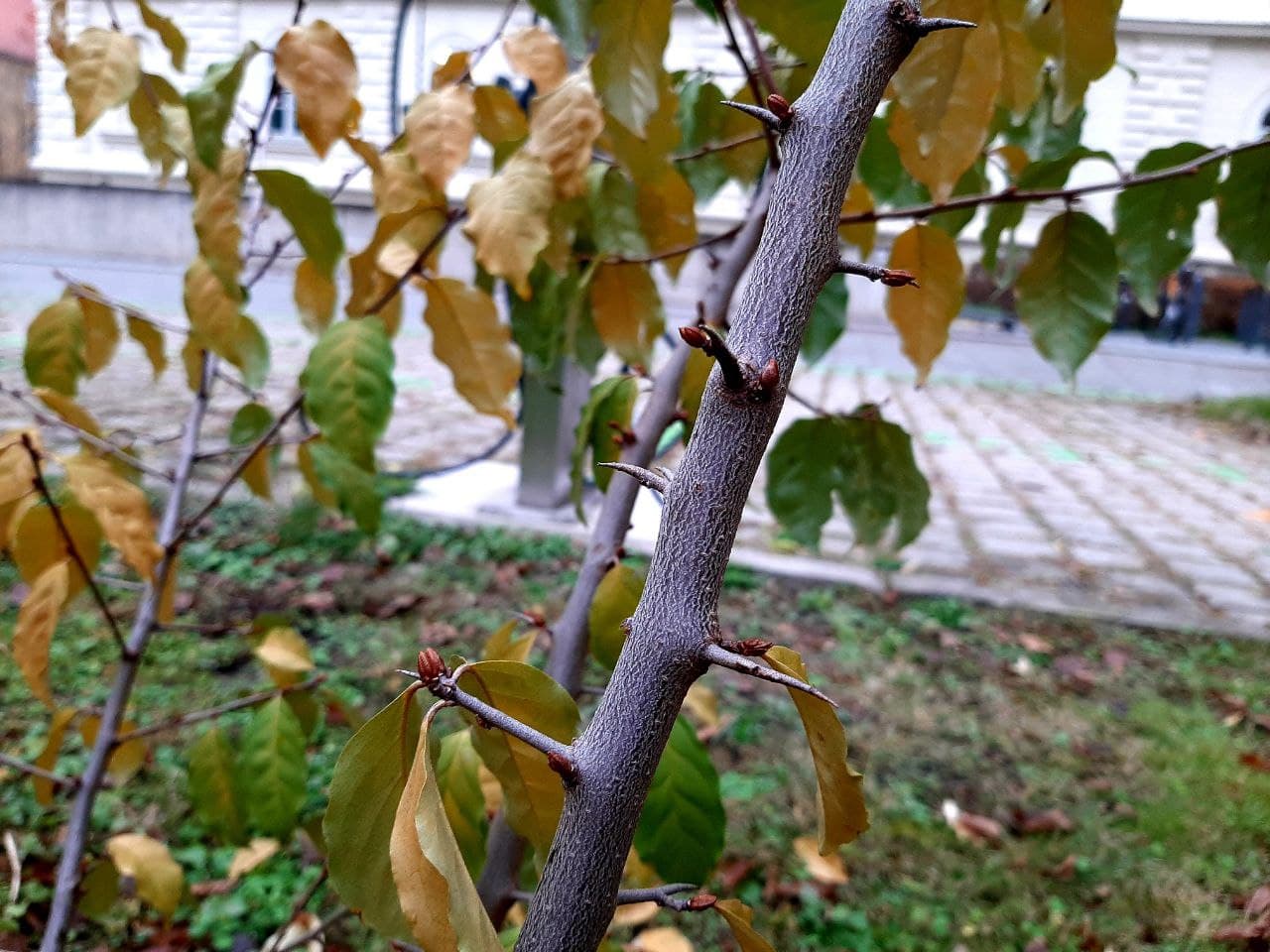
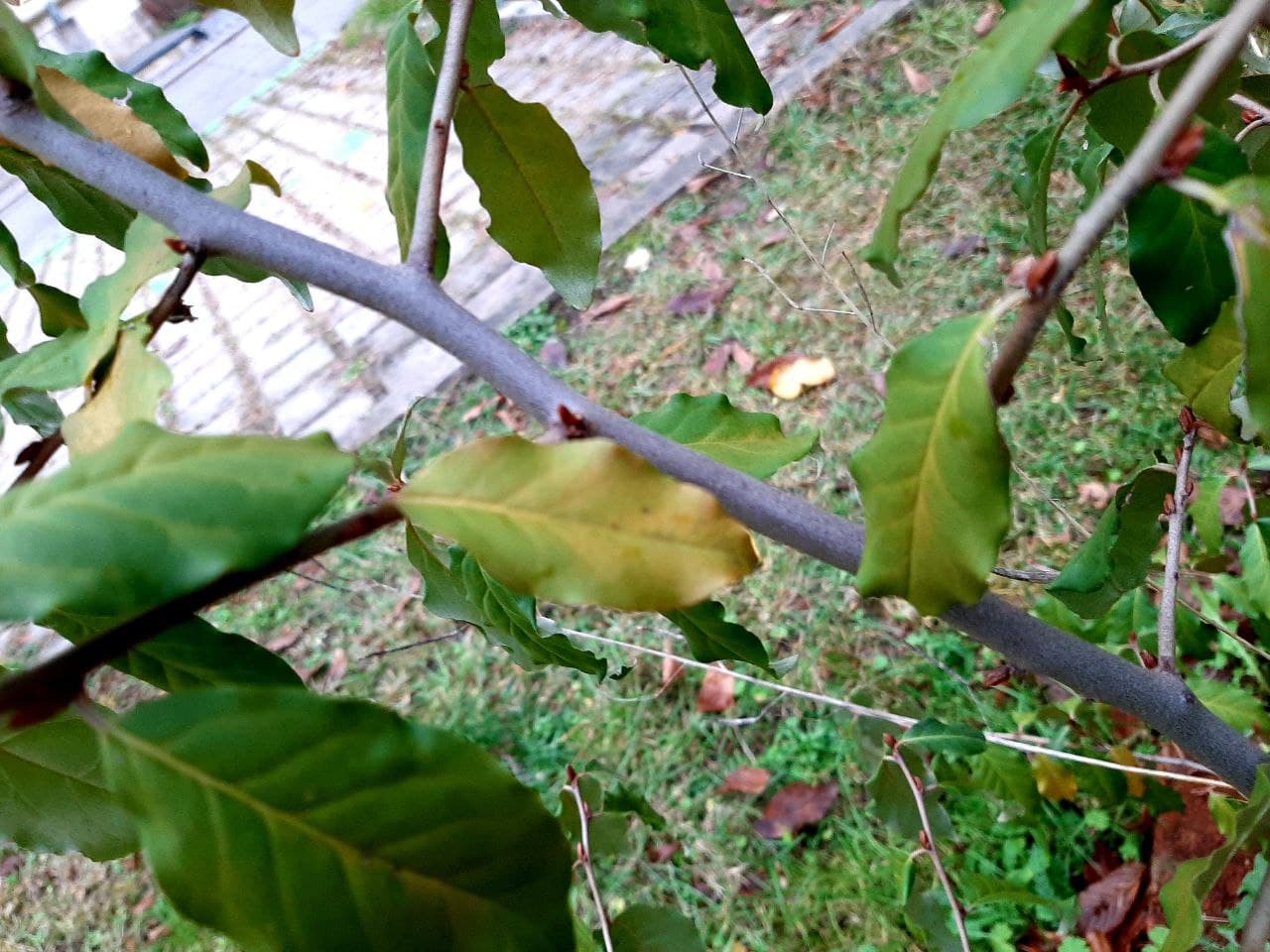
Now that they are entering dormancy, you can clearly see which genetic background predominates in which seedling.

Seedling 1 is extremely thorny and has already started shedding a lot of its leaves. This suggests that the paternal parent, Sweet Scarlet, contributed the more dominant traits in this plant. The early leaf drop fits the adaptations expected from cultivars originating in more continental climates such as Russia or Ukraine, where winters are cold and often dry.
Seedling 2, in contrast, is still not going fully dormant and shows no thorns at all. This may indicate a stronger expression of traits inherited from its mother, Daiougoumi, which was most likely selected in a milder and more humid climate.
Genetics are fun.
11 Likes
I’m in NW NC on the cusp of USDA zone 6B/7A. In wandering about my yard today because it was a gorgeous day and probably one of the last I’ll have until spring, I noticed a trend among my grafts. Hosts are a couple of different red-fruited autumn olives, red scarlet, and Moniz goumi. In general, everything in the genus here has given up all of their leaves, but some of my successful grafts that are still holding onto some are the goumis: Chorus, Carmine, & Pippi. I have a Carmine bush right outside my front door that is, ironically, the one plant in my yard I did not visit this week. (And, I was going to be lazy, but placement means that was silly, so …) That bush still has most of the leaves in it’s heart, leaving the new year’s growth bare.
I know very little about the ancestry of any of these, but the above post could suggest some of hte influences.
I know Moniz came into the US from Canada, and I believe mine may have been grafted there. England Orchard was beginning to trial it the year I got it and I lucked out and got one that had not been planted. It is my sturdiest Goumi, allegedly on some form of large yellow Autumn Olive, so I’m somewhat surprised it did not still have some of it’s own leaves given it was likely from a colder zone.
Pippi is a release by our very own @JohannsGarden, so I’m not really surprised it’s improvements have given it a bit of durability.
Carmine [aka Tilamook, before I raise hackles again] is known to be one of the better bushes by several preferences that is regularly available in the USA.
chorus was scion from England’s Orchard [Cliff has several I have not seen elsewhere] and is among my youngest grafts, but I could find nothing about it’s history when last I tried. I’m excited to see a first year graft giving me a bit more.
2 Likes
I’d anything growing or can comment on Catherine’s Find?
I can give you a bit more information about your cultivars. By the way, your observations match what I would expect.
Chorus
Is most likely a synonym for Daiougoumi. Allegedly, the Polish nurserymen who first acquired Daiougoumi in Europe renamed it ‘Chorus’, and that name started circulating. I assume Cliff received his material via Ukraine.
In any case, my point is: it is a Japanese type and therefore won’t go dormant early.
Carmine
This one is also most likely a Japanese type. I corresponded with Lucile Whitman about it. She found the plant growing in Tillamook, Oregon, initially mistaking it for a jujube. She took cuttings, and it turned out to be goumi. Burnt Ridge later named it ‘Carmine’, while One Green World named it ‘Tillamook’.
As far as I know, Oregon has a long history of Japanese immigration, so I suspect this plant may have been a Japanese cultivar or at least a seedling of Japanese origin. Your observations support that idea.
Pippi
I don’t know the parentage, but I would love to find out. Maybe @JohannsGarden will have time to answer.
9 Likes
Unless someone decides to do genetic testing of the various goumi cultivars, we’ll never be able to know for sure who 'Pippi’s parents are. However, I have grown out many seedlings from ‘Pippi’ and have found they tend to be reluctant to drop their leaves over winter. Some years its seedlings actually seem evergreen, but this seems to lessen as they grow larger.
Therefore, by its traits, ‘Pippi’ does seem to fit with what you refer to as “Japanese type.” However, I’m not sure it’s fair to divide goumi into just two groups since they also occur in Korea and looking through iNaturalist at Korean observations, I’d say they also tend to be large fruited. Given how consistent larger fruit size seems to be in Korea, I’m not sure it’s appropriate to assume Japanese sources to be the origin of all large fruited types in Europe and America.
5 Likes
I did indeed keep it very superficial by mentioning only two areas of origin. In China and Korea, goumi has been selected as well for sure! So we can absolutely refer to them as East Asian types.
However, I used the term “Japanese” because there are documented records of selection dating back to the Edo period.
2 Likes
Korean observations of goumi (Lots of pictures depicting plants both in flower and in fruit with some smaller fruited types showing, but appearing to average towards larger sizes and good productivity):
Japanese observations of goumi (Many of these observations show the flowers, but few show fruit. That said, the flowers of Japanese types appear to vary between both white and yellow.):
4 Likes
So ‘Pippi’ was found as a landscape plant ?
‘Pippi’ was not a “found” landscape plant.
I bought the ortet as a young seed grown plant. After it matured it became apparent that it deserved to be reproduced clonally and given a clonal cultivar name. The original seedling came from a nursery which grew a diversity of named varieties as well as seedlings. We could make guesses as to who its parents are, but as soon as someone starts publishing guesses, other people will misunderstand the guesses as fact. I actually already had to contact someone and ask them to edit their published description of ‘Pippi’ because they had specified the identity of its seed parent as if it were known when in fact its parents are not known, and at this point can not be known with any certainty unless genetic testing is done. For that reason, I’d prefer not to engage with documenting guesses as to its parentage. It is fully possible that one or both of its parents are named varieties or un-named seedlings.
7 Likes
This is very interesting — thank you! The information about fruit size is especially helpful. Unfortunately, it’s difficult to tell from the photos which plants are wild-type and which are cultivated selections.
Regarding the flower petals: to my knowledge, during the Edo period the Japanese generally selected plants with white flowers, as these were considered more ornamental. Wild plants, on the other hand, should still show greater variation in petal color.
Thanks for clarifying! That wasn’t clear to me either. So Pippi is a seedling that you purchased, not one you grew from seed yourself—that’s one heck of a lucky pick! 
3 Likes
At the time, there was mixed info about whether goumi would set fruit without cross pollination so I had purchased a young, cheap seedling to be the pollinator for the more expensive named variety (‘Sweet Scarlet’) I had bought. It turned out that the seedling was far better than the named variety I bought with it. Not only did the seedling (which would eventually become ‘Pippi’) produce much larger fruit, but also way more of it. It also has larger flowers than ‘Sweet Scarlet’ as well as consistently having a lusher look to its foliage when viewed side by side (I have them growing next to each other).
7 Likes
A number of years ago, I actually noticed one of the seedlings I had grown out (from ‘Pippi’ as the parent) was growing very slowly despite appearing otherwise healthy. I still don’t know yet how it will perform long term, but this year it put on a lot of growth, but still is rather compact and small. I can’t wait to see if it might prove to be a compact form that can be grown by folks with limited space. Of course, in addition to verifying if it continues to remain compact over many years, I still need to evaluate its production capability, but it hasn’t fruited yet. Maybe next year though…
I’m wondering if it might have been the result of self-pollination resulting in a recessive gene getting doubled which is causing its altered growth.
4 Likes
We sell goumi: Goumi Berry
4 Likes
@Blake You don’t need to add the “tm” after the name ‘Sweet Scarlet’. While marketing names for plants can be trademarked, they must be used along with a valid cultivar name. Since ‘Sweet Scarlet’ has been consistently used by many nurseries as a cultivar name instead of as a marketing name listed next to a cultivar name, any claim to trademark rights is automatically invalidated.
6 Likes