Yes, I’m very sure about this. But to be fair, since Goumi is hard to propagate from cuttings, it’s convenient for some nurseries to grow seedlings from a cultivar and still use the mother plant’s name. It’s not a good practice, but it does happen — and in such cases the seedling may not be self‑fertile.
Regarding ‘St. Peter’ — I’m underwhelmed. The original plant was found by Johannes Rabensteiner in the city where I live, Graz, Austria. It was a large ornamental bush growing in the district of St. Peter (actually just across the border in Waltendorf, but very close to St. Peter). The fruits hang for a long time, are smaller than Sweet Scarlet, more astringent, but the bush is self‑fertile and very prolific. It was most likely just a seedling originally planted for ornamental purposes.
I’m very familiar with this species, but I haven’t tested it yet, as there are already publications that address its carotenoid levels — even down to the cultivar level!
If you’re interested, I can list some of them. Just let me know.
I do like it a lot myself, especially since it’s a very late‑ripening fruit. I often call it a “better seabuckthorn” when I’m trying to promote it to people.
That said, I personally see greater potential in E. multiflora. Since there are almost no true cultivar collections in the West for comparison on a bioactive level, I’m trying to contribute to filling that gap.
Personally I use E. multiflora & E. umbellata as nitrogen-fixers in my orchard. Every third plant in the row is an Elaeagnaceae
Sounds like we think a lot alike. I also do that to stop disease spread. If fireblight hits my pears the disease stops when it hits a different type of bush.
I take cuttings after the bush has finished fruiting, using this season’s wood, usually characterized by fresh shoots from the base. I’ve had the best success in misting chambers with 50% shade cloth over the bed.
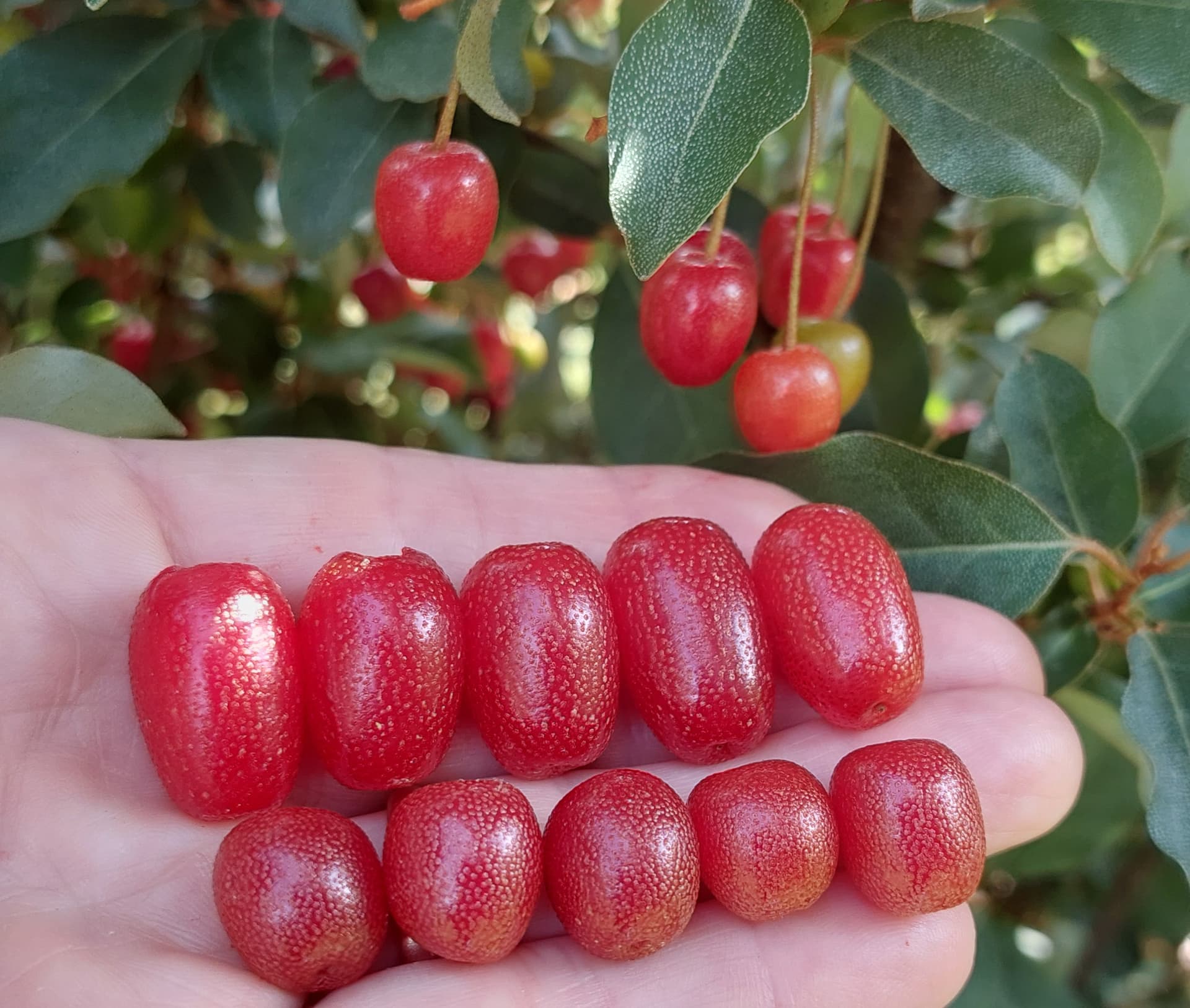
In the pic above… the row of berries on the bottom are my Red Gem. The larger berries just above them are from grafts of carmine that I added to my RG and SS a few years back.
The berries (smaller berries) on the bush are my sweet scarlet.
My Red Gem seems to be a bit unique among Red Gems in that it has larger berries than most RGs… and it ripens earlier than most other Red Gems.
I am in southern middle TN and my Red Gem is normally the first to ripen fruit … of all those that are posted here on growingfruit.com.
My Red Gem ripened first fruits May 1 this year. It has larger fruit than most other Red Gems… and my Red Gem definately taste sweeter / better that Carmine.
Carmine berries are a bit more tart than my Red Gems.
My sweet scarlet bush… starts ripening berries 2-3 weeks later than my RG… and about a week later than Carmine. They are by far my smallest goumi berries.
Hello,
First of all, congratulations for this topic which is really enriching with all your experiences! I live in France and I am very interested in goumis but unfortunately the only cultivar available is “Sweet Scarlet”. Would it be possible to buy grafts of the varieties you have this winter in order to be able to multiply them? Thank you in advance for your response.
One of my Elaeagnus umbellata rooted where I accidentally covered a branch in mulch. I cut it off and potted it up. Perhaps stool layering works for E. multiflora too?
I think multiflora just roots slowly and need nursed along for awhile before it can get separated. I haven’t tried to root mine though. I have Tillamook and raintree select(got it this summer).
Yes, layering E. multiflora works. It’s very easy, but not fast. I don’t consider any rooted E. multiflora stable (whether by layering or by cutting) until year two since first year roots are easily damaged.
Hi Manu,
I am happy that you are enjoying the topic
I won’t hand out material of my own seedlings yet, but I regularly exchange/sell scion wood of my collected cultivars.
Hello [Austrian_FruitNut,
it would be great to obtain well-known cultivars like Daiougoumi, Borinka, and others that you may have, thank you!
How can we proceed?
I just came across this blog article about Russian Goumi cultivars and wanted to share it with you.
It lists several cultivars I hadn’t heard of before:
“In my opinion E. umbellata rootstocks increase the growth in Goumies. But I have no empirical evidence for this yet. Anyway, they are very compatible with each other.
It is important to graft them low. After 4 years they rarely send shoots from the roots anymore.”
This is really interesting. I had a goumi at my other house and chopped it in half to bring one to the new house. It has been growing for 15 years. Just this year, I noticed little red berries growing in October. They were autumn olive berries. I speculated that they had been grown on autumn olive rootstock, and that they outgrew the scion. I gave part of this to a gardener friend. I think I"m going to bring part of this plant to one of my schools I volunteer at. These are great plants for schools, because each kid can have many berries.