Persimmons 2023

I use the carrot peeler for most of the work. The knife is to remove remaining skin near the calyx and in the tiny grooves Saijo fruit often have that the peeler isn’t effective with.

They were massaged once and will receive another couple of massages before I take them in. This makes them less hard when ready to eat. My first batch has shrunken in half already. At this stage they could be called Anpogaki.

6 Likes

Here’s a sample of my JT-02, picked unripe a couple weeks ago and ripened indoors.

I had a little trouble getting the fruit to full non-astringency. Once the fruit were soft, there was still some residual astringency in/under the skin. This astringency seemed to persist even after the fruit had become very soft – the skin was intact but the inside was almost liquid.

I decided to use some ethanol. In one case, I sprayed the skin of the fruit. In another case, I placed fruit in a closed container with a cup of vodka. Both methods worked to reduce or eliminate the residual astringency to levels that were either undetectable or just marginally detectable. That was after less than 1 day; next year I’ll try starting earlier and continuing longer to get firmer ripe NA fruit.

I tested a few of the fruits for sweetness, getting Brix readings ~21-23. The flavor is excellent, like ripe PCNA with added richness.

13 Likes

What are you doing soaking them in the bowl? Disinfect? Sorry I couldn’t find the answer above.

1 Like

No worries, I did not describe what was going on in the pictures. They’re being given a boiling water treatment. I read it’s supposed to disinfect them but I’m not sure how that’s supposed to work. There are plenty of spores floating around in the open air that ought to recolonize the hanging fruit yet they remain unaffected. I think having good airflow is more important to avoid spoilage while drying.

1 Like

How does its flavor and sweetness compare to H63A and Barbra’s Blush?

This year I tried Prok from my own tree, and the following from @BobVance orchard: Nikita’s Gift, Rosseyanka, Kassandra, Tam Kam and IKK Jiro. Below is my review:

Prok: completely worthless, bland and low sweetness. Will completely topwork the tree.

Nikita’s Gift: Excellent, rich flavor and very sweet.

Rosseyanka: Very good flavor, and very sweet.

Kassandra: Same as Rosseyanka, but slightly less flavor.

Tam Kam: I waited on it to slightly soften, but it turned to be mushy, less juice than Fuyu, bland and low sweetness. Completely unimpressed, could be because of insufficient ripeness, insufficient sun or because the tree is still young. Chinese market Fuyu from CA is 100 times better.

IKKJ: Same as Tam Kam, but more juice and not mushy.

4 Likes

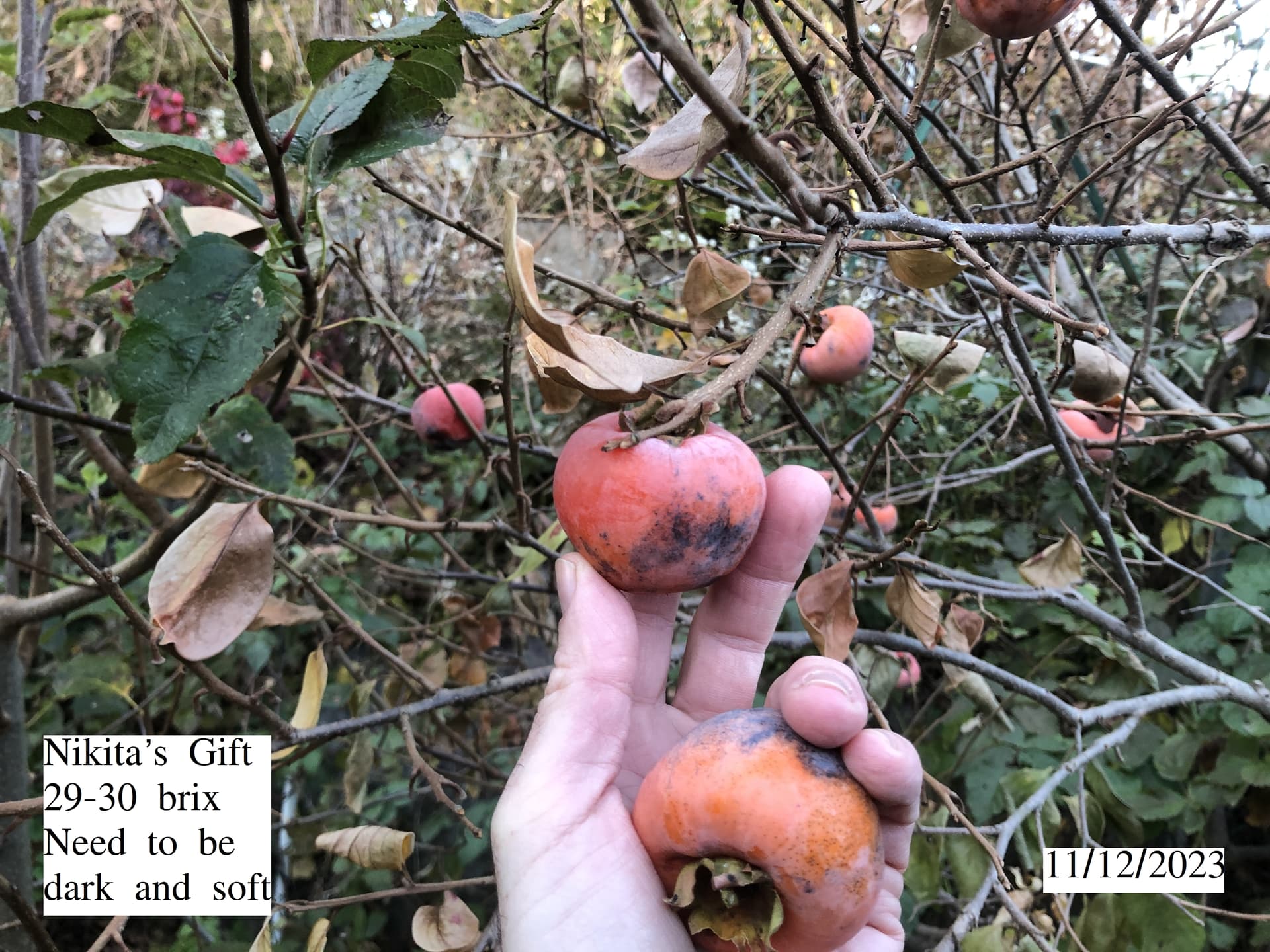
I’ve been sampling some of my harvest, but am pretty slow, as I really don’t like any remaining astringency. If you get one without any astringency, Nikita’s Gift are the best.

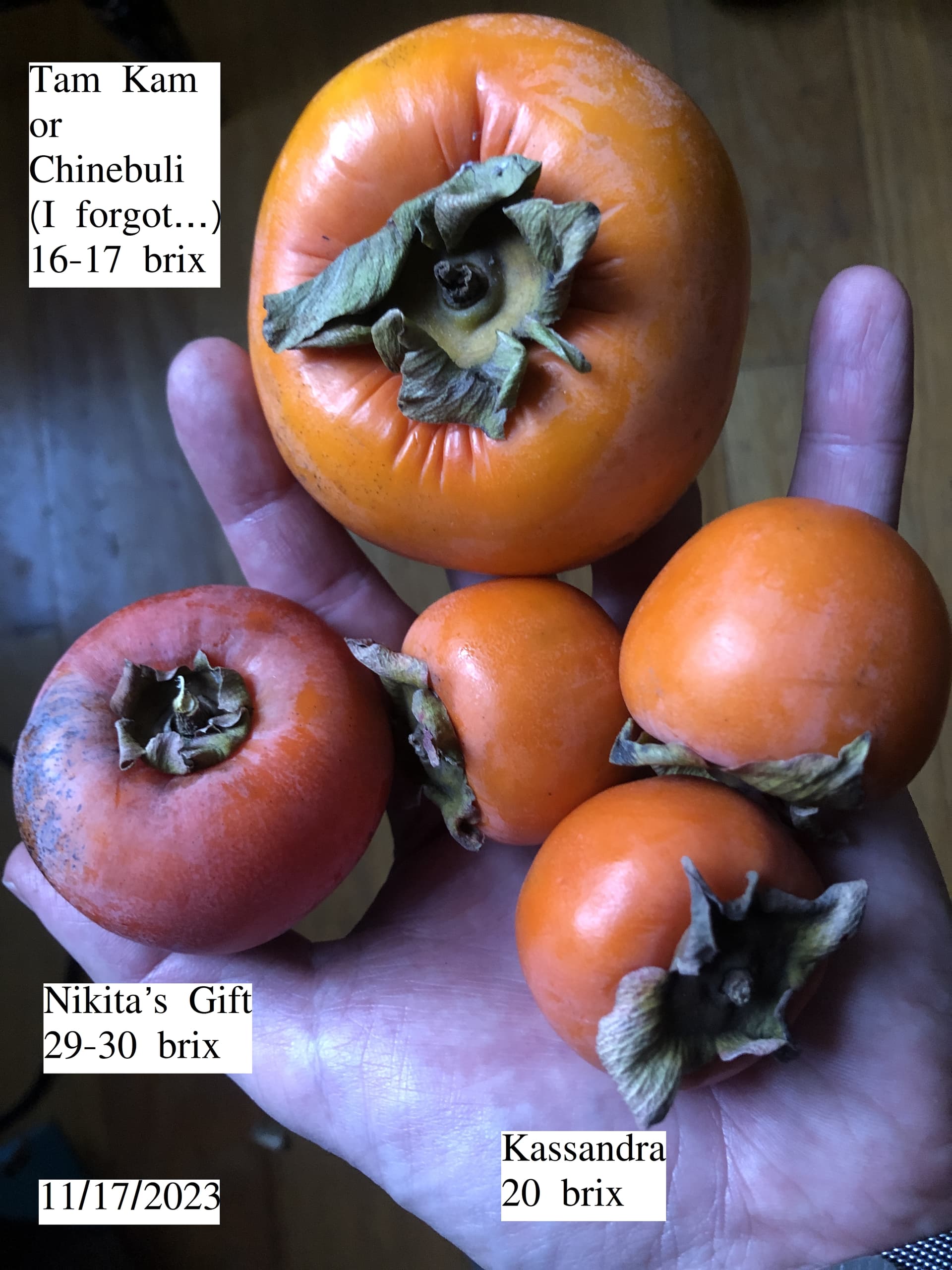
But NG is also the hardest to remove astringency from. In past years, I had some that were still astringent even when soft and 40 brix. If you can get it tree ripe and soft, you’ve got a much better shot. This year most of the ones I’ve tried have been very good. Not 40 brix, but 30 is still pretty good :slight_smile:

As of 11/20, I am still letting some NG hang on the tree. Though without leaves, I doubt much is happening. But softer/darker ones have much less chance of being horribly astringent.

That is what I’ve seen from all 3 of the non-astringents, IKKJ, Chinebuli, and Tam Kam. I’m not sure if it is weather related (extra rain and cloud-cover this year), the age of the trees, or if it is just something to expect in our climate. I picked them in November, after they dropped their leaves at first frost (11/1-11/2 this year).

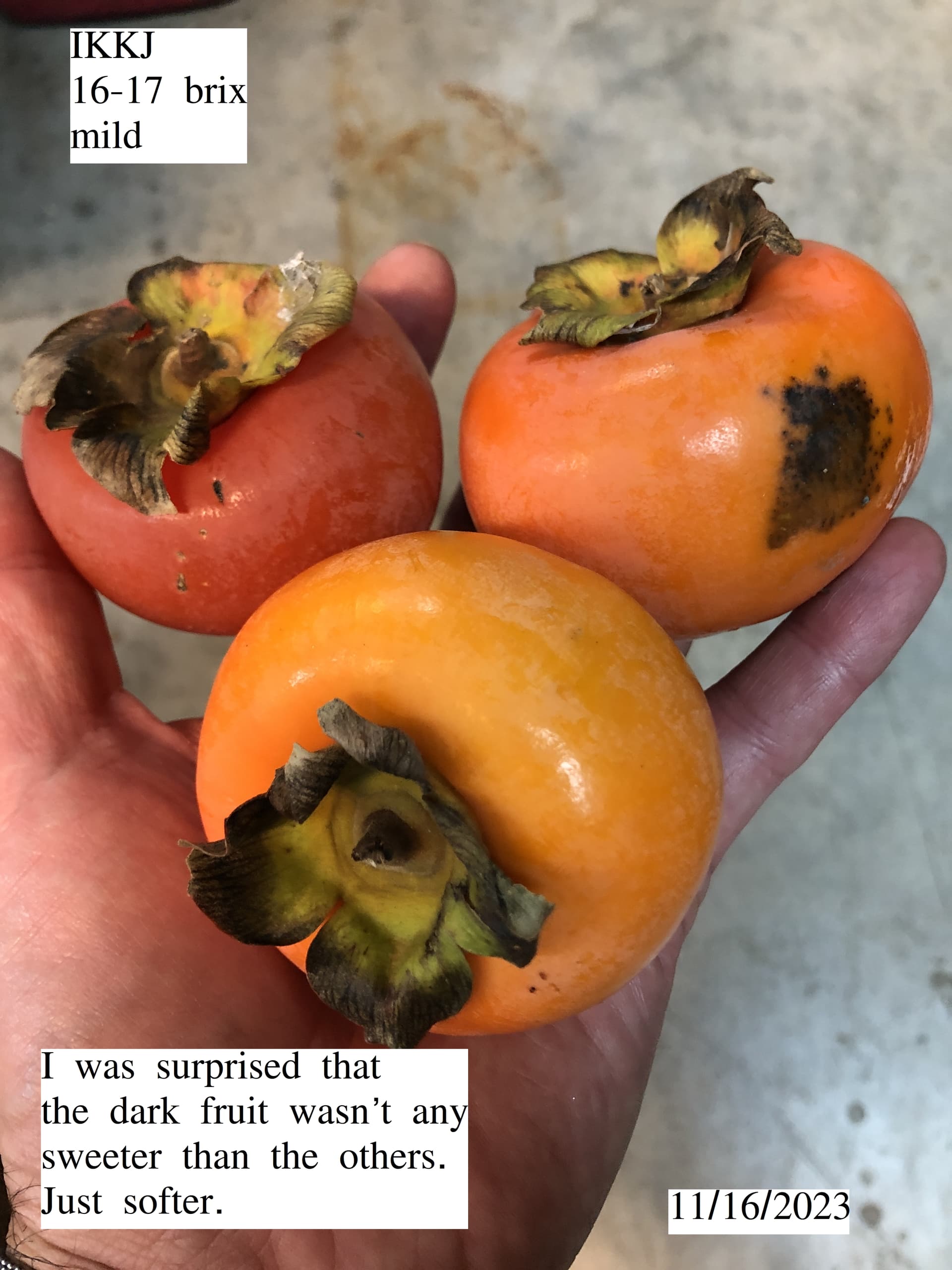
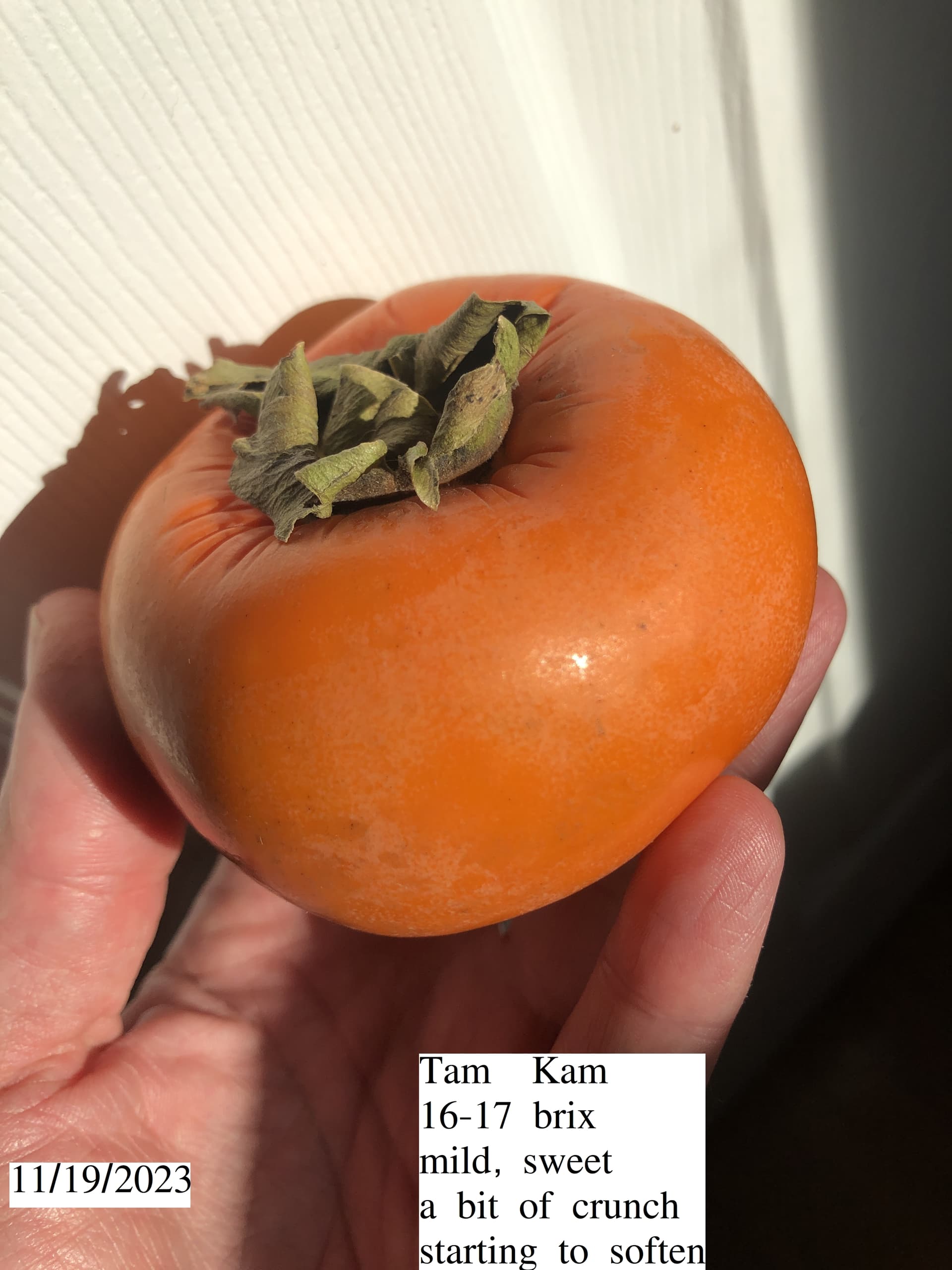
Though my conclusion isn’t quite as dire as Ahmad’s. I think when eaten mostly crisp, but just starting to slightly soften, they are still decent. Not as sweet as the potted Jiro I had a few years ago, but worth eating at 16-17 brix. The 2 fruit I got from the potted one were 18 brix. 1-2 points can make a big difference in quality.

As noted in this pic, the soft, dark-colored fruit wasn’t any sweeter or better flavored than the firmer ones. It doesn’t seem to be worth it to let NA persimmons get soft.

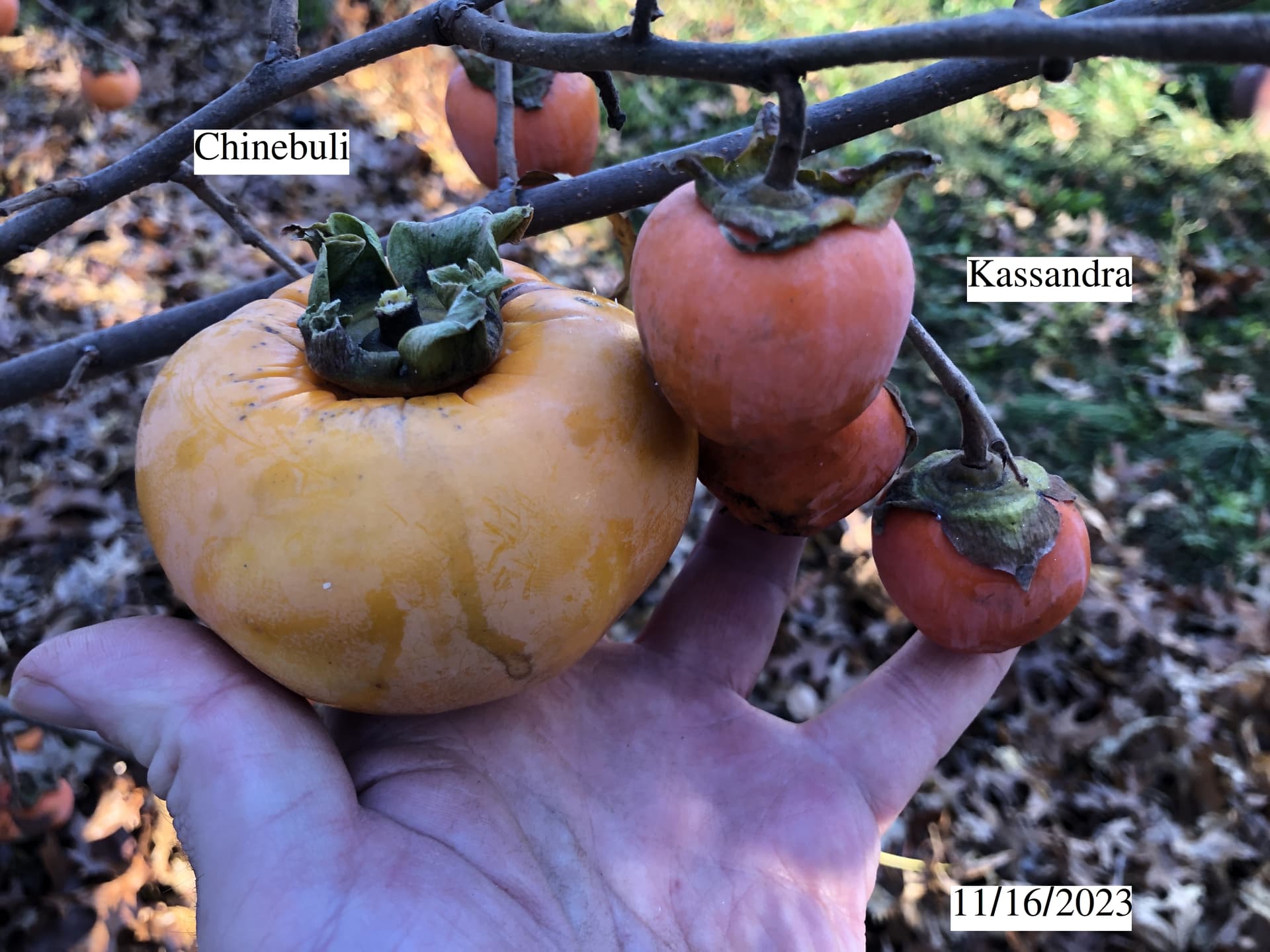
You can really see the size difference between Chinebuli (from what I’ve read, it is Jiro that got renamed in Eastern Europe) and Kassandra. These two were grown on side-by-side trees, spaced about 5’ from each other. Both were grafted in 2021 and this is their first harvest.

It’s also the first harvest for Tam Kam and Rossanka, which I grafted in May 2022, to a sucker I had transplanted a few months earlier.

I didn’t get any pics, but Miss Kim was far less productive this year than last. It went from over 100 fruit on the tree to only about 10. Miss Kim does ripen earlier than other astringent persimmons and seems to lose it’s astringency more easily. It was 20 brix, with a decent, mild taste.

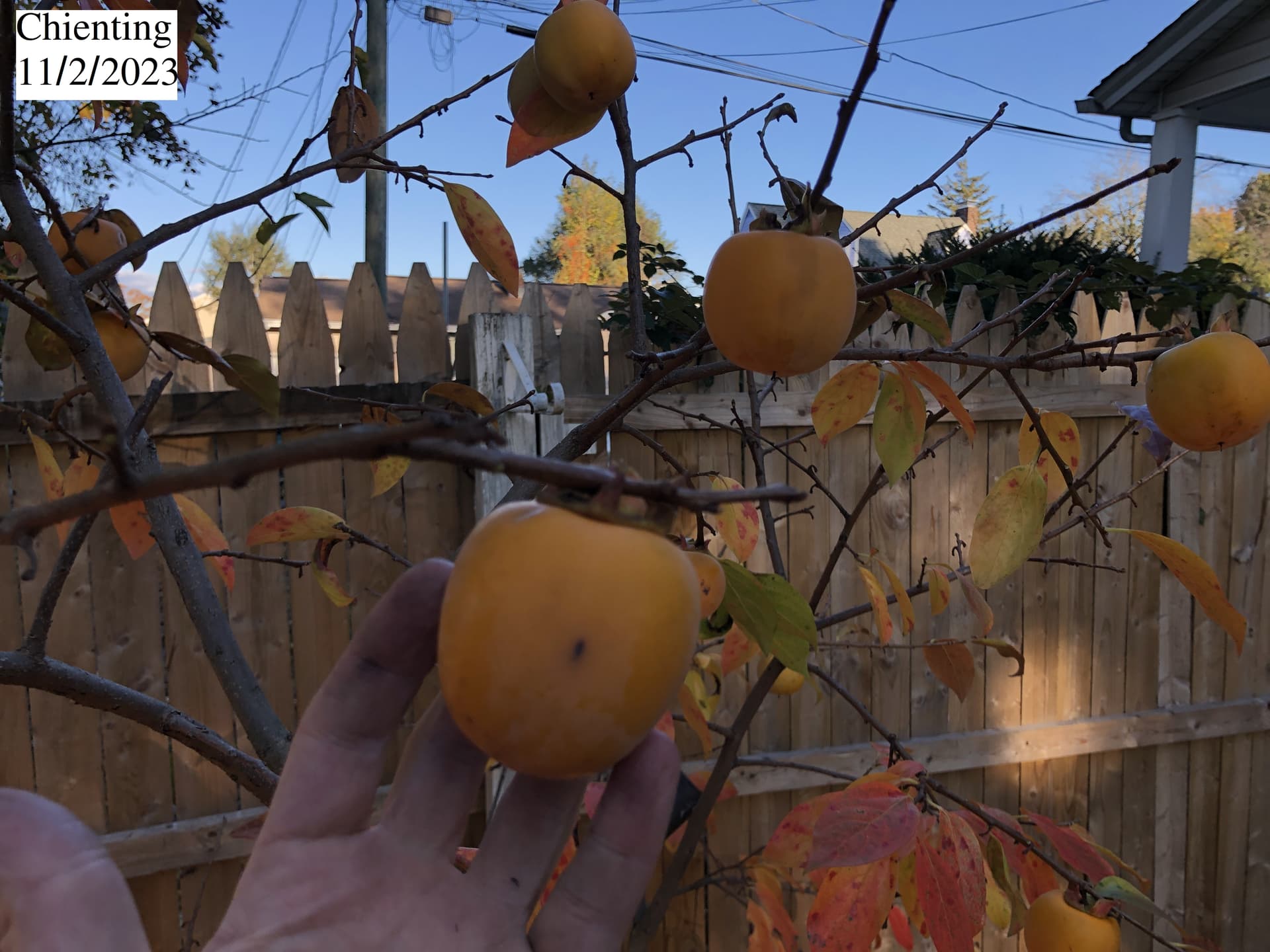
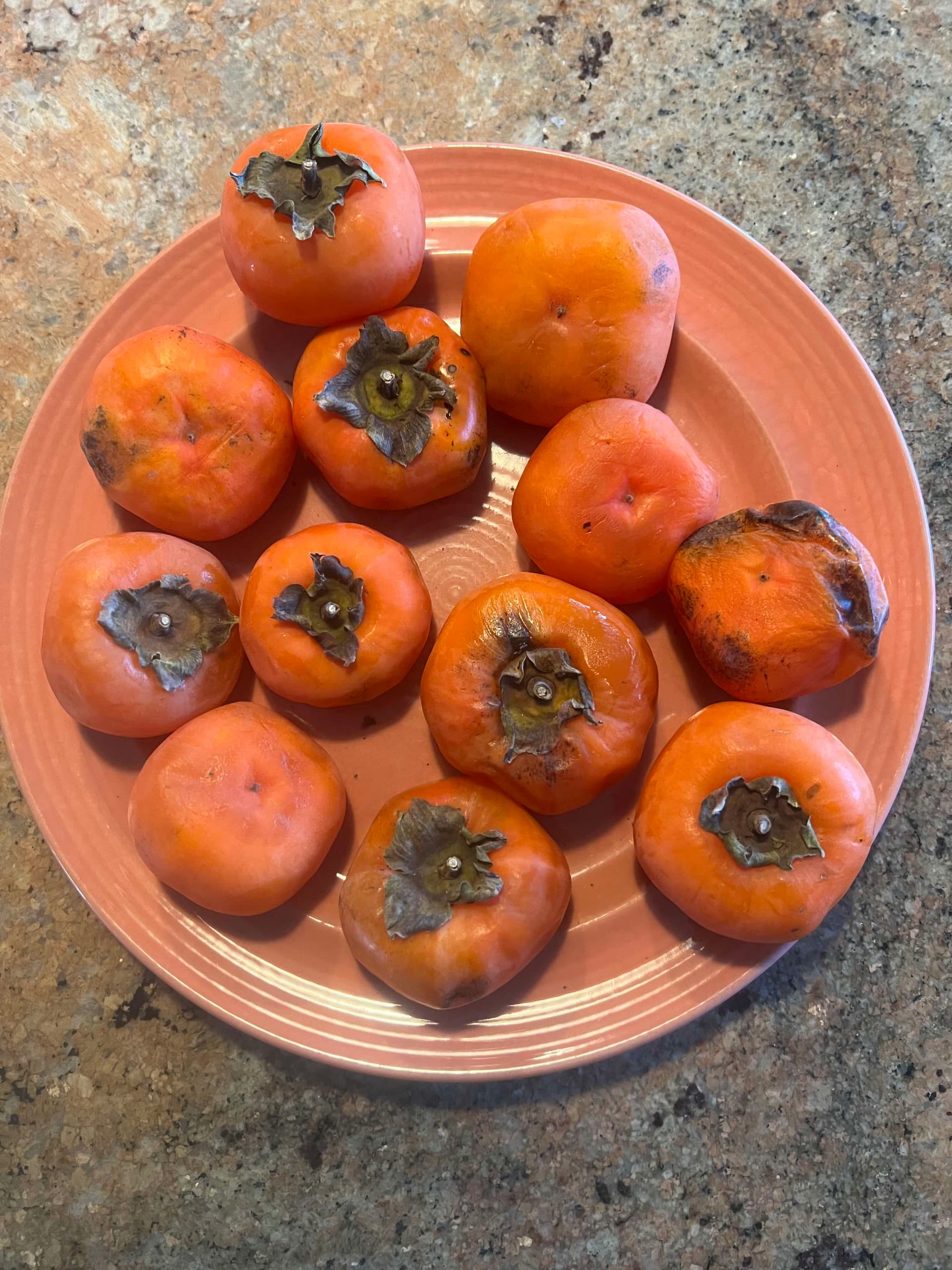
I’m guessing the Chienting hasn’t softened yet for you? From my notes, I have “(DIDO 43)- PVNA from CRFG”. Even though I think I had a male persimmon at the site (no fruit, but a ton of flowers), Chinting was still astringent. Of course, I didn’t find any seeds in it, so maybe it wasn’t really pollinated.
13 Likes

My Nikita’s gift are much less sweet. Only(?) 26-28 brix.
But I don’t sense much if any residual astringency. But admittedly astringency doesn’t really bother me all that much.

My chuchupaka (not?) has even less astringency but much less sweet. NG is still my favorite hybrid persimmon.

2 Likes

I wouldn’t give up on those nonastringents. Mine were excellent again this year, but lagging behind my PVNA Coffeecake as usual in flavor. Was the male tree a kaki or American? American pollen likely wouldn’t successfully pollinate your Chienting.

3 Likes

I consider my results with H63A and Barbra’s Blush as very tentative since the grafts are very young (2nd leaf). Of course, the JT-02 grafts are young too (3rd leaf).

That said, JT-02 seems far better. For starters, it is sweeter (in my samples). But in addition, the flavor is more appealing to me. I’m not saying that the flavor of JT-02 is stronger, rather that it is just a nice enhanced PCNA persimmon flavor, which I prefer so far to the flavor of these Americans. Note – it is not a rich PCA Kaki flavor, like Saiyo. It’s more like a good Fuyu/Jiro.

Also JT-02 has a PCNA texture – very soft and smooth. To me the flesh of American persimmons seems somewhat grainy. I experience this graininess especially when I dry American persimmons. The flesh of dried American persimmons is dense, maybe fibrous, like fine sawdust embedded in a paste matrix.

FWIW, I did not measure the sweetness of my Kassandras. I tried but I think I let them dry a bit while they ripened; in any case, I couldn’t extract juice from the pasty flesh. Subjectively, the Kassandra fruit seems roughly as sweet as JT-02. The flavor is a bit stronger and more like PCA Kaki. One that I ate ripe from the tree seemed just like Saiyo, but I wouldn’t describe Kasandra as a mini-Saiyo.

Finally, the texture of Kasandra seems a mix of Kaki and American – it is somewhat grainy.

p.s. I’ve grown IKKJ. They are not bland if fully ripened. I think they’d compare well with store-bought Fuyu/Jiro. Don’t give up on your PCNAs.

6 Likes

Correct, I am still waiting for it to soften enough.

I agree, I felt that graininess.

Do you consider Saijo the most flavorful persimmon you ate?

Nikita’s gift was definitely much more richly flavored than Kassandra.

I will probably keep my Tam Kam and IKKJ for a few years, before I consider them not worth the effort. Their problem is that my local Chinese grocery store carries really excellent Fuyus and Rojo Brillantes, so if my trees don’t produce superior fruit, I will replace them with apple trees (it’s hard to find top quality apples in supermarkets, farmers markets or even orchards these days).

1 Like

Saiyo: IDK. I ate only the one that I grew. It was excellent but to say “best ever” I’d have to have it side by side with others. FWIW, I would not describe it as especially sweet.

Kassandra vs Nikita’s Gift: People seem to agree that NG is sweeter. Maybe more flavorful is consensus too. My problem is that NG seems to ripen very late. If you understand “fig” I could describe it to you as the Black Madeira of hybrid persimmons – superbly flavored but probably too late to ever ripen here. Plus there’s all the problems will fruit drop.

Also, my Kassandra tastes way better this year than last year, when I let the tree overbear. This growing season was short due to the late frost in May, so conditions may not have been optimal. I can imagine that in a normal season it might be even better. In any case, it has proven well worth growing and eating. I don’t need it to be the tastiest.

4 Likes

I’ve considered an in ground kaki in the high tunnel. I wondered if Id be able to find one that would ripen in time. Id also given some thought to vigor/size.

1 Like

@hobilus
I think @PharmerDrewee and @BobVance may have a lot of experience and knowledge about kaki persimmons in cold zones. In high tunnel, you may be able to get the temperature inside high enough for zone 6 (would be great if it could be zone 6b.)

1 Like

NG develops a lot of sweetness even early in the season — like September. I’ve had bird pecked persimmons that were excellent.
If you have a way of protecting it in winter, I would definitely try NG.

2 Likes

The best Kasandra I ate this year ripened early on the tree after some damage. I’m wondering if I should poke a hole or cut a slice in fruits deliberately.

3 Likes

I thought that JT-02 was an astringent persimmon. I have a few from a sucker grafted in 2022, but haven’t sampled them yet.

Agreed- even if there are issues with growing NA here, astringency is such a massive downside to me that it takes an exceptional A to match a borderline NA.

That was likely the issue. The male flowers were from a Virginia sucker which I though I had grafted, but evidently did not. When I looked closely, I couldn’t find the graft union, so it looks like I’ve got another place to graft for next spring.

There were some excellent ones this fall. Particularly Evercrisp and Ludacrisp, but I also had some Braeburn and Pink Lady which were quite good as well. My apples from home weren’t as good- more damage (insect and fungal) and less thinning. Of the two, the lack of thinning was the bigger issue, as it leaves trees full of inferior fruit.

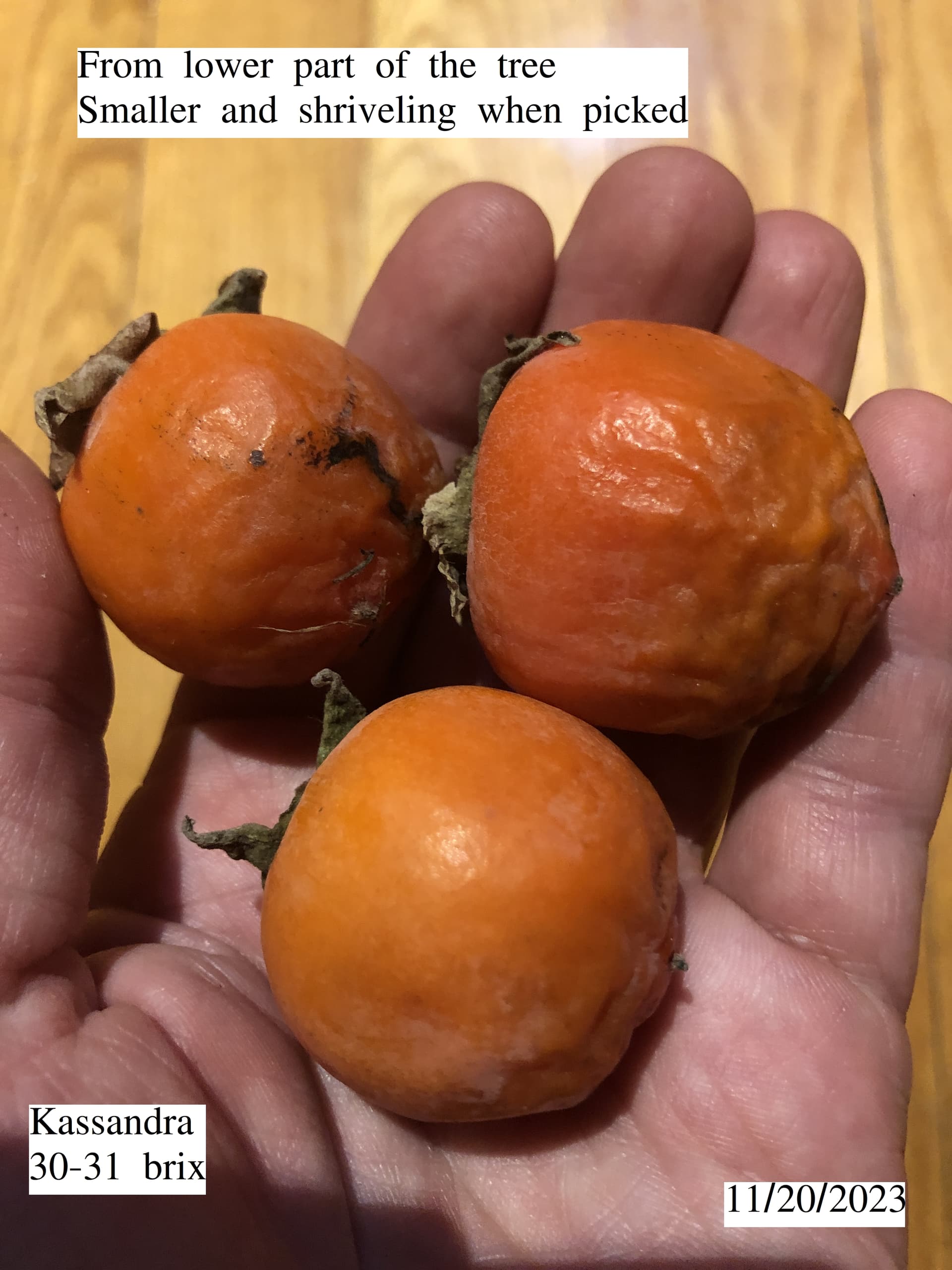
I didn’t realize that people thinned persimmons. But, my Kassandra had so many fruit that it makes sense. A lot of the fruit in the lower part of the tree were smaller and already starting to wrinkle a bit when I picked them. These fruit are now roughly 30 brix, though there was still some lingering astringency, especially in the skin.

Ahmad mentioned this idea to me last week when he stopped by, though I think it was in reference to figs. It seems like a good idea to push the harvest earlier. Probably no need for it in July/August, but it could help with both getting things started early and when you are close to harvest (crack prevention for some fruit).

My experience is mostly in what doesn’t work :slight_smile: I first planted a NA persimmon in 2011 and just started getting fruit in the last 2-3 years.

An interesting idea, but you might need to fend off the yellow jackets and ants.

5 Likes

Which orchard or farmer’s market?

1 Like

Yes, JT-02 is astringent. It is a cross between an astringent American and the non-astringent Kaki, Taishu. As Japanese-style non-astringency requires a homozygous tree with 6 non-astringency alleles, JT-02 was doomed to astringency. But JT-02 apparently inherited other traits from its PCNA parent, such as its shape, taste and texture.

5 Likes

I didn’t realize it either. But I’m forced into thinning by the amazing productivity of Kasandra.

FWIW, my fruit look exactly like yours – not the 2.5-3.0" fruit advertised, but very sweet and tasty. The >1200 fruit last year were not nearly as good, so I will be sure to thin in the future.

p.s. I got a reading of >30 brix but didn’t believe it. I thought that the solids in the fluid were distorting the reading.

4 Likes

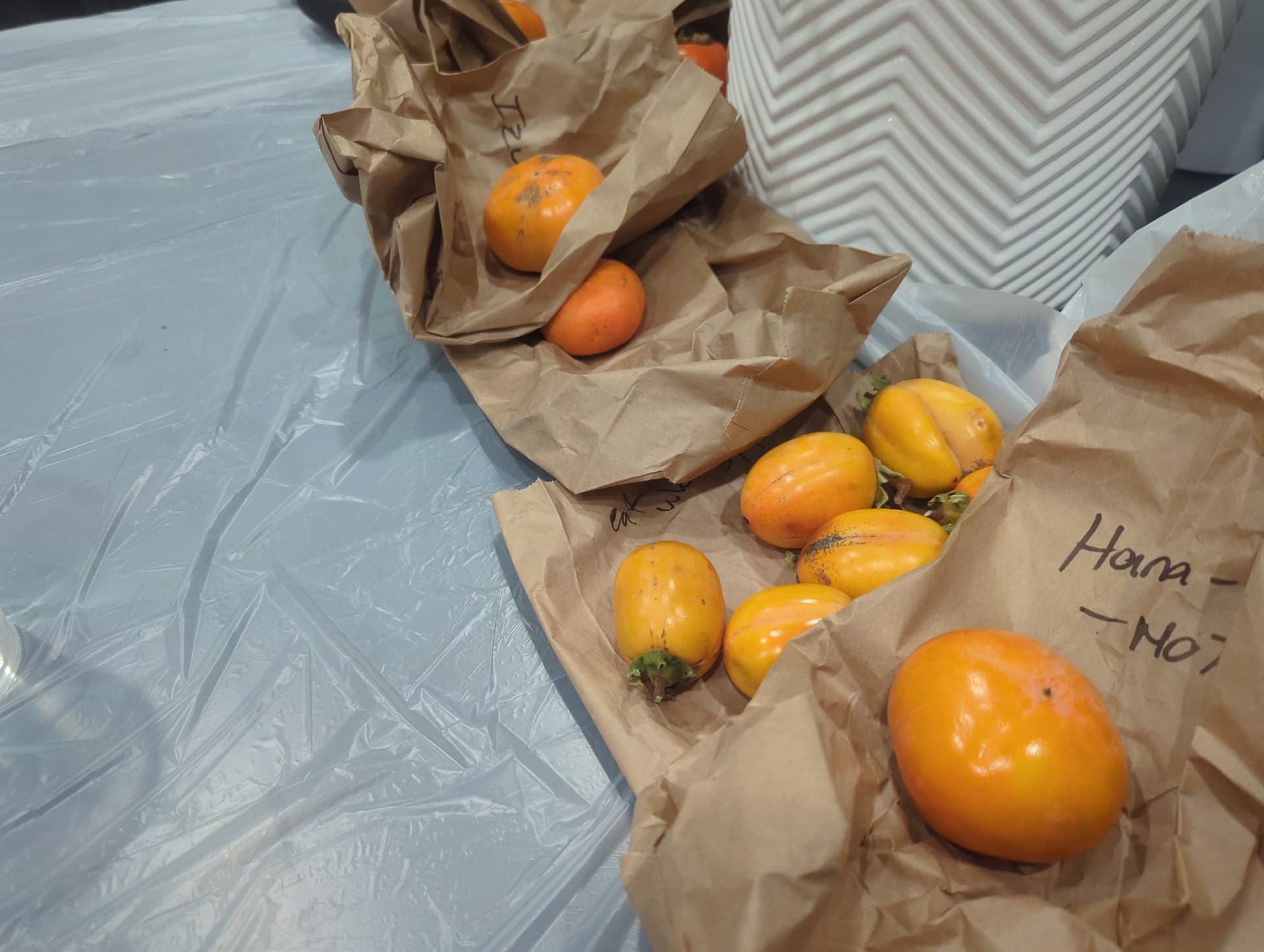
A friend sent me several varieties of persimmon fruits to sample. So far Nishimura Wase tasted awesome. Still waiting for Saijo to ripen on the counter.

11 Likes