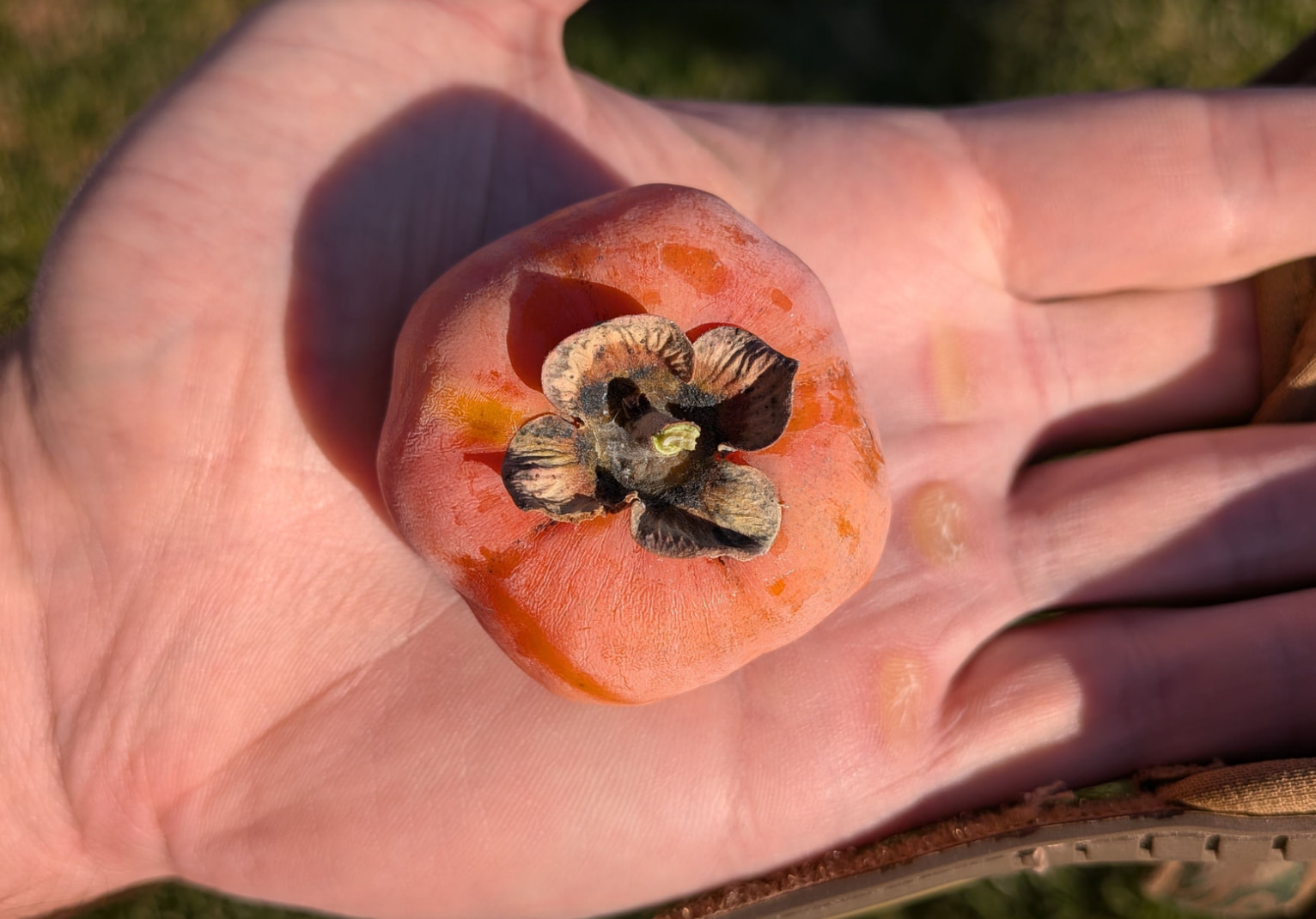
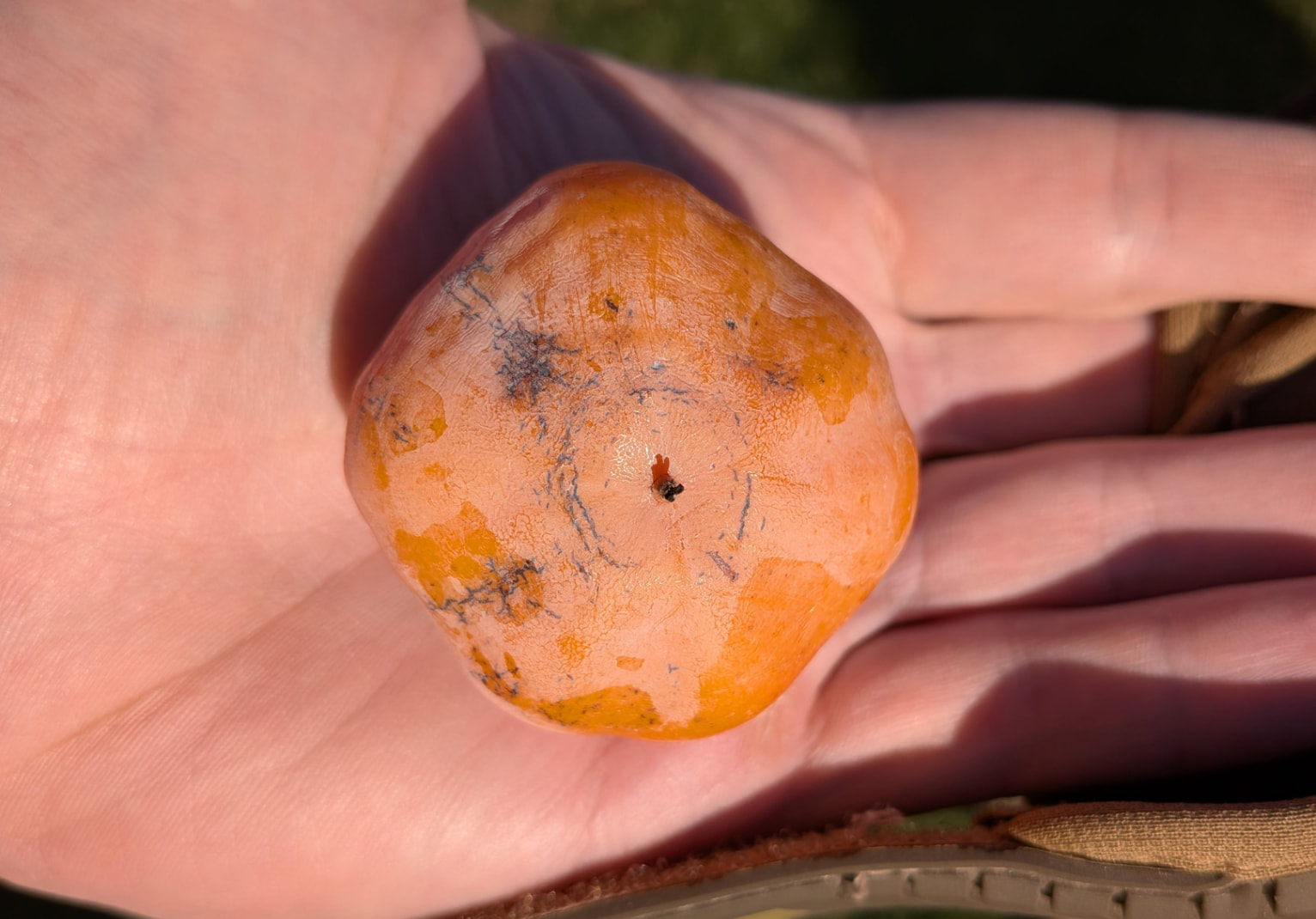
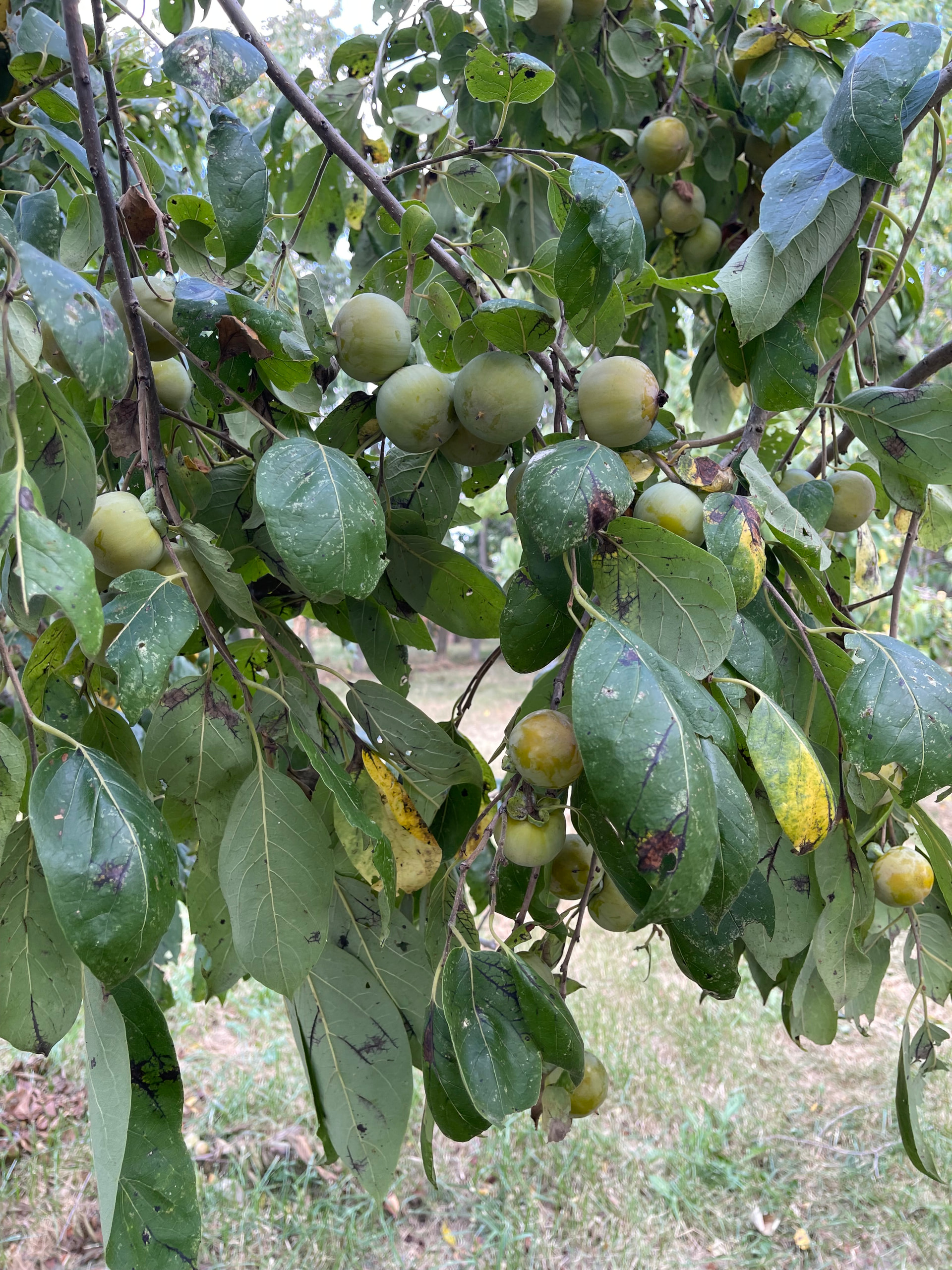
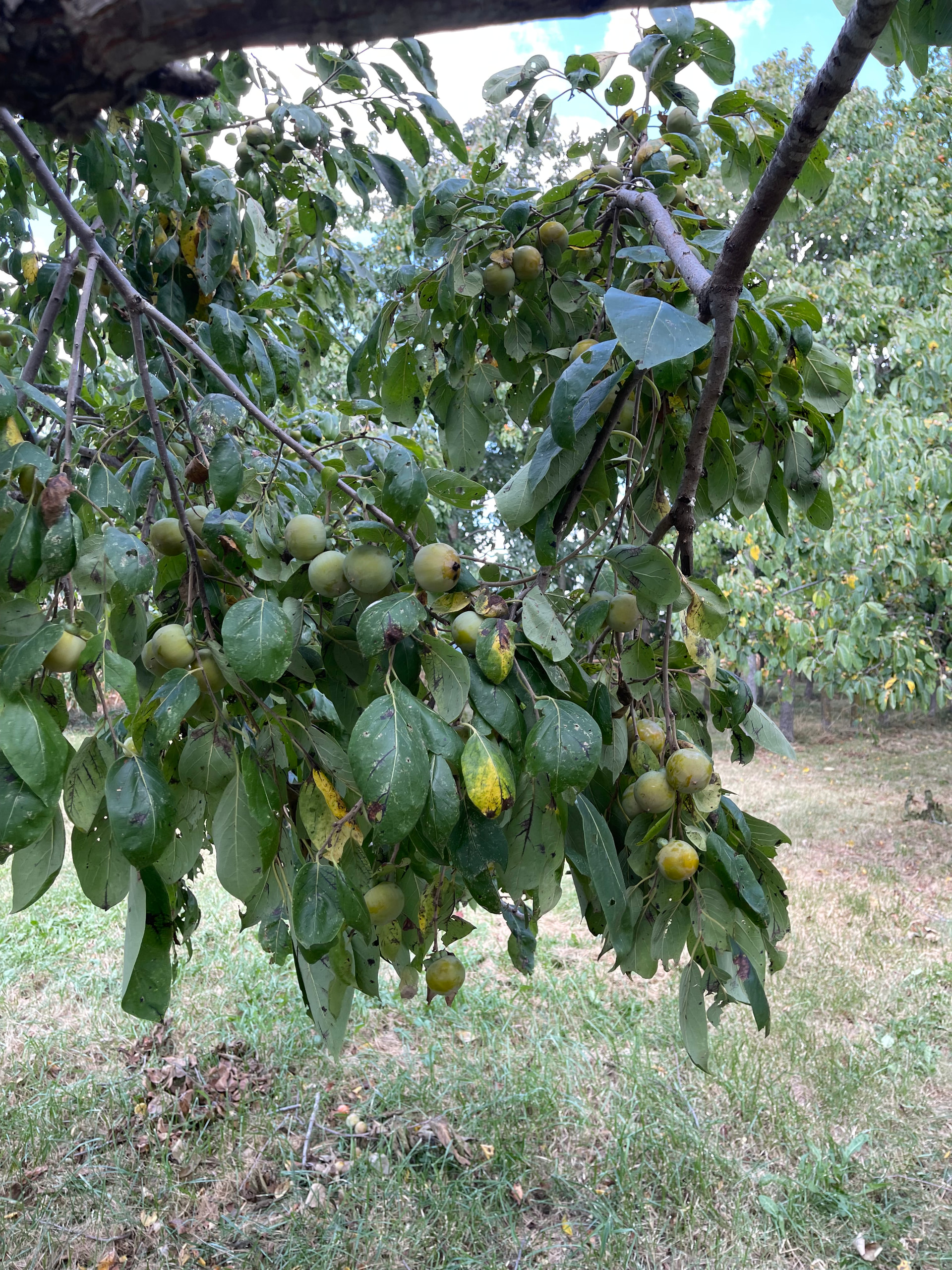
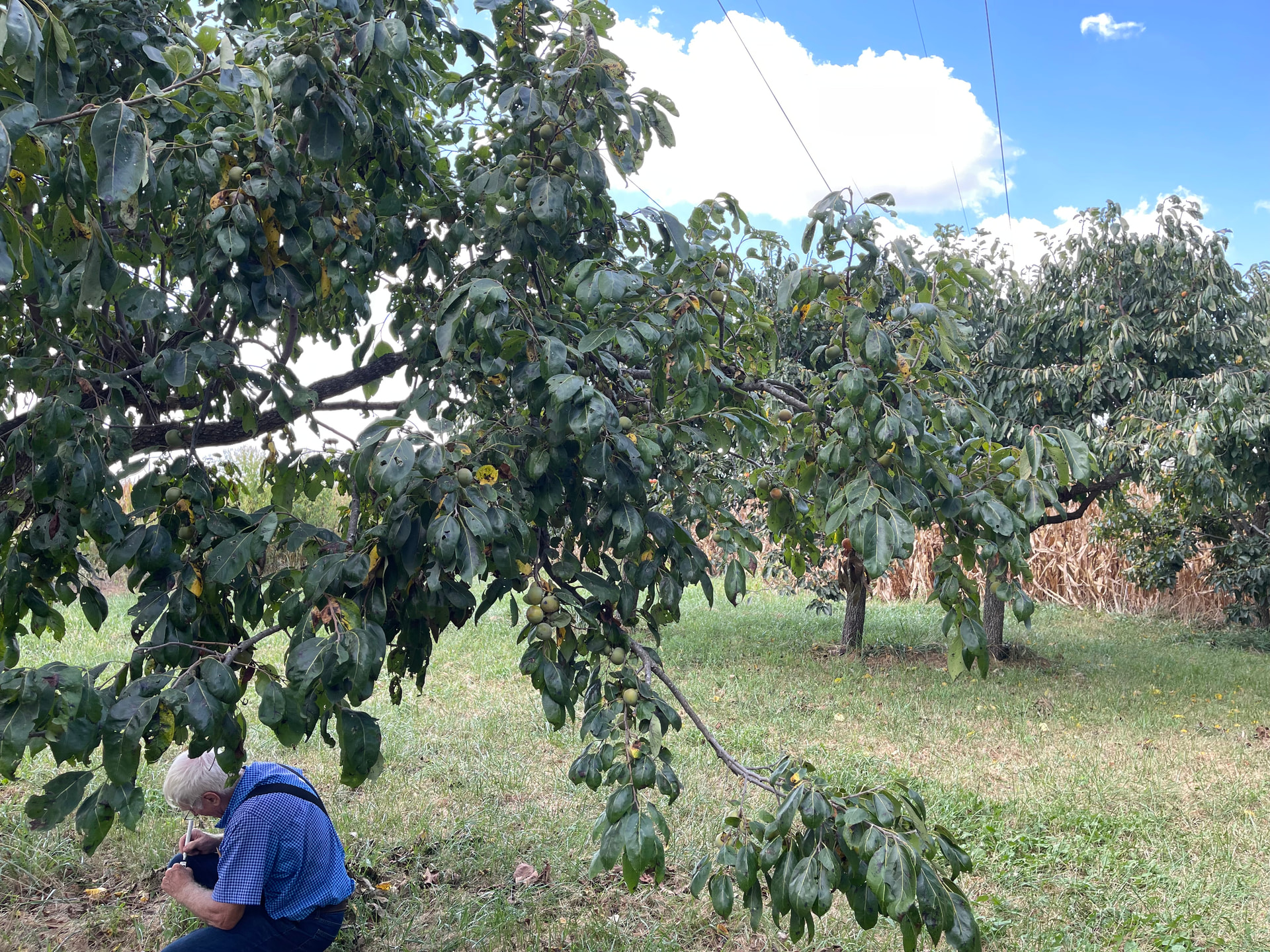
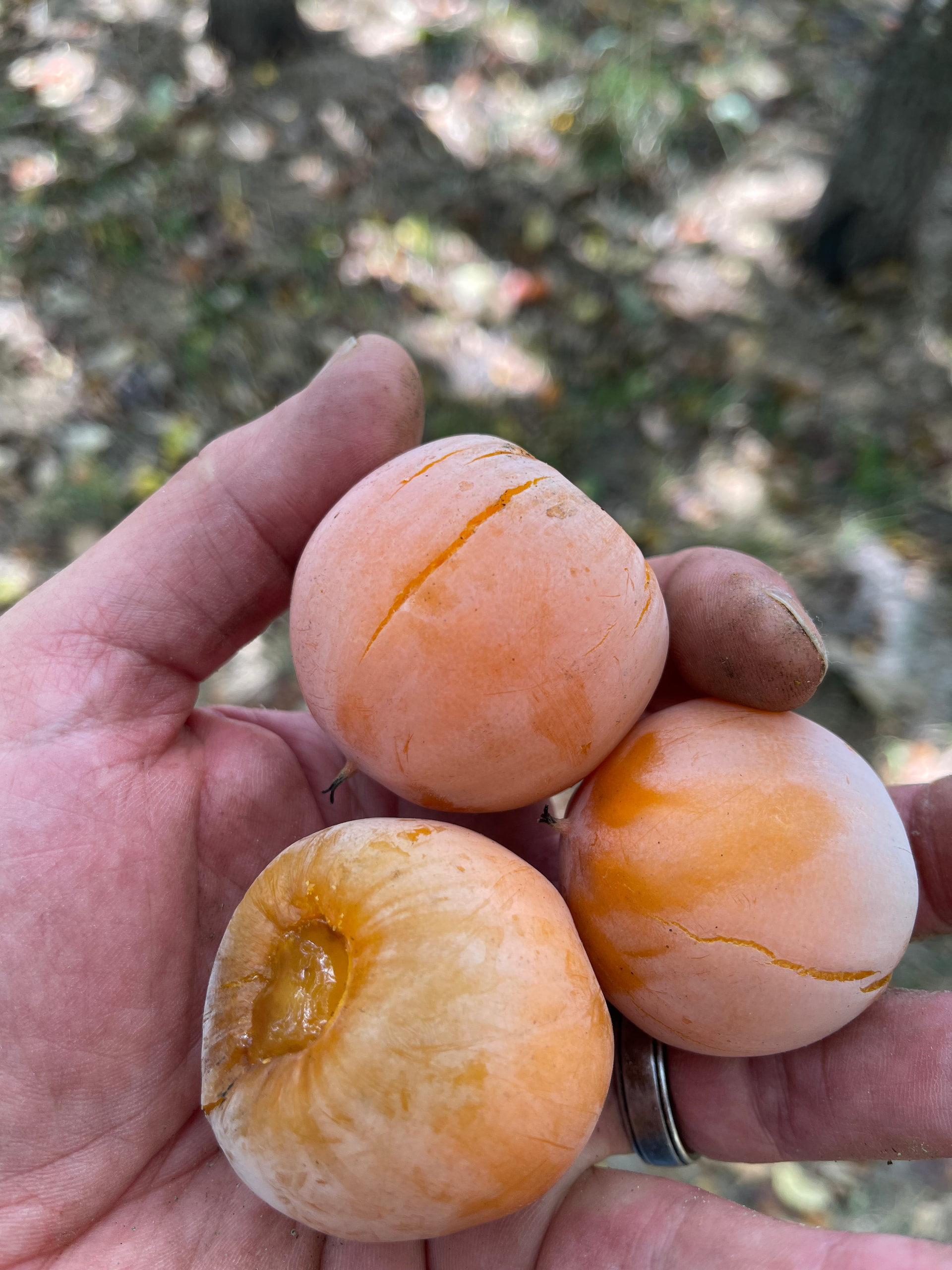
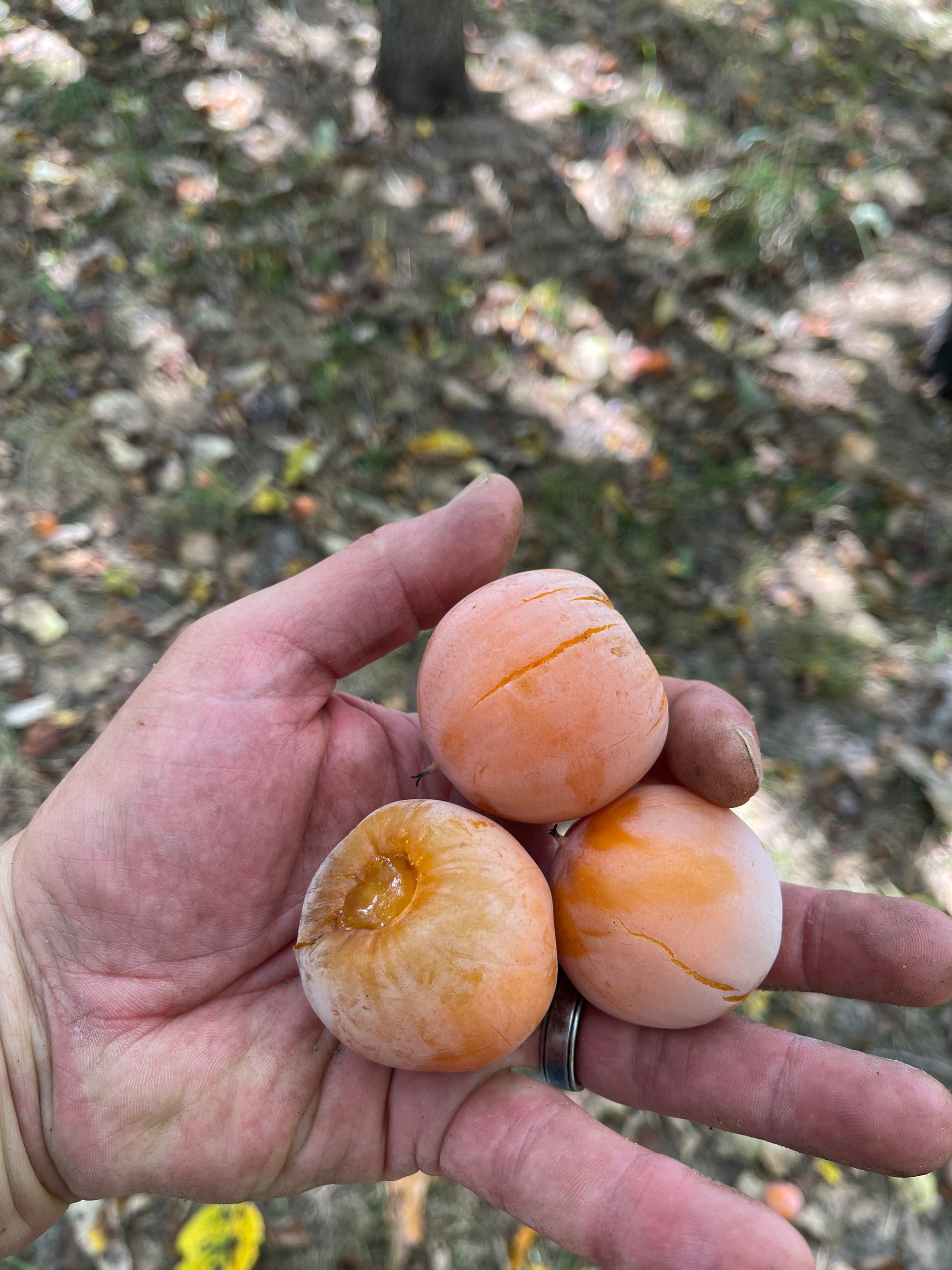
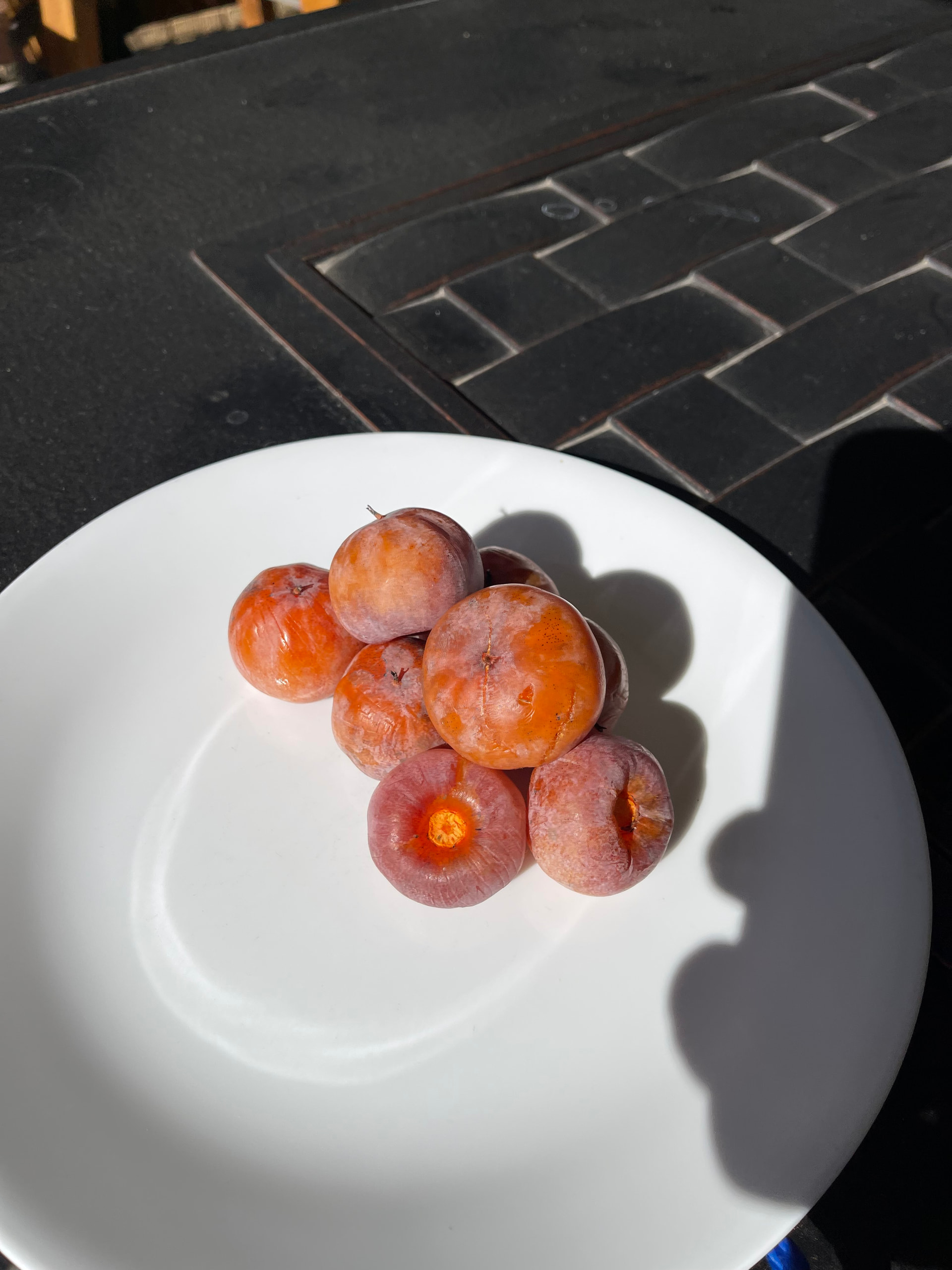
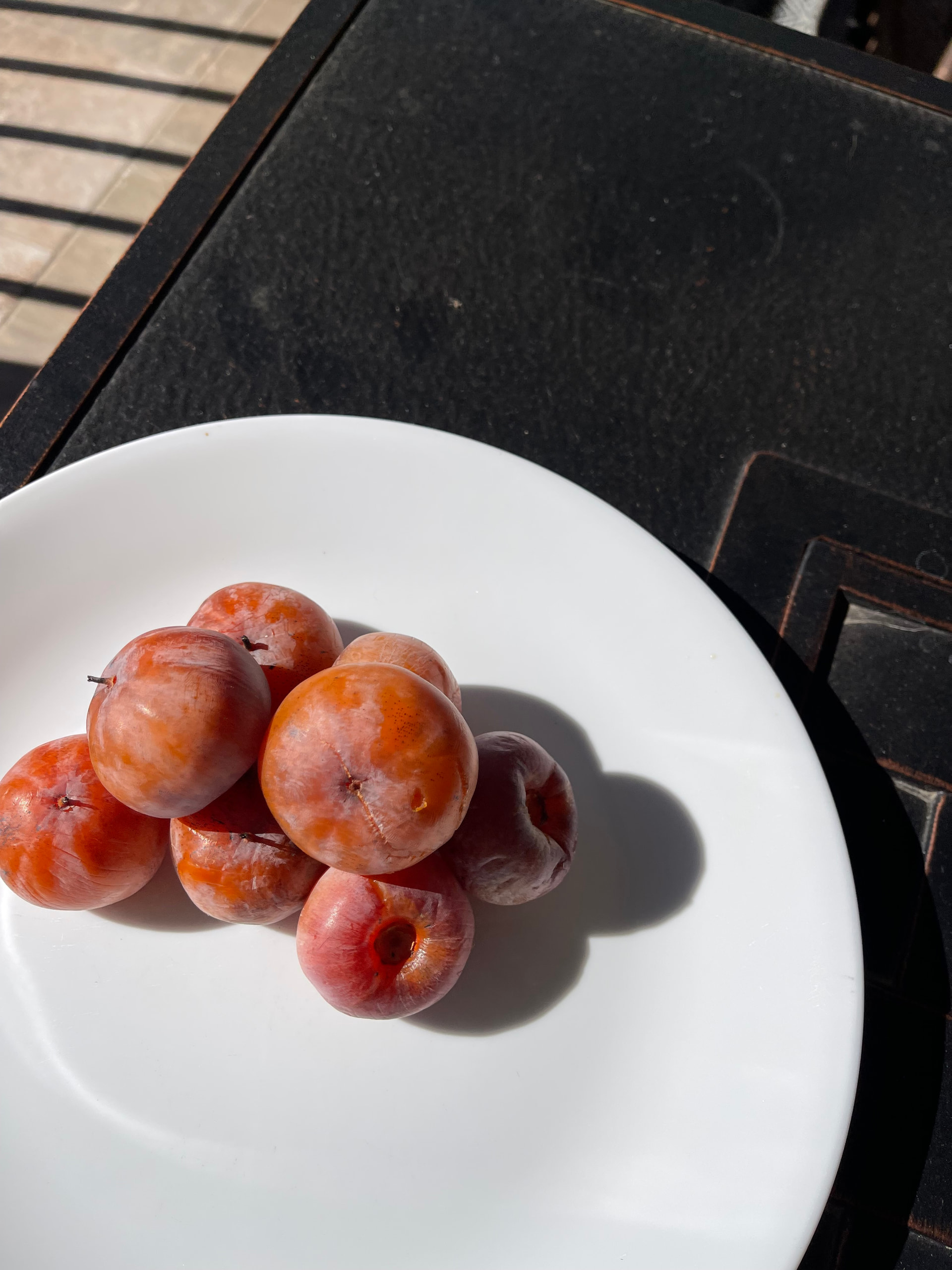
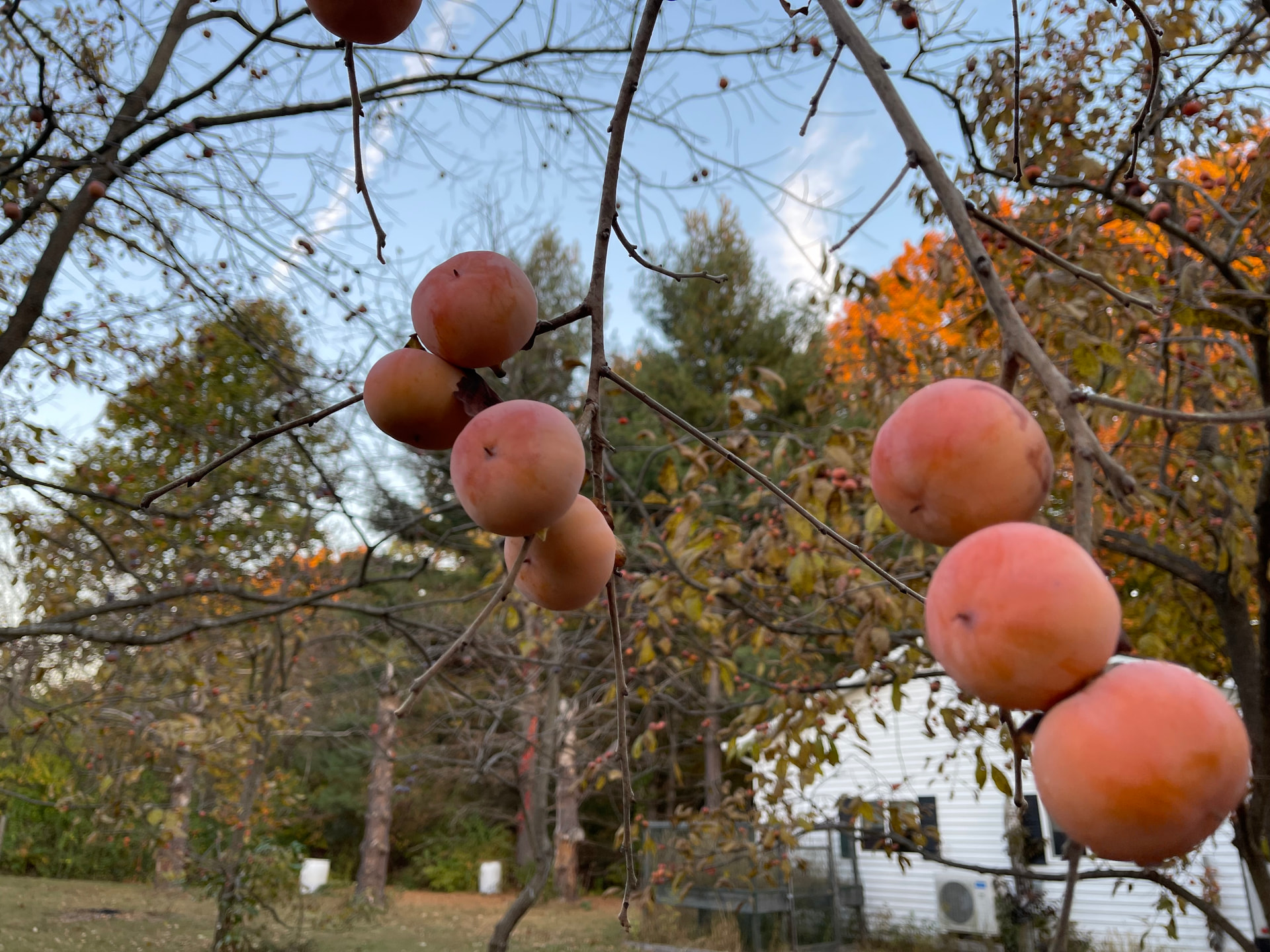
LOL, in another month all my persimmons of all varieties would be frozen solid if I left them on the trees. That said, I’ll note that Gboshi is not tree-ripe. It’s sufficiently mature to finish indoors, probably in a week more or less.
How does Giboshi compare to your other varieties? Here it is roughly even with Kasandra, Sheng and Ichi Ki Kei Jiro; a little later than Saijo; a little earlier than JT-02.
i had a single fruit on my jt-02 that seemed soft and starting to wrinkle. no idea if this is a good time to pick it. it didnt want to release very easily. sitting on the counter for now:
So for astringent Asian persimmons, I was considering Giombo, Saijo, and Giboshi (Smith’s best).
I chose Giboshi for the following reasons:
1.)Earlier ripening than Giombo and Saijo.
2.)According to research, it seems to lose its astringency faster while still retaining some texture.
3.)Cold hardy (zone 6).
4.)Dwarf tree 8-10 feet.
5.)Flavor is highly rated by a few reviewers who have tried all three.
However, despite all this, I was wanting to get more opinions of Giboshi vs Saijo vs Giombo; especially, from people who have grown all three or at least two of them…
Yes I’d say that’s 40-50% wider than Kasandra and ~3 x heavier. That’s from memory on Kasandra without any recent exact measurements.
I’m gonna defer comment on the taste until I can ripen some. It should be good – after all, it is “Smith’s Best.” Also, the flavor may vary with pollination; it’s a PVNA type.
I found a few that were ripe due to damage and eaten by hornets, but t was tough separating normal ripe flavor from any influence of spoilage. The best I can say based on those tastes is that it has a rich Kaki flavor, but not equal to Saijo or Kasandra. But don’t consider that a final judgment.
I grow Saijo in a pot and Giboshi in the ground. I once had Saijo in the ground as well but the tree died from KSDS.
Giboshi is reported to be more cold hardy. Mine has survived here unprotected and undamaged for the winters 2024-25 and 2025-26. In two prior winters I protected it. So it seems good to at least - 3F.
Giboshi ripens here after Saijo but not by much. Currently, my potted Saijo has fruit that is nearly ripe. I think it’d take 2 days inside. I’m guessing that Giboshi would take at least 1 week.
Giboshi is PVNA, so it will lose astringency early if seeded. If not seeded, I’d expect it to be typical Kaki.
The Giboshi tree does not seem to want to get big. Currently it is ~8’ tall. I purchased and planted it in 2022. So I think dwarf is right. I can’t infer anything from Saijo in a pot.
Giboshi’s flavor seems very good but so far, having tasted only my Saijo and my Giboshi, I think Saijo may be a little better.
Giboshi’s skin and texture seem firmer than Saijo’s. In my experience, Saijo transitions from hard to mush fairly quickly, whereas Giboshi is slower. Hence my plan to use Giboshi for drying whole. And think Giboshi will store better, which is important if a small tree produces a couple hundred fruits.
All that said, in Z7A (like here) I’d put Giboshi in the ground rather than Saijo.
I keep the trees for about two years in one hundred gallon cloth pots from Vivosun before I put them in ground. Once the trees are six feet tall, I transplant them in the ground. Saijo grows to about twenty + feet from all that I have read and seen.
You will eventually have to plant in ground.
I got the chance to eat a perfectly ripe Saijo from a friend’s tree last week (One or two ripened early but most still need more time. The Saijo fruit was very good - Intense kaki sweetness. Flavor reminds me of a very ripe Ichi Ki Kei Jiro flavor but much more pronounced. That is, Saijo has a bolder and richer sweetness)
My Giboshi still needs a couple of weeks before the fruit is ready to eat; so I have not had the chance to eat one yet and compare.
I do not want seeds, so the Giboshi needs to be soft (PVNA).
The size of Giboshi’s fruit is larger than Saijo. If I had to approximate, I would say 1.5 - 2 times larger.
Today I picked Sheng. It’s a vigorous but still young tree that I grafted in 2022. Last year, as I recall, it ripened roughly 20 fruits. This year it seems closer to 100, including some in a separate container and some that I left on the tree.
As with Giboshi, discussed earlier, I’m motivated largely by the advance of cold weather. Daytime temps are 50s-60s but nighttime temps get down to the 30s-40s. We haven’t had a freeze yet but it’s likely a matter of 1-2 weeks.
Last year I had good success picking them at this stage and then ripening them gradually in the garage. This year I will probably refrigerate them while pulling out a dozen each week to ripen over months.
Has anyone eaten both Giombo and Kassandra? How do they compare taste-wise? The person in the video (post 1214) and Millennial Gardener both have the same general reaction, that Giombo is possibly the best fruit they’ve tasted.
My Maekawa Jiro, in a pot with fruit on it, is still outside. How much of a frost, if any, can it take? Should I be picking the fruit and bringing them inside to ripen? @jrd51
IDK the answer to the “how much” question. I assume (!) that a frozen fruit (e.g., <30 F for a few hours) will never be the same. So that’s why I picked my Giboshi and Sheng – they seemed ripe enough to work indoors and I didn’t see them making much progress outdoors.
Whether you can get away with picking the fruit and then ripping it indoors depends on how ripe the fruit is when you pick it. I think it needs to be at least orange-ish. Can you post a picture?
Thanks for the response. We had one hard freeze here and the tree was under the carport. I don’t know if the fruit was <30F. The fruit is orange but not red. A photo will have to wait until tomorrow.
Maybe my question should have been different. Is it true that a frost is ok on a hybrid persimmon but not on an Asian persimmon? Or is frost only ok on American persimmons? Sorry for the rookie questions.
I also have a question about persimmon ripening. I’ve got 3 Americans (h63a, prok, and u20a) and 3 hybrids (Bohzy Dar, Kassandra, and Sophie’s gift). I have heard that with kaki persimmons pollination causes them to ripen quicker and may not always be desirable. However would pollination from my Bohzy Dar cause the Americans or other hybrids to ripen quicker? Is there change to the flavor?
I suppose it could be a good thing to ripen earlier since I am in zone 6 and we usually get our first frost mid October. I’m also curious if frost affects the ripening of pollinated vs unpollinated and if it is desirable too.
Noticed a couple of accessions that I need to go back and get wood from this winter. I-128A (not to be confused with L-128A which is also a very nice persimmon) was just absolutely covered in nice, big persimmons.
K-43A (Could be off by a position label or so as it is getting hard to definitively nail down tree locations as the trees slowly die off) is interesting as it is large, yet is the firmest, ripe D. virginiana cultivar I’ve come across. These ones fell from 30-35 feet onto hard baked clay soil and kept their shape - also tasted good.
Finally got around to really paying attention to Knightsville (one I got from Jerry), and it’s a lot nicer than I realized. Has a pretty reddish color and richer than normal flavor, but the most unique characteristic is its near seedlessness. There are wild persimmon here, and I have grafted males as well. I think I got two seeds out of seven fruit last time I visited it.
A few years ago when my Early Golden sported some male flowers I bagged them and a few Knightsville flowers as well since they are close to each other. Later on when I came back to harvest the seeds none of the fruit had seeds. I just thought I messed that one up even though all my other crosses produced seeds. Now know that she just rarely sets seeds.
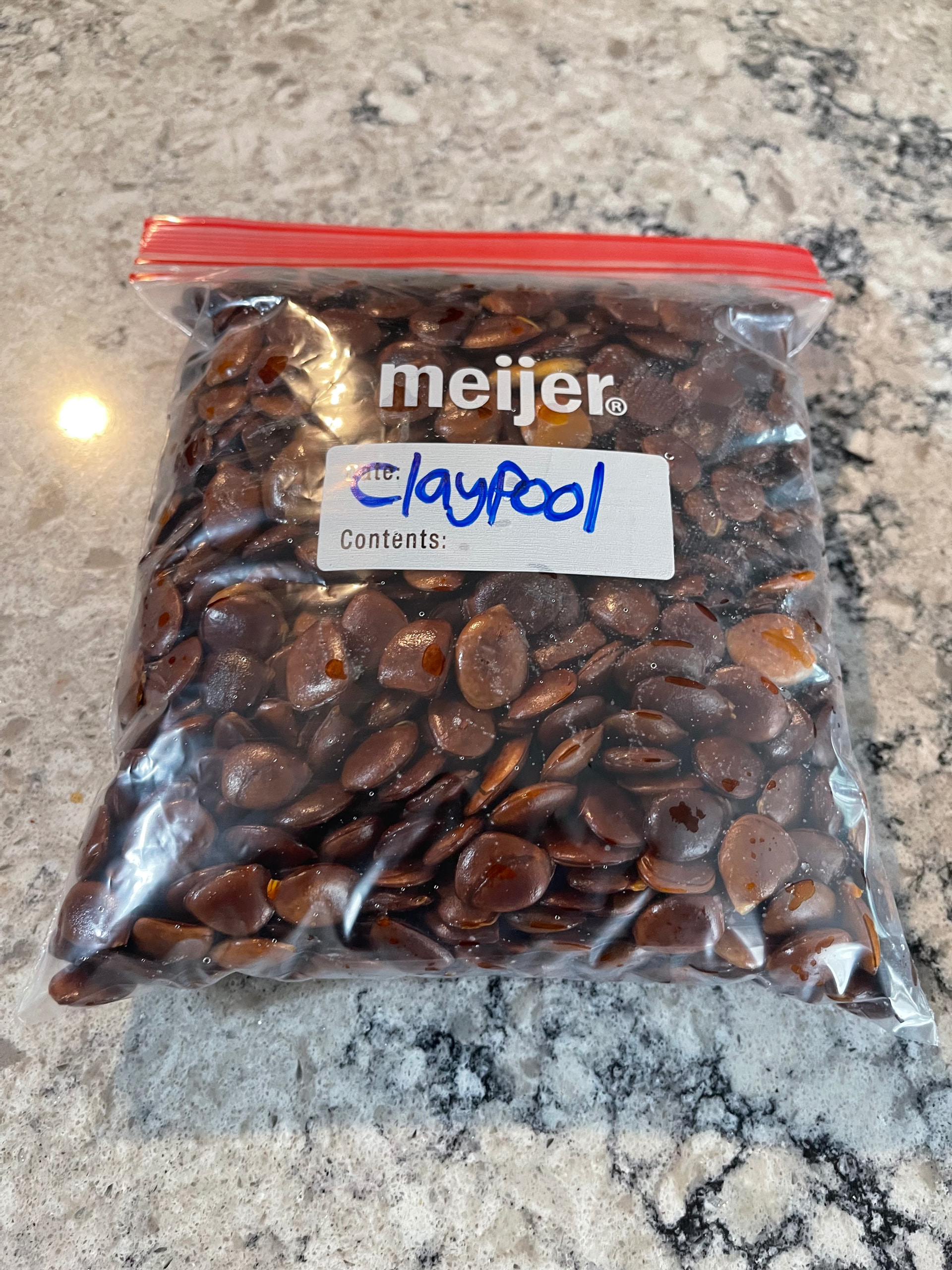
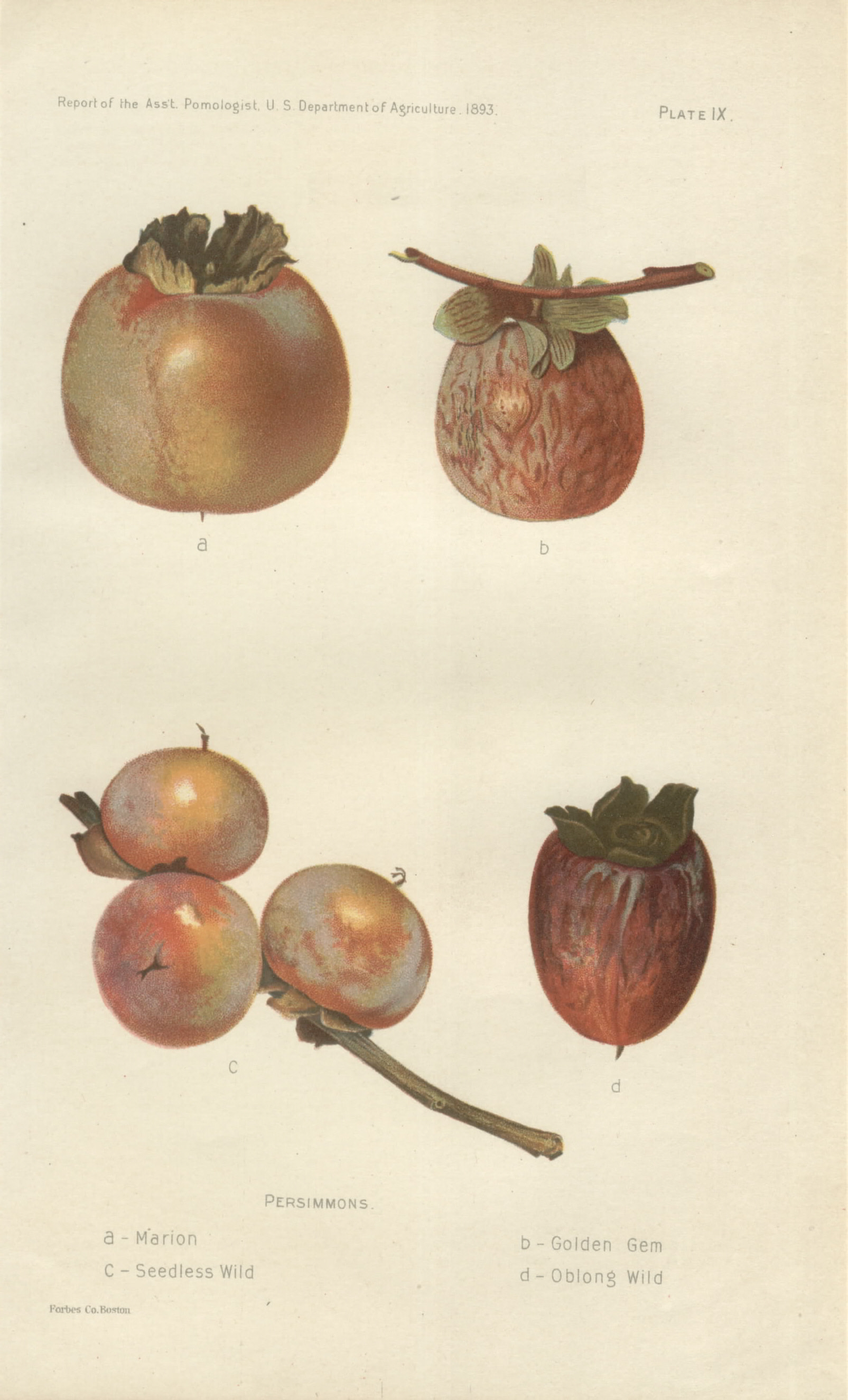
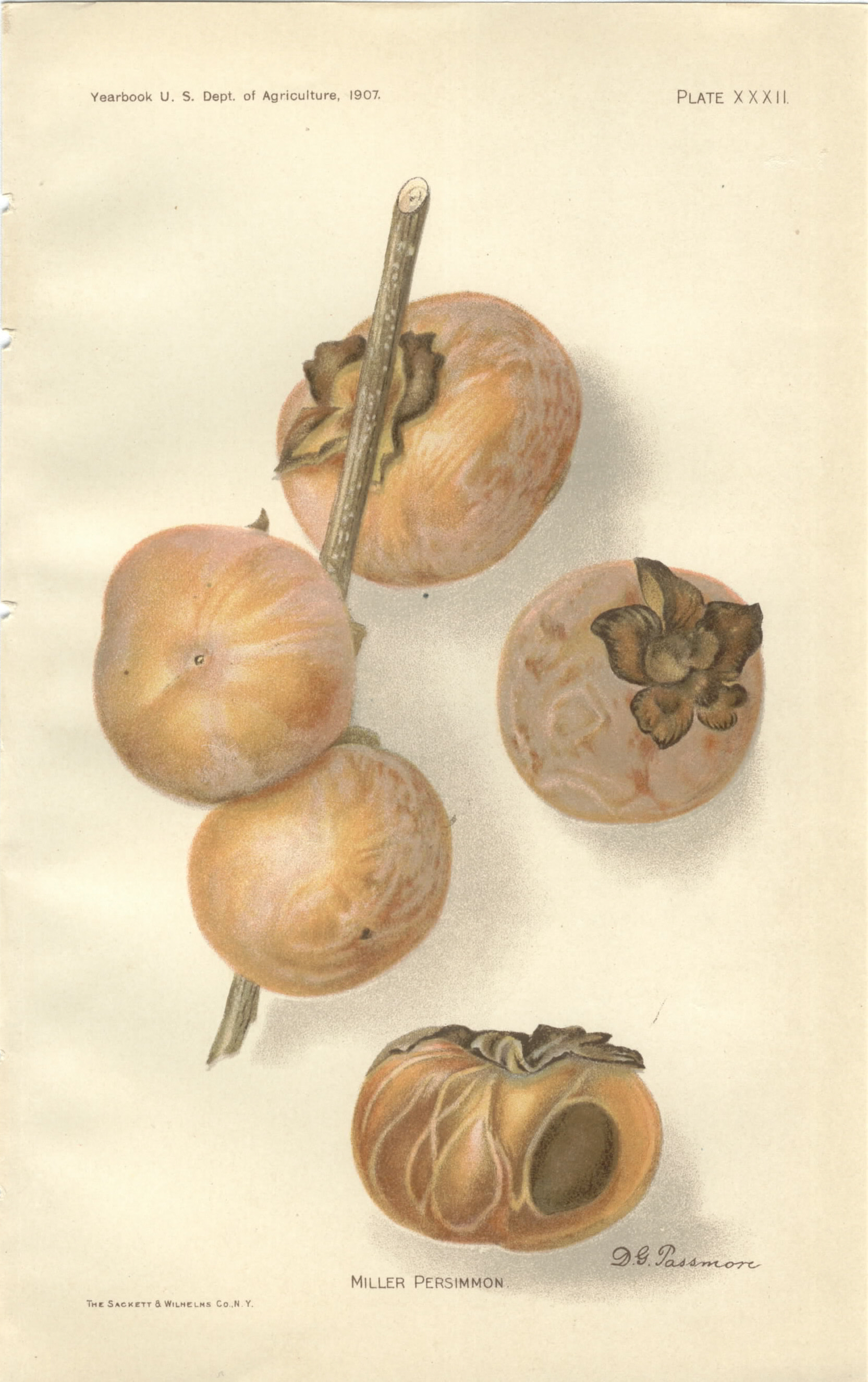
I am at the point where I think what is distributed as Marion, Miller, Golden Supreme, and Ruby (the modern big one - not the little, historical one first propagated by James Little) are all actually just the Miller. I had Ruby, Miller, and Golden Supreme all next to each other. The fruit look exactly the same (large and flattish), ripen around the same time (mid to late), and most distinctively the seeds have the same morphology - very large and flat like Lima beans. I took two of the trees out this year to make room for different varieties.
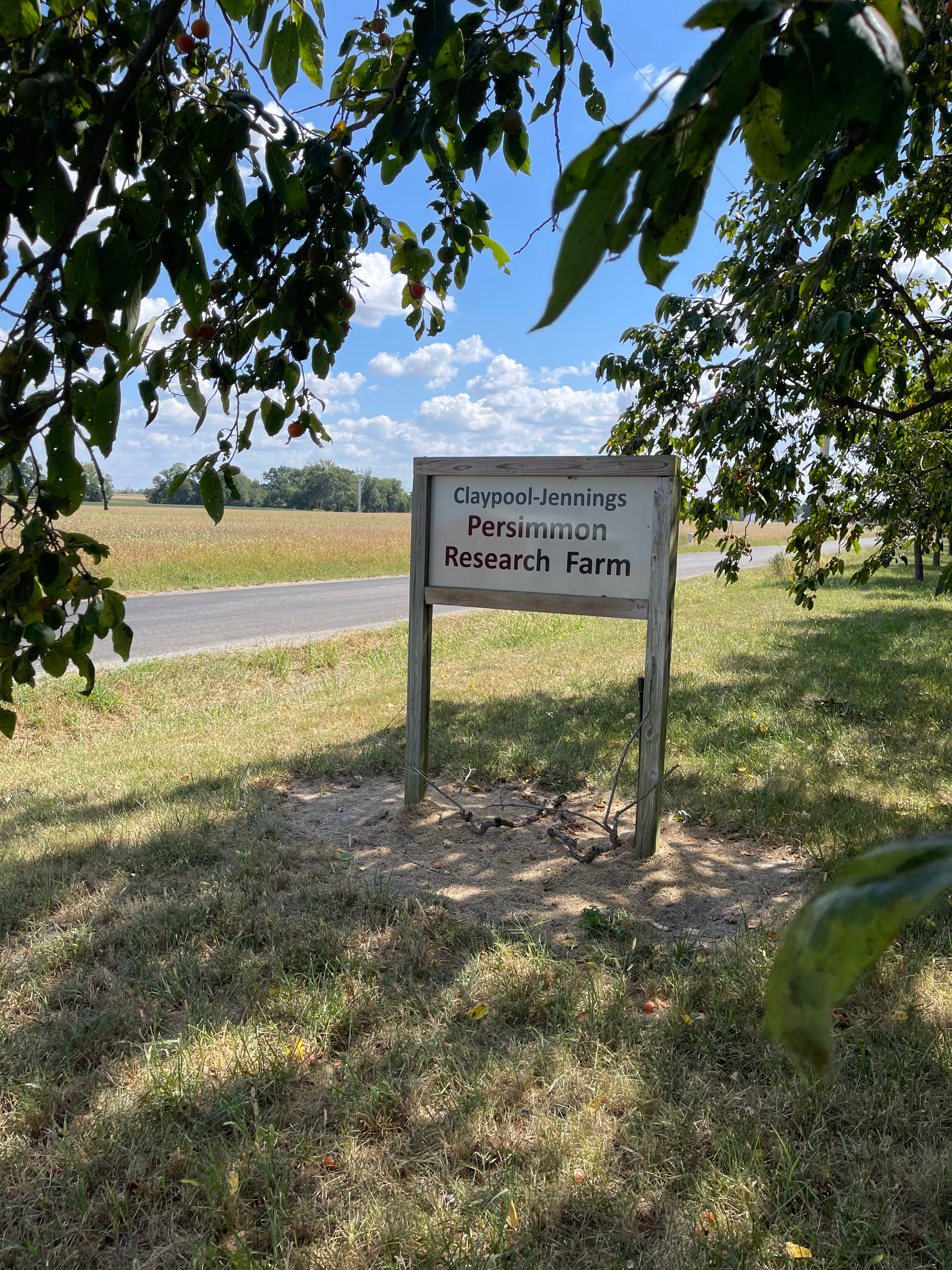
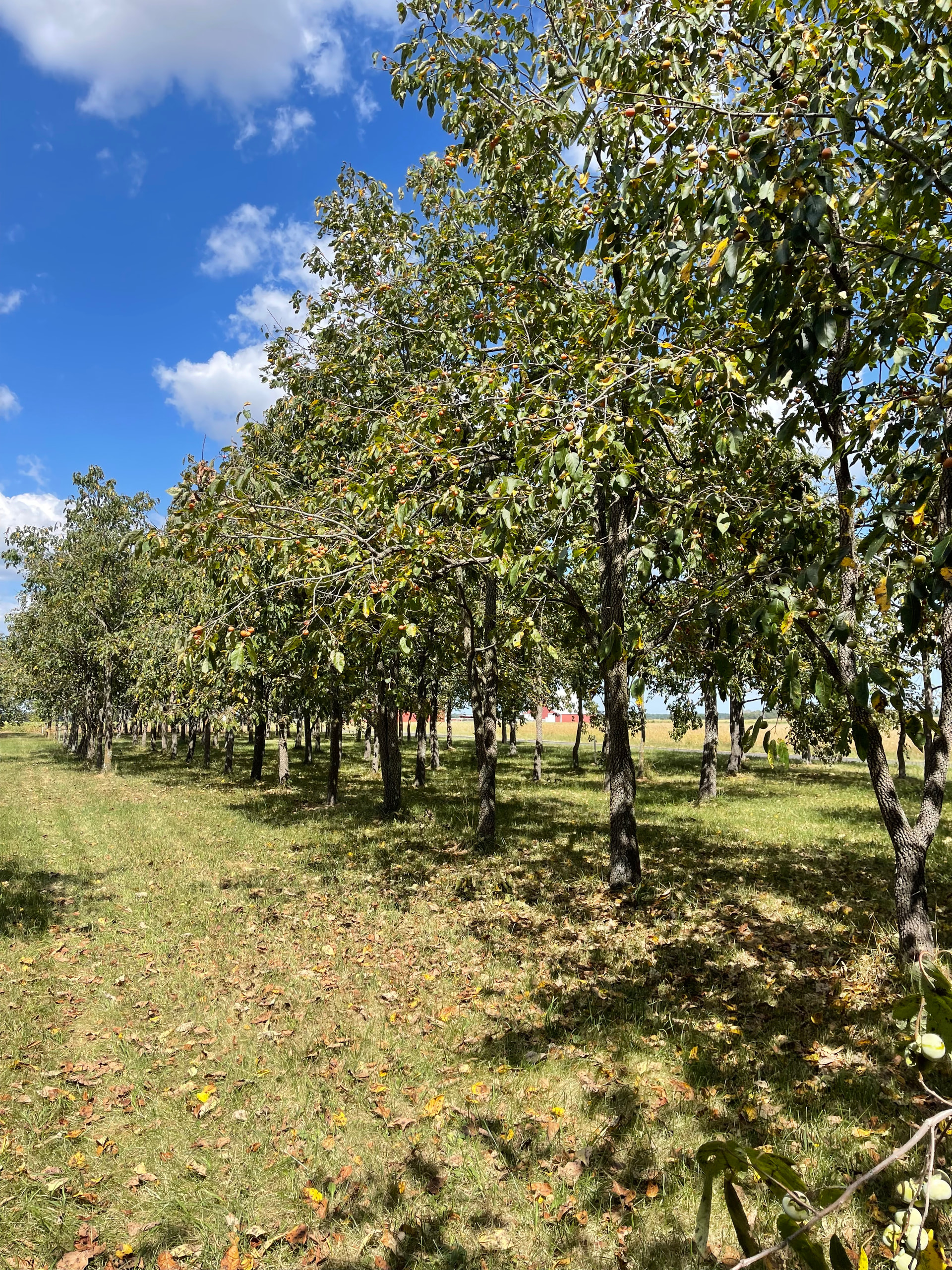
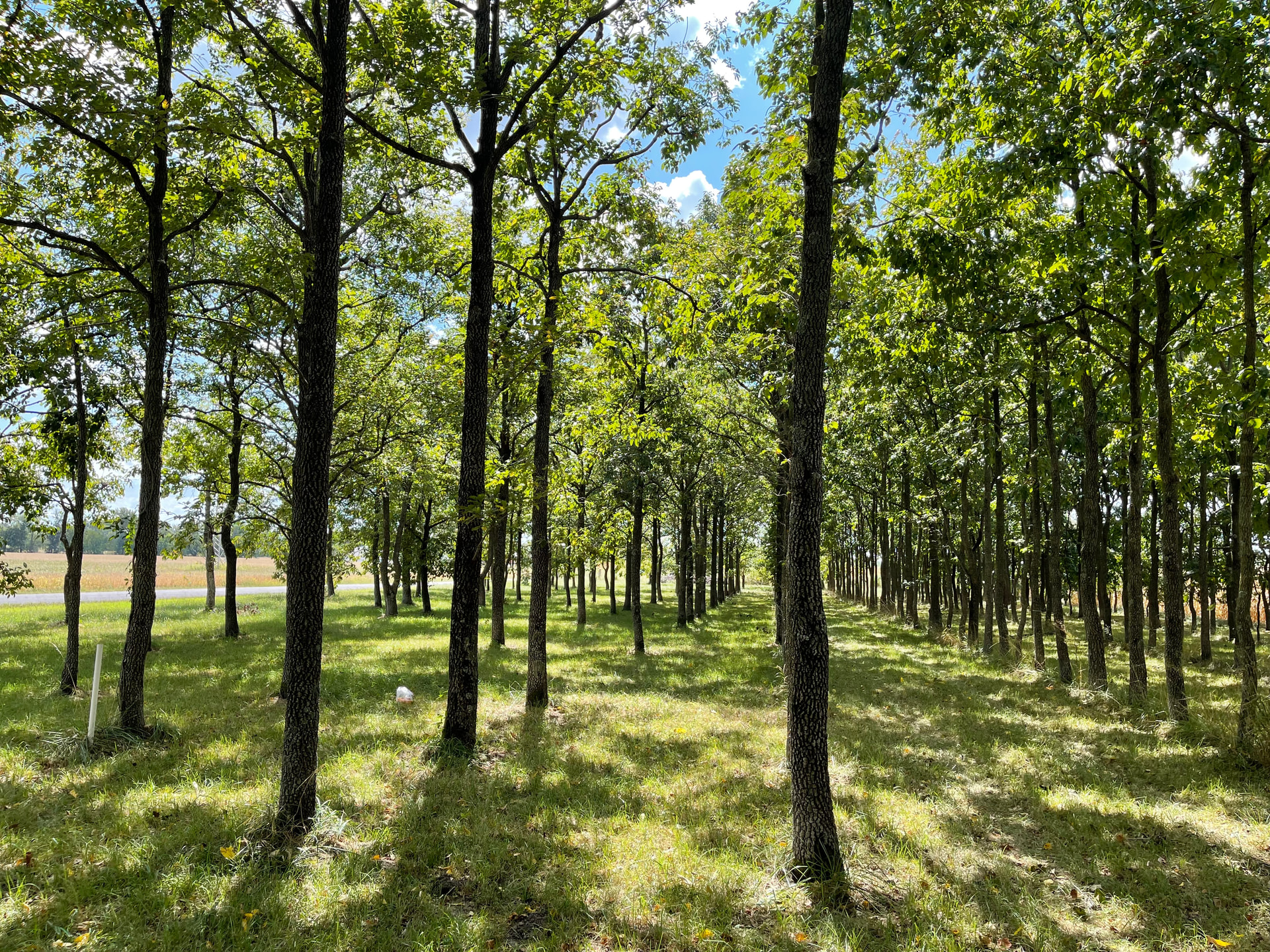
At the Claypool orchard, the Golden Supreme and Marion also looked the same. In the book Persimmons for Everyone published by NAFEX back in the eighties, JC McDaniel made note of of what he thought was a mixup between Miller and Marion and that what was being grown were the same cultivar. They were once distinct, but it appears not to be the case any longer.
If this is true, then the genetic diversity of the Claypool crosses is less than thought. I’m told the folks at Savannah may have done some genetic testing on these cultivars? Hope my conjecture is incorrect.
This is an old USDA Yearbook chromolithograph. The one in the upper left corner is Marion.